Picture the scenario: it’s a grey Sunday afternoon in October, the kids have exhausted everything on the streaming apps, and you’re rifling through a drawer looking for something to do that doesn’t involve another subscription account or a forty-five-minute firmware update. Or maybe you’re further along in life — the living room already has one too many devices with blinking standby lights — and what you actually want is a small box that lets you revisit the games of your youth without signing up for anything or deciphering a twenty-page quick-start guide. Either way, the frustration is the same: you want to plug something in and actually play, not spend the evening troubleshooting.
Plug and play games consoles exist precisely for these situations. They arrive with games already loaded, connect to your TV in a handful of steps, and get out of the way so you can actually play. The category is broader than you might expect: retro arcade sticks loaded with thousands of classic titles, motion-sensing consoles that get children moving, handheld devices that need no TV whatsoever, and even AR-enhanced consoles that put a more modern spin on built-in gaming. The hard part is working out which one fits your actual situation — because the gap between a satisfying purchase and a disappointing one can be surprisingly wide, and the marketing claims don’t always match the real-world experience.
How These Picks Were Evaluated
These picks were selected from plug and play games consoles currently listed on Amazon UK, assessed against a consistent set of criteria: how genuinely simple the setup process is, what TV connection method is used (HDMI tends to be more reliable than USB for video output), the size and quality of the built-in game library, whether controllers are wireless or wired, and the weight of real buyer feedback available. A product backed by 800 verified reviews tells a fundamentally different story to one with three, and that gap has been flagged throughout each section.
One practical note: some products here are new to market and carry very limited review data. Rather than glossing over that, each section states the review count explicitly. Where buyer evidence is thin, the potential upside is set out alongside the real uncertainty — so you can decide whether limited data is acceptable for your situation or whether a more established pick is the safer call.
Best Overall Plug and Play Console
The YRPRSODF TV Game Console Built in 100+ Games is the most thoroughly reviewed plug and play option in this guide, sitting at close to 900 ratings on Amazon UK — a volume of buyer feedback that gives this pick considerably more credibility than most of its rivals in the category. When a product has been purchased and reviewed by that many people, the pattern of feedback becomes genuinely informative rather than anecdotal, which matters a lot in a market segment full of newly launched listings.
It comes with over 100 built-in games, a 2.4GHz wireless gamepad, and HD TV output. What distinguishes it from a conventional retro stick is the somatosensory (motion-sensing) control option: the controller responds to physical movement, so gameplay can involve tilting, swinging, and shifting your body rather than just pressing buttons. For family use or younger players who find traditional controller layouts with multiple buttons and analogue sticks confusing, that distinction is significant — it changes the whole character of the experience and makes the console accessible to people who have never held a gamepad before.
Setup follows the plug and play model cleanly: connect to the TV via the included cable, insert the wireless receiver dongle, and you’re playing within minutes. No Wi-Fi credentials, no app store account, no background downloads. The wireless controller also means players aren’t tethered to the console, which matters especially when motion-sensing gameplay requires room to move around.
The 3.9-out-of-5 rating reflects a product that delivers its core promise while falling short in specific areas. Positive reviewers highlight the accessible motion gameplay, the straightforward setup, and the broad family appeal of the included titles. Critical feedback notes that the 100+ game library skews towards casual, party-style content rather than deep retro fare — if your goal is pixel-perfect arcade classics or 16-bit platformers, this isn’t the right tool. Motion-sensing gameplay also suits casual sessions better than competitive play; anyone wanting tight, responsive input for skill-based gaming will find the experience unsatisfying.
Build quality draws some comment in the reviews: the console and controller feel lightweight, which is fine for occasional family use but may not hold up to rough handling from young children over many months. Where this console shines is as a living room activity device — something to do together, across a wide age range, with no prior experience required. The motion-sensing format levels the playing field between children and adults in a way that button-based controllers don’t. For a tested, broadly accessible plug and play option that works straight from the box and keeps mixed-age households entertained, this is the most defensible starting point in the guide.
Best Budget Pick
For UK buyers of a certain vintage, the ZX Spectrum is more than a games console — it’s a formative piece of computing history, the rubber-keyed home computer that for many people was the gateway to gaming, programming, and the early digital world. The Spectrum Game Console Video Games Retro Collection USB 8-Bit Plug & Play draws on that heritage in a compact, affordable device, and at the budget end of this guide, it’s the pick that offers the strongest nostalgia-per-pound value.
This is a USB plug and play unit built around 8-bit gaming — the chunky sprites, bleeping audio, and lo-fi visual style that defined home computing in the early 1980s. The game selection reflects the character of that era rather than an all-platform retro sweep, and the aesthetic is authentic to the source material. If you’re buying this for yourself, you likely already know whether the Spectrum era resonates with you. If you’re buying it as a gift, it works best for someone who either remembers that period with affection or is curious about where UK home gaming started.
With 46 reviews and a 4.2-out-of-5 rating, this has some of the most consistently positive buyer feedback relative to its price tier of any product in this guide. Reviewers note that the plug-in setup works cleanly as described, the game selection accurately reflects the 8-bit Spectrum era, and the overall experience is satisfying for what it promises. There’s no pairing process, no software to install — you connect it and play. For a device at this price point, that frictionless quality comes through clearly in the reviews.
The limitations are predictable given the format. The game library is small compared with multi-emulator alternatives: this is a curated slice of a specific computing era, not a 20,000-title sweep across retro platforms. If you’re after variety and volume, it will feel limited. The USB connection also requires some thought — not all TV USB ports function as display inputs. Some televisions use USB ports purely for charging or firmware updates rather than video output. Confirming your TV’s USB capabilities before ordering is a worthwhile step to avoid a mismatch.
For what it is — a compact, honest tribute to ZX Spectrum gaming at an accessible price — it’s a satisfying buy. It makes a thoughtful gift for someone who grew up in the 1980s British computing scene, and it’s an interesting way to show younger family members what home gaming looked like before 3D graphics and online multiplayer. Don’t approach it expecting a comprehensive retro library. Approach it as a specific, well-executed piece of gaming history, and it delivers on that straightforward promise.
Best for Massive Game Libraries
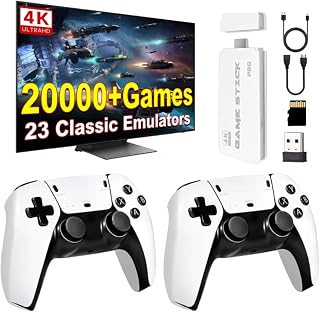
If your first question when evaluating a plug and play console is always “how many games does it include?”, the Retro Game Stick with 20,000+ Games and 23 Emulators answers that question loudly. Twenty thousand preloaded titles across 23 emulated platforms covers a significant sweep of gaming history — from early 8-bit systems through to more complex 16-bit and 32-bit era releases. The package ships with a pair of upgraded 2.4GHz wireless controllers, so two players can start immediately without an additional purchase.
Setup follows the standard game-stick pattern: plug the HDMI end into your TV, insert the wireless dongles for both controllers, connect power, and navigate the on-screen menu. No account creation, no downloads, no manual installation. The breadth of the library means you can move from classic side-scrollers to fighting games, puzzle titles to shoot-em-ups, across decades of releases — without buying a single cartridge. For buyers who enjoy browsing and discovering rather than replaying specific remembered titles, that range has real appeal.
The 3.2-out-of-5 rating from 31 reviews is the lowest in this guide, and the critical feedback deserves honest attention before you buy. Reviewers report that emulation quality across the vast library is inconsistent: some games run smoothly with accurate audio and responsive controls, while others suffer from slowdown, graphical glitches, or input lag that disrupts play. Achieving uniform quality across 20,000 titles is essentially impossible, and buyers expecting a polished, precision experience will be disappointed. This is a wide net cast across retro gaming history — not a carefully curated collection where every title has been tested.
The controllers also receive mixed reactions. Functional for casual exploration and adequate for an hour or two of browsing the library, they become frustrating for players who need precise, responsive input for demanding platformers or technical fighting games. Wireless range in a typical living room is acceptable, and the 2.4GHz connection handles most titles without significant lag.
Where this stick does well is offering enormous range with minimal effort. For buyers who enjoy flicking through a huge catalogue, trying titles they’ve never encountered, and playing casually before moving on, the scale of the library is a genuine draw. The dual-controller setup also makes it well-suited to households where two people want to game together without an extra purchase. Go in with calibrated expectations: this is a broad retro sampler for casual explorers, not a precision instrument for dedicated players. With that understanding, the value proposition holds up.
Best for Gaming on the Go
Every other console in this guide requires a television. The Handheld Retro Game Console in Grey does not. This is a self-contained portable device with its own built-in screen — the pick for gaming on a commute, during a long journey, in a waiting room, or simply in bed without claiming the living room TV. In a guide otherwise dominated by TV-connected systems, that portability opens up use cases the other picks cannot cover.
The 4.7-out-of-5 rating is the highest of any product featured in this guide — and it comes from 12 reviews, which is a small sample that needs stating clearly. Twelve buyers, however enthusiastic, don’t provide the statistical confidence that 900 do. That said, the early feedback is consistent: buyers report a varied built-in game library, a clean display for its size, and a compact form factor that is comfortable to hold. The plug and play aspect here means switching on is the only setup step — no cables, no TV, no additional hardware required at all.
For the specific scenarios where this console shines, no competing pick in this guide comes close. If your household TV is perpetually occupied by other people, if you travel frequently and want something that fits in a jacket pocket, or if you’re buying for a child to keep occupied on long car journeys, the self-contained design solves the problem that TV-connected alternatives fundamentally cannot. There’s no HDMI cable to forget, no need for a spare screen, and no dependency on any other piece of equipment.
The honest tradeoffs are real. A built-in screen on a budget handheld carries resolution and brightness constraints — this is not a premium portable display, and approaching it with those expectations would be unrealistic. The compact form factor may also feel cramped for adults with larger hands during extended sessions. And with only 12 reviews, long-term durability and reliability are still unknown quantities — you’re working with early impressions rather than a sustained track record from a broad buyer base.
If portability is your primary requirement and you’re comfortable making a purchase with limited review data, this is the most distinctive and practical option in the guide. For TV-based gaming, the other picks here will serve you better — but none of them goes wherever this one does, and that independence from a television solves a problem the rest of the guide cannot.
Best for Kids’ Active Play
The Educational Motion Gaming Console for Kids in Grey takes a different approach to the plug and play format: rather than a controller you sit with, this is a motion-sensing system designed to get children physically engaged. Gameplay is controlled through movement and gestures rather than button presses, which changes the experience in two meaningful ways — how accessible it is for very young players, and how active the session becomes compared with a traditional seated controller setup.
The educational framing sets this apart from pure entertainment devices. The design positions it as content that supports children’s development alongside play — whether that’s through physical co-ordination tasks, cognitive challenges, or structured game progression. For parents who want gaming that feels purposeful rather than purely time-filling, that distinction carries weight.
Be straightforward with yourself about the review data here: 4 reviews and a 3.8-out-of-5 rating is a very thin sample from which to draw firm conclusions. Individual experiences could vary significantly from what those early buyers encountered. The existing reviewers note that setup works as described and that children respond positively to the motion-sensing interaction, but four data points are not a verdict — they’re an early signal worth noting with appropriate caution.
The motion-gaming format does carry a real practical advantage for younger children. Traditional controller layouts — multiple buttons, triggers, analogue sticks — are confusing and frustrating for children encountering them for the first time. A console that responds to arm movements and body gestures dramatically lowers that skill barrier, keeps younger players engaged without a steep learning curve, and makes gaming accessible at ages where button-based controllers simply aren’t practical. For parents concerned about sedentary screen time, a console that demands physical activity is also a considerably more comfortable option.
If the thin review data gives you pause, the YRPRSODF TV Game Console (B09WVZ4GDX) covers motion-sensing family play with a far larger body of buyer evidence behind it. For a device specifically focused on educational goals and active children’s development, this takes a more purposeful approach — but buy it with clear-eyed expectations about the limited information currently available, and check back as the review count grows.
Best for AR Family Entertainment
The AR Motion Game Console for Kids with HDMI Plug and Play TV goes a step beyond standard motion gaming by adding an augmented reality layer to the TV experience. AR gaming overlays digital game elements onto real-world visuals, so players become part of the game rather than watching a character respond to their inputs on screen. For children in particular, that level of immersion can make gameplay considerably more engaging than a standard controller-based setup — and more likely to hold attention over repeated sessions.
The HDMI connection gives this a practical advantage over USB-only plug and play devices: it works cleanly with any modern flat-panel TV without compatibility concerns. Setup should follow the standard plug and play pattern — connect the HDMI, follow the on-screen steps, and play. The interface and game content are designed for younger players, which means the difficulty curve is approachable and the navigation clear enough for children to manage independently. A navy blue colour variant is also available under a separate listing if the grey doesn’t suit your preference.
The rating is 5.0 out of 5 — but from only 3 reviews, which is simply not enough data to carry meaningful statistical weight. Three enthusiastic early buyers is a promising opening signal, not a reliable guarantee of quality across a wider user base. Be clear-eyed about that before purchasing. The product is distinctive in the category: AR-enhanced plug and play gaming for children at this price tier is uncommon, which is interesting — but uncommon doesn’t automatically mean reliably good, especially at low review volumes.
For the right buyer — someone who specifically wants an AR gaming experience, has considered the more-reviewed alternatives in this guide, and is comfortable with limited buyer evidence — this is a worthwhile option to explore. The novelty of AR interaction has real staying power for young children who tire quickly of repetitive formats. A standard retro console may feel routine after a few weeks; a format where the player is physically inside the game has more potential to stay fresh over time.
Treat this as an informed early purchase rather than a safe default. If certainty matters more than novelty, the better-reviewed picks in this guide are the right call. If the AR concept is specifically what you’re after and you can accept the limited data, this is the only option in the guide that offers it.
What to Look For When Buying a Plug and Play Console
- TV connection type: HDMI is the most reliable output for modern TVs — any flat-panel screen made in the last decade or so will have at least one HDMI port. USB connections are less consistent; some TVs use USB ports solely for charging or firmware updates rather than video display. If a device connects via USB, confirm your TV supports video output via that port before purchasing.
- Wireless vs wired controllers: Wireless controllers — typically using a 2.4GHz dongle — give you freedom to sit or stand where you like, which matters especially for motion-sensing or active play. Wired controllers are more reliable from a connectivity standpoint but constrain your position considerably. Check whether wireless controllers need batteries, as they’re often not included in the box.
- Game library size vs quality: Raw game count is a misleading metric on its own. A console with 100 well-emulated, playable titles can be far more satisfying than one claiming 20,000 games where quality is inconsistent across the library. If you have specific titles you want to return to regularly, prioritise emulation quality over sheer numbers.
- Standalone vs PC-dependent: True plug and play consoles are self-contained — plug in and play. Some devices in this category are USB hard drives that require a Windows PC to function. Read product descriptions carefully to confirm you’re getting a standalone unit if that’s what you need, as the distinction isn’t always obvious from the listing title.
- Handheld vs TV-connected: TV-connected consoles give you a large shared screen and suit living room sessions. Handheld consoles work anywhere but have smaller built-in screens and may feel cramped for extended play. Match the form factor to how you’ll realistically use the device day to day rather than how you imagine you might use it.
- Age suitability: Motion-sensing and AR consoles lower the skill barrier significantly for young children. Traditional button-based controllers suit older children and adults with gaming experience. If you’re buying for a mixed-age group, confirm the control scheme is genuinely accessible for the youngest or least experienced player in the household.
- Review volume: In a category with many recently launched products, review count matters as much as star rating. A 5.0-star average from 3 buyers is far less reliable than a 3.9-star average from 900. A modest rating from a large sample is generally more trustworthy than a perfect score from a handful of early buyers — weight the evidence accordingly.
The Verdict
For the majority of buyers reading this guide — someone who wants a plug and play console that works reliably, suits a household rather than a single player, and won’t cause a frustrating evening of troubleshooting — the YRPRSODF TV Game Console (B09WVZ4GDX) is the most defensible choice. It has by far the largest buyer base of any product here, its motion-sensing gameplay appeals across a wide age range, and the straightforward HDMI setup fulfils the plug and play promise without caveats. The 100+ game library won’t satisfy a dedicated retro purist, but for family-friendly living room entertainment it performs consistently.
If sheer game volume is the priority, the Retro Game Stick with 20,000+ Games (B0FJ1ZF2X5) offers extraordinary range — with the honest caveat that emulation quality is uneven and reading the mixed reviews before committing is advisable. For UK nostalgia in a compact, genuinely affordable package, the Spectrum Game Console USB 8-Bit (B0GFGPXT5R) is the best-regarded budget option in the guide — focused, honest, and well-reviewed relative to its price. And for gaming that doesn’t need a TV at all, the Handheld Retro Game Console (B0HFN59FMJ) is the only pick here that travels with you.
The AR and educational motion consoles (B0H3LHJH7X and B0HCMVTXXV) are interesting early-market options, but limited buyer data makes them harder to recommend as first-choice picks. If their specific features are appealing and you’re comfortable with the uncertainty that comes with early-stage products, they’re worth considering — otherwise, the more established options carry considerably less risk.
This guide was produced independently. No payment was received to feature any specific product. All opinions are based on publicly available specifications, verified buyer feedback patterns, and category research.
Quick Comparison Table




FAQ
Do plug and play games consoles need an internet connection?
No — that’s one of the defining characteristics of the category. Games are stored on the device itself, so there’s no downloading or streaming required. You can play without Wi-Fi, without a router, and without any ongoing connectivity. This makes them reliable for travel, rural areas, or households where you’d rather keep gaming devices off the network entirely.
Will a plug and play console work with my TV?
Consoles with HDMI output work with any modern flat-panel television — virtually all screens made in the last ten to fifteen years. USB-based devices are less universal: some TVs use USB ports for power or file playback only, not as a display input. If you’re considering a USB plug and play device, check your TV’s manual to confirm it supports video output via USB before buying.
What’s the difference between a retro game stick and a handheld console?
A retro game stick plugs into your TV via HDMI — you play on the big screen using a separate wireless controller. A handheld console has its own built-in screen and needs no TV at all. Game sticks are better for shared living room sessions; handheld devices are better for personal, portable use wherever you happen to be.
Are the games on plug and play consoles legal in the UK?
Officially licensed devices — such as branded ZX Spectrum collections — are legitimate legal products. Consoles loaded with thousands of games via third-party emulation occupy a more complex legal grey area around copyright and ROM distribution in the UK. If this is relevant to your purchasing decision, it’s worth researching the current legal position on emulation before buying.
How many built-in games should a plug and play console have?
There’s no single right answer, and raw game count is a misleading metric on its own. A console with 100 well-emulated, playable titles can be more satisfying than one claiming 20,000 games where quality is inconsistent across the library. If you enjoy browsing and discovering, a larger library makes sense. If you have specific titles in mind, prioritise emulation quality over sheer numbers.
Can you add more games to a plug and play console?
Most plug and play consoles are closed systems — the built-in game library is fixed at manufacture and cannot be expanded through normal use. A small number of more advanced devices allow additions via SD card, but this typically requires technical setup and raises questions about the legality of ROM files. For the majority of buyers, assume the included library is what you get.