You’ve been playing with the club’s house cues for long enough to know that every single one has a problem. This one is bent halfway down the shaft. That one has a tip so flat and shiny it won’t hold chalk for more than a shot or two. The third one — the decent straight one — has effectively become someone else’s unofficial property because they arrive an hour early every week. Or perhaps you’ve just assembled a second-hand table in the garage and you’ve been borrowing a single stick from a friend, and the moment has finally arrived to invest in something that’s actually yours.
The moment you start shopping for a cue on Amazon, choices multiply fast. Ash shaft or maple? Two-piece or 3/4 jointed? Snooker tip or pool tip? What length is right for your table and room? Does a carbon fibre shaft perform differently, or is that just marketing? These aren’t trivial questions. Pick the wrong cue for your game and your storage situation and you’ll spend months fighting a stick that was never suited to you. This guide covers what actually matters for UK buyers — across snooker, UK eight-ball pool, and American-style pool — based on real Amazon.co.uk buyer evidence and solid category knowledge.
How These Picks Were Chosen
Every cue featured here was selected by cross-referencing Amazon.co.uk buyer feedback volume, rating patterns, and what players actually say after months of real use rather than first-week impressions. The evaluation focused on five core areas: shaft material and construction quality, including resistance to warping over time; tip specification and suitability for the intended game; joint type and reliability through repeated assembly; weight availability and balance; and whether any included accessories add practical value to the package.
Where a cue has a large review base, the conclusions reflect extensive real-world use across many players and playing styles. Where the review base is thin, this guide says so directly, because that changes the risk level for your purchase. No cue was included to fill a section — if a tier had nothing genuinely worth recommending, it was left out.
Best Versatile Snooker & Pool Cue
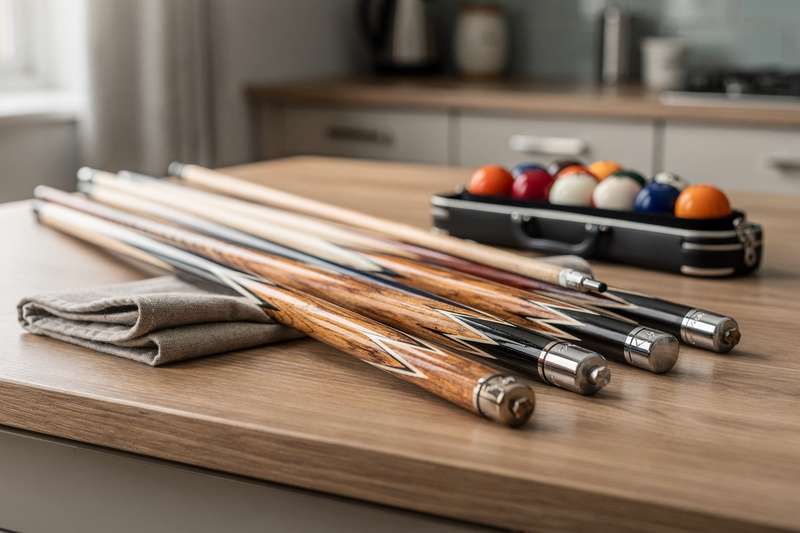
The AONETIGER 3/4 Jointed Snooker Billiard Pool Cue Handmade Ash Shaft 3 Piece Tips 9.7mm with Extension Accessories Hard Case/Bag to Choose is the pick for players who want a single well-built cue that handles both snooker and UK eight-ball pool. With over 405 reviews at 4.4 stars on Amazon.co.uk, this is the most extensively buyer-tested cue in this guide — that volume of feedback gives you real confidence that the shaft arrives straight, the joint screws together firmly, and the overall build holds up across regular use rather than just the first few sessions.
The most distinctive feature is the 3/4 jointed construction. Unlike a standard two-piece cue that splits at the midpoint, a 3/4 joint divides the cue so that the butt section separates from the longer shaft end. In practical terms, the longest piece you carry is shorter than a standard two-piece shaft — a real benefit if you travel to a club by public transport, store the cue in a bag rather than a rack, or have limited space at home. It also means the shaft behaves closer to a one-piece during the actual shot, since the joint sits further from your bridge hand and is less likely to affect your feel through the delivery stroke.
The shaft is handmade ash. Ash is the traditional choice for UK snooker and pool cues because it has a natural flex that communicates feedback through the hand at contact — it responds to subtle changes in cue speed and tip placement in a way that helps you understand what’s happening during the shot. When you’re learning to apply top, back, or side spin consistently, that tactile information is useful. The 9.7mm tip is slightly narrower than the 10mm standard on many snooker cues, giving you a more precise contact point on the cue ball. On tight positional shots where a small amount of english is the difference between an easy next position and a safety situation, that extra precision is perceptible in play.
The included extension is a practical addition that often gets overlooked when comparing cues. On a full-size table, certain long shots require either a rest or an uncomfortable stretch that compromises your bridge and delivery. An extension attaches to the butt end so you can reach these shots with a normal grip, keeping your technique consistent. The option to choose between a hard case and a soft bag at the point of purchase is also sensible — a hard case protects the shaft from impact and keeps it straight in storage; a soft bag suits casual transport in a kit bag alongside other kit.
The honest tradeoffs: the 3/4 joint takes a short adjustment period if you’ve only ever handled two-piece cues. You need to assemble it correctly and firmly every time — any looseness in the joint affects shot alignment. Several buyers note the tip needed bedding in over the first few sessions before holding chalk reliably, which is normal at this level but worth knowing. The AONETIGER is a snooker and billiard crossover cue rather than a dedicated single-game stick, so it won’t be as purpose-tuned as a cue built specifically for snooker or specifically for pool. For players who move between both games and want one reliable cue, this is the strongest all-round choice in the guide.
Best Budget Pool Cue
The Aklot Pool Cue, Cue Sticks 58" Pool Cues Adult Canadian Maple Wood Cue Stick for Professional Billiard Players 18 19 20 21 oz is the standout choice at the budget end of the pool cue market. It holds a 4.5-star rating from over 360 Amazon.co.uk reviews — the highest rating of any cue in this guide — which for an entry-level maple cue is a strong signal that it consistently does what it promises: arrives straight, plays consistently, and handles regular use without complaint.
The shaft is Canadian maple, the standard choice for American-style pool cues worldwide. Maple is denser and stiffer than ash, which means power transfers efficiently and the shaft deflects less on contact. For straight-line shots, breaks, and table-length positional play, maple performs consistently well. The tradeoff is that maple gives less tactile feedback on subtle english than ash — the cue ball reacts accurately to your spin, but the information coming back through your hand at contact is less expressive. For players building their game from scratch, that predictability is actually an advantage: the cue does what you tell it, helping you identify your own technique as the source of miss-hits rather than second-guessing the equipment.
Weight choice is one of the Aklot’s most practical features at this price tier. Available in 18, 19, 20, and 21 oz options, you can match the cue to your build and preferred stroke before you buy rather than discovering after a month of play that the fixed weight doesn’t suit you. At 18–19oz, the cue suits players who generate pace through their arm action; at 20–21oz, the cue’s momentum carries more of the work through the ball. Starting at 19oz gives most adults a sensible middle ground. Being able to choose weight at this price level is uncommon — most budget cues come in a single fixed option — and it’s a detail that saves frustration once you’ve been playing regularly and know what suits your game.
At 58 inches, the Aklot is sized for American pool. For UK buyers this is worth noting: the standard length for UK snooker and pub pool cues is 57 inches, and on a table positioned near a wall in a typical room, the extra inch occasionally puts you in a tight spot on certain shots. In an open space or on a genuinely full-size American pool table, you won’t notice the difference. For UK pub pool or snooker on club tables, the 57-inch POWERGLIDE One covered in the next section may suit better. But if your primary game is American-style pool, or your table has clearance all round, the Aklot is the sharper pick.
The Aklot makes no attempt at decorative ambition — the finish is clean but plain, no inlays, no detailed graphics. For a first cue bought to build consistent technique, that’s the correct approach. A plain cue that plays dependably is worth far more at this stage than a striking one that’s mediocre. The Aklot’s high rating across a large review base reflects exactly this: it does the fundamentals properly, arrives straight, and gives you a reliable platform to build your game on.
Best Entry-Level Snooker Cue
If you’re specifically starting out in snooker — or playing UK eight-ball pool at clubs and pubs — the POWERGLIDE One 2-Piece Snooker Cue Stick | Ash Wood Shaft and Butt with Decal Design | Brass Joint | Full Size 57" | 10 mm Tip is the most targeted entry-level option available here. POWERGLIDE is a brand that UK snooker and pool players will recognise from decades of consistent presence in the market — not a fashion label, just a reliable supplier that keeps appearing on the tables of recreational players who’ve been using the same stick for years without complaint.
The construction uses ash wood for both the shaft and the butt — a more meaningful detail than it first appears. Some budget cues economise by using a cheaper wood for the butt section and only ash for the taper near the tip. The POWERGLIDE One uses ash throughout, giving a more consistent flex and weight distribution along the full length of the cue. Ash has the grain pattern and natural stiffness that suits snooker play: it’s responsive to subtle cue speed changes and communicates feedback on off-centre hits in a way that helps beginners understand what happened during the shot rather than simply noting that the ball didn’t go where intended.
The 10mm tip is the standard specification for UK snooker cues and pub pool. This size gives enough contact surface to be forgiving on slightly mistimed hits while still offering sufficient control for applying top, back, and side spin deliberately. For a beginner learning how english affects cue ball travel, 10mm is the right starting point: precise enough to develop proper technique over time, forgiving enough that a marginally off-centre hit doesn’t immediately miscue. At 57 inches, this is the correct length for UK snooker tables and standard pub pool tables — no fighting for clearance near the cushions in a well-proportioned room.
The brass joint deserves a specific mention. It’s a detail that rarely surfaces in first-pass buying decisions but materially affects long-term performance. Brass holds its thread longer under repeated assembly and disassembly compared to plastic or aluminium, meaning the cue maintains its alignment session after session rather than developing wobble after a few months of regular use. A cue that’s even slightly loose at the joint introduces inconsistency into every shot — addressing this later is more effort than it sounds, so getting a solid joint from the start is worth prioritising.
The tradeoffs: with 30 reviews at 4.1 stars, there’s less buyer evidence here than for the AONETIGER or Aklot. The rating is respectable for an entry-level cue, and the pattern in available feedback points to the stock tip as the potential weak link — at this price level, the tip tends to be on the softer side and may need replacing after a few months of regular play. Swapping a cue tip is routine maintenance that any sports shop handles cheaply, and it’s learnable at home with basic equipment, but worth knowing before you buy rather than being surprised when chalk stops sticking reliably. For players who want a properly specified, brand-backed snooker cue at the lowest reasonable entry price, the POWERGLIDE One is the correct starting point.
Best for Carbon Shaft Construction
The PowerGlide Premium Carbon Pool Cue represents something different from the other picks in this guide: a carbon-shafted pool cue from a brand that UK players know, at a price point that brings carbon shaft technology within reach without requiring a premium budget.
The practical argument for carbon is well-established at the serious amateur level. Traditional ash and maple shafts are organic materials that respond to their environment — they absorb moisture in humid conditions, dry out in heated rooms, and gradually shift shape as temperature and humidity fluctuate through the seasons. A cue stored in a British garage across a full winter and summer will behave differently by spring, and that change is easy to misattribute to your technique rather than the equipment. Carbon fibre is dimensionally stable: it doesn’t absorb moisture, doesn’t warp, and delivers the same hit in January as it does in August. For players whose cue lives anywhere that isn’t a consistently climate-controlled indoor space, this is a concrete practical advantage — particularly relevant in the UK, where garages, conservatories, and spare rooms swing considerably in temperature throughout the year.
Carbon shafts also deliver a consistent hit because the material properties are uniform and don’t vary with use or environment. A well-made carbon shaft has the same stiffness and flex profile in session one as in session one hundred. The tradeoff is a distinctly different feel compared to traditional wood: carbon is stiffer, the feedback at contact is sharper, and the sensation through the hand on a slightly mistimed shot differs from what ash or maple players are used to. Some players adapt quickly and prefer it; others find it takes deliberate recalibration, particularly on softer positional shots where touch matters most. Neither response is wrong — it’s a preference that only reveals itself in play.
PowerGlide’s positioning of a carbon shaft in a pool cue makes sense for UK buyers: it’s designed around pool dimensions and tip specifications rather than being a US-market product adapted for UK use. The brand’s familiarity in UK cue sports gives a degree of confidence in build standards that you wouldn’t get from an unfamiliar import label.
Here is the caveat you need to weigh carefully before buying: at the time of research, this listing had only two reviews on Amazon.co.uk. That’s not enough data to draw reliable conclusions about long-term joint durability, tip wear rate, or how the shaft performs after a full year of regular play. The 4.5-star average from those two buyers is encouraging, but two opinions is a very small sample. If you’re drawn to carbon shaft technology and want a brand-familiar option — particularly if variable-temperature storage is a concern — this is worth considering as a considered purchase rather than a default recommendation. If you want a cue whose performance is confirmed by hundreds of real players, the AONETIGER remains the safer starting point, and the PowerGlide Premium Carbon becomes a more compelling option once its review base has had time to grow.
What to Look for When Buying a Cue
- Shaft material: Ash is the traditional UK choice for snooker and eight-ball pool, offering natural flex and tactile feedback that helps you read your shots. Maple is denser and stiffer, the standard for American-style pool — it transfers power efficiently but gives less feel on spin. Carbon fibre is dimensionally stable and humidity-proof, eliminating warping in variable-temperature storage environments, but has a stiffer, more mechanical feel that takes adjustment. Your choice here affects long-term shaft behaviour and in-session feedback, not just aesthetics.
- Tip diameter: Snooker cues typically use 9.5–10mm tips; UK eight-ball pool cues are usually 10mm; American pool cues often run 11–13mm. A narrower tip gives a more precise contact point on the cue ball, which helps when applying deliberate spin — but it’s less forgiving on slightly mistimed hits. Start with 10mm for snooker and UK pool; don’t size up unless you’re specifically playing American-style pool and want the larger contact area.
- Cue length: Standard UK snooker and pub pool cues are 57 inches. American pool cues are commonly 58 inches. For most UK playing environments, 57 inches is the correct choice. If your room is very tight or your table is near walls, specialist short cues (around 48–52 inches) exist and are worth investigating. A longer cue is not inherently better — in a confined space it creates awkward shots near the cushions that a shorter cue handles cleanly.
- Weight: Most cues range from 17oz to 21oz. A 19oz cue is a safe starting point for most adults — substantial enough to feel controlled, light enough to deliver with pace. Lighter cues (17–18oz) suit players who generate speed through their arm action; heavier cues (20–21oz) suit those who prefer the cue’s momentum to carry through the ball. If your club has different weights to borrow, spend a session with each before committing — the difference is far more apparent in play than in a product description.
- Joint type: A two-piece cue splits at the midpoint for transport. A 3/4 jointed cue divides closer to the butt, giving a longer shaft section that behaves closer to a one-piece. What matters most is joint material — brass holds thread significantly better than plastic or aluminium under repeated use. Never buy a cue where the joint wobbles when screwed together on the day you receive it; that play only gets worse over time.
- Included accessories: A hard case keeps the shaft straight in storage and protects against accidental impact — a cue left leaning against a wall for weeks will warp. An extension lets you reach long shots without an over-stretched bridge. Spare tips save a trip to the sports shop when the stock tip wears faster than expected. At the entry level, meaningful accessories included in the box represent real value.
- Review volume and pattern: A cue with 300+ reviews has been tested across many playing styles, environments, and storage conditions. One with under 20 reviews may be perfectly good, but you’re taking a larger leap of faith. Check both the star rating and the review count — a 4.7-star average from 8 reviews tells you far less than a 4.3-star average from 400. Look at what critical reviews say too: recurring complaints about specific features are much more informative than isolated bad experiences.
Verdict
For most UK buyers coming to this guide without a specific game already settled on, the AONETIGER 3/4 Jointed Snooker Billiard Pool Cue is the strongest all-round recommendation. It has the most extensive buyer evidence of any cue here — over 400 reviews at 4.4 stars — which means you’re buying with real confidence rather than hope. The 3/4 jointed construction, handmade ash shaft, 9.7mm precision tip, included extension, and choice of hard case or soft bag make this a carefully assembled package. It covers the correct dimensions and specifications for UK playing environments and has been tested by enough real players to know it holds up across regular use.
If you’re certain you’ll only play snooker and want the lowest reasonable price for a properly specified stick, the POWERGLIDE One is the more targeted choice — 57 inches, ash throughout, brass joint, 10mm tip, from a brand UK players know. If you primarily play American-style pool on a full-size table and want a maple cue with weight options, the Aklot is the sharper budget pick, with a 4.5-star rating from 360+ reviews backing up its core promise.
The PowerGlide Premium Carbon is worth revisiting as its review base grows. Carbon shaft technology addresses a real storage problem for players in variable-temperature environments, and PowerGlide brings UK market familiarity to the category. Two reviews isn’t enough to recommend it as a first cue for most buyers right now — but check back in a few months, and if the rating holds as the numbers build, it becomes a much more interesting proposition in the mid-range pool cue space.
We were not paid to feature any specific product in this guide. All opinions are independent and based on publicly available specifications, verified buyer feedback patterns, and category research.
Quick Comparison Table




FAQ
What is the difference between a snooker cue and a pool cue?
Snooker cues are typically 57 inches long with a narrow tip (9.5–10mm), designed for smaller snooker balls and precision positional play. American pool cues tend to run 58 inches with a wider tip (11–13mm) for larger balls and a different game structure. UK eight-ball pool cues sit closest to snooker dimensions — usually 57 inches with a 10mm tip — so one cue at that specification covers both snooker and UK pub pool comfortably for most players without needing a dedicated stick for each game.
How do I choose the right weight for a cue?
Most cues are available between 17oz and 21oz. Starting at 19oz is a sensible default for most adults — heavy enough to feel solid through the stroke, light enough to control across a long session. Lighter cues (17–18oz) suit players who generate pace through faster arm speed; heavier cues (20–21oz) suit those who prefer a deliberate stroke where the cue’s momentum carries through the ball. If your club has cues in different weights, spend a session with each before committing — the difference is far more apparent in play than in a description.
Is a two-piece cue as good as a one-piece?
For club and home play, a well-made two-piece cue performs indistinguishably from a one-piece. The joint is the only variable that matters — a cheap joint develops wobble after months of repeated assembly and disassembly, which introduces inconsistency into your shot line. Brass joints hold their thread significantly better than plastic or aluminium over time. One-piece cues only offer a meaningful advantage at the very highest competitive levels, for players who also never need to transport their cue.
What does a 3/4 jointed cue mean?
A 3/4 jointed cue divides so that the back quarter — the butt — separates from the longer front shaft section, rather than splitting at the midpoint as a standard two-piece does. The longer shaft section plays closer to a one-piece during the shot since the joint sits further from your bridge hand. It is also more compact for transport, as the longest piece you carry is shorter than a half-length section, making it well-suited to players who commute to a club or store their cue in limited space.
How should I look after my cue?
Store it horizontally on a rack or vertically in a hard case — never lean it against a wall for extended periods, as gravity and humidity cause gradual warping in ash and maple shafts over time. After each session, wipe the shaft with a clean dry cloth to remove chalk dust and skin oils, which build up on the surface and affect its smoothness over months of play. Replace the tip when it becomes glazed, compressed, or stops holding chalk consistently — this is routine maintenance, not a sign of a poor-quality cue, and an inexpensive job at any billiards shop or sports retailer.
Does a carbon fibre shaft really make a difference?
Carbon fibre shafts don’t warp and don’t react to humidity or temperature changes — a practical advantage if your cue is stored in a garage, conservatory, or any space that isn’t consistently climate-controlled through a British winter. The tradeoff is a stiffer, more mechanical feel compared to ash or maple that takes adjustment, particularly on softer positional shots where touch is the priority. Carbon is worth exploring once your technique is established on a traditional shaft; it is less well-suited as a first cue when you are still calibrating what a well-struck hit should feel like.