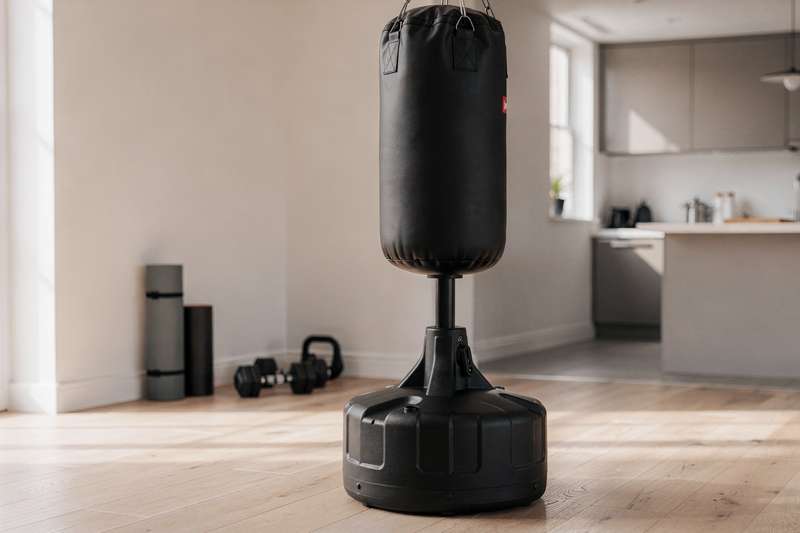
Picture this: you’ve been going to a boxing fitness class for a few months, your jab-cross is starting to feel natural, and you want to keep the momentum going between sessions. The spare room — barely 3 metres square — could work as a training space, but the ceiling is plasterboard and the landlord has already said no to wall fixings. You ordered a cheap freestanding bag from a marketplace seller six weeks ago, and it’s been wobbling across your laminate flooring ever since. Every time you throw anything with real intent, the bag slides a foot to the left and you spend half the workout chasing it around the room instead of training. You want a bag that actually holds its ground — or at the very least, one that makes sense for your space and your training goals.
The punch bag market in the UK has expanded considerably, covering everything from water-filled hanging bags to inflatable freestanding tubes. The quality gap between the best options and the worst is substantial, and the type of training you do matters more than most buyers realise when choosing between them. This guide cuts through the noise so you can find what genuinely suits your space, your mounting options, and how seriously you train.
How These Bags Were Assessed
Five criteria shaped the selection here: fill quality and response feel (does the bag absorb impact cleanly, or does it feel dead and unresponsive?), shell durability under sustained use, practical mounting options for real UK home settings, size and weight range for different training styles, and patterns across verified buyer reviews. With combined review counts running into the hundreds for most shortlisted products, consistent failure themes emerged — seam splitting, base instability, poor-quality swivels — and those themes influenced every recommendation. Wherever a rating falls below four stars, that context is acknowledged directly rather than glossed over.
Best Pre-Filled Hanging Punch Bag
The Dyno Heavy Filled Punch Bag is one of the few hanging bags at this level that arrives pre-filled and ready to install, which is a more significant practical advantage than it might first appear. Available in 3FT, 4FT, and 5FT sizes, it covers training needs from children and younger teens through to adults working boxing, kickboxing, Muay Thai, or karate. With 4.5/5 stars from 125 verified buyers, it is among the highest-rated products on this shortlist.
The appeal of a pre-filled bag becomes clear once you have been through the alternative. Filling a bag from scratch requires sourcing the right material, packing it to a consistent density without creating dead spots, and getting the firmness right for your style of training. Pack it too loosely and the bag feels unresponsive and unsatisfying; pack it too densely and it punishes your wrists in the early weeks, particularly if your wrapping technique is still developing. The Dyno’s pre-filled construction removes that guesswork entirely.
The shell handles the kind of varied striking that comes with mixed martial arts training — not just straight punches, but roundhouse kicks, knees, and elbows. That breadth matters if you cross-train, since bags built purely for boxing sometimes lack adequate padding distribution across the lower sections where kicks land. The 5FT option covers the lower-body target area properly for adult kickers; the 4FT version can feel short for taller adults throwing low roundhouses, as the target zone sits awkwardly high on the bag.
When choosing between sizes, a practical starting point: 3FT suits children and early teens; 4FT works for smaller adults (roughly under 170cm) or those focusing exclusively on boxing technique; 5FT is the standard for adult all-round training. Whatever size you go for, you will need a separate mounting solution — a ceiling joist fixing, a wall bracket, or a dedicated freestanding bag stand. None are supplied. The chains provided are functional but basic; fitting a quality bearing swivel between the ceiling fixing and the chains significantly reduces the twisting motion that throws off combination rhythm. It is a modest additional cost that makes a noticeable difference to the training experience.
For anyone who has a suitable hanging point and wants a bag ready to train on from day one across multiple striking disciplines, the Dyno is a reliable, well-rated option. The range of three sizes also makes it practical for households where training needs vary between family members — you can match the bag to whoever uses it most regularly without being locked into one configuration.
Best Water-Filled Punch Bag
The Bull Doza Fight Wear Pro Water Punch Bag is the most-reviewed product on this shortlist, with 463 verified buyers rating it at an average of 4.3/5 stars. That volume of feedback tells you more than a smaller sample can: enough buyers have trained on it long enough to come back and rate it honestly, and the majority are satisfied with what they bought.
Water-filled bags behave differently from fabric-stuffed bags in ways that matter for your training. The water shifts on impact, giving the bag a dynamic resistance that more closely resembles hitting a pad held by a training partner — there is give, then pushback, rather than the dead, fixed-point thud you get from densely packed fabric. For anyone training without a coach monitoring technique, this response is genuinely kinder on the wrists and knuckles during longer sessions, reducing the cumulative stress that comes from repeated impact on an unyielding surface.
The waterproof shell is built for heavy use and comes in three sizes, giving you the option to match the bag to your height and training intensity. The practical advantage that often gets overlooked is portability: because you fill the bag yourself with water, you can drain it when you need to move it. If your training space is a shared garage, a room that doubles as something else between sessions, or a property you might move out of in the next year, being able to drain and relocate the bag is a real-world benefit that neither fabric-filled bags nor heavy freestanding bases offer.
One honest maintenance note: water bags benefit from an occasional seam check. Even well-made examples can develop slow weeps at stress points over time, and catching them early is far preferable to discovering the problem via a damp floor weeks later. A quick look each month takes about thirty seconds. Also relevant for UK winters: if your training space drops below zero — an unheated garage in January is the obvious scenario — drain the bag before a cold snap or move it somewhere insulated. Frozen water expands, and that pressure is not kind to seams or valves.
For the majority of home trainers looking for a high-quality hanging punch bag that rewards regular use, the Bull Doza Pro Water Punch Bag has the strongest track record on this list. The combination of review depth, consistent rating, the dynamic feel of the water fill, and the ability to drain and move it as needed make it the benchmark recommendation for this buying decision.
Best Punch Bag Set for Beginners
The RDX Heavy 5FT Punch Bag Pro Training set is aimed at buyers who want to start training without spending time sourcing separate components. RDX is a well-established brand in the boxing and MMA space, and this product is available in 2-piece, 3-piece, and 4-piece configurations — so you can opt into gloves, bracket hardware, and accessories depending on what you already own. With 4.1/5 stars from 378 reviews, it sits slightly below the top performers on this shortlist but offers the widest all-in-one package coverage of anything here.
The 5FT bag has a maximum filling capacity of 50KG, which allows it to be packed to a density that challenges adult power properly rather than just absorbing light contact. RDX offers both pre-filled and unfilled versions: the unfilled variant lets you control fill density to your preference — firmer for power-focused sessions, slightly softer for speed work — while the pre-filled version removes the effort of sourcing and packing material. Beginners are generally better served by the pre-filled option; more experienced trainers who know exactly what feel they want will appreciate the flexibility the unfilled version provides.
The gloves included in the set are entry-level rather than performance-grade, but they are adequate for casual home sessions and remove the immediate pressure to buy separately when you are just getting started. They handle light-to-moderate bag work without issue. Once you are training more seriously — four or more sessions per week with real power output — upgrading to dedicated boxing gloves is worth the investment. The included pair buys you time to figure out what you want without extra upfront outlay.
Where mixed reviews appear is around fill consistency. Some buyers report that the pre-filled bag develops uneven density after a few weeks of training — harder spots and softer spots rather than a uniform feel throughout the bag. This is a recognised pattern with pre-filled synthetic bags at this price tier rather than a unique failing of this product specifically. Rotating the bag periodically and redistributing the fill if needed addresses it. The bracket and mounting hardware supplied with higher configurations is rated for regular use but may not hold up to very high-intensity daily sessions over the long term — if you train seriously at volume, upgrading the mounting hardware independently is worth doing.
Despite those caveats, the RDX set’s core proposition holds: everything needed to start training, in one order, from a brand with a track record in combat sports equipment. For beginners who want to get moving quickly without a sourcing project, it is the most practical all-in-one option on this list.
Best Freestanding Punch Bag for Renters
The Free Standing Boxing Punch Bag with Suction Cup Base is built for the scenario that describes a large proportion of the UK home training market: you cannot drill into the ceiling, the walls are off-limits, and you need a bag that sets up without permanent installation. At 4.2/5 stars from 108 reviewers, it is the freestanding option on this list that most repays attention for anyone in rented accommodation.
The suction cup base is the defining feature. Conventional freestanding bags use a heavy base you fill with water or sand — effective when stable, but substantial to move and requiring a hose or funnel to fill. A suction-cup base anchors directly to the floor surface in minutes, weighs next to nothing when not in position, and requires no filling at all. For anyone who packs the bag away between training sessions rather than leaving it permanently installed, the difference in setup and breakdown time is considerable.
The training experience suits boxing combinations, speed work, and general fitness use. The bag handles punch sequences well and absorbs impact without the excessive bounce-back you get from lighter inflatable designs. The important caveat is the floor-surface dependency you need to weigh before buying. On smooth tiles or polished hardwood, suction is reliable under punching loads. On textured rubber matting, dusty concrete, or worn laminate, suction becomes unreliable — and several reviewers specifically mention the base losing purchase under sustained heavy low kicks, where the sideways force vector works against the suction grip. Clean and smooth is the operating condition; anything else and stability suffers under harder training.
Build quality sits at a functional level for home training. The shell material and stitching handle regular moderate-intensity sessions without issue. Reviewers using it for fitness boxing, cardio training, and stress relief report consistent satisfaction; those attempting competition-prep-level heavy bag work find it limiting, which is an honest constraint of the design rather than a defect. This bag is solving a specific access problem for home trainers who cannot make permanent installations — it is not trying to replicate a commercial gym setup.
If you are a renter, a student, or simply someone whose training space cannot accommodate wall or ceiling fixings, this suction-cup freestanding design removes the installation barrier that stops many people from training at home at all. Check your floor surface thoroughly before buying — and if it is anything other than smooth and consistently clean, either treat the surface or consider a different mounting solution.
Best Budget Freestanding Pick
The NZQXJXZ Freestanding Punching Bags for Adults sits at 3.4/5 stars from 445 reviewers, and it is worth spending a moment on what that combination of numbers tells you. With 445 reviews, this is a widely-purchased bag; the below-average rating reflects consistent feedback from a large sample rather than an outlier bad run. That feedback has a recognisable pattern, which is useful information before you commit.
At 175cm tall, it is a full-height freestanding bag — tall enough for adults of most heights to work upper and mid-body combinations without stooping, and the height covers the strike zones needed for general fitness boxing. The inflatable construction is the main practical advantage: deflated, it folds nearly flat and takes up minimal storage space. If you live in a small flat where training equipment needs to disappear between sessions, an inflatable bag that packs away in a cupboard occupies a different practical category to anything else on this list. The accessible entry cost also means the financial risk is low if you are not yet certain whether a punch bag will suit your training routine before committing to a larger investment.
The 3.4-star rating reflects two recurring issues across the reviews. The first is base stability: under heavy strikes, particularly powerful low kicks, the bag moves noticeably more than dedicated heavy bags. The connection between the inflatable section and the base is where mechanical stress concentrates, and several reviewers note this junction shows wear faster than the rest of the bag. The second issue is the response characteristic of an inflatable structure — it rebounds more actively than a filled bag. That suits speed work and coordination training but does not replicate the resistance feel needed for power development or heavy combination work where you want the bag to absorb, not bounce back immediately.
Longevity at the lower end of the reviews is also a consistent theme. Seam fatigue around the base and at inflation valves appears in feedback from buyers who have used it over several months. At entry-level pricing, some compromise on lifespan is expected — this is not a bag built for five years of hard training, and it would be misleading to suggest otherwise.
Where buyers do express satisfaction is in the use cases that suit the design: light fitness boxing, speed and coordination work, stress relief, and as a teenager’s introduction to the sport at low commitment cost. If those describe your training goals, the NZQXJXZ is a reasonable starting point. If you train with real intensity and plan to develop serious power, the honest advice is to invest in a heavier, higher-rated option — you will outgrow this bag quickly, and replacing it will cost more in the long run than buying the right thing from the start.
What to Look For When Buying a Punch Bag
- Fill material and density: Fill determines how the bag feels and responds. Compressed fabric and textile scraps give a firm, consistent response — the traditional standard for heavy bag training. Water fill provides more dynamic movement and is gentler on the joints over long sessions, making it well-suited to training without a coach watching your form. Sand fill is very dense and extremely firm, which can place unusual stress on wrists and knuckles for anyone training without wraps or whose technique is still developing. Whatever the fill, look for evidence of uniform packing — uneven density creates frustrating hard spots that disrupt your combinations and can cause wrist strain.
- Shell material: Synthetic leather (PU) is the standard for home bags — durable, resistant to moisture, and relatively comfortable on impact. Genuine leather handles very sustained heavy use better and ages well, but costs more and needs occasional conditioning to prevent cracking. Vinyl is cheapest and most common at entry-level; it can crack in cold conditions, which matters for UK garages through winter where temperatures can drop significantly between November and February.
- Size and weight: As a practical guide: 3FT bags suit children and younger teens; 4FT is appropriate for lighter adults or those focusing on pure boxing technique; 5FT and above is the adult standard covering the full striking range. For kickboxing and Muay Thai specifically, height matters more than for straight boxing — a 4FT bag places the low kick target zone awkwardly high on the bag for most adults. Heavier bags swing less under impact, which aids power development; lighter bags require more control and are better for speed-focused training.
- Mounting method: Ceiling-hung bags give the most natural swing arc and closest feel to training conditions, but require a structural fixing — a genuine ceiling joist or rated beam, not plasterboard or a hollow partition. Wall brackets are a good alternative for lower ceilings. Freestanding bases filled with water or sand are portable and avoid drilling but add to the overall cost and are less stable under powerful low kicks. Suction-cup bases are the lightest and quickest to set up, but require smooth, clean floor surfaces to work reliably.
- Chain and swivel quality: This is where cheaper kits often fail first. A bag that twists on every combination disrupts your rhythm, affects technique, and is simply frustrating to train on. A quality bearing swivel — fitted between your ceiling fixing and the bag’s chains — makes a meaningful difference for a modest additional cost. Check buyer photos in reviews to see whether the supplied hardware looks adequate or clearly undersized for sustained use, and budget for an upgrade if needed.
- Seam and stitching quality: Seam failure is the most common cause of premature bag deterioration. Look for double or triple stitching, reinforced panels at the top fixing point and the bottom panel (both high-stress areas), and evidence in buyer reviews of seams holding up after several months of training. Review photos document seam failure clearly when it occurs — they are worth looking at before you buy.
- Dynamic load capacity: The static weight of a hanging bag and the load your ceiling fixing must handle under impact are different figures. As a practical rule, your mounting hardware and structural fixing should be rated for substantially more than the bag’s filled weight — the forces generated by a heavy kick significantly exceed the bag’s resting weight. If you are uncertain about whether a fixing point is suitable, consult a professional before installing a heavy bag from it.
Verdict
For most UK buyers shopping for a serious home training punch bag, the Bull Doza Fight Wear Pro Water Punch Bag is the one to shortlist first. The widest verified review base on this shortlist (463 buyers), a consistent 4.3-star average, and the practical advantages of the water-fill design — dynamic impact feel, joint-friendly response, and the ability to drain and relocate as needed — put it clearly ahead for regular home training use. The three-size range means you can match it to your height and training style without compromise, and the waterproof shell handles the mixed-discipline striking that most home trainers actually do.
If ceiling or wall installation is not an option in your space, the Free Standing Boxing Punch Bag with Suction Cup Base is the most practical freestanding alternative for renters and flat dwellers — provided your floor surface is clean and smooth enough to support the suction reliably. Beginners who want everything in a single package without sourcing components separately will find the RDX Heavy 5FT Punch Bag Pro Training set gets them training quickly without additional orders for gloves and hardware. If you have a hanging point and want one clear recommendation, the Bull Doza is it — the review evidence backs it up more strongly than anything else on this list.
We were not paid to feature any specific product in this guide. All opinions are independent and based on publicly available specifications, verified buyer feedback patterns, and category research.
Quick Comparison Table


FAQ
What size punch bag is best for adults?
For most adults, a 5FT (approximately 150cm) bag gives the best balance of strike-zone height and realistic low-kick target coverage. A 4FT bag can feel restrictive for taller adults and limits the low roundhouse target area if you train kickboxing. If you primarily work straight boxing punches and your ceiling height is limited, 4FT is workable — but for mixed striking disciplines, 5FT is the better default.
Can I hang a punch bag in a rented flat?
Hanging a heavy bag requires a secure structural fixing — a genuine ceiling joist or rated wall stud, not plasterboard or a hollow partition. In rented accommodation, drilling without landlord permission typically violates the tenancy agreement. A freestanding bag with a weighted base or a suction-cup anchor is the practical solution for renters — it avoids any risk of property damage and moves with you when you leave.
Do I need boxing gloves to use a punch bag?
For anything beyond very light technical work, yes. Regular bare-knuckle heavy bag training significantly increases the risk of skin abrasion, knuckle damage, and wrist strain — particularly as your power develops and sessions get longer. At a minimum, use hand wraps to support the wrist and protect the knuckles. Boxing gloves (typically 10oz to 12oz for bag work) are the better solution and help develop correct wrist alignment under impact.
What is the difference between a water-filled and a fabric-filled punch bag?
Water-filled bags respond dynamically to impact — the water shifts, giving the bag movement and a feel closer to hitting a held pad. They tend to be gentler on joints during longer sessions and can be drained for easy transport or storage. Fabric-filled bags (compressed textiles and rags) give a firmer, more static response and are the traditional standard for heavy bag training where power development is the primary goal. The right choice depends on your training objectives and whether being able to relocate the bag matters for your space.
How do I stop my freestanding punch bag from sliding around?
Fill the base to its maximum recommended capacity with water or sand, whichever the manufacturer specifies — a partially filled base is the most common cause of unwanted movement. Placing the bag on a quality non-slip rubber mat also reduces sliding significantly. For suction-cup designs, the floor must be clean, dry, and smooth — even a thin layer of dust reduces adhesion substantially. If the bag still moves after these steps, it may simply not be rated for your current training intensity.
How long should a punch bag last with regular use?
A well-made hanging bag used three to four times per week should remain in good condition for several years before the shell or stitching shows meaningful wear — assuming you train with gloves and hand wraps rather than bare knuckles. Budget freestanding bags, particularly inflatable designs, typically show significant wear after one to two years of consistent training. Key areas to monitor are the seams at the top fixing point and bottom panel, inflation valves on air-filled bags, and the condition of chains or straps at the attachment points.