Picture this: you’re on the fourteenth hole, your bag has been biting into your shoulder since the second, and the climb to the sixteenth green is already occupying your thoughts. You’ve been carrying your clubs for years, but your back has started to express a view about it. Your playing partner made the switch to an electric trolley two seasons ago — they still look fresh on eighteen while you’re grinding through the last few holes. So you search Amazon for a golf cart and immediately land on a confusing mix of three-wheeled push carts, remote-controlled electric trolleys, enclosures for motorised buggies, cleaning accessories, and brand names used as product titles with no further description attached. The reviews are patchy. You can’t tell which option will cope with a soggy UK parkland course, fit alongside your bag in the car boot, or actually be worth the cost.
One thing worth clarifying before going further: in the UK, “golf cart” on Amazon almost always refers to a trolley — a wheeled frame you walk alongside to carry your clubs, either pushed manually or powered by an electric motor. The motorised riding carts common on American courses are a different category, largely sold through specialist dealers rather than Amazon UK. This guide addresses what UK golfers actually search for and buy: push trolleys, electric trolleys, and the protective accessories that make them more useful in British weather.
How These Picks Were Evaluated
The shortlist was assembled from the most-reviewed and highest-rated golf cart products on Amazon UK, then filtered to include only products relevant to the guide topic. For push trolleys and electric models, assessment criteria included: folding mechanism ease and resulting folded dimensions, the trolley’s own weight, wheel size and grip on wet terrain, handle height adjustability, bag compatibility, and battery endurance for electric options. For cart accessories, the focus was on fit, weather protection, and durability signals drawn from buyer feedback patterns.
Where products carried substantial review volume, patterns across verified Amazon UK buyer feedback were assessed to surface consistent praise and recurring complaints. One caveat applies to this guide: the Caddytek push cart currently carries no buyer reviews on its Amazon UK listing. That product’s section below states this plainly and relies on the brand’s wider market reputation rather than verified buyer experience on this specific listing.
Best Electric Golf Trolley — CRUISER GOLF
The CRUISER GOLF electric trolley is the strongest all-round pick in this guide. At 4.5 stars from 236 verified buyers on Amazon UK, it holds the highest rating combined with meaningful review volume in this shortlist — and the patterns in those reviews consistently point to UK golfers who are satisfied with the product across real course conditions.
The case for switching to an electric trolley is straightforward. Pushing or carrying a loaded golf bag across an 18-hole round involves several miles of walking, often on courses with elevation changes that compound the physical effort. The cumulative fatigue over a full season of regular play is real — particularly if your back, shoulders, or knees have started making their opinions known. An electric trolley removes the pushing effort entirely. You walk alongside it, the motor takes the strain, and you arrive at the eighteenth green in noticeably better shape than if you had been pushing the whole way. Over time, this tends to translate into more consistent golf: tired golfers make worse decisions, especially on the back nine.
What the CRUISER GOLF does particularly well is pack powered convenience into a compact, foldable format that works in a standard UK car boot. Fitting an electric trolley alongside a full golf bag and waterproofs in a typical hatchback is a genuine logistical challenge, and it’s one that some electric trolleys fail entirely. Buyers of the CRUISER GOLF consistently note that the folded unit is more compact than they expected, and that getting it in and out of the boot doesn’t require rearranging everything else or an awkward stacking order. For golfers who drive to the course — which describes most UK golfers — that boot compatibility matters on every single trip.
Battery life is the specification that makes or breaks an electric trolley. The CRUISER GOLF is designed for a full 18-hole round, and UK buyer reviews confirm this holds on typical parkland and heathland courses. Cold weather does reduce battery capacity to a degree — a characteristic of rechargeable battery chemistry broadly, not a specific fault with this model — and hillier courses demand more from the motor than flat terrain. Charging after every round and storing the battery indoors rather than in a cold garage or car boot will significantly extend its working lifespan across seasons. Before buying, check whether replacement batteries are available to purchase separately; some brands use proprietary connectors that make replacements difficult to source after a couple of seasons.
The practical limitation of the CRUISER GOLF is that it is a guided trolley rather than a remote-control unit. You hold the handle and the motor assists; the trolley does not follow you autonomously or respond to a wireless remote. For most golfers upgrading from a manual push cart, this distinction barely registers — the benefit of motor assistance is significant regardless of how it is controlled. But if you have used a remote-control trolley and want hands-free operation, you would need to look at specialist golf trolley retailers beyond Amazon UK’s standard catalogue. For the large majority of UK golfers who simply want a reliable, well-reviewed electric trolley that handles British courses comfortably, the CRUISER GOLF is the most confident pick available here.
Before your first round with any electric trolley, spend a few minutes setting the handle height correctly for your stature. Pushing at the wrong height creates unnecessary tension in the wrists and forearms that builds over a full round. Most electric trolleys use a quick-release collar for height adjustment; get it right once and it stays right. The CRUISER GOLF’s accessory mounting points are compatible with standard golf trolley add-ons — a drinks holder and scorecard holder are the two most popular additions, and both make an 18-hole round considerably more civilised on a warm summer day or a wet autumn morning.
Best Manual Push Trolley — Cube 3.0 3 Wheeled Golf Trolley
If you would rather avoid the cost and complexity of electric power, the Cube 3.0 3 Wheeled Golf Trolley is the most straightforward manual option in this guide. It holds 4.3 stars from 119 Amazon UK buyers — a smaller feedback base than the CRUISER GOLF, but a solid and consistent rating for a category where golfers tend to be specific about what frustrates them.
Three-wheeled push trolleys are the standard format for UK golf, and for good reason. A single front wheel makes the trolley considerably easier to manoeuvre through the narrow paths between fairways, to turn sharply around obstacles, and to push in a straight line without fighting the front end for direction. The Cube 3.0 uses this tri-wheel geometry effectively: the layout provides natural pushing stability without requiring constant minor steering corrections, which is exactly what you want when your attention should be on the round rather than the equipment beneath your bag.
The fold mechanism and folded dimensions are two things that make or break a push trolley as a daily piece of kit. A trolley that collapses quickly and flat fits in the boot alongside your bag without a second thought. One that folds awkwardly or demands two hands and a degree of patience to collapse becomes a mild irritant every single trip. The Cube 3.0’s folding system receives consistent praise in buyer reviews for being quick and intuitive — it collapses without tools and produces a compact package that fits comfortably in a standard car boot without dominating the available space.
The trolley’s own weight is worth factoring in before buying, even though it’s easy to overlook until you’ve been lifting a trolley in and out of the boot fifty times in a season. Three-wheeled push trolleys are generally lighter than four-wheelers, and the Cube 3.0 keeps its weight manageable without the frame feeling insubstantial. Multiple buyers note it handles the wet, sometimes muddy conditions typical of UK courses through autumn and winter without wheels clogging or the frame flexing under a loaded bag. That seasonal resilience matters considerably when you’re trying to use the trolley through a heavy February on a soft parkland course.
The honest limitation of any manual push trolley is the physical effort on uphills. On a mostly flat course, pushing is barely noticeable. On a course with sustained climbs, you will feel it in your legs and arms by the fifteenth hole, particularly after a demanding front nine. If your regular course is particularly hilly or if you play multiple times a week, the CRUISER GOLF electric option above is the more sensible long-term investment. But on flat or gently rolling terrain, the Cube 3.0 is a reliable, cost-effective workhorse: no batteries, no charging regime, no motor maintenance — just a solid three-wheel frame doing its job round after round.
Best Golf Cart Enclosure — 10L0L
The 10L0L golf cart accessories brand is the most-reviewed entry in this guide, with 590 ratings at 4.2 stars on Amazon UK — the highest review volume here by a significant margin. The listing uses the brand name as its title; at this price point, the 10L0L range centres on enclosure and protection sets for motorised golf carts: weather barriers designed to fit around the front and sides of a sit-in buggy to protect riders from wind, rain, and cold during a round.
This section is specifically relevant to golfers who own or regularly use a motorised golf buggy — the kind you sit inside rather than push alongside. If you walk the course with a push trolley, this product does not apply to your situation, and you would do better looking at the CRUISER GOLF or Cube 3.0 sections above. But if you have regular access to a motorised cart, protecting it from the UK’s reliably damp conditions is a practical priority. An enclosure transforms year-round buggy use from something you endure in British autumn and winter to something you can actually enjoy.
The typical 10L0L enclosure design uses a clear PVC front panel that provides forward visibility while acting as a windshield, combined with more substantial fabric side panels that zip or clip to the cart’s roof frame. On a cold, wet morning on an exposed parkland or links course, the difference this makes is immediate. Even on milder days with intermittent showers, a well-fitted enclosure changes the experience of cart-based golf entirely — riders stay dry, hands stay warm, and the round doesn’t become a battle against the elements.
Fit is the most important variable to confirm before buying. Golf cart enclosures are designed around specific roof dimensions, and the measurements for a Club Car differ from those of an E-Z-GO, which differ again from a Yamaha. Buyers who confirm compatibility with their specific cart model before purchasing tend to be satisfied with the result; those who skip the measuring step sometimes find the fit looser than ideal around the zips or panels. Measure your cart’s roof width and depth carefully and compare against the product specification before ordering — this avoids the most common source of frustration with enclosure purchases.
The feedback pattern across 590 reviews suggests 10L0L’s materials hold up well across a full season of regular UK use. Zip quality is the metric that separates good enclosures from mediocre ones in buyer feedback — it is the most common single point of failure across brands at this price tier. The 10L0L construction receives generally positive comments here compared to cheaper alternatives. Clear PVC panels will cloud and yellow over multiple seasons of UV exposure, but this is a characteristic of PVC enclosures broadly rather than a brand-specific issue, and becomes apparent over years rather than months. Overall, this is the most review-supported cart enclosure option currently available on Amazon UK in this category.
Best Budget Push Cart — Caddytek
The Caddytek push golf cart comes with a caveat that belongs at the top rather than the bottom: the Amazon UK listing currently carries no buyer reviews. That is unusual enough to state plainly, and it means this pick cannot be based on verified buyer experience the way the others in this guide are. Check the listing before buying — reviews may have appeared since this guide was published, or the listing may still be without them, in which case you are buying on brand reputation alone.
With that clearly stated, CaddyTek as a brand has an established presence in the push golf cart market, particularly across North America, where their four-wheel carts have built a consistent following over many years. The four-wheel configuration is the primary reason buyers specifically seek them out. While three-wheelers dominate UK golf trolley sales, the four-wheel format offers a stability advantage that is easy to underestimate until you have experienced its absence: the cart stays put when you park it on a slope. On a three-wheeler, a gentle incline can send it rolling slowly away while you are addressing the ball. A four-wheeler, with its wider four-point stance, simply does not do this.
If your regular course is hilly — and many UK parkland courses are — the difference between a three-wheeler that drifts on every slope and a four-wheeler that stays where you put it adds up over an 18-hole round in ways that are initially easy to dismiss and later difficult to ignore. The tradeoff is that four-wheelers are slightly heavier and take up marginally more boot space when folded, because the wider stance does not entirely disappear in the collapsed position. On a flat course where you rarely park the trolley on a gradient, the four-wheel advantage goes largely unused, and the lighter three-wheeler makes more sense.
The Caddytek frame design typically uses lightweight aluminium tubing, keeping the cart manageable to lift without sacrificing structural rigidity across years of regular use. The folding mechanism collapses the cart into a relatively slim package for boot storage, and the bag attachment system uses an adjustable strap-and-clip arrangement that accommodates most standard golf bag sizes. Taller players occasionally find that budget push cart handles do not extend quite as high as they would like — if you are over six feet, check the maximum handle height against the product specification before committing.
The bottom line on the Caddytek: if reviews have accumulated on the Amazon UK listing by the time you are reading this, they will tell you far more than this guide can about how the specific product performs day to day. If the listing remains review-free, the Cube 3.0 three-wheeler above is a more thoroughly verified alternative at a comparable price tier, or consider seeking out CaddyTek products through UK golf retailers where their range tends to be more established. The four-wheel stability argument is a real one for golfers on hilly courses — it is worth keeping on your radar even if three wheels remain the UK default.
What to Look for When Buying a Golf Cart or Trolley
- Manual vs electric: Push trolleys are lighter, need no charging, and cost less upfront. Electric trolleys remove all pushing effort and make a meaningful difference on hilly courses and during back-to-back rounds. The right choice depends on your course terrain, how often you play, and whether any physical limitations make sustained pushing uncomfortable over a full 18 holes.
- Three wheels vs four wheels: Three-wheelers are lighter, easier to steer, and the standard format across UK golf. Four-wheelers offer better stability when the cart is stationary on a slope and are far less likely to roll away mid-shot. If your course has significant inclines and you frequently park the trolley on gradients, the four-wheel advantage is worth the marginally higher weight and slightly larger folded size.
- Folded dimensions and trolley weight: Measure your car boot before buying and compare against the trolley’s stated folded dimensions. A trolley that collapses to a flat, compact shape fits easily alongside a bag; one that folds awkwardly wastes boot space on every visit to the course. Also check the trolley’s own weight — after a hundred trips, the difference between four and seven kilograms becomes very apparent when loading and unloading.
- Handle height adjustability: Handle height affects pushing comfort more than most golfers expect before they have used a poorly adjusted trolley for 18 holes. Look for a model that adjusts across a range suited to your height via a quick-release mechanism that does not require tools. This matters particularly if the trolley is shared between golfers of different statures.
- Bag compatibility: Most trolleys fit most bags, but wide-bodied cart bags and narrow pencil bags sit at different ends of the compatibility range. Check that the clip or strap system fits your bag’s diameter, and confirm the lower cradle supports your bag’s base securely without the bag tilting forward on uphills.
- Battery availability and charger type (electric models): For electric trolleys, check whether replacement batteries can be sourced separately at a reasonable cost. Some brands use proprietary connectors that make replacements expensive or difficult to find after a few seasons. Confirm the included charger is UK-compatible and that the stated round range is sufficient for your course.
- Cart enclosure dimensions and zip quality: For motorised cart owners buying an enclosure, confirm compatibility with your specific cart model before purchasing. Measure roof width and depth. In buyer reviews, focus on comments about zip durability and how well the panels seal at the edges — these are the failure points where cheaper enclosures let in weather first, and the pattern across reviews usually makes the difference clear.
Verdict
For most UK golfers shopping on Amazon, the CRUISER GOLF electric trolley is the pick most likely to make a tangible difference to how you feel after a round. It holds the highest star rating combined with meaningful buyer volume in this guide — 4.5 stars from 236 reviews — and the consistent pattern in that feedback points to a product that performs reliably on the kinds of courses UK golfers actually play. Making the switch from carrying or pushing manually to a powered electric trolley is the kind of upgrade most golfers report they wish they had made sooner. You finish rounds less fatigued, your decision-making on the back nine is sharper, and the cumulative physical wear on your back and shoulders across a season is noticeably reduced.
If the electric price point is a sticking point, the Cube 3.0 3 Wheeled Golf Trolley is the most sensible manual alternative — well-reviewed, compact when folded, and entirely dependable for golfers on flat to moderately hilly courses. For anyone who owns a motorised cart and wants to use it comfortably through a UK winter, the 10L0L enclosure range is the most review-supported option on Amazon UK in that accessories category. And if the four-wheel stability format appeals for hilly courses, keep an eye on the Caddytek listing for review accumulation before committing.
We were not paid to feature any specific product in this guide. All opinions are independent and based on publicly available specifications, verified buyer feedback patterns, and category research.
Quick Comparison Table


FAQ
What is the difference between a golf cart and a golf trolley in the UK?
In the UK, “golf trolley” refers to the wheeled frame used to carry clubs while walking — either a manual push model or an electric powered version. “Golf cart” is often used interchangeably with trolley in common UK usage, though in the US it specifically refers to the motorised riding vehicle. On Amazon UK, searches for “golf cart” predominantly return push trolleys and electric trolleys rather than riding vehicles.
Is an electric golf trolley worth buying for UK courses?
For most golfers who walk the course regularly, yes. UK courses frequently include meaningful elevation changes, and an electric trolley removes the physical effort of pushing a loaded bag across 18 holes. The main practical requirements are remembering to charge before each round and storing the battery indoors during cold months to protect its longevity. Most buyers report an immediate improvement in energy levels, particularly on the back nine.
Are three-wheel or four-wheel push trolleys better for UK golf?
Three-wheelers are lighter, easier to manoeuvre, and the standard format across UK golf. Four-wheelers offer better stability when the trolley is stationary on a slope and are less likely to roll away while you are addressing the ball. If your course is mostly flat, a three-wheeler is the more practical everyday choice. If it is hilly and you frequently park the trolley on gradients, the four-wheel stability is a genuine advantage worth having.
What should I check before buying a golf cart enclosure?
Confirm compatibility with your specific cart model before anything else. Club Car, E-Z-GO, and Yamaha carts have different roof dimensions, and an enclosure designed for one will not fit another correctly. Measure your cart’s roof width and depth and compare carefully against the product specification. In buyer reviews, look specifically at comments on zip durability and panel fit — these are where cheaper enclosures typically fail first.
How long does an electric golf trolley battery last per round?
Most electric golf trolleys are rated for a full 18-hole round, covering roughly four to five miles on a typical UK course. Battery performance decreases slightly in cold conditions — common across UK golf from autumn through early spring — and on courses where sustained climbs demand more from the motor. Charging after every round and avoiding cold storage significantly extends overall battery lifespan across seasons.
What accessories do most golfers add to their push or electric trolley?
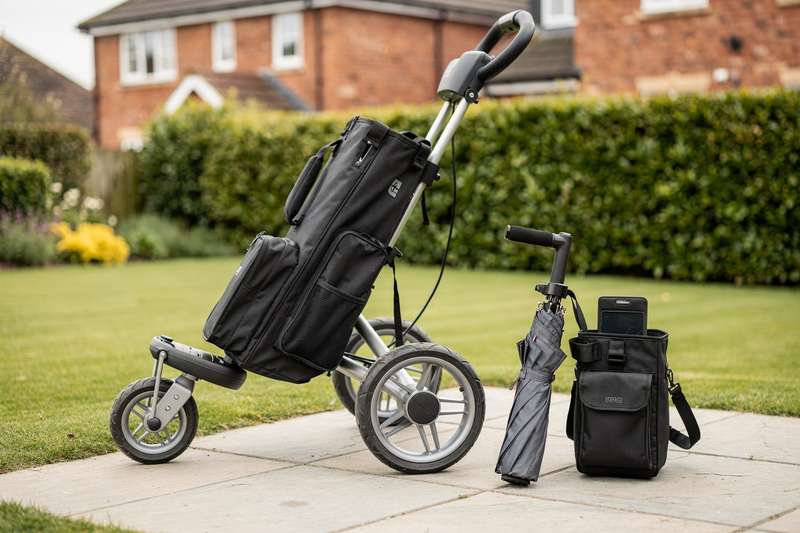
The most popular additions are a scorecard holder, a drinks holder, and an umbrella mount. An umbrella mount keeps your golf umbrella accessible without taking up bag space — particularly useful on UK courses where rain can arrive without much warning. GPS device holders and towel clips are also common. Most push and electric trolleys include universal accessory mounting points, so you are rarely locked into a single brand’s add-ons.