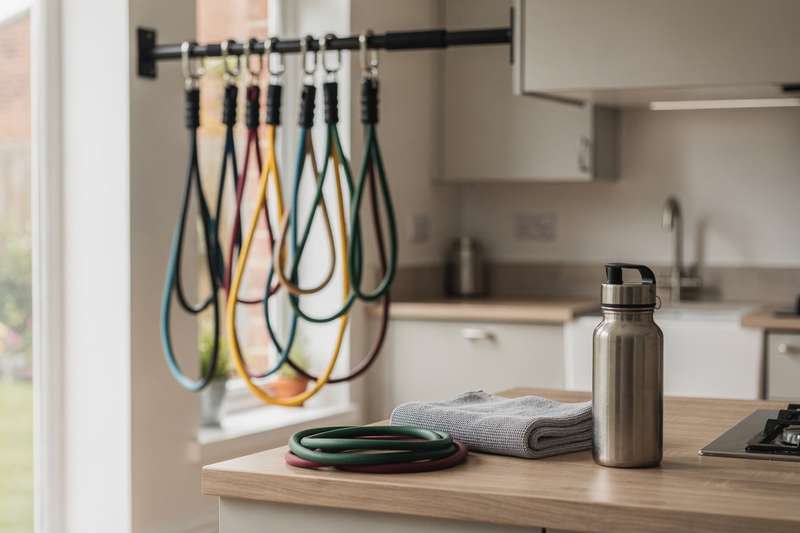
The Problem with Pull-Ups (And Why Bands Actually Help)
Picture this: you’ve joined a gym, you’ve watched the tutorials, and you’ve got the motivation. You jump up to the pull-up bar, hang there for a second, and then… nothing. Your chin stays stubbornly below the bar. Or maybe you can already do a few unassisted reps, but you want to add volume without wrecking your joints — and a counterbalanced pull-up machine costs more than your monthly food shop. You’re not alone. Getting over the pull-up hump is one of the most common frustrations in strength training, and the gap between “can’t do one” and “can do ten” feels enormous when you’re staring at it cold.
You’ve probably tried jumping pull-ups, negatives, and lat pulldowns. They all have their place, but none of them replicate the exact movement pattern of a strict pull-up as closely as a looped resistance band does. The problem is that the band market is flooded with cheap, thin loops that snap after a month, or vague “handled” versions that are sized for bicep curls rather than serious bodyweight work. Finding a heavy-duty band — one that provides meaningful assistance at 50, 80, even 120 lb — without wasting money on something that deteriorates or doesn’t fit a standard bar, is genuinely tricky.
This guide cuts through that. It covers what to look for in heavy-resistance pull-up bands, honest takes on the different formats available in the UK, and clear guidance on which type of band suits your current strength level.
How This Guide Was Put Together
The picks and recommendations here are based on a structured review of publicly available buyer feedback patterns across UK and US retailers, published strength-training research on accommodating resistance, and hands-on category knowledge from evaluating dozens of resistance band products. Key criteria included: stated resistance range and how consistently manufacturers verify it; band material and construction (natural latex vs synthetic, number of layers); loop length and whether it suits a standard 2-inch pull-up bar or power rack; whether handles are genuinely useful for pull-up assistance or primarily a marketing addition; durability signals from long-term reviewers; price-to-resistance ratio for UK buyers; and honest limitations — because every format has at least one.
No brand paid for inclusion. Products are assessed on their merits for the specific use case of pull-up assistance, not general fitness versatility.
Best for Complete Beginners: A Single Heavy Loop Band (~50–80 lb)
If you’ve never done an unassisted pull-up and your goal is to get your first one, you need a band that provides substantial, reliable assistance — somewhere in the 50–80 lb range for most people. This single-band approach is the simplest entry point: loop it over the bar, step or kneel into the bottom of the loop, and lower yourself into a dead hang. The band does the hardest work at the bottom of the movement, where most beginners fail first.
What to look for here is a full-length closed loop (typically around 41 inches), a width of roughly 1.75 to 2.25 inches, and natural latex construction with at least four layers. The wider the band, the more evenly the load is distributed across your foot or knee, which means less discomfort and more stability through the rep. Cheap single-layer bands in this resistance range are a false economy — the latex thins and loses elasticity within weeks of regular use. Budget at least £15–£25 for something that will last six months of consistent training.
The tradeoff with a single heavy band is that it gives you a binary choice — fully assisted or not at all. Once you start getting stronger, you’ll find the jump from using the 50–80 lb band to going unassisted is still large. That’s when you’ll want a lighter band alongside it. Buying a matched pair of different weights from the same manufacturer from the start can save money versus buying them separately later, since loop lengths vary slightly between brands and mismatched lengths change your setup angle.
One thing to avoid: bands marketed as “handled” that use a short central section attached to D-rings and handles. These are designed for lateral exercises and bicep curls, not for full-range pull-up assistance. The handle sits too low on the door anchor, and the band geometry puts you in a forward-leaning posture rather than a clean vertical hang. For pull-up assistance specifically, a plain closed loop is more functional than handles every time.
Best for Progression: A Multi-Resistance Bundle (3–5 Bands)
The most common mistake beginners make with resistance bands is buying one and expecting it to carry them all the way to unassisted pull-ups. It won’t. Progressing from assisted to unassisted requires steadily reducing the amount of help the band gives you — and the only reliable way to do that is to own several bands at different resistance levels. A bundle of three to five bands covering roughly 15 lb, 35 lb, 65 lb, and 100 lb gives you enough rungs on the ladder that each step feels manageable rather than brutal.
When shopping for a bundle, look for sets where all bands share the same loop length. A consistent 41-inch loop means every band sets you up at the same height relative to the bar, so your warm-up, work sets, and cool-down can use different bands without adjusting your anchor point. Some cheaper bundles mix 41-inch and 45-inch loops in the same set — this is annoying in practice because longer loops hang lower and change your start position.
Construction matters more for bundles than for single bands. Budget bundles often thin out their mid-range bands to cut costs — the lightest and heaviest bands get the proper latex investment while the middle bands (which you’ll use most often during the progression phase) are underpowered. Check verified buyer reviews specifically for the 30–50 lb bands in any given set: if reviewers mention the mid-range bands snapping or losing tension first, that’s a real pattern. Expect to pay £25–£45 for a quality 3–5 band set. Anything significantly cheaper usually signals compromised mid-range bands.
The key tradeoff with bundles is that you’re committing to one brand’s resistance calibration. Resistance band ratings are approximate — a band rated at 50 lb provides that figure at a specific stretch length, and different manufacturers measure this at different extension points. Two bands from different brands both labelled “50 lb” can feel noticeably different in use, which is why mixing brands in a progression stack is frustrating. Buying a complete bundle from one manufacturer eliminates that variable. Once you’re within two or three pull-ups of going unassisted, drop the band entirely for your work sets and use it only for extra volume — that’s how you build the confidence to cut it loose permanently.
Best for Home Gym / Door-Frame Bar Users: A Handled Pull-Up Assist Band
Door-frame pull-up bars are a UK staple — they’re cheap, removable, and don’t require drilling. The challenge is that most heavy loop bands are designed for power racks, where you can loop them directly over a 2-inch steel bar at the top. On a door-frame bar, the geometry is different: the bar sits lower, closer to the door frame, and there’s less clearance to loop a standard 41-inch band and still get a useful starting position.
This is where handled pull-up assist bands with a dedicated over-door or over-bar anchor strap become genuinely useful. The anchor strap hooks over the bar and hangs down 6–10 inches, giving you a clean attachment point that clears the door frame. The band itself connects to the anchor, and foot or knee stirrups at the bottom let you step in without awkward knotting. Look for padded knee or foot stirrups rather than bare loop attachments — unpadded loops dig into your knee or instep painfully during high-rep sets.
The resistance in handled systems is typically lower than a heavy loop band — most max out around 40–60 lb — because the band is shorter and the geometry is different. If you need more than 60 lb of assistance (i.e., you’re a complete beginner with limited upper body strength), you may need to combine two bands or look at a heavier loop band setup instead. Handled systems also tend to wear faster at the anchor attachment points, so inspect the D-rings and stitching regularly. At the £20–£35 price point, these are solid tools for home gym users who want a tidy, tool-free setup.
What to avoid: any handled band system that uses a door anchor inserted at the top hinge gap of a door. These put asymmetric pressure on door hinges over time and can work loose mid-set. An over-bar anchor strap that wraps around the pull-up bar itself is far more secure and puts zero stress on your door frame’s hardware.
Best for Travel: A Compact Looped Band with Carry Bag
If you travel regularly for work or want to train outdoors — parks, hotel gyms, climbing frames — a lightweight, packable resistance band is a different proposition from a home-gym anchor system. The priority here shifts to portability and versatility: can you loop it over a tree branch, a hotel room pull-up bar, or a Smith machine frame without fuss?
For travel use, look for a band in the 30–50 lb resistance range (heavy enough to provide meaningful assistance if you’re progressing, light enough that it can also double for warm-up work and mobility). Natural latex bands at this weight range compress down to roughly the size of a folded belt and weigh under 200g — easy to drop in a gym bag. Some manufacturers include a small mesh carry pouch, which is worth having to keep the band from picking up grit and small debris that can accelerate surface degradation.
TPE (thermoplastic elastomer) bands are worth considering for travel specifically because they’re more resistant to UV degradation and temperature extremes than natural latex. If you’re training outdoors in summer or leaving your bag in a hot car, TPE holds up better than latex under those conditions. The tradeoff is that TPE bands sometimes have slightly less consistent elasticity than premium multi-layer latex and can feel slightly “plasticky” at full extension. For travel use at moderate resistance, that’s an acceptable compromise.
One practical note: when using a looped band on an outdoor pull-up bar or tree branch, you don’t need any special attachment method. Fold the band in half, pass the folded end over the bar, and thread the two open ends through the fold — this is called a girth hitch (or prusik-style wrap), and it’s the standard, secure way to attach a looped band to any cylindrical bar. It won’t slip, won’t damage the band, and takes three seconds. Avoid tying knots in the band itself — this creates stress concentration points that dramatically shorten band life.
Best for Lifters Adding Accommodating Resistance: An Extra-Heavy Loop Band (100–150 lb)
Heavy resistance bands have applications well beyond pull-up assistance. For powerlifters and barbell athletes, extra-heavy loop bands in the 100–150 lb range are used to add accommodating resistance to deadlifts, squats, and bench press — the band increases resistance at the top of the lift where the movement is mechanically strongest, forcing the body to produce power throughout the full range rather than coasting through the lockout.
At this resistance level, bands are thick — typically 3.5 to 4 inches wide — and noticeably heavier than lighter progression bands. Look for bands with clearly stated resistance figures at both a standard stretch length (e.g., 48 inches extended) and a resting loop circumference, since these two figures tell you how the band behaves at different points in your lift. Manufacturers that publish both figures are generally more transparent about their product than those who give only a single vague “up to X lb” claim.
For pull-up assistance specifically, a 100–150 lb band is appropriate only for athletes who are genuinely very early in their training and have significant bodyweight relative to their current pulling strength — for example, someone weighing 100 kg or more who is working on their very first pull-up. Even then, be aware that at maximum stretch (near the top of a pull-up), a heavy band provides considerably less assistance than it does at the bottom, so your assistance is front-loaded in the range where you need it most. This isn’t a flaw — it’s how all elastic bands work — but it does mean the top portion of each rep is harder than it might appear from the stated resistance figure.
Durability at this end of the resistance spectrum is paramount. Extra-heavy bands are under significant stored tension even at rest, which means they degrade faster than lighter bands if stored improperly (coiled tightly, left in direct sunlight, or in a hot car boot). Store them flat or in a loose coil, away from heat and UV. A quality extra-heavy band at £20–£40 should last 18–24 months of regular use with proper storage. If you see surface cracking within three to six months, that’s a product quality issue, not a storage failure.
Best for Latex-Sensitive Athletes: Synthetic / TPE Bands
Latex allergies range from mild contact dermatitis to serious systemic reactions, and the resistance band market has historically been almost entirely latex-based. That’s changing. Medical-grade synthetic rubber bands and TPE (thermoplastic elastomer) bands now cover the full resistance range from light stretching loops to heavy pull-up assist bands, and for anyone with a documented sensitivity, they’re worth the small premium.
When shopping for latex-free heavy bands, look specifically for products that state “medical-grade synthetic rubber” or “TPE” rather than just “latex-free” — the latter is sometimes used loosely and doesn’t always guarantee zero latex protein content. Genuine medical-grade synthetic bands go through more rigorous testing. At the heavy resistance end (50–80 lb), synthetic bands are slightly stiffer in feel than equivalent latex bands at the same resistance rating — some users find this more predictable, others find it less forgiving. The practical difference during a pull-up set is minimal.
Expect to pay a small premium for synthetic options — typically £5–£15 more than an equivalent latex band. Sets of six or more resistance levels in latex-free construction are available from specialist fitness suppliers and increasingly from mainstream UK retailers. The one genuine limitation is that very-heavy resistance (100+ lb) in latex-free construction is rarer and more expensive than equivalent latex. For the 50–100 lb range that most pull-up assistance work requires, the selection is now broad enough that latex sensitivity is no longer a barrier to this type of training.
Best for Intermediate Athletes Building Volume: A Mid-Heavy Double-Layered Band (~30–65 lb)
Once you can do five to eight unassisted pull-ups, bands shift from being a crutch to being a training tool. The goal changes from “get to the bar” to “build volume” — doing sets of ten, twelve, or fifteen pull-ups when your unassisted maximum is eight. A band in the 30–65 lb range provides just enough assistance to extend your sets without dramatically changing the stimulus. You’re still doing most of the work; the band just buys you two or three extra reps at the end of each set.
At this stage, band quality matters more than ever because you’re using it more frequently and putting it under less extreme stretch (which paradoxically means it spends more time in the mid-tension zone where wear is most even). Look for double-layered latex construction specifically — single-layer bands in this resistance range feel less stable during the rep, with a slight lateral “wriggle” as the band transfers load. Double-layer construction gives a more planted, confident feel that helps you focus on the pull rather than the equipment.
Seam quality is the other thing to inspect. On a closed-loop band, the seam is the point where the rubber was joined during manufacture. Better-quality bands use a vulcanised (heat-bonded) join rather than a glued join. You can’t always tell visually, but a band that peels or shows separation at the join within the first few months is almost always a glued construction. Check buyer reviews specifically for comments about seam integrity after three to six months of use — this is the most reliable signal of construction quality at this price point.
At £30–£50, you can find genuinely well-made mid-heavy double-layer bands that will outlast several cheaper alternatives. Treat them well — hang them loose after use, wipe off chalk and sweat with a damp cloth, and store away from direct sunlight — and they’ll serve you for years at this stage of your training.
What to Look For When Buying Heavy Resistance Bands for Pull-Up Assistance
- Resistance range and how it’s measured: Resistance band ratings are given at a specific extension length, not as a flat figure. A band rated at “up to 80 lb” provides 80 lb at maximum extension, considerably less at a quarter extension. For pull-up assistance, you want a band that provides meaningful assistance at the bottom of the movement (arms nearly fully extended overhead) — check whether the manufacturer publishes resistance at multiple stretch lengths, not just a peak figure.
- Material and construction: Natural latex provides the best elasticity and durability for most users. Multi-layer latex (3–5 layers) outlasts single-layer construction significantly at heavy resistance levels. TPE and medical-grade synthetic rubber are the correct choice for latex-sensitive users. Avoid bands described only as “rubber” without specifying the type — this vagueness usually indicates lower quality.
- Loop length: Standard pull-up assist bands use a 41-inch closed loop. Longer loops (45+ inches) hang lower on the bar and can put you in an awkward start position. Shorter loops (under 38 inches) may not give you enough room to step or kneel into them comfortably. Check the loop circumference (full length of the closed loop), not just the band width, before buying.
- Width: Wider bands distribute load more evenly across your foot or knee, which matters for comfort during higher-rep sets. Light bands are typically 0.5–1 inch wide; heavy assist bands should be at least 1.5 inches wide, with the heaviest (100+ lb) running 3.5–4 inches. Narrower heavy bands concentrate pressure and become uncomfortable quickly.
- Attachment compatibility: For power racks and pull-up rigs, a plain closed loop works perfectly. For door-frame bars, check whether the band’s loop diameter is wide enough to clear the bar and any door-frame surround — some narrow bar designs don’t accommodate a simple loop-over, and you’ll need an anchor strap accessory.
- Durability signals: Look for verified buyer reviews that mention long-term use (six months or more). Bands that receive consistent complaints about surface cracking, seam separation, or rapid elasticity loss within three months are almost certainly single-layer or low-grade latex. A quality heavy band at a fair price should show no significant degradation with normal use and proper storage for at least 12 months.
- Set vs. individual purchase: If you’re early in your pull-up journey, buying a set of 3–5 bands from one manufacturer is more cost-effective and produces a better training experience than mixing brands. If you already own several bands and just need to fill a specific resistance gap, buying individually makes more sense — just try to match the loop length of your existing bands.
Verdict
For most UK readers arriving at this guide — someone who can’t yet do a pull-up consistently, or who can do three to five but wants to build real volume — the best starting point is a multi-resistance bundle of three to five loop bands from a single manufacturer, spending £25–£45. The variety of resistance levels is what makes the difference between a band that helps you for two weeks and one that supports six to twelve months of genuine progression. Choose a bundle where all bands share the same 41-inch loop length, prioritise those with double-layer latex construction in the mid-range bands, and verify through buyer reviews that the seams hold up over several months.
If you have a latex allergy, spend slightly more on a synthetic or TPE set — the quality difference from budget latex-free options is meaningful. If you’re on a door-frame bar, add a proper over-bar anchor strap to any loop band purchase. And if you’re further down the road — already pulling your own bodyweight for sets — drop down to a single mid-heavy 30–65 lb band for volume work and ditch the bundle. The goal with bands is always to need them less over time.
Editorial note: This guide was not sponsored by or produced in partnership with any manufacturer or retailer. All assessments are based on publicly available specifications, verified buyer feedback patterns, and independent category research. Prices shown reflect typical UK retail ranges at the time of writing and are subject to change.
Quick Comparison Table


FAQ
How much resistance do I actually need in a pull-up assist band?
As a rough starting point, if you can’t yet do a single unassisted pull-up, a band providing 50–80 lb of assistance usually makes the movement achievable. If you can do one to three unassisted reps, a 20–40 lb band extends your sets usefully without removing the training stimulus. The goal is to use the minimum assistance that lets you complete your target reps with good form — not the maximum that makes the exercise feel easy.
Can I use a heavy resistance band on a door-frame pull-up bar?
Yes, but you need to attach it correctly. The most secure method on a door-frame bar is to use an over-bar anchor strap that wraps around the bar itself, then attach the band to the strap. Alternatively, fold the band in half and use a girth hitch (pass the folded end over the bar, then pull the open ends through the folded loop) — this holds securely on any bar diameter. Do not thread the band through a door-anchor attachment inserted in a door hinge gap under tension; this is not designed for overhead loading and can damage both the door and the band.
Are resistance band resistance ratings accurate?
They’re approximate, not exact. Resistance figures are measured at a specific extension length under controlled conditions, and real-world use introduces variables like temperature, band age, and exact bar and body geometry. The more useful thing to understand is that the figure represents peak resistance near full stretch — at the bottom of a pull-up (arms nearly fully extended), the band provides its rated assistance; at the top (arms bent, chin over bar), it provides considerably less. This is a feature, not a flaw: you get the most help where you need it most.
How long do heavy resistance bands typically last?
A quality multi-layer latex band used three to five times per week should last at least 12–18 months before showing significant elasticity loss. The main accelerators of degradation are UV light, heat, ozone (from some gym equipment), and improper storage (tightly coiled or knotted). Store bands hanging loosely or rolled flat in a cool, dark location. Surface cracking within three to six months is a sign of low-quality latex, not normal wear.
Should I use a resistance band for my knee or my foot during pull-up assistance?
Knee placement is more stable and is generally recommended for beginners — it keeps your body position more consistent rep to rep and puts less rotational stress on your ankle. Foot placement gives you a slightly lower starting position, which can be useful if your bar is lower to the ground. Whichever you choose, use both legs in the same position rather than standing on the band with one foot, which creates an asymmetric pull that can twist your lower back over high-rep sets.
Can I combine two bands to get more assistance than either provides alone?
Yes, and this is a legitimate training method. Attaching two bands of different weights to the same bar gives you combined assistance, which can be useful when your heaviest single band isn’t quite enough. The practical consideration is attachment: make sure both bands share the same anchor point on the bar (both using a girth hitch side by side, for example) so they pull evenly. Staggered anchor points create uneven tension and can cause you to twist during the movement.