When Your Shoulder Stops You Doing the Simple Things
You reach up to grab a mug from the top shelf and something stops you — not a sharp snap, just a nagging ache that reminds you it’s there. Or maybe you’re three weeks post-physio discharge, handed a printout of exercises and told to “keep going at home,” but you have no idea which resistance band to buy, how firm it should be, or whether a flat loop is even the right format for external rotation work. Perhaps you tried a cheap set from a supermarket, the bands snapped after a fortnight, and you’re back to square one.
Shoulder rehab is specific. The exercises your physiotherapist prescribed — internal rotation, external rotation, scaption, band pull-aparts — demand controlled, low-load resistance at precise angles. The wrong band makes it harder to perform those movements safely. Too stiff, and you compensate with momentum. Too slack, and there’s no meaningful challenge. This guide cuts through the noise so you can get the right tool and actually do your rehab consistently.
How This Guide Was Put Together
This guide is built around the practical demands of shoulder rehabilitation, not general fitness. The evaluation criteria are drawn from patterns across physiotherapy resources, verified buyer feedback on UK retail platforms, published exercise guidance, and hands-on category research into band construction and material durability. Key criteria included: resistance progression (whether each tier truly offers a meaningful step-up), format suitability for common rehab movements, latex versus latex-free options, durability signals such as seam construction and material thickness, anchor compatibility for door-mounted exercises, handle ergonomics, and overall value for the typical home user recovering from rotator cuff strain, impingement, or post-surgical rehab.
Products were assessed across five types: flat therapy bands in continuous rolls or pre-cut lengths, fabric-covered flat loops, traditional tube bands with handles, figure-eight or short tube bands, and door-anchor kits. The goal was to match each format to where it genuinely excels in a shoulder rehab programme — not to rank them against each other, but to help you pick the right tool for your specific stage of recovery.
Quick Picks at a Glance
| Best for | Price range | Key feature |
|---|---|---|
| Early-stage & gentle rehab | Under £15 | Pre-cut flat latex therapy bands, ultra-light to medium resistance tiers |
| Rotator cuff isolation work | £15–£30 | Tube band with padded handles and door anchor, multiple resistance levels |
| Latex-free sensitivity | £10–£20 | TPE flat therapy bands, hypoallergenic, colour-coded progression |
| Pull-apart & overhead mobility | £8–£18 | Long flat loop band, low to medium tension, wide grip surface |
| Late rehab & strength progression | £20–£40 | Fabric-covered loop set, structured resistance tiers, durable construction |
| Travel & portability | £10–£25 | Compact figure-eight tube band with foam handles, lightweight carry pouch |
| Full home rehab kit | £25–£50 | Bundle with flat bands, tube bands, door anchor, and exercise guide |
Best for Early-Stage & Gentle Rehab: Pre-Cut Flat Latex Therapy Bands
If you are in the first few weeks after a shoulder injury, surgery, or a flare-up of impingement, the single most important quality in a resistance band is that it allows genuinely sub-maximal loading. Pre-cut flat latex therapy bands — the kind physiotherapists hand out in clinical settings — are the standard for this stage because you can vary resistance simply by shortening your grip or doubling the band over, rather than committing to a fixed stiffness.
Look for sets that include at least three or four graduated resistance levels, typically colour-coded from yellow (lightest, around 1–2 lb of force at moderate elongation) through red and green up to blue. The lightest bands are surprisingly useful: external rotation of the shoulder with a yellow band feels almost effortless when you’re healthy, but after rotator cuff repair or prolonged disuse it is exactly the right starting load. Avoid any set that jumps straight from “light” to “heavy” with nothing in between — that gap makes progressive overload impossible.
The main drawback of pre-cut flat bands is that they can roll up during use. For standing exercises like band pull-aparts or front raises, this is a minor annoyance. For seated or supine rotator cuff exercises it can affect grip consistency. Look for bands that are at least 5 cm wide, which resists rolling far better than narrower versions. Also check the length — 1.2 m to 1.5 m is ideal for shoulder exercises, giving enough slack to anchor underfoot or wrap around a fixed point.
Durability is the honest weakness here. Flat latex bands degrade with UV exposure and sweat. Store them away from direct sunlight, wipe them down after use, and treat them with a light dusting of talc occasionally. A quality set should last six to twelve months with daily use before showing micro-tears. Inspect the band visually before each session — small nicks or white stress marks mean it is time to replace. For the price (typically under £15 for a multi-level set), replacement is not a major concern.
Best for Rotator Cuff Isolation Work: Tube Bands with Padded Handles and Door Anchor
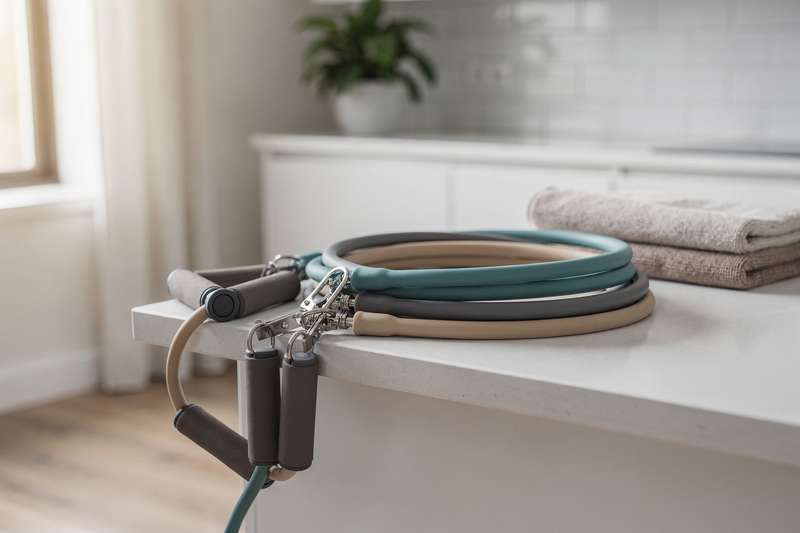
The tube band with padded handles is the workhorse of home shoulder rehab once you have moved past the ultra-light phase. The handles allow a consistent, neutral grip — important for exercises like internal and external rotation where hand positioning directly affects how the load travels through the shoulder joint. Without handles, you’re often compensating grip tension, which shifts muscle recruitment away from the rotator cuff muscles you’re trying to train.
The door anchor is what makes this format genuinely versatile for shoulder work. A simple foam or rubber anchor loops over a door (closing it traps the anchor in place) and lets you set the cable attachment point at hip height, chest height, or above head height. This matters enormously for exercises like standing rows, face pulls, and diagonal pulls across the body — movements that are staples of shoulder stability programmes. Without an anchor, you’re restricted to floor-anchored or self-anchored exercises, which limits your exercise variety significantly.
When choosing a tube band set, prioritise the quality of the end fittings. Cheap carabiner-style clips can develop play over time and occasionally snap open mid-exercise — a tube band under tension that suddenly releases puts real force through the shoulder. Look for solid metal D-ring connectors with a screw-lock or welded gate. The tube itself should feel substantial; a diameter of at least 9–10 mm suggests adequate latex thickness. Thinner tubes reach their resistance ceiling quickly and are more prone to snapping near the handle connection point, which is where most failures occur.
Resistance levels matter here too. A set covering light, medium, and heavy — roughly equivalent to 5 lb, 12 lb, and 20 lb of resistance at moderate stretch — covers most of the shoulder rehab progression from mid-recovery to return-to-sport loading. If a set only comes with one band, skip it. The ability to swap to a lighter band on tired days is not weakness — it’s good rehab practice. Sets in the £15–£30 range typically include three bands and a door anchor, which is the practical minimum.
Best for Latex Sensitivity: TPE Flat Therapy Bands
Latex allergy is more common than most people realise, and even a mild sensitivity can cause skin irritation during the sustained contact of a 20-minute rehab session. Thermoplastic elastomer (TPE) flat bands offer the same format as traditional latex therapy bands — flat, pre-cut lengths in graduated resistance levels — but without any natural rubber content. They are worth considering even if you don’t have a known latex allergy, simply because the material tends to feel slightly softer against the skin and doesn’t degrade as quickly with sweat exposure.
The practical performance of TPE bands is comparable to latex for the light-to-medium resistance range most relevant to shoulder rehab. The key specification to check is elongation percentage: a good TPE band should stretch to at least 200% of its resting length before significant resistance builds. Bands that feel stiff at short elongation make exercises like external rotation awkward because the resistance spikes too early in the range of motion. This is particularly an issue in early post-surgical rehab where range of motion is still restricted.
Colour coding between TPE band brands is not standardised. One brand’s green may be equivalent to another brand’s blue. This matters when your physiotherapist says “use the green band” — always re-test the actual resistance yourself rather than assuming colour equates to tension. A simple way to check: anchor the band to a door handle and pull to arm’s length. If it takes noticeable effort, it is medium resistance. If it’s barely there, it’s light. This sounds obvious but saves a lot of confusion.
TPE bands are slightly more expensive than basic latex equivalents — typically £10–£20 for a set of five or six lengths. The tradeoff is worth it if latex sensitivity is a concern, or if you prefer a band that feels more durable over time. They tend not to develop the sticky, degraded texture that old latex bands get when stored poorly.
Best for Pull-Aparts and Overhead Mobility: Long Flat Loop Bands
Band pull-aparts and their overhead variation are foundational exercises for posterior shoulder health — strengthening the rear deltoids, rhomboids, and the external rotators that often become inhibited in people with rounded posture or anterior shoulder dominance. For these specific movements, a long flat loop band (roughly 100–120 cm in circumference, forming a large oval loop) is arguably the best tool available because of how naturally it distributes load across the palm and allows smooth arm movement without a fixed anchor point.
The format matters here: tube bands with handles are awkward for pull-aparts because the handles limit where you can grip, and the cylindrical surface concentrates pressure on the palm. A flat loop band sits evenly across the fingers and can be gripped at any width, which lets you adjust resistance on the fly by moving your hands closer together (more resistance) or further apart (less). This simple adjustment mechanism makes flat loop bands highly adaptable during the exercise itself — useful when fatigue sets in mid-set.
For shoulder rehab specifically, you want a low-to-medium tension flat loop. The lightest available in this format is typically a “mini” resistance equivalent, but for pull-aparts you want something that offers a few kilograms of resistance at full arm-span width. Look for bands labelled light or medium in the loop format — heavy flat loops are designed for assisted pull-ups and offer far too much resistance for this purpose.
One genuine limitation: long flat loop bands are not ideal for anchored exercises. They are designed for self-anchored movements where both ends stay in your hands. If your rehab programme includes a lot of single-arm cable-style exercises (internal rotation, scaption), you’ll need a tube band set as well. Think of the flat loop as a specialist tool for pull-aparts, face pulls from a wall anchor, and overhead mobility work — not a complete solution on its own. Pricing for a single good-quality flat loop band is typically £8–£18.
Best for Late Rehab and Strength Progression: Fabric-Covered Loop Sets
Fabric-covered loop bands — elasticated cores wrapped in a woven fabric sleeve — are designed to resist rolling, stay put on skin or clothing, and offer higher resistance levels than standard flat latex loops. They are well suited to the later stages of shoulder rehabilitation, when the goal shifts from gentle range-of-motion work to building endurance and loading capacity in preparation for returning to sport, overhead work, or daily activities that require sustained shoulder strength.
The fabric sleeve means these bands sit firmly against the body without the pinching or bunching that thin latex loops can cause. For exercises like banded shoulder presses, lateral raises with progressive loading, or anchored rows with meaningful resistance, the stability of the band’s position matters — you don’t want to be resetting a rolled band every few reps. Fabric-covered bands eliminate that issue almost entirely.
Resistance levels in fabric-covered sets typically start around 15–30 lb of tension at moderate stretch, which means they are inappropriate for acute or early-stage rehab. Using this level of resistance too early after shoulder injury risks re-aggravating the tissue, and it’s worth being direct about that: these bands are for late-stage rehab and general shoulder conditioning, not for the first weeks of recovery. If your physiotherapist has cleared you for progressive loading and you’re looking to build capacity beyond what a light therapy band offers, this format delivers well.
Quality varies widely in fabric-covered bands. The critical failure point is the seam where the fabric sleeve joins at the end of the loop. Poorly stitched seams can split under tension, which is both frustrating and potentially dangerous during an overhead exercise. Before buying, check buyer feedback specifically for comments on seam durability after extended use. A good set in this category costs £20–£40 and should last well over a year with consistent use if the construction quality is sound.
Best for Travel and Portability: Figure-Eight Tube Bands
A figure-eight resistance band is a short tube band formed into a double-loop shape, with a foam or padded handle at each end. The design is compact enough to fold into a jacket pocket, requires no anchor point, and is specifically suited to exercises performed with both hands simultaneously — making it practical for shoulder rehab movements like bilateral external rotation, chest stretches, and shoulder stabilisation work.
The main appeal for travel is simplicity. You don’t need a door to anchor it, there are no separate clips or connectors to lose, and the resistance is fixed (within the band’s specification) without any setup. For a hotel room or a living room with no suitable door, a figure-eight band means you can maintain your rehab routine without improvising.
The tradeoff is limited versatility. Because the band is short and the two handles are fixed relative to each other, you can’t adjust the starting position or resistance the way you can with a longer tube band. Single-arm exercises are awkward unless you anchor one handle under a foot or around a fixed object. And the resistance levels available in figure-eight format tend to be in the light-to-medium range, which suits shoulder rehab well but won’t satisfy anyone looking for heavy loading.
When assessing figure-eight bands, check that the tube connection point at the centre crossing is reinforced — this is where the band experiences the most stress. A simple tie or unprotected crossing will fail faster than a stitched or moulded joint. Foam handles should be dense enough not to compress flat under grip pressure. A decent figure-eight band in the right resistance for shoulder work typically costs £10–£25, and buying two different resistance levels gives you enough progression for most travel rehab needs.
Best Full Home Rehab Kit: Bundle with Multiple Band Types and Door Anchor
If you are starting from scratch and want everything you need to run a complete shoulder rehab programme at home, a bundled kit that includes flat therapy bands, tube bands with handles, a door anchor, and an exercise guide is the most efficient starting point. The value case is straightforward: buying these components separately costs more, and the best bundles are assembled with rehab progression in mind rather than just general fitness.
What distinguishes a genuinely useful rehab bundle from a generic “12 piece resistance band set” is the inclusion of genuinely light resistance options. Many fitness-focused bundles start at medium resistance because that’s where the general population trains. Shoulder rehab starts lighter. A good rehab bundle should include at least one band light enough that even a deconditioned shoulder can complete eight to twelve controlled repetitions without fatigue in the first two to three reps.
Door anchor quality is worth scrutinising in bundle purchases. A flat foam anchor that traps between the door and frame is the standard format, and it works adequately for most tube band exercises. However, some cheaper anchors are too thin and allow the band to shift position during use, or they damage door frames over time. A fabric-covered anchor with a reinforced loop is more reliable. Also confirm the anchor can be positioned at multiple heights — mid-height for rows, high for overhead pulls, low for upward diagonal movements.
The exercise guide included in bundles varies from almost useless (a generic poster with general fitness exercises) to genuinely helpful (QR code linking to video demonstrations of shoulder-specific movements). It won’t replace physiotherapy guidance, but a decent guide can help you check form on exercises you’re unfamiliar with. Bundles in the £25–£50 range from established fitness accessories brands tend to offer the best combination of band quality and useful extras.
What to Look for When Buying Resistance Bands for Shoulder Rehab
- Resistance range starting from genuinely light: Shoulder rehab often begins at loads that feel trivially easy to a healthy person. Look for sets where the lightest band offers 1–3 lb of resistance at moderate stretch. If the lightest option in a set feels challenging from week one, the set is calibrated for fitness training rather than rehabilitation.
- Format matched to your exercises: Flat therapy bands suit bilateral and self-anchored movements; tube bands with handles work best for anchored single-arm rotator cuff exercises; flat loops are ideal for pull-aparts and overhead mobility. You may need two formats rather than one.
- Latex versus TPE: Check for latex allergy before purchasing any natural rubber band. TPE bands are a straightforward substitute with comparable performance at the resistance levels used in shoulder rehab.
- Construction quality at connection points: The point where band meets handle, clip, or loop seam is where failures occur. Look for reinforced stitching, moulded connections, or solid metal hardware. Avoid plastic clips that show visible flex under load.
- Door anchor compatibility: If your physiotherapy programme includes anchored exercises (which most shoulder programmes do), confirm whether a door anchor is included or available separately. Check that your door configuration (fire doors, UPVC) can safely accommodate the anchor style.
- Band length and width for shoulder exercises: For flat therapy bands, 1.2–1.5 m length and at least 5 cm width prevents rolling and gives enough range for standing exercises. For tube bands, 120 cm of tube length is standard and suitable for most users.
- Inspectability and replaceability: All resistance bands degrade over time. Prefer sets where individual bands can be replaced rather than a kit that forces you to replace everything. And commit to inspecting bands for micro-tears, white stress marks, or sticky degradation before each session.
Comparison Table
| Type | Best rehab stage | Resistance start point | Anchor needed? | Latex-free option? | Approx. price range |
|---|---|---|---|---|---|
| Pre-cut flat latex therapy bands | Early to mid rehab | Ultra-light (~1–2 lb) | No (floor or hand) | No (latex only) | Under £15 |
| Tube bands with padded handles & door anchor | Mid to late rehab | Light (~5 lb) | Yes (door anchor included) | Sometimes (check listing) | £15–£30 |
| TPE flat therapy bands | Early to mid rehab | Ultra-light (~1–2 lb) | No (floor or hand) | Yes (TPE is latex-free) | £10–£20 |
| Long flat loop bands | Mid rehab, mobility focus | Light (~3–5 lb) | No (self-anchored) | Yes (available in TPE/fabric) | £8–£18 |
| Fabric-covered loop sets | Late rehab & conditioning | Medium (~15 lb+) | No (self-anchored) | Yes (fabric over elastic) | £20–£40 |
| Figure-eight tube bands | Mid rehab, travel | Light to medium | No | Sometimes (check listing) | £10–£25 |
| Full rehab bundle kit | Early through to late rehab | Ultra-light (if rehab-focused) | Yes (anchor included) | Varies by brand | £25–£50 |
Verdict
For the majority of people doing shoulder rehab at home — whether that’s recovering from rotator cuff strain, managing impingement, or following a post-discharge physiotherapy programme — the combination of a pre-cut flat latex (or TPE) therapy band set for early-stage work and a tube band set with door anchor and handles for mid-to-late stage exercises covers almost everything you’ll need. These two formats together cost under £40 and give you the full resistance progression from ultra-light to meaningful loading.
If budget is tight and you have to choose one, start with whichever format your physiotherapy programme specifies. Most NHS and private physio discharge programmes are written around flat therapy bands because that’s what clinics stock, so a pre-cut flat band set is the safer default if you’re uncertain. Add tube bands with a door anchor once you’re cleared for resisted single-arm movements.
Avoid being drawn in by large sets with 10 or 12 bands — quantity rarely equates to quality in this category, and having too many near-identical resistance levels is confusing rather than useful. A set of four clearly differentiated resistance levels, well-constructed, will serve you better than a dozen bands that feel similar to each other.
This guide was produced independently. No product manufacturer or retailer paid for inclusion or influenced the recommendations. All assessments are based on publicly available specifications, published physiotherapy exercise guidance, and verified buyer feedback patterns. Prices shown are approximate at the time of writing and may change.
FAQ
Which resistance band colour should I start with for shoulder rehab?
Most physiotherapy-grade flat band sets follow a progression from yellow (lightest) through red, green, blue, to black or grey (heaviest). For early shoulder rehab, yellow or red is appropriate for most people — these bands offer just 1–4 lb of resistance at moderate stretch, which is exactly right for retraining rotator cuff muscles after injury or disuse. Colour coding is not standardised across all brands, so always check the resistance specification rather than relying on colour alone when buying outside a clinical set.
Can I use resistance bands if I’ve had rotator cuff surgery?
Yes, but only once your surgeon or physiotherapist has cleared you for active-resisted exercise — this typically happens at six to twelve weeks post-operation depending on the repair type. Before that window, resistance bands may load the healing tissue prematurely. Once cleared, flat therapy bands in the lightest available resistance are the appropriate starting point, progressing gradually under physiotherapy supervision.
How do I anchor a resistance band for shoulder exercises without a door?
Several alternatives work well. You can stand on the middle of a long flat band to anchor it underfoot for front raises, lateral raises, or reverse flies. A looped band can be secured around a table or chair leg for seated exercises. Wall-mounted anchor hooks (available for under £10 and fixed with a screw or adhesive plate) are a more permanent solution if drilling is an option. A sturdy banister or fence post also works for outdoor use. Avoid anchoring around anything with sharp edges that could cut the band under tension.
How long should a resistance band last before I need to replace it?
A well-maintained flat latex band used daily for shoulder rehab should last six to twelve months. Tube bands with metal connectors and proper storage typically last one to two years. Fabric-covered bands often outlast both due to the protective sleeve. The key is inspection before each session — look for white stress marks, small nicks, or surface stickiness (a sign of latex degradation). A band showing any of these signs should be replaced before it snaps under load.
Is there a difference between resistance bands marketed for physiotherapy and those sold for general fitness?
Yes, and the difference matters for shoulder rehab. Physiotherapy-grade flat bands start at lighter resistance levels and are tested for consistent elongation properties, meaning the resistance increase per centimetre of stretch is predictable. General fitness bands often start at resistances more appropriate for leg training or assisted pull-ups, which is too high for early shoulder work. If you’re buying from a general fitness range, check that the lightest band in the set genuinely offers under 5 lb of resistance at a moderate stretch.
Can I use resistance bands for shoulder pain prevention, or are they only useful during recovery?
Resistance bands are equally effective for prevention as they are for recovery. Band pull-aparts, face pulls, and external rotation exercises done two or three times per week are well-supported in physiotherapy literature for maintaining posterior shoulder strength and reducing the risk of impingement in people who sit at desks, train overhead, or have a history of shoulder issues. There’s no need to wait for an injury to use these tools.