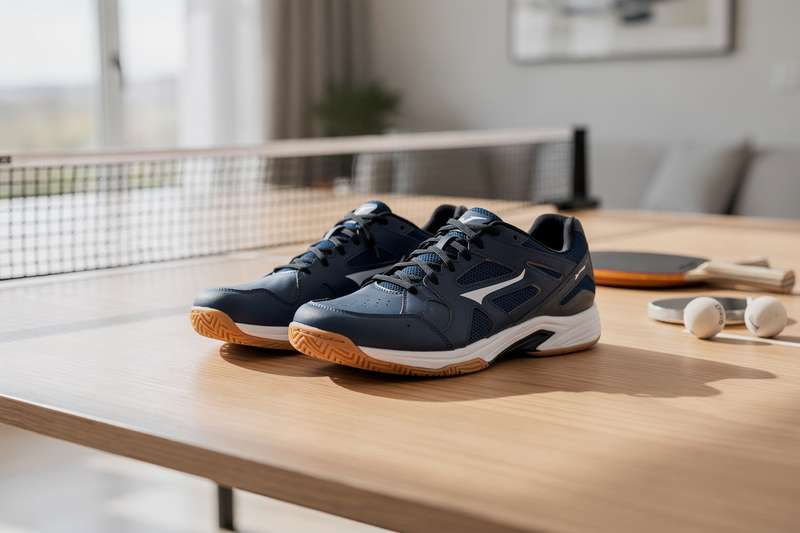
You’re mid-rally, feet planted on a sports hall floor in a pair of old running trainers. You lunge left for a wide forehand, your foot slides a fraction too late, and the ball clips the edge — point gone. It wasn’t your shot selection that let you down. It was your shoes. Running trainers are engineered for forward motion and heel-strike cushioning; they’re not built for the rapid lateral shuffle, low defensive stance, and explosive forefoot pivot that table tennis demands on virtually every point. Gym trainers tend to be too heavy and too inflexible where it matters. Cross-trainers compromise in every direction but fail to nail any of them.
If that sounds familiar — if you’ve been playing in shoes designed for an entirely different sport — the difference a purpose-built pair makes can catch you off guard. Not only in comfort over longer sessions, but in your ability to react, push off, and change direction without that frustrating fraction-of-a-second slip. This guide covers five picks currently available on Amazon UK, from a budget option for recreational players to the most reviewed dedicated table tennis shoe on the market.
How We Chose These Picks
For this guide, we assessed five distinct table tennis and indoor court shoe products available on Amazon UK, after removing colourway and size variants that represent the same underlying model. Evaluation criteria included: sole material and grip pattern (non-marking rubber is the baseline for indoor court use), lateral support structure (critical for the side-to-side weight shifts that define table tennis movement), midsole stack height (lower generally aids court feel and pivot speed), upper breathability, fit profile including width, and verified buyer feedback where available. The JOOLA Court 20 carries the strongest evidence base with 121 reviews at 4.3 stars. One pick — the FitVille wide-fit shoe — carries no verified reviews at the time of writing; that section draws on product specifications and the brand’s track record in wide-fitting footwear rather than buyer patterns, as noted clearly in that section.
Best Overall
The JOOLA Court 20 Table Tennis Shoes are the most reviewed table tennis-specific shoe currently listed on Amazon UK, and that evidence base — 121 ratings at 4.3 out of 5 stars — gives you a level of confidence that the other picks in this guide cannot yet match. JOOLA is a brand that has supplied tables, bats, and balls to clubs and national teams for decades, and their approach to footwear reflects genuine familiarity with the sport’s physical demands rather than generic indoor shoe design repurposed for the table tennis market.
The Court 20 is built low to the ground, with a slim midsole that keeps your centre of gravity close to the floor. This matters more than it might first appear. When your weight sits low, you can push off laterally and change direction faster. A thick-cushioned running shoe raises your foot further from the court surface, adding small fractions of reaction time that accumulate over a five-game match. The Court 20 avoids that problem without sacrificing the cushioning you need to stay comfortable through sessions that run past an hour.
The outsole uses a non-marking rubber compound with a grip pattern calibrated for the smooth, polished flooring common in UK sports halls and dedicated table tennis venues. Buyers consistently note that the grip holds well through diagonal shuffles and split-steps at club level, without the sole wearing down prematurely on harder gymnasium floors. Several reviewers who had previously used badminton shoes as a substitute found the Court 20’s lateral reinforcement noticeably more purposeful. Badminton keeps you on your toes for overhead work; table tennis demands a flatter, wider stance, and the Court 20’s construction reflects that distinction.
Where it falls short: a number of reviewers with wider feet found the toe box on the snug side. If you typically need a wider fit, sizing up by half a size is a sensible precaution rather than assuming the standard last will accommodate you. The Court 20 also sits in the mid-range tier, not the cheapest option here — but for a club player training twice a week or more, the construction quality should see you through a full season without significant sole degradation.
JOOLA lists the Court 20 across multiple colourway variants on Amazon; all are functionally the same shoe. Whichever colourway suits you, you’re buying the same model with the same performance profile. For consistent club play backed by a substantial pool of verified buyer experience, the Court 20 is the straightforward overall pick in this guide.
Best Budget Pick
The Men’s Table Tennis Shoes Indoor Sneaker Soft Bottom Lightweight Mesh Pingpong Shoes occupy a useful position in this guide: a purpose-built table tennis shoe at a budget price point, with 30 verified reviews and a 4.1-star rating suggesting buyers are broadly satisfied despite the entry-level cost.
The mesh upper is the standout design feature, contributing directly to the shoe’s lightweight feel and providing decent airflow through longer sessions. When you’re trading shots for 40-plus minutes in a warm sports hall, a breathable upper makes a real difference to comfort — it’s one of the key reasons dedicated indoor court shoes consistently outperform repurposed running trainers, which are often built with more structured, less ventilated materials. The soft, flexible sole is another purposeful design choice for table tennis specifically: it allows the forefoot to bend naturally during pivots, rather than fighting against a rigid structure that slows foot response time.
The tradeoffs are predictable for the budget tier. Thirty reviews is a meaningful sample to trust directionally, but not large enough to give confident insight into long-term durability. Buyers generally found the shoe comfortable from the outset and praised its lightness; a smaller group flagged that the grip, while adequate on most smooth indoor surfaces, doesn’t quite match the precision of a more expensive dedicated court shoe on particularly slick or polished floors. For recreational players training once a week, that distinction is unlikely to cause problems. For those doing intensive footwork drills multiple times a week, the additional outlay for the Court 20 above is worth considering.
Sizing appears to run true to standard UK sizes based on available feedback. If you’re caught between sizes, err slightly larger — a snug shoe becomes actively uncomfortable during lateral movement. The mesh upper offers minimal protection against moisture, but for a purely indoor sport this is rarely a practical concern.
For a player just entering club play, returning after a break, or equipping a teenager before their level of commitment is confirmed, this is a credible starting point. It’s designed for the sport rather than being a repurposed gym trainer, which puts it meaningfully ahead of the default footwear most beginners reach for when they first start playing.
Best Unisex Option
The JiuQing Table Tennis Shoes Mens Womens Indoor Court Sneakers Non-Slip Breathable for Tennis Pickleball Training carry the highest average rating of any shoe in this guide at 4.9 stars — a striking figure, though drawn from only 10 reviews. With a small sample, a handful of strongly positive experiences can push an average to heights that a broader pool would naturally moderate, so treat this as an encouraging early signal rather than settled evidence.
That said, the 10 buyers who have reviewed this shoe are notably positive, and the design features align with what you’d want for recreational table tennis and indoor court use more broadly. The shoe is available in sizing for both men and women — a practical benefit among the options in this guide, most of which are either men’s-specific or tagged unisex with gendered lasts that don’t work equally well for both sexes. For mixed households where multiple people share the same sport, or for female players who want a proper indoor court shoe without having to work from a men’s size run, the JiuQing’s dual-gender sizing has real practical value.
The non-slip rubber sole is the central performance claim, and the non-marking compound is appropriate for indoor court surfaces. Breathability is handled through a mesh or perforated upper that keeps airflow moving during more active sessions. The lightweight construction reduces fatigue over longer play periods — a difference that compounds over a two-hour club evening where you’re on your feet continuously.
Where this shoe is less proven is in long-term durability and lateral support under sustained, intensive use. With only 10 reviews, there isn’t sufficient feedback to assess how the sole holds up after six months of regular training, or how the upper responds to the repetitive lateral stress of serious footwork practice. For recreational players — those playing once or twice a week for enjoyment rather than competitive development — that’s a reasonable trade at its price point. For club players training seriously, the JOOLA Court 20 provides considerably more evidence-based reassurance.
If you’re buying for a casual player who wants a proper indoor court shoe without paying for a specialist brand, and particularly if dual-gender sizing matters for your household, the JiuQing is worth considering — with realistic expectations about what 10 early reviews can and can’t confirm about long-term performance.
Best for Families and Junior Players
If you’re kitting out more than one person at home, or looking for a shoe that works across both adult and junior sizes, the Table Tennis Shoes Men Women Indoor Sneakers Anti-Slip Lightweight Breathable Soft for Kids Adult is the only option in this guide explicitly designed to cover that broad demographic, with sizing available across junior and adult ranges.
The 3.8-star rating from 17 reviews is the lowest average here, and it’s worth being direct about what that typically indicates. A 3.8 rating suggests a shoe that performs adequately for certain use cases while falling short in others. Based on the review patterns, the picture is consistent: comfortable and acceptable for light recreational use, but short on the lateral stability that more committed players start to need as their technique develops. For a ten-year-old getting their first proper experience of table tennis at a school club or family session, that limitation is arguably acceptable — the shoe is a clear step up from running trainers, has a non-slip sole, and is light enough not to tire younger legs during shorter sessions.
The breathable upper construction is a positive here. Younger players tend to run warm, and overheating becomes uncomfortable quickly in an enclosed sports hall. The soft sole also reduces impact during the stop-start movements of recreational play, which is worth considering for growing feet not yet conditioned to extended court movement.
The limitation becomes more apparent as a player’s game develops. As footwork patterns become more deliberate — stepping into shots, loading weight for a topspin drive, recovering quickly to the ready position — you’ll find the lateral support structure here is fairly minimal. The grip holds on most indoor surfaces, but serious footwork training will expose this shoe’s limits faster than the options above. If a junior player is showing real interest in improving beyond casual levels, moving them up to the JOOLA Court 20 is the sensible next step rather than replacing like for like.
For light recreational use, family sessions, or as a temporary shoe while a younger player decides how seriously they want to take the sport, this option fills a gap that none of the other picks in this guide address. The size range across junior and adult levels is the practical advantage — useful if you’re buying once for multiple people at different stages of the game.
Best for Wide Feet
The FitVille Mens Wide Fit Tennis Badminton Squash Shoe is the only pick in this guide that currently carries no verified Amazon reviews — a fact worth stating plainly before anything else. Every other pick above has buyer feedback to draw on; this one requires you to rely on product specifications and FitVille’s established standing as a brand that specialises in wide-fitting footwear for people who have consistently struggled to find comfortable athletic shoes in standard width profiles.
FitVille’s product range is built specifically around feet that fall outside standard width profiles: wider toe boxes, more accommodating midfoot volumes, and last shapes designed to avoid compressing the foot sideways under lateral load. For table tennis players who have found every standard-fit court shoe uncomfortable regardless of how well it reviews — because the width profile simply doesn’t match their feet — FitVille’s approach is distinctly different from everything else in this guide. The practical consequences of a poorly fitting shoe are worth taking seriously: when a shoe squeezes the sides of your foot, you unconsciously adjust your stance and movement patterns to compensate, which reduces performance and risks cumulative discomfort in the ankle and knee over longer sessions.
The listing covers tennis, badminton, and squash — indoor court sports that share meaningful footwear requirements with table tennis. The grip construction and non-slip sole appropriate for those sports translate directly to table tennis court surfaces. Badminton in particular demands more explosive lateral movement than table tennis, so the lateral support structure of a shoe built for that sport is more than sufficient for competitive ping pong.
The key tradeoff is that absence of verified reviews. FitVille’s reputation in wide-fitting footwear is broadly positive across their product range, but without buyers speaking specifically to this model’s performance on a table tennis court, there’s honest uncertainty that responsible evaluation requires you to acknowledge. This is also a men’s-specific listing based on the product title; women with wide feet will need to look at alternative women’s-range options.
If you have standard or narrow feet, the JOOLA Court 20 is the more evidence-backed starting point. But if you’re a wide-footed player who has found every other court shoe uncomfortable regardless of what the reviews say, FitVille is the most targeted solution available in this guide — and the absence of early reviews shouldn’t automatically disqualify it for someone the other options have consistently let down.
What to Look for in Table Tennis Shoes
- Non-marking rubber sole: The baseline requirement for any indoor court shoe. A non-marking compound won’t leave scuff marks on sports hall or club floors — both a courtesy to venue operators and a sign that the rubber is formulated for indoor traction rather than outdoor durability. Check the listing explicitly states non-marking if your venue has strict floor care rules.
- Low midsole stack height: Table tennis footwork is low to the ground. A thick, heavily cushioned sole raises your foot from the surface and reduces reactive push-off speed. You need enough cushioning to stay comfortable through a two-hour session, but not so much that you sacrifice court feel and lateral agility. Purpose-built table tennis shoes balance this in a way that running shoes simply don’t.
- Lateral support structure: The majority of table tennis movement is side to side — shuffling, stepping, recovering position. The upper and midsole need to resist the lateral force of a sharp crosscourt step without the foot rolling over. Running shoe uppers are designed for the heel-to-toe cycle, not for that kind of sideways load.
- Forefoot flexibility: Your shoe needs to bend naturally at the forefoot as you pivot and push off into a stroke. A stiff sole fights that movement and increases fatigue over longer sessions. Soft, flexible forefoot construction is a direct performance advantage for table tennis — look for descriptions mentioning a soft sole or flexible construction in product listings.
- Breathable upper: Table tennis involves continuous movement in enclosed indoor spaces, often without meaningful airflow. Mesh or perforated uppers keep feet cooler and reduce moisture build-up over longer sessions — a practical comfort factor that becomes more relevant the longer your sessions run.
- Fit and width: A shoe that’s too narrow across the midfoot or toe box causes discomfort and may subtly alter how you plant and move. If your feet are wider than average, look explicitly for wide-fit options — a longer shoe with the same width profile doesn’t address the underlying problem.
- Weight: Lighter shoes reduce fatigue and allow quicker foot movement. Purpose-built indoor court shoes are noticeably lighter than most running trainers — worth comparing directly when assessing options at similar price tiers.
Verdict
For the majority of UK table tennis players — whether you’re playing twice a week at a local club, working on your footwork in dedicated training, or building towards league competition — the JOOLA Court 20 Table Tennis Shoes are the right choice. They carry the largest verified review base of any option currently available on Amazon UK, come from a brand with genuine sport-specific expertise, and strike the right balance between non-marking grip, lateral support, and midsole cushioning for the demands of club-level play.
If your budget is tighter, the Men’s Table Tennis Shoes Indoor Sneaker Soft Bottom Lightweight Mesh Pingpong Shoes are a credible step up from repurposed trainers, with enough buyer feedback to suggest they perform as claimed for recreational use. Wide-footed players should consider the FitVille option despite the absence of reviews, because persisting in a poorly fitting shoe actively undermines your movement and comfort over time. For families or juniors just getting into the sport, the Table Tennis Shoes Men Women Indoor Sneakers Anti-Slip Lightweight Breathable Soft for Kids Adult covers a size range the other picks don’t reach.
One clear recommendation for the typical UK club player: the JOOLA Court 20, without hesitation.
We were not paid to feature any specific product in this guide. All opinions are independent and based on publicly available specifications, verified buyer feedback patterns, and category research.
Quick Comparison Table


FAQ
Do I really need dedicated table tennis shoes, or will any sports shoe do?
Dedicated table tennis shoes make a noticeable difference over general sports shoes for two main reasons: the sole grip pattern is designed for smooth indoor court surfaces, and the lateral support structure suits the side-to-side movement the sport demands. Running trainers in particular have cushioning designed for forward motion, which actively works against quick lateral steps. For casual home play you can manage with clean, flat-soled gym shoes, but for regular club play the upgrade is worth the investment.
Can I use badminton shoes for table tennis?
Yes — badminton shoes are among the better alternatives to dedicated table tennis footwear. Both sports need lateral support, non-marking soles, and lightweight construction. The main difference is that badminton involves more vertical movement, so badminton shoes may have slightly more toe box room and upward flex than a table tennis-specific design. In practice, most players find them comfortable and functional for table tennis, particularly at club level.
How often should I replace my table tennis shoes?
For regular club players training two or more sessions per week, replacing your shoes every 9–12 months is a sensible guideline. The key indicator is sole wear rather than upper condition — once the grip pattern on the outsole starts to flatten or the rubber shows visible wear in high-contact areas, traction drops and lateral stability is compromised. Players training less frequently can typically extend the lifespan to 18 months or beyond.
What should I look for when sizing table tennis shoes?
Most table tennis shoes fit true to standard UK sizes, though models with narrower lasts may benefit from half a size up, particularly for wider feet. Because table tennis involves considerable lateral movement, a shoe that feels slightly snug in a static fitting will often become uncomfortable during play. When uncertain between sizes, go slightly larger rather than smaller, and check that the toe box gives your toes room to splay naturally under sideways load.
Are table tennis shoes suitable for other indoor sports?
Generally yes. The non-marking sole, lateral support, and lightweight construction that suit table tennis also translate well to badminton, squash, and general indoor court use. The reverse is broadly true as well: shoes built for badminton or squash work well for table tennis. Running shoes, however, aren’t a suitable substitute for any of these sports, as their construction is optimised for a fundamentally different movement pattern.
What’s the main practical difference between a budget and a mid-range table tennis shoe?
Budget options tend to use lighter construction with less structured lateral support — adequate for recreational play but showing limitations as your game develops and footwork becomes more deliberate. Mid-range shoes from established brands use more purposeful materials, better grip rubber compounds, and more refined support structures. For players training seriously or competing in club leagues, the mid-range investment typically pays off in both performance and durability across a full season.