Picture this: it’s a drizzly Saturday morning in September, a brand-new skateboard arrived from Amazon two days ago, and your kid has been practising kickturns on the patio path between rain showers. Everything’s going brilliantly — until you realise the helmet rattles when they shake their head, the wheels keep skipping on rough ground, and there isn’t a single tool in the house capable of adjusting the trucks. Three days of genuine excitement, and now the board is leaning against the fence getting rained on.
Adults hit the same wall. You grab your old board from the loft, inspired by a mate’s Sunday skatepark session, and discover the bearings are gummed up and grinding. Or you’ve just bought a pair of inline skates and realised mid-session that the wheels feel sluggish, you’ve got no pads, and you have no clear idea what you’d need to sort it out.
The actual board, skates, or scooter gets all the attention when you’re shopping. What rarely gets mentioned is that the accessories — helmets that actually fit, tools that work without the wrong-sized Allen key, bearings that keep rolling session after session — are what separate a rewarding long-term hobby from something that gets abandoned after a fortnight. This guide covers the essential kit that makes riding enjoyable from the outset.
How We Chose These Picks
For this guide, we focused on five essential accessory categories that UK skaters, scooter riders, and rollerskaters actually need: two protective helmets covering different head shapes and riding styles, an all-in-one maintenance multi-tool, a quality bearing set, and a creative training aid for younger riders. Products were assessed against real Amazon UK buyer feedback patterns — prioritising items with meaningful review volumes and consistently high average ratings — alongside specification depth, build-quality indicators drawn from buyer commentary, and how well each item solves the practical problems riders encounter most often. Where review volumes are more modest, we’ve said so plainly. Where two products operate in similar territory, we’ve explained the key differences so you can match the pick to your situation rather than guess.
Best Multi-Sport Protective Helmet
The CORE Protection Helmet Skate/BMX/Bike/MTB/Roller Derby/Scooter is the most field-tested option in this guide, backed by 281 Amazon UK reviews at an average of 4.4 out of 5 stars. That review volume is meaningful: it means the helmet has been through real-world sessions — at skateparks, on cycle paths, at BMX tracks — for its strengths and weaknesses to show up clearly in the feedback.
The headline feature is multi-sport coverage that actually holds up in practice. Whether the wearer is on a stunt scooter, a skateboard, a BMX, or a pair of rollerskates, this helmet is designed to protect across all four disciplines. For families where kit gets shared or where kids’ interests shift between activities — which is extremely common — that versatility is a real practical advantage. You’re buying one helmet that doesn’t become redundant if the skateboard gets swapped for a scooter next year.
Build quality for the price bracket is solid. The outer shell is designed to withstand impact without shattering, and the interior foam liner does the everyday job that most recreational helmets are asked to do: absorbing the knocks that happen during learning phases, when falls are frequent and usually low-speed. Ventilation channels are built in, which matters more than you might expect during longer sessions. A poorly ventilated helmet gets uncomfortable quickly and ends up coming off between runs, which defeats the point entirely.
The tradeoffs worth knowing: some buyers in the review base note that sizing runs a touch large, which means measuring head circumference carefully before selecting a size is worth doing rather than guessing. The retention system is functional but doesn’t offer the on-the-fly, fine-tuned adjustment you get from a dial system. If the person you’re buying for is a young child with a head that’s actively growing, or someone who finds standard fit systems awkward, the 80SIX helmet in the next section is worth considering. For adults and older teens who know their measurements and want a reliable, multi-discipline lid without paying a premium, the CORE Protection Helmet has the evidence to support it.
The aspect buyers return to most often in positive reviews is longevity — not just how the helmet performs out of the box, but how it holds up after months of regular sessions in British conditions. A helmet that starts slipping or losing its fit after a few months is not a safe helmet. The feedback here suggests it holds its shape and fit well over time, which is ultimately the metric that matters most.
Best Helmet for Beginners with an Adjustable Fit
The 80SIX Deluxe Comfort Skateboard Helmet with Fit Dial for Adults, Youth and Kids approaches the fit problem differently from most helmets at its price point. Rather than relying entirely on foam pad thickness and size selection, it uses a rear-mounted dial retention system that lets you fine-tune the fit with a simple twist — even with gloves on, even mid-session if the helmet has shifted slightly.
This dial mechanism matters more than it sounds. Foam compresses over time, meaning a helmet that fit well when new can start feeling loose after a season of regular use. A dial system lets you take up that slack in seconds. For children in particular — whose heads are still growing and who will resist wearing anything uncomfortable — this adjustability is a significant practical advantage. It can mean the difference between a helmet that actually gets worn every session and one that comes off the moment you stop watching.
Rated at 4.7 out of 5 stars from 56 reviews on Amazon UK, the rating is high but the review volume is more modest than the CORE Protection Helmet above. That’s worth acknowledging: 56 reviews tells you the product works, but the sample is smaller and therefore less predictive for edge cases like unusual head shapes or very heavy use. What the existing reviews do consistently report is that the comfort padding is noticeably softer than comparable budget alternatives, that the dial works exactly as described, and that the helmet doesn’t feel oppressive during extended riding sessions. The Deluxe Comfort framing isn’t empty — buyers who’ve used cheaper lids notice the difference in interior quality fairly quickly.
The 80SIX covers adults, youth, and children under the same product family, which is practical for households where multiple people ride. It’s described as suitable for skating, BMX, scootering, and rollerskating, so the use-case overlap with the CORE Protection Helmet is significant. The key distinction: if precise, repeatable fit adjustment is your priority — particularly for a young child or someone who has struggled with standard helmet sizing — this is the one to choose. If you want a larger body of buyer evidence and the CORE’s established track record, that’s the stronger pick.
A practical note on variants: the 80SIX Deluxe Comfort Helmet is available in different colourways under separate listings on Amazon UK. They share the same core design, dial mechanism, and specifications — the only difference is colour. Choose based on preference rather than any functional consideration, and confirm the size range covers the head you’re buying for before adding to basket.
Best All-in-One Skateboard Maintenance Tool
The All-In-One Skate Tools Multi-function Portable Skateboard T Tool Accessory with T-type Allen Key and L-type Phillips Head Wrench Screwdriver is one of those purchases that feels almost too obvious once you own it. Before you have it, you’re hunting through the kitchen drawer for an Allen key that’s the wrong size, using a coin on a screw that needs a proper driver, and wondering why your truck adjustment never quite worked. After you have it, the whole thing takes two minutes.
With 327 reviews at 4.6 out of 5 stars on Amazon UK, this is the highest-reviewed product in this guide and one of the most accessible in terms of cost. The T-tool format has been standard in skating for decades because it works well: the T-shape gives you the leverage needed to loosen tight axle nuts without straining your wrist or rounding the bolt head, and having multiple functions in a single compact tool means you can carry it to the skatepark in a jacket pocket rather than hauling a bag.
Each function matters individually. The T-type Allen key handles the hardware that holds your trucks to the deck — loose hardware causes wobble and contributes to falls. The L-type Phillips head screwdriver takes care of the various screws across truck components and deck fittings. A dedicated socket for the standard axle nut size means you’re not improvising with ill-fitting tools that strip metal over time. Once you’ve stripped an axle nut with the wrong tool, you understand exactly why having the right one matters.
The honest limitation is build material: at this price point, you’re getting a functional tool, not a professional-grade instrument. For someone setting up and adjusting boards several times a week in a professional context, a heavier-duty kit would be more appropriate. For the vast majority of UK skaters and parents of young riders — people who need to set up a new board correctly, adjust trucks seasonally, and tighten the odd loose nut at the park — it handles everything required without fuss.
If you’re giving a skateboard or scooter as a gift, pairing it with this tool is one of the most practically useful additions you can make. Boards frequently arrive needing minor adjustment, and most new riders don’t discover that until they’re already frustrated on the driveway. Having the right tool from day one turns a potentially discouraging first session into a clean, well-set-up ride from the start.
Best Bearings for Smoother Rolling
The CORE ABEC 9 Skateboard Bearings — a pack of four premium sealed 608 bearings compatible with skateboards, longboards, stunt scooters, and roller skates — address the most overlooked performance issue in the beginner-to-intermediate category. The complaint you hear constantly from people on entry-level boards is that the board feels sluggish or the wheels feel rough on smooth ground. Nine times out of ten, the stock bearings are the reason.
ABEC 9 sits near the top of the standard precision scale for skateboard bearings. Higher ABEC ratings indicate tighter manufacturing tolerances, which means less friction and a smoother, freer spin. In practical riding terms, the difference is noticeable even on flat ground: the board carries momentum further after each push, and on a slight slope it keeps rolling where a lower-rated bearing would lose speed quickly. For rollerskaters and scooter riders, the same physics apply — the 608 format is standard across all three disciplines, so compatibility is rarely a concern.
The sealed design is particularly relevant for UK riders. Open bearings are more susceptible to moisture, grit, and the general griminess of skating outdoors in weather that changes every twenty minutes. Sealed bearings come pre-lubricated and enclosed, which slows the rate at which they degrade in damp conditions. They’re not indestructible, but they hold up meaningfully better through British autumn and spring sessions than unsealed equivalents.
At 4.5 out of 5 stars from 275 reviews, the buyer pattern is consistent: most positive feedback specifically mentions roll quality and how different the board feels compared to stock bearings on budget setups. The price point makes them accessible as an upgrade even if the primary board was an entry-level or gifted purchase — which is often exactly the scenario where the improvement is most noticeable and most needed.
One practical note: skateboards use eight bearings in total — two per wheel, four wheels. This pack contains four. If you’re replacing all bearings on a full skateboard, you’ll need two packs. For inline skates and scooters, the bearing count depends on your specific setup, so check before ordering. For a targeted fix — replacing the two worn bearings on one grinding wheel, for instance — a single pack is exactly the right quantity.
Best for Young Skaters Learning Tricks at Home
The Finger Skateboard Ramps Sets DIY Assembly Mini Finger Skateboard 14 Pieces Fingerboard Skatepark for Kids Children Training Props occupies a different niche from the other products in this guide, and that’s a deliberate choice. This is for the child who is obsessed with skateboarding, talks about tricks constantly, and wants to engage with the culture even when the weather won’t cooperate or when they can’t yet get to a proper skatepark.
Fingerboarding has been around for decades, but modern sets have moved well beyond the tiny plastic boards that used to come as magazine freebies. This 14-piece set includes a DIY assembly skatepark layout, meaning the engagement isn’t just operating a small deck on a desk: children build the park themselves, experiment with ramp placement and obstacle configuration, and develop a spatial understanding of how trick sequences and ramp angles interact. That assembly element adds a creative phase before the play phase, which tends to significantly extend how long a toy like this sees active use.
Rated at 4.4 out of 5 stars from 74 reviews, the feedback is positive and consistent. Parents particularly note that the ramp components feel sturdy rather than flimsy, and that children spend more time with the set than expected. The DIY aspect is mentioned repeatedly as a highlight rather than a frustration — kids set it up together, adjust the layout between sessions, and return to it across multiple days. For a child who’s been asking for a real skateboard but isn’t yet old enough or big enough for a full-size setup, or one who already skates and wants an indoor complement to outdoor sessions, this is a practical gift that tends to see genuine use.
Honest context: fingerboarding transfers some conceptual knowledge to real skating — trick names, the mechanical logic of what makes moves work, how ramp angles affect what’s possible — rather than the physical skills themselves. The balance, muscle memory, and timing that actual skating demands can only be built through time on a real board. Think of this as a creative and educational play item that sits alongside real skating rather than replacing it.
Compared to the other products in this guide, this set occupies the lightest niche. It’s not safety-critical, not maintenance-essential, and not a substitute for the real thing. What it is, for the right child, is an engaging toy that keeps skating culture alive between real sessions — and for a young rider, keeping that enthusiasm burning through a rainy October is actually worth a fair bit.
What to Look For When Buying Skating Accessories
Before adding anything to your basket, run through these criteria to make sure what you’re buying fits your situation.
- Helmet safety certification: Look for helmets that reference recognised safety standards on their listing or packaging. In the UK and Europe, EN 1078 is the standard applicable to skateboarding and cycling helmets. A helmet with no stated certification is worth treating with caution regardless of price — certification testing involves real impact assessment, not just a label.
- Fit adjustment system: Dial or ratchet retention systems allow you to adjust helmet fit quickly and repeatedly, which matters most for children whose head size changes over time. Pad-only sizing requires you to pick the correct size upfront and swap pads if the fit drifts. If buying for a young child or someone with a non-standard head shape, the flexibility of a dial system is worth the modest additional cost.
- Bearing ABEC rating: ABEC ratings (3, 5, 7, 9) indicate the precision of bearing manufacture. Higher numbers mean smoother, lower-friction spin and longer roll-out per push. For recreational and intermediate riding, ABEC 7 or 9 is the sensible target. Ceramic bearings operate outside the ABEC scale and are a premium upgrade for competitive or advanced riders rather than a beginner priority.
- Bearing format compatibility: The 608 format is the standard bearing size across skateboards, inline skates, stunt scooters, and longboards. Before buying, confirm your equipment uses 608 bearings — most standard setups do, but some specialist or older equipment uses different specifications. Check the manufacturer’s documentation if you’re not certain.
- Skate tool function coverage: A skateboard T-tool should cover the standard socket sizes used for axle nuts, kingpin nuts, and truck hardware. Check that it also includes a Phillips head screwdriver function — many inexpensive tools omit this and leave you still reaching for a separate driver for basic maintenance.
- Age and weight ratings: Helmets, pads, and boards all carry age and weight guidance that reflects how the materials are calibrated for impact absorption. A helmet designed for a young child uses different foam density to one designed for an adult. Check the rating before purchase, not after arrival.
- Pack quantities versus actual needs: Bearing packs come in fours or eights, and a full skateboard needs eight. Pad kits vary in what they include. Read the listing description carefully to confirm pack contents, particularly if you’re replacing components selectively rather than kitting out from scratch.
Verdict
If you’re buying just one item from this guide right now, make it a helmet — and the CORE Protection Helmet Skate/BMX/Bike/MTB/Roller Derby/Scooter has the most substantive real-world evidence behind it. At 281 reviews and 4.4 stars, it has been tested by enough real UK riders for you to trust the pattern. It works across skateboarding, scootering, BMX, and rollerskating, which gives you coverage regardless of how your or your child’s riding interests develop over time.
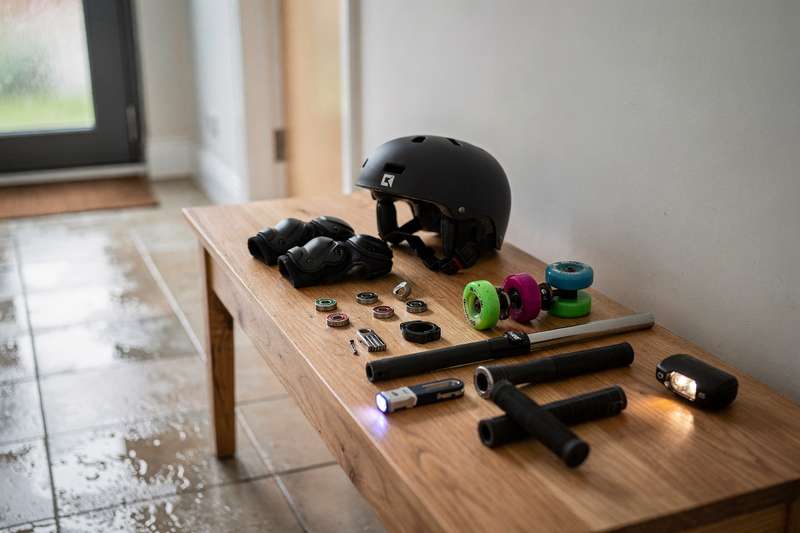
Pair it with the All-In-One Skate Tool if you’re setting up a new board or suspect your current setup needs attention — it removes a frustrating friction point from the very first session. If your wheels feel slow or rough, a set of CORE ABEC 9 Bearings is the upgrade that makes a noticeable real-world difference at an accessible price. The 80SIX Deluxe Comfort Helmet is the better choice if fit adjustability is your main priority, particularly for younger riders. The Finger Skateboard Ramps Set is a thoughtful addition for children who want to stay connected to skating culture between outdoor sessions.
Good accessories don’t make you a better skater overnight. But the wrong ones — or missing ones — make it harder to learn, less safe, and significantly less fun. Getting the basics right from the start means the riding itself can take centre stage.
We were not paid to feature any specific product in this guide. All product selections are based independently on publicly available specifications, verified buyer feedback patterns, and category research. No manufacturer or retailer influenced which products appear here.
Quick Comparison Table


FAQ
Do I need a helmet for skateboarding or scootering in the UK?
There is no current UK law requiring adults to wear helmets on skateboards or scooters in public spaces, but the majority of managed skateparks — particularly those run by local councils — mandate helmets for all users, with particularly strict enforcement for under-18s. More practically, falls are not a matter of if but when for any rider learning new skills, and head injuries from even low-speed falls on concrete can be serious. Wearing a properly fitted, certified helmet is basic, straightforward injury prevention.
What does ABEC 9 mean for skateboard bearings?
ABEC stands for Annular Bearing Engineers’ Committee, and the number indicates manufacturing precision. A rating of 9 means very tight component tolerances, resulting in lower friction and a smoother spin compared to ABEC 3 or 5 bearings. In practical skating terms, the board rolls further after each push and feels noticeably less sluggish underfoot. The upgrade is most apparent when replacing the basic stock bearings that come on many entry-level boards, which are typically ABEC 3 or unrated.
Can I use the same bearings in a skateboard and inline skates?
In most cases, yes. The 608 bearing format is standard across skateboards, longboards, stunt scooters, and inline skates, making them broadly interchangeable between these disciplines. The key thing to verify is that your specific inline skates use 608-size bearings — the vast majority do, but some specialist speed skates and older models use different specifications. When in doubt, check the manufacturer’s documentation for your skate model before ordering.
How do I know if my skateboard needs a maintenance adjustment?
The most common signs are trucks that feel too loose — the board sways side to side and feels unstable — or too tight, where the board won’t turn even when you lean firmly. Wheels that wobble noticeably on their axles usually indicate a loose axle nut. All three issues are fixable in a couple of minutes with a proper T-tool, but they make riding frustrating and, in the case of very loose axle nuts, potentially unsafe. New boards especially often need minor truck adjustment straight out of the box.
Are fingerboard sets useful for learning real skateboarding tricks?
They teach conceptual knowledge — trick names, the mechanical logic of what makes an ollie work, how ramp angles affect which tricks are possible — rather than the physical skills themselves. That conceptual grounding can be helpful when you move to a real board, as you already understand what you’re trying to achieve. However, the balance, muscle memory, and timing that real skating demands can only be built through time on an actual board. Fingerboarding works best as a creative complement to real skating, not a replacement for it.
What age can children start skateboarding or scooting?
Most children develop sufficient balance and coordination for a kick scooter from around age 3 to 4, as the handlebar provides support that makes the early balance requirement much more manageable. Skateboarding typically suits children from around age 5 to 6, though individual readiness varies significantly. Starting with a correctly sized board, a properly fitted helmet, and knee and wrist pads removes most of the early risk and makes the initial learning phase far less discouraging for everyone involved.