Picture this: it’s a Saturday morning, your tee time is 90 minutes away, and you’re standing in the garage wrestling your trolley bag free from behind a pair of old carry bags, a bundle of loose clubs, two sets of muddy golf shoes, and a broken umbrella you’ve been meaning to bin for six months. You finally drag it out, notice your pitching wedge is lying on the floor instead of in the bag, shove it in as fast as you can, and leave the house slightly frazzled. You arrive at the first tee technically on time — but the round already feels like it started badly before you’d even gripped a club.
Golf equipment accumulates. One bag becomes two when you upgrade. Spare clubs linger because you might use that old 3-iron again someday. Balls, tees, gloves, rangefinders, waterproofs, and spare spikes find their way into corners, shelves, and boot wells where they settle until they become a problem. Without some deliberate structure, that chaos grows steadily and the round before every round becomes a 20-minute scavenger hunt through your own garage.
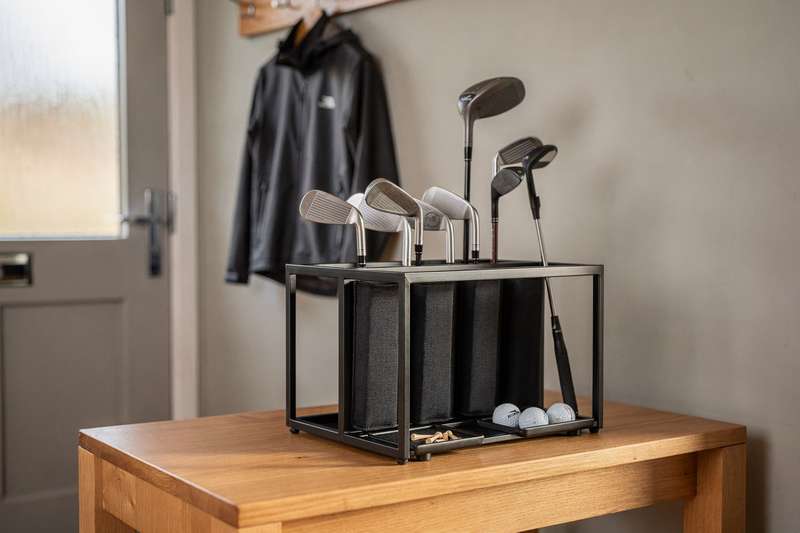
A golf club organiser — whether it’s a freestanding garage rack, a wheeled storage stand, a cylindrical in-bag tube caddy, or a car boot bag — solves this at source. Your gear gets a place, your clubs are protected from rattling and scratching, and the time between deciding to play and actually loading the car shrinks from a stressful scramble to a matter of minutes. This guide covers the most practical options available on Amazon UK right now, honestly assessed for what they actually deliver.
How These Products Were Evaluated
The picks in this guide were assessed against criteria that reflect how UK golfers actually store and use their equipment. Build quality and material finish came first — specifically steel gauge, rust resistance, and whether the construction is realistic for a damp, unheated UK garage environment. Storage capacity was weighed against physical footprint: an organiser that holds everything but dominates a compact single-car garage is not always the right trade-off, and the best pick for a golfer with a spacious double garage will differ from the best pick for someone with a narrow utility room.
Mobility features — integrated wheels, locking casters — were weighted heavily, since repositioning a fully loaded stand is a practical daily concern for many golfers. Secondary storage zones (shelves, hooks, accessory pockets) were assessed for how much of a golfer’s broader kit the system can consolidate into one location. Assembly complexity and real-world buyer feedback patterns from Amazon UK reviews were used to identify consistent themes — both positive and negative — that don’t appear in product descriptions. Products from the same manufacturer that appeared to be colour or size variants of the same model were grouped into a single recommendation to avoid near-identical picks occupying separate sections.
Best for Garage and Home Storage
The EXTCCT Golf Bag Storage Organizer is the starting point for any golfer who wants to clear garage clutter and give their equipment a permanent, dedicated home. Rated 4.5 out of 5 stars from 88 reviewers on Amazon UK, it’s a freestanding stationary stand built to hold full-size golf bags, loose clubs, and accessories within one consolidated footprint — an extra-large format that takes the storage problem seriously rather than offering a token solution.
The structure creates distinct zones: a primary bay for the bag itself, shelving or rack sections for balls, shoes, and accessories, and hook or loop points for smaller items like gloves, headcovers, and towels. For golfers who keep one comprehensive bag loaded year-round, this kind of purpose-built stand beats generic shelving because it keeps the bag consistently upright rather than leaning against a wall and gradually sliding onto the floor at the worst possible moment.
Buyer feedback highlights two consistent positives: the steel frame remains steady even under the weight of a loaded cart bag, and assembly is manageable as a solo project — typically completed in under an hour. The rigidity matters more than it first appears. A wobbly rack becomes annoying fast when you’re trying to pull a single club without dislodging the entire setup. The extra-large format also gives accessories breathing room rather than forcing everything into a tight, disorganised heap where finding a specific glove becomes its own ordeal.
The honest trade-off is that this is a stationary unit. Once it’s loaded and positioned, moving it is either a two-person job or requires unpacking first. If your garage doubles as a workshop, a shared space, or a parking area where floor plans shift regularly, that lack of mobility becomes a recurring frustration rather than a minor inconvenience. It’s also purely a home-storage solution — not something that accompanies you to the course.
Before ordering, measure your available floor space carefully and check the assembled dimensions in the product listing. The extra-large footprint is an advantage when you have room for it, but in a compact garage already occupied by bikes, tools, and garden equipment, a wide organiser can feel intrusive. Position it close to the garage door so grabbing your bag doesn’t require navigating around it. If a different colour or size configuration suits your setup, variants of this organiser are listed separately on Amazon UK.
Best for Easy Mobility
The EXTCCT Golf Bags Storage Organizer with Wheels is the version that matters most if you need your storage to move with you rather than stay fixed permanently in one corner. It carries a 4.6 out of 5 star rating from 74 reviewers on Amazon UK — the highest of any home-storage product in this guide — and the integrated wheel system is consistently the feature buyers highlight in positive reviews.
The practical difference wheels make in a garage setting is larger than it first appears. A fully loaded golf organiser is heavy — a cart bag alone can approach 10kg or more before you’ve added anything else to the shelves. Without wheels, repositioning it even a metre means unpacking, dragging, and repacking. With a smooth set of casters, you can push the whole loaded unit out of the way when you need the floor space for another task, roll it close to your car when preparing for a round, or move it between an indoor room and a covered driveway without emptying it first.
The storage structure follows the same logic as the static version: a steel frame sized for full golf bags, with additional zones for loose clubs, gear, and accessories. Construction keeps bags upright and stable rather than leaning. Buyers report that the unit holds firm once positioned — locking casters prevent unwanted drift when you’re pulling clubs or adjusting the bag’s orientation during loading.
The real seasonal advantage shows over a full playing year. During winter, you roll everything into a corner indoors, out of the way. When the season picks up and you’re playing weekly, you wheel the loaded organiser close to your car, load up, and leave — without unpacking from a fixed position each time. That reduction in friction is small per round but adds up noticeably across a full season. It’s also useful if you host or store equipment for more than one golfer: a wheeled unit can be repositioned to make space when needed without committing to permanent layout changes.
One practical note: casters require a reasonably flat, smooth floor to roll well. If your garage has significant cracks, raised thresholds at the door, or uneven slabs, the wheels may catch or require more effort than expected. The organiser also performs best in covered storage — prolonged outdoor exposure will accelerate surface wear on steel components. Different size configurations of this wheeled model are available under separate listings on Amazon UK if a larger or smaller frame better suits your needs.
Best for Keeping Clubs Tidy Inside Your Bag
The Golf Club Holder and Organiser for Golf Bag solves a different problem entirely: not where you store your bag, but what’s happening inside it during a round. This cylindrical tube caddy holds up to 6 clubs in individual separated channels, preventing shafts from clashing against each other, grips from tangling, and the persistent metallic clatter that accompanies unorganised clubs on a trolley or carry bag across 18 holes.
At 4.7 out of 5 stars from 31 reviewers, it’s the highest-rated product in this entire guide. The praise in buyer feedback is specific and consistent: it works exactly as described, it’s light enough not to register on a carry bag, and it protects shafts from the minor scratches and dents that accumulate when metal contacts metal repeatedly. For golfers who’ve noticed their shafts picking up small nicks or their grips wearing faster than expected, persistent club-on-club contact inside the bag is often the culprit — and this type of caddy addresses that directly.
The cylindrical format is designed to sit inside a standard golf bag opening. Each club slots into its own channel and stays separated and upright, so selecting a specific iron is quick and deliberate rather than a rummage through a tangle. For anyone who’s spent valuable time mid-round fishing out the right club from a disorganised bag, that shift in retrieval experience is noticeable from the very first outing.
The honest constraint is capacity: 6 clubs is not 14. Most golfers use a tube caddy for shorter irons and wedges — the clubs they reach for most frequently during a round — and leave woods, hybrids, and longer irons in the bag’s standard top dividers. If you want every single club separated individually, you’d either need multiple caddies or a bag with full-length built-in dividers. But for preventing shaft damage and reducing the friction of disorganised short irons and wedges, one caddy positioned for your most-used clubs makes a consistent difference on the course.
This is also the most budget-friendly pick in this guide — the kind of low-cost, highly specific accessory that’s easy to overlook when you’re focused on bigger storage problems, but which delivers a real improvement to the daily experience of using your bag. If your garage storage is already sorted and the genuine frustration is inside the bag itself, this is precisely the right product to address it. Lightweight construction means it’s equally suited to carry bags, trolley bags, and electric trolley setups without adding perceptible weight.
Best for Car Boot Organisation
The Golf Trunk Organizer Travel Bag targets a different kind of disorder: the rolling chaos that accumulates in your car boot between rounds. Spare balls, a second glove, a rangefinder, damp waterproofs, muddy shoes, and loose tees — without a structured container, the boot becomes a moving jumble that makes arriving at the course feel unprepared rather than ready to play.
A transparency note before you commit: this product has 7 reviews on Amazon UK with a 3.7-star rating, which is both a small review pool and a below-average score. Drawing confident conclusions about consistent quality or long-term durability from that data would be overstating what the evidence supports. If you prefer buying products with a well-established track record, the other picks in this guide are better proven. This option is included here because no other product in this guide addresses the car boot use case — and for many golfers who drive to their club and keep supplies in the car rather than repacking from home before each round, boot chaos is a recurring frustration entirely separate from the garage-storage problem.
The concept is straightforward: a structured bag with divided compartments for accessories, a dedicated section for golf shoes that keeps mud from transferring to other items, and enough internal organisation to stop everything rolling loose on bends and during braking. Golfers who keep a stock of essentials in the car — spare balls, tees, a rangefinder, waterproofs, an extra glove — find that a dedicated container makes arriving consistently better prepared, rather than arriving to find everything scattered across the boot floor.
The bag format offers practical flexibility: unlike a rigid rack, there’s nothing to assemble, it can be pulled out and restocked at home, and it transfers between vehicles without effort. It occupies no fixed floor space in your garage and requires no installation. For frequent golfers who treat the car boot as a secondary equipment zone, that simplicity has appeal that a freestanding garage rack cannot replicate.
Given the limited review data, approach this as an affordable experiment rather than a confident purchase. If the divided sections match what you typically carry and the dimensions suit your boot layout, the modest entry cost keeps the risk low. Pair it with a garage rack from elsewhere in this guide and you’ve addressed both storage scenarios — home and in-transit — without either solution needing to do more than it’s designed for.
What to Look For in a Golf Club Organiser
- Capacity matched to your bag count: Before anything else, confirm how many golf bags you need to accommodate. Some organisers are built for one bag; others hold two or more. Do not assume that “extra large” automatically means two bags — read the capacity specification in the listing directly. If multiple people in your household play regularly, a dual-bag rack will almost always prove to be the more practical long-term choice.
- Footprint versus storage gained: A wide, well-structured storage rack sounds ideal until it prevents your car from fitting in the garage. Measure your available floor space before purchasing and check the organiser’s assembled dimensions — both width and depth. Depth is frequently underestimated: bags and clubs extend backwards from the rack by considerably more than the frame’s visible profile suggests.
- Static versus wheeled design: A stationary rack is typically simpler in construction and marginally more stable, but a wheeled unit with locking casters adds flexibility for repositioning — useful in shared, multipurpose, or compact garages. If you play regularly and access your storage several times per week, the convenience of wheels justifies the small additional cost.
- Secondary storage zones: The most useful organisers do more than hold the bag upright. Look for shelves, hooks, or side compartments sized for golf shoes, loose balls, tees, gloves, umbrellas, and rangefinders. Consolidating more of your kit into one system means fewer places for clutter to escape to, and fewer items left stranded on a shelf or floor when you’re rushing to leave.
- Build material and rust resistance: Most garage-grade organisers use steel frames. In a damp, unheated UK garage — the standard for most homes — a powder-coated or zinc-plated finish will significantly outlast bare or lightly finished steel. A rack that begins corroding within 12 months is a false economy regardless of what it cost initially.
- Assembly requirements: Most freestanding steel racks require self-assembly. Check whether tools are required, whether instructions are included in the packaging, and what the general reviewer consensus says about the process. Some otherwise well-designed products have poorly written instructions that turn a straightforward 45-minute task into a half-day exercise in frustration.
- In-bag versus standalone: If your garage storage is already sorted and the real problem is clubs rattling or scratching inside the bag during a round, an in-bag tube caddy is a far cheaper and more precisely targeted fix than any freestanding rack. These are distinct product categories solving different problems — make sure you’re buying for your actual frustration, not a problem you don’t have.
Verdict
For most UK golfers with a garage or covered storage space, the EXTCCT Golf Bags Storage Organizer with Wheels is the strongest all-round pick. Its 4.6-star rating, integrated wheel system, and solid steel construction give it a practical advantage over a fixed rack for the majority of golfers who need their storage to be accessible and repositionable rather than permanently parked. You can wheel it close to your car before a round, tuck it into a corner when the space is needed for something else, and move the fully loaded unit without unpacking anything. Across a full playing season, that convenience pays off consistently.
If you’re certain your organiser will stay in one fixed position permanently and mobility isn’t a concern, the EXTCCT Golf Bag Storage Organizer is a solid and slightly more accessible alternative — equally well-reviewed for stationary storage, without the added complexity of the wheeled base.
If your frustration is inside the bag rather than in the garage — clubs rattling and scratching mid-round, or short irons getting lost in the bag’s interior — the Golf Club Holder and Organiser for Golf Bag is the most precisely targeted solution in this guide. Lightweight, highly rated, and priced at the budget end of this category, it addresses a specific course-side problem that no garage rack can solve.
We were not paid to feature any specific product in this guide. All opinions are independent and based on publicly available specifications, verified buyer feedback patterns, and category research.
Quick Comparison Table


FAQ
What’s the difference between a golf bag organiser and a golf club organiser?
A golf bag organiser is a freestanding rack or stand designed to store your entire golf bag upright — most commonly in a garage or utility room. A golf club organiser typically refers to a system that specifically separates and protects individual clubs, whether that’s a standalone rack with individual club slots or an in-bag tube caddy that sits inside your existing bag. Many products serve both purposes, but it’s worth confirming which problem a product primarily addresses before buying.
How do I choose the right organiser size for my garage?
Measure your available floor space first, then compare it against the organiser’s assembled dimensions in the product listing. Pay particular attention to depth as well as width — bags and clubs extend backwards from the rack by considerably more than the frame’s front profile suggests. If your garage is compact or shared with other uses, prioritise a smaller footprint with good vertical storage rather than wide horizontal shelving that dominates the floor.
Can I keep a steel golf organiser in an unheated UK garage?
Yes, but a powder-coated or zinc-plated finish will significantly extend the rack’s lifespan compared to bare or lightly treated steel. Unheated UK garages can be persistently damp, especially through autumn and winter, and steel components without proper surface treatment will eventually develop surface rust. Covered storage is always preferable to any outdoor exposure, even for organisers rated for garage use.
Do wheeled golf storage racks stay stable when fully loaded?
Yes, provided the wheels include a locking mechanism — which most quality wheeled racks feature as standard. Once locked, the unit should stay firmly in position even when you’re pulling clubs out or placing a heavy bag into the stand. Look specifically for models with at least two locking casters and a wide, stable base rather than a narrow upright frame if stability is your primary concern.
How do in-bag club organisers work, and are they worth using?
In-bag club organisers — typically cylindrical tube caddies — sit inside your golf bag and provide individual channels for clubs, preventing shafts from clattering together and reducing grip wear from constant contact. They work best for shorter irons and wedges, adding negligible weight and making specific club selection quicker. For carry-bag users and anyone who has noticed shaft scratches or accelerating grip wear, they’re a cost-effective and lightweight solution that addresses the problem directly.
Is a car boot golf organiser worth buying separately from a garage rack?
If you drive to your golf club regularly and keep accessories — balls, tees, a spare glove, a rangefinder, muddy shoes — in your car between rounds, a dedicated boot bag keeps everything contained and prevents loose items rolling freely. A garage rack and a boot organiser solve different problems: one manages home storage, the other manages in-car chaos. Golfers who play frequently enough to keep a permanent stock of supplies in the car often find value in addressing both scenarios rather than relying on one system to cover everything.