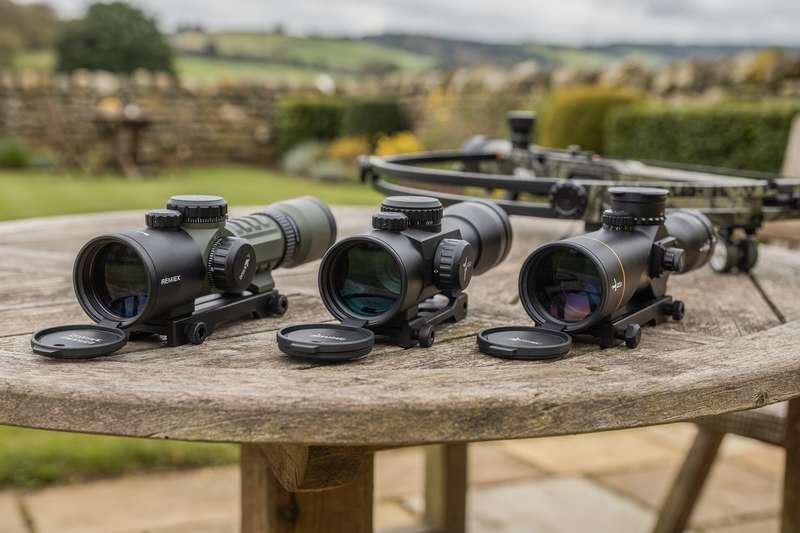
You’ve just upgraded your crossbow — faster, more powerful, more accurate than anything you’ve owned before. You take it to the range, settle into position, and realise the bundled scope that came in the box is blurry at the edges, washes out in low light, and the reticle lines up differently every session. Your bolts are grouping six inches apart at 40 yards, and you know it’s not the bow’s fault. You’ve probably already tried shimming the mount, re-zeroing twice, and blaming the wind. The truth is simpler: the glass is letting you down.
This is one of the most common frustrations for crossbow hunters in the UK — especially those stepping up from entry-level setups. The crossbow itself can handle 60-yard shots with authority, but if the optic can’t deliver a consistent, clear sight picture from first light through to dusk, you’re leaving performance on the table. Worse, you risk an unethical shot when a deer steps out at a tricky angle and you’re squinting through a dark, imprecise reticle.
This guide cuts through the noise. Whether you want a premium auto-ranging scope that does the thinking for you, a rugged multi-coated workhorse with a proper BDC reticle, or a no-fuss budget option that holds zero, there’s a pick here that suits your crossbow, your quarry, and your shooting style.
How We Evaluated These Scopes
Selecting the best crossbow scopes for a UK audience isn’t just about pulling the highest-rated products from a list. Crossbow optics have unique requirements that standard rifle or air gun scopes don’t always meet — they must handle the short, violent reverse-recoil of a crossbow limb rather than a conventional firearm’s rearward push. A scope rated for centrefire rifles may still fail on a crossbow within a dozen shots.
The criteria used to evaluate each pick include: optical clarity and multi-coating quality, reticle design and calibration (particularly BDC or illuminated subtension accuracy), build durability and waterproofing, real-world reviewer patterns from verified purchasers, ease of zero adjustment, compatibility with standard Picatinny and Weaver rails, and overall value relative to tier. Where ASINs had substantial review counts on Amazon UK, those feedback patterns were treated as primary evidence. Technology tier was also a factor — separating genuine crossbow-designed optics from repurposed rifle scopes.
Best Premium Auto-Ranging Scope: Garmin Xero X1i
The Garmin Xero X1i Crossbow Scope sits at the very top of what crossbow optics technology can currently offer, and if you shoot with it once in the field you’ll understand why it commands such a significant premium. This is not a scope you buy because you’re after a bargain — you buy it because you want to eliminate range estimation entirely from your shooting process and replace it with laser-precise automation.
The Xero X1i features built-in auto-ranging that activates the moment you put the crosshairs on a target, then projects a precise illuminated aiming point adjusted for your actual arrow’s ballistic trajectory. There’s no separate button to press, no mental calculation, no guessing holdover at 47 yards versus 52 yards. At 3.5x magnification it keeps both near and mid-range shots well within a manageable field of view, and the illuminated aim points are crisp enough to use in the grey half-light of a November dawn. Rated 4.6 stars from 69 verified Amazon reviewers, the feedback consistently praises the speed and accuracy of the ranging system in real hunting conditions.
Where the Xero X1i struggles is obvious: the price puts it firmly in the premium tier, and it requires setup via the Garmin app before it delivers full functionality. You’ll need to input your arrow speed and bolt weight accurately — shortcuts here will cost you on the range. The 3.5x fixed magnification is also a point of contention for hunters who prefer variable power for close-range work or want to stretch shots beyond 80 yards. It’s also worth noting that the auto-ranging works best on stationary or slow-moving targets; fast-crossing shots are still a case for good judgement.
For the crossbow hunter who takes accuracy as seriously as their quarry and doesn’t mind investing in proper kit, the Garmin Xero X1i is in a class of its own. If budget is no object and you want the most technologically capable setup available on Amazon UK right now, this is it. Just set aside time to configure it properly before season opens — it rewards preparation.
Best All-Round BDC Scope: Vortex Optics Crossfire II 2-7×32
The Vortex Optics Crossfire II 2-7×32 Second Focal Plane Crossbow Scope is the pick that will suit the greatest number of UK crossbow hunters, and with 656 Amazon reviews averaging 4.7 stars, the evidence strongly backs that assessment. This is a scope that gets the fundamentals exactly right: clear, multi-coated glass, a BDC reticle specifically designed for crossbow trajectories, and rock-solid zero retention across the variable 2-7x magnification range.
The XBR-2 reticle is the standout feature here. It’s calibrated for a 40-yard zero and provides accurate holdover references out to 100 yards, which comfortably covers the realistic ethical shooting range for most UK crossbow hunters. The dual illumination options — red and green — make low-light use genuinely practical rather than a marketing gimmick, and the fully multi-coated lenses transmit noticeably more light than budget alternatives. At 2x the scope is wide enough for close-range shooting in woodland, while 7x gives you the detail you need for precise shot placement at distance.
The 30mm tube is a robust, industry-standard size that works with a wide range of quality rings, and the flip-up caps included in the kit are a welcome addition. Build quality feels solid — the scope is nitrogen-purged and O-ring sealed for weather resistance, which matters in the UK’s unpredictable shooting conditions. Weight at around 14 ounces keeps your rig balanced without top-heaviness.
The main tradeoff is that the XBR-2 reticle is calibrated for specific arrow speeds, so you’ll need to verify it’s dialled in for your particular bolt’s velocity. If your crossbow shoots significantly faster or slower than the reticle’s calibration point, the holdover marks may not land where you expect at longer ranges. Vortex’s customer service and warranty are well regarded, which counts for a lot in an optic you’re likely to keep for years. For mid-range hunters who want the best combination of optical quality, usable reticle design, and long-term reliability, this is the pick.
Best Budget Scope: Truglo 4x32mm Compact Crossbow Scope
The Truglo 210341-SSI 4×32 Crossbow Scope is the honest budget pick — no rangefinding wizardry, no variable magnification, just a dependable fixed 4x optic that does its job consistently and holds zero without complaint. With 423 Amazon reviewers giving it 4.2 stars, it has the breadth of feedback to back that claim up across a wide range of users and crossbow types.
The 4x magnification is fixed, which is actually a practical feature at this price point — fewer internal adjustments means fewer things to go wrong. For hunting in typical UK woodland at ranges from 20 to 50 yards, 4x is entirely adequate. The illuminated reticle offers multiple aiming points for different distances, with the kind of brightness adjustment that’s genuinely useful rather than merely decorative. Mounting rings are included, which saves you a separate purchase and means you can get shooting straight out of the box.
Where you feel the budget is in the edge-to-edge clarity — the glass is noticeably less sharp toward the periphery than the Vortex Crossfire II. In full daylight at standard hunting distances this is rarely a problem, but at dawn or dusk the reduced light transmission becomes more apparent. The reticle’s illumination also isn’t as precisely calibrated as purpose-designed BDC systems, so you’ll want to spend time at the range working out your exact holdover at each distance rather than trusting printed yard markers blindly.
For a first-time crossbow scope, a younger hunter’s setup, or a backup optic to have on hand, the Truglo delivers solid results at an accessible entry point. It’s not the scope you’ll use if you’re pushing shots to 70 yards, but for practical UK hunting distances in reasonable light, it more than holds its own.
Best Scope for Variable-Range Hunting: MT2-7X32CB Crossbow Scope
The MT2-7X32CB Crossbow Scope with Speed Ring occupies an interesting middle ground — it offers variable 2-7x magnification and an illuminated reticle at a mid-range price point, and the inclusion of a speed ring makes it more genuinely crossbow-specific than many repurposed rifle scopes at similar prices. Rated 4.1 stars from 64 reviewers, it’s a newer listing with solid early feedback.
The speed ring is the most useful feature for hunters who own crossbows at different velocity ratings. By rotating the ring to match your bow’s arrow speed — the scope covers a broad range from 270 to 450 FPS — you shift the BDC reticle’s calibration to account for your bolt’s actual trajectory. This means the holdover marks are far more likely to correspond to real-world impact points than on a fixed-calibration scope. For hunters who shoot multiple crossbows or have upgraded their bow’s limbs, this adjustability is genuinely practical.
The 1-inch tube is smaller than the 30mm tube on the Crossfire II, which limits the range of available ring options somewhat but keeps weight down. The illuminated reticle covers red and green options across multiple brightness settings. Glass clarity is competent for the price tier — it won’t challenge premium optics in low-light conditions, but in daylight it produces a clean, usable image from 2x through to 7x.
The tradeoff is build robustness. At this price point the turret adjustments feel less precise than on the Vortex, and the illumination controls require some familiarity before they become second nature in the field. That said, if you want variable magnification and speed-ring adjustability without stepping up to premium pricing, this scope delivers a sensible package. It suits hunters who shoot at variable distances and want reticle calibration they can actually match to their specific setup.
Best Specialist Scope for Consistent Zero: Excalibur Dead-Zone Scope
The Excalibur Crossbow Dead-Zone 1952 Scope is a purpose-built crossbow optic from one of the most respected names in the category — Excalibur is a Canadian brand with decades of crossbow-specific engineering behind it, and the Dead-Zone scope reflects that heritage. Rated 4.4 stars from 39 reviewers, the sample size is smaller but the pattern is consistent: hunters who use it report excellent zero retention and a reticle that works as advertised in real hunting conditions.
The 1-inch, 32mm objective tube keeps this scope compact and lightweight, which suits recurve crossbow users or anyone who wants to keep the overall rig weight manageable. The Dead-Zone reticle is calibrated specifically for crossbow bolt trajectories rather than being adapted from a rifle scope design — this matters more than it sounds. Purpose-calibrated crossbow reticles account for the different ballistic arc of a bolt compared to a bullet, meaning the holdover subtensions correspond to actual impact points rather than approximate ones.
Where the Dead-Zone shows its limitations is at the higher end of the magnification range — at 4x it provides a clear, bright image, but it doesn’t offer the variable magnification of the Crossfire II or the MT2-7X. For hunters who operate primarily at set distances in known hides or tree stands, fixed magnification is often an advantage rather than a limitation; you set up for your typical shot and forget about it. But if you hunt diverse terrain where shot distances vary significantly, you may find yourself wanting more flexibility.
The Excalibur Dead-Zone is a particularly strong choice for recurve crossbow users, anyone upgrading from an Excalibur bundled scope, or hunters who prioritise zero consistency above all else. It’s a no-nonsense optic that rewards disciplined shooting and range practice without demanding a premium investment.
What to Look For When Buying a Crossbow Scope
- Crossbow-specific reticle design: Generic rifle scopes are engineered for a bullet’s relatively flat trajectory — a crossbow bolt drops significantly faster over distance. Look for scopes with BDC (bullet drop compensation) reticles calibrated for crossbow bolt velocities, or better yet, a speed ring that lets you match the reticle to your specific arrow speed. Holdover marks that don’t match your bolt’s actual arc are worse than useless.
- Reverse-recoil durability: Crossbows generate a violent forward snap of the limbs as the string releases — this is the opposite direction to a firearm’s recoil and it’s surprisingly hard on internal optic components. Not every scope rated for rifle recoil will survive crossbow use. Look for optics explicitly listed as crossbow-compatible, or those from brands with a track record in the category.
- Objective lens size and light transmission: The 32mm objective lens found on most compact crossbow scopes is adequate in good light, but larger objectives (40mm and above) gather meaningfully more light during the dawn and dusk windows when deer and other quarry are most active in the UK. Fully multi-coated lenses make a greater difference than raw objective size — look for this specification explicitly.
- Illuminated reticle quality: Many scopes advertise illuminated reticles, but the quality varies enormously. Look for multiple brightness settings, both red and green colour options (green is often more visible against foliage), and an auto-off function to preserve battery life. A reticle that washes out in full daylight or is too dim in low light defeats the purpose entirely.
- Tube diameter and mount compatibility: Most crossbow scopes use either a 1-inch (25.4mm) or 30mm main tube. The 30mm tube generally allows for a wider range of quality rings and slightly more adjustment travel. Verify that your crossbow’s rail system accepts the mount style — most modern crossbows use Weaver or Picatinny rails, but older models vary. Using the wrong rings can cause permanent zero shift under repeated shots.
- Eye relief: Crossbow scopes typically offer longer eye relief than standard rifle scopes because the shooting position can vary. Look for at least 3 inches of eye relief to avoid scope bite on follow-through, particularly on high-draw-weight bows with significant forward movement on release.
- Rangefinding integration: If you want to eliminate range estimation from the process entirely, consider a scope with integrated rangefinding. These command a significant premium but remove one of the largest sources of field error. Budget-tier rangefinding scopes provide the distance readout; premium options like the Garmin Xero X1i go further and auto-calculate the correct aiming point for you.
Verdict
For the majority of UK crossbow hunters — those shooting at realistic hunting distances in mixed lighting conditions, with a crossbow producing typical arrow speeds — the Vortex Optics Crossfire II 2-7×32 Crossbow Scope is the pick to buy. It has the highest rating of any optic in this group from the largest review base, and the XBR-2 reticle is genuinely well-designed for crossbow ballistics rather than being a rifle reticle with a crossbow badge on the box. The variable 2-7x magnification covers the full spectrum of UK hunting scenarios — tight woodland shots at 20 yards through to open field placements at 60-plus — and the multi-coated glass handles low-light conditions far better than its price tier suggests it should.
If budget is the primary constraint, the Truglo 4x32mm is a sound, honest choice that won’t embarrass itself in the field at practical hunting distances. And if money is no consideration and you want the ultimate technological advantage, the Garmin Xero X1i delivers a level of ranging automation that genuinely changes how you shoot. But for the crossbow hunter who wants the best blend of optical quality, reticle accuracy, durability, and long-term value, the Vortex Crossfire II is the clear recommendation.
We were not paid to feature any specific product in this guide. All opinions are independent and based on publicly available specifications, verified buyer feedback patterns, and category research.
Quick Comparison Table


FAQ
Can I use a standard rifle scope on a crossbow?
Technically some rifle scopes can be mounted on a crossbow, but it’s a significant risk. Crossbows generate a reverse-recoil — a forward snap rather than rearward push — that many rifle-rated scopes aren’t designed to survive repeatedly. Purpose-built crossbow scopes are a much safer choice, and their reticles are calibrated for bolt trajectories rather than bullet paths, which improves accuracy at hunting distances.
What magnification do I need for crossbow hunting in the UK?
For most UK hunting scenarios — woodland deer stalking, field shooting, and hide-based hunting — a variable scope in the 2-7x range covers virtually every realistic shot distance. Fixed 4x scopes work well if your typical shots are at known distances. You rarely need more than 7x for ethical crossbow hunting, and higher magnification can actually make fast target acquisition harder at close range.
What is a BDC reticle and do I need one?
BDC stands for bullet drop compensation — on crossbow scopes, it’s more accurately bolt drop compensation. The reticle includes multiple aiming points below the primary crosshair, each corresponding to a longer distance holdover. When calibrated correctly for your arrow’s speed, these subtensions let you aim accurately at 40, 50, 60, and further yards without mental arithmetic. For hunting beyond 30 yards, a proper BDC reticle makes a meaningful difference to shot confidence and consistency.
Do illuminated reticles make a real difference for dawn and dusk hunting?
Yes, significantly. The legal shooting hours in the UK often include dawn and dusk periods when ambient light is low and contrast is poor. An illuminated reticle — especially one with multiple brightness settings and a green option for woodland backgrounds — makes it far easier to see your aiming point against a dark or shadowed target. Look for scopes where the illumination can be fully turned off as well, to preserve battery life during daylight hours.
Is a rangefinding scope worth the investment for crossbow hunting?
For hunters who regularly take shots beyond 40 yards, or who hunt variable terrain where distances change between setups, a rangefinding scope removes one of the most common sources of field error. Entry-level rangefinding scopes show you the distance and leave the holdover calculation to you; premium options like the Garmin Xero X1i compute and display the exact aiming point automatically. Whether that technology justifies the premium depends entirely on how often uncertain range estimation has cost you a clean shot.
How do I zero a crossbow scope correctly?
Start by ensuring your scope rings are properly torqued and the scope is aligned with the rail — a loose mount makes zero retention impossible. Most hunters zero at 20 yards first, then confirm holdover points at 30, 40, and 50 yards. Use a shooting rest to eliminate human variability during the zeroing process. If your scope has a speed ring, set it to match your measured arrow velocity before zeroing. Always fire at least three bolts per distance to establish a group before adjusting the turrets.