You know the feeling. You’ve looked at your lawn or patio — a patchy, compacted, slug-prone expanse — and decided this is finally the year you grow your own vegetables. You’ve watched the YouTube videos. You’ve priced up timber. You’ve given up on timber because pressure-treated wood is a rabbit hole of chemical concerns and untreated pine rots within two growing seasons. A neighbour mentioned galvanised steel raised beds and now you’re on Amazon at 11pm, confronted by dozens of options that all look suspiciously similar, with dimensions stated in a mixture of centimetres and feet, product titles that run to 40 words, and photos that could have been taken anywhere on earth.
The core problem isn’t finding a raised bed — it’s knowing which one will still be standing in five years, which one will fit your specific space without leaving a two-inch overhang over the patio slabs, and which one won’t arrive with sharp edges that draw blood the moment you try to assemble it. This guide cuts through exactly that noise. We’ve studied the real-world feedback patterns from hundreds of UK buyers, compared construction details, and matched each pick to a specific gardening scenario — so you can stop scrolling and start growing.
How We Chose These Picks
Every product in this guide is a galvanised steel raised bed kit currently available on amazon.co.uk, evaluated against a consistent set of criteria. We prioritised beds with meaningful review counts from UK buyers, looking specifically at patterns in feedback — where people mentioned rust, sharp edges, wobbly joins, or unexpectedly easy assembly. We considered dimensions carefully, because the difference between 30cm and 43cm depth is the difference between shallow-rooted salads and deep-rooting carrots. Material gauge (the thickness of the steel sheet) matters for longevity, so we flagged thicker-gauge options where reviewers confirmed rigidity. Safety edging — rolled or taped lips on the top rim — was treated as a genuine differentiator, not a marketing point, because assembling a metal bed kit with an unprotected edge is an unpleasant experience. We also considered modularity, set value (two beds for the price of one), and the size range available in each product family.
Best Overall Raised Bed Kit for Most Gardens
The INNO STAGE Galvanized Raised Garden Bed Kits, 120x60x43cm earns its place at the top of this list because it addresses the two things that frustrate people most about metal raised beds: it’s meaningfully tall, and it’s built by a brand with a track record serious enough to show up in multiple product lines with consistently positive feedback — 51 reviews at 4.6/5 stars at the time of research.
The 43cm height is the key selling point here. Most budget raised beds sit at 30cm, which is fine for lettuce, strawberries, and herbs but insufficient for carrots, parsnips, or courgettes, which need at least 35–40cm of loose soil to develop properly. At 43cm, this bed clears that threshold comfortably. The 120x60cm footprint is sensible for a standard garden or patio: wide enough to plant three rows of vegetables but narrow enough that you can reach the centre from either side without stepping in.
The galvanised steel construction uses a corrugated panel design, which adds rigidity without relying entirely on wall thickness. Assembly is tool-free — panels slot into corner posts — and INNO STAGE’s instruction quality tends to be above average compared with no-name alternatives. Reviewers consistently mention that the bed feels solid once assembled, with no flex in the sidewalls when filled with compost.
The tradeoff is that 43cm of depth means you’ll need a significant volume of growing medium to fill it. Budget for a mix of topsoil and compost, or use the “lasagne” layering method (cardboard, wood chip, then topsoil) to fill the lower portion more economically. The 120x60cm size is also the only standard dimension available in this listing, so if you need a longer run — say 180cm or 240cm — you’d need to buy multiple units and butt them together, which works but isn’t seamless.
If you’re setting up your first proper kitchen garden bed and want something that will support root vegetables as well as salads, this is the pick to start with.
Best for Beginners on a Tighter Budget
The Metal Galvanized Raised Garden Bed Kit, 4 x 2 x 1 ft Galvanized Steel Raised Garden Planter Box Outdoor with Open Base for Growing Vegetable is the entry point of this category — a compact, genuinely affordable kit that gets you growing without a large upfront investment.
The dimensions translate to roughly 120x60x30cm, which is a well-proven footprint for raised bed gardening. At 30cm deep, it’s suited to salad crops, herbs, onions, beetroot, and strawberries — essentially anything with a shallow to moderate root system. If your goal is a productive salad patch on a budget, this delivers exactly that. The open base means roots can extend into the soil below if you’re placing it directly on earth, which is actually a benefit in that scenario.
With 18 reviews averaging 4.5 stars, the sample size is smaller than some alternatives here, but the feedback pattern is positive — buyers note straightforward assembly and a finished appearance that looks tidier than improvised timber solutions. The galvanised finish should resist rust adequately for UK conditions, though as with any entry-level steel bed, it’s worth checking annually for any coating damage, particularly at the panel joins.
Where this bed asks for compromise is in structural rigidity when fully loaded. At this size and price tier, the steel gauge tends to be thinner, and buyers with heavy, wet compost mixes occasionally report slight bowing of the longer sidewalls. The fix is simple — a central support stake or brace rod run across the width — but it’s worth knowing about upfront. If you’re planning to fill with a particularly dense mix or heavy clay-enriched soil, step up to a heavier-gauge option.
For a first raised bed experiment, a balcony herb garden, or a children’s growing project, this is the sensible, low-risk starting point.
Best Raised Bed Kit for Flexibility — Multiple Configurations
The Raised Garden Bed Kit | 3-in-1 Adjustable Galvanized Planter Boxes for Vegetables, Flowers | 12″ Tall, Multiple Sizes (4x2x1ft, 3x3x1ft, 5×1 is genuinely different from the rest of this list because of its configurability. You’re not locked into one footprint — the same kit can be assembled as a 4x2ft rectangle, a 3x3ft square, or a 5x1ft narrow run.
That last configuration — the 5x1ft strip — is particularly useful for gardeners working with awkward spaces: the border alongside a path, the strip between a fence and a lawn edge, or the narrow gap beside a raised terrace. Most raised bed kits ignore these dimensions entirely. With 20 reviews averaging 4.8 stars (the highest rating in this group), early buyers are clearly satisfied with the execution of this flexibility.
The 12-inch (approximately 30cm) depth places it in the mid-range for growing capacity — good for herbs, leafy greens, strawberries, and compact root crops. The galvanised steel construction follows the standard corrugated panel approach, and the adjustable configuration works because panels are designed to connect in multiple orientations rather than being pre-shaped for one layout.
The honest caveat here is that with only 20 reviews, the long-term durability picture is less established than for options with hundreds of UK buyers reporting back over multiple seasons. The design concept is sound, but if longevity in UK winter conditions is your top concern, give this another season of reviews before committing. If spatial flexibility is your priority — or if you genuinely don’t know yet whether you want a square bed or a rectangle — this is the most versatile buy in the group.
Best Large-Format Bed for Serious Vegetable Growing
The Galvanized Raised Garden Bed – 8x2x1FT Metal Planter Boxes Outdoor | Oval Steel Raised Bed Kit for Gardening with Protective Tape, Bracing R is the pick for gardeners who want to grow in serious volume. At 8x2ft (roughly 240x60cm), this is significantly longer than the standard 120cm beds that dominate this category — and that extra length makes a real difference to how much you can plant.
With 448 reviews at 4.4 stars, this is by far the most reviewed product in this roundup, which means the feedback picture is the most reliable. The overall rating is slightly lower than some smaller-sample competitors, and reading the review patterns reveals why: a minority of buyers found the protective tape around the edges less comprehensive than expected, and a few noted that the bracing rods (which run across the width to prevent bowing in a long bed) require careful alignment during assembly. Neither issue is a dealbreaker, but they’re worth knowing about.
The oval or slightly curved end-panel design is a visual differentiator — it softens the industrial look of corrugated steel and gives the bed a more finished appearance in a garden setting. The protective tape on the top rim addresses the sharp-edge problem that plagues cheaper kits; it’s not as robust as a fully rolled edge, but it does the job for normal use.
At 1ft (30cm) depth, this is a salad, herb, and shallow-root bed. For a large kitchen garden where you want to grow tomatoes in grow bags inside the bed, salads along the edges, and herbs at the ends — this format works extremely well. If you have the garden space and want to maximise growing area from a single purchase, this is the one to choose.
Best Set of Two Beds — Best Value for Expanding Growers
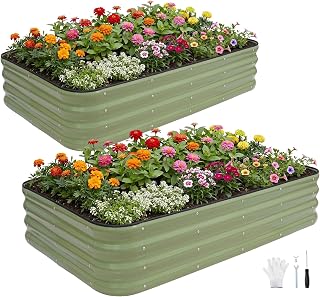
The Raised Beds for Garden, Set of 2 Galvanised Garden Planters Box Outdoor, 120x60x30cm Metal Raised Garden Bed for Vegetables, Fruits, Flowers solves a problem that catches many first-time raised bed buyers off guard: one bed is rarely enough once you start growing.
Getting two 120x60x30cm beds in one order makes immediate practical sense. You can dedicate one bed to brassicas and root crops on a rotation, and the other to salads and herbs that you harvest continuously. Or use both for the same crop type and double your yield. The 73 reviews at 4.5 stars suggest a solid if unspectacular product — the kind that reliably does what it says without surprising you in either direction.
The 120x60cm footprint is the same as several other picks here, which is worth noting: this is the sweet spot for single-person reach (you can work the centre of the bed from either long side) and standard garden proportion. At 30cm deep, the growing range is the same as other shallow beds — herbs, salads, onions, beetroot — but two of them gives you rotation flexibility that a single bed cannot offer.
Assembly tends to follow the standard tool-free panel-and-post approach. Buyers note that having two beds to assemble at once actually helps you understand the process faster — by the second one, you’ve figured out the corner post orientation and it goes together cleanly. The galvanised finish appears consistent across both units in each set, which isn’t always guaranteed with multi-unit value packs.
If your plan is to set up a proper kitchen garden patch with crop rotation from day one, buying this two-bed set rather than a single bed saves you the hassle of ordering a second unit mid-season when you realise you’ve run out of space.
Best Mid-Range Galvanised Bed with Safety Edging
The Galvanized Metal Raised Garden Bed Kit – 120x60x30CM Outdoor Planter Box with Safety Edging and Gloves for Vegetables, Fruits, Flowers stands out in this category for one specific reason: it ships with both safety edging on the top rim and a pair of gloves included in the box. This might sound like a minor detail, but if you’ve ever assembled a metal raised bed and discovered the hard way that the top edge is sharp enough to draw blood, you’ll understand why it matters.
The 120x60x30cm dimensions place this squarely in the standard footprint — practical for most gardens and patios, reachable from either side, and compatible with standard growing bags and fleece covers. The 4.6/5 rating from 43 reviewers indicates a reliable product that’s building a positive feedback base, though the review count is still growing. Early buyers highlight the safety edging as a genuine quality-of-life improvement over bare-edge alternatives.
The galvanised steel construction follows the corrugated panel design common to this category. What lifts it above pure budget options is the evident attention to user safety — the edging and included gloves suggest a manufacturer thinking about the assembly experience, not just the product shot. At 30cm deep, growing capacity is the same as other shallow-format beds: herbs, salads, strawberries, shallow-rooted vegetables.
The tradeoff is that 30cm depth limits you if you want to grow carrots or parsnips of any real length. And at 120x60cm, it’s a single-bed purchase — if you’re planning a larger kitchen garden, you’ll need to order multiples. But as a first raised bed that prioritises a safe, clean assembly experience, this is a considered choice that doesn’t cut corners where it matters most.
Best Wider Bed for Maximising Growing Space
The INNO STAGE Adjustable Raised Garden Bed, 150 x 90 x 30cm Metal Planter Boxes Outdoor for Growing Vegetables, Herbs, Flowers Steel Plant Raised offers a wider footprint than the standard 60cm beds that dominate this category, and that extra width changes how you can plant.
At 90cm wide, this bed allows a three-row planting pattern with more comfortable spacing between rows — useful if you’re growing larger plants like courgettes, kale, or climbing French beans with supports. The 150cm length gives a total growing area of 1.35 square metres, meaningfully more than the 0.72 square metres of a standard 120x60cm bed. INNO STAGE’s brand consistency is a positive signal — the same manufacturer appears in multiple listings in this guide, and their build quality has been validated across their product range by UK buyers.
The 38 reviews at 4.6 stars follow the brand’s usual pattern: positive, with particular praise for build quality and assembly clarity. At 30cm depth, this is a wide-format shallow bed — brilliant for maximising surface area growing, less suited to deep-rooting crops. If you’re growing a wide variety of salads, cut flowers, herbs, and compact vegetables, the extra width gives you more planting combinations than a narrow bed allows.
The practical consideration is reach: at 90cm wide, you can no longer comfortably reach the centre from a standing position on either side. Plan to kneel or use a kneeler pad, or position the bed against a wall or fence so you access it from one side only (which means placing it no more than 60cm from the access point). With that positioning thought through in advance, this is an excellent option for high-yield growing in a compact garden.
Best Premium British-Brand Raised Bed
The Harbour Housewares Raised Garden Bed – Anthracite – 180 x 90cm – Rectangle – Bottomless Metal Raised Bed Galvanised Steel Planter Box for Gr comes from one of the more recognisable garden furniture brands selling through Amazon UK, and that provenance shows in the finish and sizing.
The anthracite colour finish is the first thing you’ll notice — rather than the utilitarian silver-grey of bare galvanised steel, this bed presents a dark, powder-coated appearance that sits comfortably in a more designed garden setting. If your raised bed is going to be visible from the house, on a patio you care about aesthetically, or in a front garden, the colour choice matters. Anthracite is a practical choice too: it doesn’t show soil splatter the way lighter finishes do.
At 180x90cm, this is a large bed — the biggest single footprint in this roundup. The 292 reviews at 4.7 stars give this the strongest combination of review volume and rating outside the 8ft bed: that’s meaningful for a higher-priced, aesthetically focused product. UK buyers are clearly satisfied with both the look and the durability. The bottomless design allows root extension into the ground below and also means drainage is never an issue.
The tradeoffs are predictable for a premium pick: the larger footprint requires more growing medium to fill (calculate your cubic volume carefully before ordering compost), and the 90cm width brings the same reach consideration as the INNO STAGE wider bed above. The powder-coat finish, while attractive, needs to be checked annually for chips or scratches, particularly at the panel connection points — bare steel exposed through a chipped coating will eventually rust in UK conditions. Touch-up paint is widely available. If you’re setting up a permanent kitchen garden feature and want it to look considered rather than functional, this is the pick.
What to Look For When Buying a Raised Bed Kit
- Depth (and what you plan to grow): This is the single most important dimension. Thirty centimetres suits herbs, salads, strawberries, onions, and beetroot. Forty centimetres or more opens up courgettes, dwarf beans, and moderate-length carrots. If you want full-length carrots or parsnips, aim for 45cm minimum or supplement with deep-loosened soil below an open-base bed. Don’t buy a 30cm bed and expect to grow prize parsnips.
- Steel gauge and construction method: Thicker steel costs more but resists bowing under the weight of wet compost, particularly in longer beds (over 120cm). Corrugated panel designs add structural rigidity without requiring very thick gauge. For beds over 150cm long, look for listings that mention bracing rods or cross-supports — these prevent the classic “barrel bulge” that develops after the first winter.
- Edge treatment: The top rim of a metal raised bed can be genuinely sharp. Look for rolled edges, protective tape, or safety edging in the product description. If a listing makes no mention of edge treatment at all, read the reviews carefully — buyers will mention it if it’s an issue. Included gloves are a bonus for assembly but not a substitute for a properly finished edge.
- Galvanised vs powder-coated finish: Standard galvanised steel (silver-grey) is the most durable finish for UK conditions — the zinc coating protects the steel even if lightly scratched. Powder-coated finishes look better but require more maintenance; any chip in the coating needs prompt attention to prevent rust spreading underneath. Both can last many years with basic care.
- Base type — open or closed: Most raised bed kits are bottomless (open base), which is correct for placing on soil — roots extend down, drainage is natural, and worms can enter from below. If you’re placing on a hard surface like concrete or paving, you’ll need to either add a liner with drainage holes or accept that you’ll need to water more carefully to avoid waterlogging.
- Assembly method: Tool-free panel-and-post designs are the norm for this category and are genuinely easy for one person to manage in 15–30 minutes. Check whether the listing supplies corner posts, screws (if needed), and clear instructions — occasionally budget listings assume you have hardware that isn’t included.
- Footprint relative to your reach: A standard rule of thumb — don’t make a raised bed wider than 120cm (4ft) if you need to access it from both sides, or 60cm if you access it from one side only. Wider beds exist and work well, but factor in how you’ll actually reach the centre before ordering.
Verdict — Which Raised Bed Kit Should Most People Buy?
For the majority of UK gardeners setting up their first or second raised bed, the INNO STAGE Galvanized Raised Garden Bed Kits at 120x60x43cm is the pick we’d reach for first. The 43cm depth is the deciding factor: it’s the minimum for serious vegetable growing, it separates this bed from the cluster of 30cm options, and it gives you growing versatility that a shallower bed simply cannot match. The brand has a credible track record across its product range, assembly feedback is consistently positive, and the 120x60cm footprint works in almost any garden or larger patio.
If budget is the primary consideration, the two-bed set (B0G64H5NRV) gives you instant rotation capacity at a reasonable outlay, and rotation is genuinely important for avoiding soil-borne disease build-up. If aesthetics matter as much as function — if the bed is going in a visible, designed garden space — the Harbour Housewares anthracite option is the upgrade worth paying for. But for practical, capable, everyday growing? The INNO STAGE 43cm bed is where to start.
We were not paid to feature any specific product in this guide. All opinions are independent and based on publicly available specifications, verified buyer feedback patterns, and category research.
Quick Comparison Table




FAQ
What depth raised bed do I need for growing vegetables in the UK?
For most common vegetables — salads, herbs, onions, beetroot, and strawberries — 30cm of depth is sufficient, provided the bed has an open base allowing roots to extend into the soil below. For courgettes, dwarf beans, and carrots, aim for at least 40cm. If you’re placing the bed on concrete or paving with no access to natural soil below, add 10–15cm to whatever depth you’d normally need, to compensate for the root restriction.
Is galvanised steel safe for growing vegetables?
Galvanised steel is widely used for food-growing raised beds and is generally considered safe. The zinc coating that gives galvanised steel its corrosion resistance is not taken up by plants in meaningful quantities under normal conditions. Many professional market gardeners use galvanised beds routinely. If you’re concerned, you can line the interior with horticultural membrane (not plastic sheeting, which blocks drainage) before filling with soil.
Do I need to put anything in the base of a raised bed kit?
If the bed is going on soil, no base is needed — the bottomless design is intentional, allowing drainage, earthworm access, and root extension. If you’re placing on a hard surface like paving or concrete, lay a thick layer of coarse gravel or grit at the bottom for drainage before adding your growing medium. Without drainage provision on a hard surface, compost can become waterlogged and root rot follows quickly.
How do I stop the sides of my raised bed bowing outward?
Bowing (sometimes called “barrel bulge”) happens when wet, heavy compost exerts outward pressure on the sidewalls of a long bed. The best prevention is to choose a bed that includes cross-bracing rods, or to add your own using lengths of threaded rod with washers and nuts at each end, running across the width of the bed at soil level. For beds under 120cm long, bowing is rarely an issue with standard gauge steel. For beds 180cm or longer, cross-bracing is worth the extra step.
How long do galvanised steel raised beds last in the UK?
A well-made galvanised steel raised bed should last ten years or more in UK conditions, even through wet winters. The zinc coating corrodes slowly, and surface rust — which looks alarming but is actually superficial — can appear at cut edges or join points after a few years without compromising structural integrity. Powder-coated finishes can last similarly long if chips are touched up promptly. Avoid leaving the bed filled with standing water, which accelerates corrosion at the base.
Can I put a raised bed kit directly on paving or a deck?
Yes, but with two important adjustments. First, ensure drainage — add a layer of gravel or perlite at the base of the bed before your growing medium, and if possible drill a few drainage holes in any liner you use. Second, protect your surface — metal beds can mark or stain paving over time; placing rubber feet or strips of pond liner under the bed frame prevents direct contact. On a wooden deck, check weight loading before filling with soil, as a large filled bed can be surprisingly heavy.