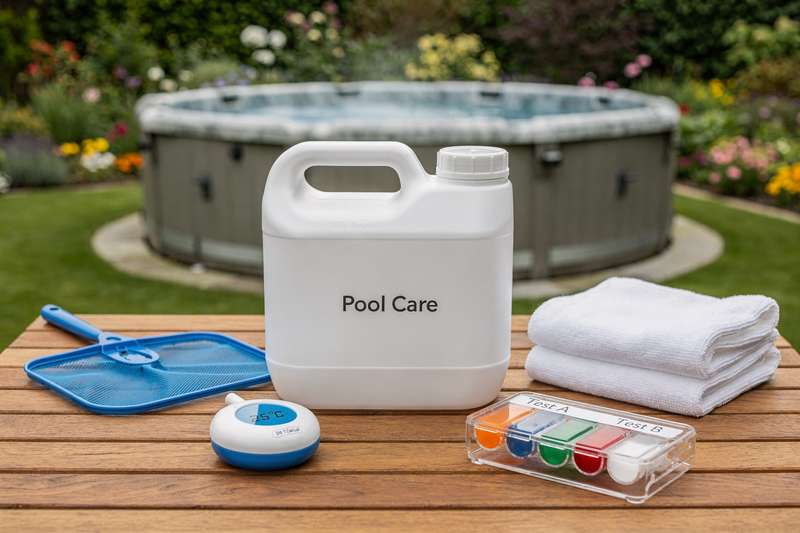
Picture this: it’s one of those rare British summer evenings where the temperature actually climbs above 20°C, your inflatable hot tub or above-ground pool is full and ready, and you’ve invited a few friends round. You dip a finger in the water and it’s a murky, slightly eye-stinging grey-green. You grab the bottle of chlorine granules sitting on the shed shelf — nearly empty, and you can’t quite remember if you added anything yesterday or three days ago. Sound familiar? For most UK pool and hot tub owners, the chemistry side of ownership is where the dream quietly unravels. The actual relaxation is brilliant; the guessing game around sanitiser levels, pH drift, and algae prevention is where the frustration piles up. You’ve probably already bought a few products that gave you confusing colour changes on the test strip, or granules that clumped and left white residue on the liner. This guide cuts through the noise and points you to the specific products that actually work — so you spend less time fussing over your water and more time in it.
How We Evaluated These Picks
Every product featured in this guide was assessed against a consistent set of criteria. First, real-world buyer feedback: where a product had verified reviews on Amazon UK, those were read carefully to identify recurring praise and recurring complaints, not just headline ratings. Second, format fit: whether the product’s format — granules, tablets, test strips — suits the UK market’s typical setup of inflatable or small above-ground pools and portable hot tubs. Third, ease of use: can a first-time owner apply it correctly without a chemistry degree? Fourth, coverage breadth: how many parameters does a test strip measure, and how accurate is the colour match under typical UK daylight conditions? Fifth, value per application: not price per unit, but cost-per-test or cost-per-treatment over a season. The result is a short, honest shortlist of the products worth putting in your trolley right now.
Best All-Round Test Strips for Daily Monitoring
The AQUASPARKLE 4-Way Test Strips sit at the top of this guide for one simple reason: they have the largest verified review count of any test strip in this category — over 900 reviews on Amazon UK — and they maintain a strong 4.6-star rating across that wide sample. That breadth of real-world feedback is far more reassuring than a perfect score from a handful of buyers.
AQUASPARKLE is a UK-focused pool and spa brand, and the 4-Way strips reflect that. They test for free chlorine, total bromine, pH, and total alkalinity — the four parameters you genuinely need to check every day when your hot tub or pool is in use. That’s the right scope for a daily dip-and-read routine: it covers sanitiser level so you know whether the water is safe, pH so you know whether the sanitiser is even working properly (chlorine becomes almost useless above pH 7.8), and alkalinity as the stabilising buffer that stops pH from bouncing around wildly.
In practice, users report the colour match is reliable under natural light, which is important because UK overcast conditions can make colour discrimination harder than manufacturers’ photos suggest. The strips react quickly — typically around 15 seconds — and the colour blocks are large enough to read without squinting. One consistent point of honest feedback from reviewers: like all paper-based test strips, these need to be kept dry and sealed between uses, and the tube should never be left open on a damp poolside surface. Keep them in the house, open the tube briefly, use one strip, reseal immediately. That one habit prevents the false readings that frustrate so many pool owners.
Where the 4-Way strips don’t go is into total hardness or cyanuric acid (stabiliser). If you’re running a pool that gets heavy use or you’re topping up with very hard water, you’ll eventually want a wider panel test. But for the everyday routine of a hot tub or small above-ground pool, four parameters is exactly what you need without visual overload. These are the strips to keep by the tub all season.
Best Budget Test Strips for Occasional Checks
If you only need to test your pool water a few times per week rather than daily, the Pool and Spa Test Strips 50 Counts offer a straightforward 3-in-1 panel covering free chlorine, total alkalinity, and pH, with 624 verified Amazon UK reviews backing a 4.1-star rating.
The 50-count format is the key detail here. If you’re only running a pool or hot tub for the eight-to-ten-week UK outdoor season, 50 strips is a practical quantity: you’re not left with a tube of 125 strips that have expired before next summer. The 3-way panel covers the essentials — you can always do a deeper test with a liquid kit or wider-panel strips if something looks off — making these a sensible low-cost starting point for first-time pool owners who want to build good testing habits without investing heavily until they know how often they’ll actually use the water.
The 4.1-star rating does reflect some inconsistency in colour accuracy at pH borderline readings, which is worth knowing. Most reviewers find the chlorine and alkalinity results dependable; pH colour differentiation in the 7.2–7.6 range can be a little ambiguous. For that reason, this product works well as a quick sanity-check strip rather than a precision tool. If you get an uncertain reading, a second test from a different strip in the same tube almost always clarifies it.
For households who maintain a small inflatable pool or hot tub and just need confidence that the water isn’t badly out of range before each use, this budget strip does the job cleanly. It’s not the deepest test available, but it’s the one you’re most likely to actually use consistently because it’s affordable enough to buy in multiples.
Best Wide-Panel Test Strips for Comprehensive Water Analysis
When your water keeps drifting or you suspect an underlying issue that a 3-way or 4-way strip can’t pinpoint, the 7-in-1 Hot Tub Test Strips, 175 Strips Pool Test Strips give you the broadest diagnostic picture available in a dip-strip format, earning 4.7 stars from 28 early reviewers — a very strong start for a newer listing.
With 175 strips and seven parameters per test, this product is genuinely aimed at owners who want to manage their water proactively rather than reactively. The seven parameters tested include chlorine, bromine, pH, alkalinity, and additional markers that help identify hardness and other chemical imbalances that basic strips miss entirely. If you’ve ever added chlorine correctly, maintained pH, and still watched your water cloud over, the missing variable is often a parameter your basic strips couldn’t see.
The 175-strip count is also worth flagging. Run a hot tub through a full season, testing daily, and you’ll easily burn through 60–80 strips. At 175, this pack covers a full season with strips to spare for next spring’s start-up checks. The higher per-pack investment reflects that volume — this sits in a mid-range tier — but the cost-per-test works out favourably against buying two or three smaller packs over the same period.
The honest caveat with a 28-review base is that the sample is still thin. The initial feedback pattern is positive, but any product with fewer than 100 reviews carries more uncertainty than one with 500+. That said, for experienced pool owners who know what seven parameters they’re looking for and want a single strip to cover them all, this is currently the strongest option in that segment among products available on Amazon UK. Keep an eye on the review count as it grows — confidence will only increase.
Best Test Strips for Hot Tub Specifics
The DIPSTIK Pool and Spa Test Strips take a slightly different approach to the usual strip format, and 335 reviews at 4.6 stars suggest that approach is landing well. These test for pH, total hardness, bromine, free chlorine, and total alkalinity — five parameters in a combination that’s particularly relevant for hot tub owners specifically.
The inclusion of total hardness is the differentiator here. Hard water is a significant issue across large parts of England, particularly in the South East and Midlands, and in a hot tub the consequences show up as calcium scaling on the shell, jets, and cover. If you live in a hard water area and you’re not monitoring hardness, you’ll eventually face a scaling problem that’s expensive to treat and impossible to ignore. Most basic strips skip hardness entirely; DIPSTIK includes it without overcomplicating the panel.
The bromine option also matters for indoor or covered hot tubs. Bromine is a more stable sanitiser than chlorine at higher temperatures and is less prone to the smell that chlorine can develop in an enclosed space. If you’ve switched from chlorine to bromine in your hot tub, having a strip that reads both sanitiser types accurately — rather than giving you a chlorine reading and expecting you to extrapolate — removes a genuine source of confusion.
Reviewers highlight that the colour blocks are well-separated and legible, which is an underrated quality in a test strip. Some cheaper strips cram the colour scale so tightly that distinguishing between a pH of 7.2 and 7.4 is genuinely difficult. DIPSTIK’s spacing makes the readings more decisive, which in turn makes treatment decisions less stressful. If you run a covered hot tub in a hard water area, these are the strips to reach for.
Best Chlorine Granules for Fast Water Treatment
Switching from test strips to the treatment side of the equation, the PristiClear Chlorine Granules 1kg stand out as the highest-rated sanitiser in this category, with 4.8 stars from 106 reviews — a combination that signals genuine product quality rather than a statistical anomaly.
Fast-dissolving granules are the most practical sanitiser format for UK pool and hot tub owners because they work quickly and can be dosed precisely without the guesswork that slow-dissolving tablets sometimes introduce. With granules, you measure the dose, add it directly to the water (or pre-dissolve in a small bucket if you’re cautious), and the product gets to work within minutes rather than hours. That responsiveness matters when you want to use the tub this evening rather than tomorrow.
PristiClear position this product as suitable for both hot tubs and swimming pools, which is accurate — the active compound is sodium dichloro-s-triazinetrione (a stabilised chlorine), effective across the temperature range you’d encounter in either a heated spa or an outdoor pool on a warm day. The 1kg pack is a sensible quantity for a season’s use in a typical 1,000–1,500 litre inflatable hot tub: large enough to be cost-effective, small enough that you’re not storing a huge quantity of oxidising chemical in the shed.
The honest consideration with any granular chlorine is storage. Granules are hygroscopic — they absorb moisture from the air — so the container must be sealed tightly between uses and stored somewhere cool and dry, away from any other pool chemicals. Mixing chlorine granules with other oxidising agents (like non-chlorine shock or algaecide concentrate) in a confined space is a safety risk. Keep them separate, store them correctly, and they’ll last a full season without degrading. Reviewers who mention long-term satisfaction consistently flag proper storage as the key variable.
Best Chlorine Tablets for Hands-Off Sanitisation
The Clearwater 1 kg Multifunction Chlorine Tablets take a different approach to the same sanitisation challenge: rather than adding granules manually every day or two, these slow-dissolving tablets sit in a floating dispenser or skimmer basket and release sanitiser gradually over several days. The 4-in-1 formulation covers sanitisation, stabilisation, algae prevention, and clarification in a single tablet — which reduces the number of separate products you need to manage.
This format suits owners who want a lower-maintenance routine. If you test your water every two or three days rather than daily, and you’re not dramatically changing bather load week to week, a tablet dispenser gives you a steadier baseline sanitiser level than sporadic granule dosing. The built-in stabiliser (cyanuric acid) is particularly useful for outdoor pools, where UV degradation would otherwise deplete chlorine rapidly in direct sunlight. Stabilised chlorine simply lasts longer outdoors.
The algaecide component is worth understanding correctly. Algaecide in a tablet doesn’t replace the need for shock treatment when algae is already present — it’s a preventive agent that discourages algae from establishing rather than a cure once you have a green pool. Use it consistently from the start of the season and you’ll likely never need it as a cure. Skip it for three weeks and then try to use it as a fix — that’s where people get disappointed.
One real-world consideration: slow-dissolving tablets are not suitable for direct placement in a hot tub shell without a dispenser. High-concentration chlorine sitting on the acrylic surface can cause bleaching or surface damage. Always use a proper floating dispenser and keep it moving, or use a dedicated skimmer basket if your pool has one. Used correctly, these tablets represent a genuinely convenient weekly-maintenance option for above-ground pools and larger garden pools through the summer.
What to Look For When Buying Pool and Hot Tub Supplies
- Test strip parameter count vs. your setup: A 3-way strip is sufficient for a small pool you check occasionally. A 7-way strip makes more sense for a heated hot tub running year-round, where hardness, stabiliser, and bromine levels all matter. Match the strip breadth to how intensively you manage your water — more parameters is only useful if you know what to do with the information.
- Granules vs. tablets for your routine: Granules give you faster, more precise control — dose what you need when you need it. Tablets are more hands-off but slower to respond when levels drop sharply. Many owners use tablets as the baseline and granules for shock dosing after heavy use or a rainy period. Running both formats isn’t overkill; it’s how most experienced pool owners operate.
- Sanitiser type — chlorine vs. bromine: Chlorine is the standard for outdoor pools and works well in lower-temperature water. Bromine is more stable at the higher temperatures typical of hot tubs (35–40°C), produces less noticeable odour, and handles pH fluctuations better. If you run a hot tub rather than a pool, consider whether your test strips and chemical regime are actually suited to a bromine system rather than defaulting to chlorine out of habit.
- Pack size and shelf life: UK pool season is short. A 1 kg tub of granules or a 150-strip pack is appropriate for a single season. Buying very large quantities — 5 kg drums, 500-strip packs — only makes sense if you’re running a pool year-round or managing multiple bodies of water. Chlorine degrades over time, and test strips have a shelf life; don’t over-buy just because the per-unit cost looks attractive.
- Storage requirements: All pool chemicals are reactive. Chlorine compounds must be stored separately from other oxidising agents, away from heat, damp, and direct sunlight. If you don’t have a dedicated, dry chemical storage space, factor that in before buying a large stock. A shed with temperature swings and occasional moisture ingress is not ideal — a sealed, ventilated external store is the right solution.
- UK water hardness: Hard water areas (much of England south of the Trent) require active hardness management in hot tubs. If your test strips don’t measure total hardness, you may be missing calcium build-up until it’s already scaled your jets and heater. Add a hardness-measuring strip or a liquid test kit to your routine if you’re in a known hard water postcode.
- Accuracy of test strip colour read: Test strips are only as useful as your ability to read them accurately. Check that the strip you buy has well-separated colour blocks and is designed to be read within a specific time window (usually 15–30 seconds). Reading too early or too late gives false results. Always compare colour against the chart in natural daylight, not artificial indoor lighting.
Verdict
For the majority of UK garden pool and hot tub owners — running an inflatable hot tub or a small above-ground pool through the British summer — the smartest starting point is a combination of reliable test strips and a quality granular chlorine. Among the strips in this guide, the AQUASPARKLE 4-Way Test Strips earn the recommendation for their wide, verified review base and the practical four-parameter panel that covers what matters most daily. On the treatment side, the PristiClear Chlorine Granules 1kg offer the highest-rated fast-dissolving option available with a meaningful review count behind them.
If you want to go deeper — particularly if you’re in a hard water area or running a bromine hot tub — the DIPSTIK strips add hardness monitoring at the same rating level. And if your pool runs all season and you prefer a hands-off tablet routine, the Clearwater Multifunction Tablets give you a set-and-check approach that suits lower-maintenance owners. Start with the AQUASPARKLE strips and PristiClear granules; add the others as your routine matures.
We were not paid to feature any specific product in this guide. All opinions are independent and based on publicly available specifications, verified buyer feedback patterns, and category research.
Quick Comparison Table


FAQ
How often should I test my hot tub or pool water?
For a hot tub in active use, testing daily is the standard recommendation — water chemistry in a small, heated body of water shifts quickly with bather load and temperature. For a larger outdoor pool used less intensively, testing every two to three days is typically sufficient. After heavy use, a rainstorm, or adding fresh water, always test immediately regardless of your normal schedule.
What is the ideal pH range for a pool or hot tub?
The target range is 7.2 to 7.6 for both pools and hot tubs. Below 7.2 the water becomes acidic enough to irritate eyes and corrode fittings; above 7.6 chlorine loses most of its sanitising effectiveness and scale begins to form more readily. pH in this range is the single most important parameter to maintain consistently — it governs whether everything else you add to the water actually does its job.
Can I use the same chlorine products in a pool and a hot tub?
Technically the same chemicals can be used in both, but the dosing and format need to match the application. Hot tubs have much smaller water volumes than pools (typically 1,000–1,500 litres vs. 10,000+ litres), so doses need to be scaled down carefully to avoid overdosing. Slow-dissolving tablets designed for large pool skimmer baskets can produce very high localised concentrations in a hot tub shell — granules or tablet dispensers sized for spas are safer in smaller volumes.
What causes cloudy water in a hot tub even after adding chlorine?
Cloudiness after dosing usually points to one of three issues: pH or alkalinity is out of range and preventing the chlorine from working properly, the water has high calcium hardness causing turbidity, or there’s a build-up of organic matter (body oils, lotions, sunscreen) that needs a non-chlorine shock oxidiser to break down. Test all parameters — not just chlorine — before adding more sanitiser, as over-dosing on chlorine rarely resolves cloudiness caused by hardness or pH problems.
How long do test strips last once opened?
Most test strips carry an expiry date on the packaging and are typically stable for 12 to 24 months from manufacture when stored correctly. Once opened, the critical factor is moisture — store the tube sealed, in a dry indoor location, and never touch the test pads with wet fingers. Strips left open on a poolside table in humid conditions can degrade within weeks and produce inaccurate readings, so the storage habit is as important as the expiry date.
Is bromine better than chlorine for a hot tub?
Bromine has genuine advantages in hot tubs specifically: it remains active at higher temperatures and higher pH levels, produces less of the sharp smell associated with chlorine in enclosed or covered spaces, and is gentler on skin and eyes at the temperatures used in a spa. The trade-off is that bromine is not reactivated by sunlight, so it’s less efficient in outdoor pools where UV exposure is constant. For a covered or indoor hot tub, bromine is often the better choice; for an outdoor garden pool, chlorine is the more cost-effective option.