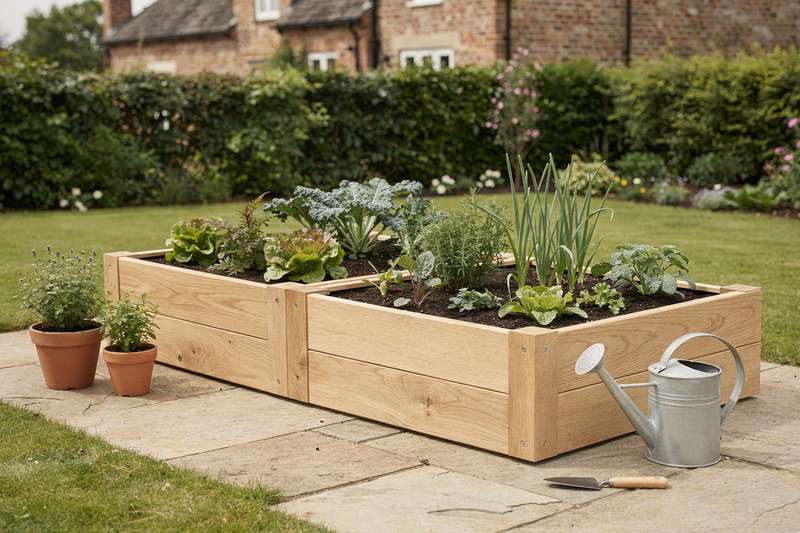
You know that patch at the back of your garden — the one that looks as though it should be producing courgettes and runner beans by July, but reliably yields nothing except waterlogged clay and a healthy slug population? Most British gardens come with at least one of these problem areas: heavy, compacted soil that drains badly after rain, a patch where the topsoil is thin and exhausted, or a paved courtyard where there is no workable ground at all. You have tried digging it over and incorporating bags of compost. You have tried pots, but they dry out in a single warm day and the compost turns hydrophobic by August. Someone on the allotment forum mentioned raised beds. Now you are staring at a screen trying to work out which raised bed is actually worth buying — one that will still look solid two winters from now, fit the space you have, and be deep enough to grow something more ambitious than cress.
The appeal of raised beds is entirely practical. You fill them with the right growing medium from scratch, they drain freely, and the soil warms up a full two or three weeks earlier in spring — which in a UK climate is the difference between harvesting in June or waiting until late July. But choosing the wrong bed means wobbly, bowing panels after the first wet season, a footprint too narrow for any useful crop rotation, or a depth too shallow for anything beyond salad leaves. Add to that the challenge of supporting climbing crops inside a raised bed — because a trellis designed for open ground tilts sideways in loose raised-bed growing mix — and the decision gets genuinely complicated.
This guide cuts through all of that. Five raised beds available right now on Amazon UK, selected for structural quality, practical dimensions, and real-buyer evidence across multiple growing seasons — with honest notes on integrating support structures for climbing crops once your bed is in place.
How These Picks Were Selected
Eight raised bed products from the current Amazon UK catalogue went through a systematic evaluation before this shortlist was confirmed. The first filter was material quality: the UK’s rain-heavy climate makes corrosion resistance non-negotiable. Hot-dip galvanised steel is the minimum acceptable standard; zinc-aluminium-magnesium alloy coatings offer improved longevity; powder-coated finishes add visual appeal but only matter if the underlying metal is properly protected. Any product without a clear specification of its coating method was treated with caution.
The second filter was depth. The most common mistake first-time buyers make is choosing a bed too shallow for the crops they want to grow. Root vegetables need 45cm or more; most fruiting crops need at least 30cm. I checked whether advertised depths matched what reviewers experienced in practice, and where they diverged I noted it. Third, I checked width against ergonomic reach — a bed wider than 120cm forces you to step inside, compacting the growing medium and eroding the key advantage of raised-bed cultivation. Beyond dimensions, I studied review patterns for structural failure modes, misleading specifications, assembly difficulty, and longevity reports from buyers who had used their bed across multiple growing seasons. Finally, I considered each bed’s compatibility with add-on climbing support structures.
Best Overall: Harbour Housewares Raised Garden Bed – Anthracite – 180 x 90cm
The Harbour Housewares Raised Garden Bed – Anthracite – 180 x 90cm sits at the top of this guide on the strength of its review profile: 4.7 stars from 318 verified buyers is an outstanding result for a garden product that UK customers are using through the full four-season cycle, including wet winters and the occasional dry summer. When a product holds that score across a sample of that size, it typically means the problems are minor and isolated rather than systematic.
The 180 x 90cm footprint is the sweet spot for most UK back gardens. Long enough to run a proper crop sequence — a row of climbing beans at one end, tomatoes in the middle, a salad strip at the other end — and at exactly 90cm wide you can reach the centre comfortably from both sides without stepping in. That matters considerably more than it sounds. Compacting the growing medium in a raised bed undoes its main advantage: loose, aerated soil that roots can move through freely and that drains quickly after heavy rain.
The anthracite colour is more than an aesthetic choice. Dark-coloured metal absorbs solar radiation and warms the growing medium faster in spring — in a UK climate, this can advance your first sowings by two to three weeks compared to an identical bed in light grey or silver. The tradeoff is worth knowing: in a very sheltered, south-facing spot during a hot summer, root zone temperatures in a dark bed can rise enough to stress heat-sensitive crops like lettuce or spinach. If your site is exposed and north-facing, the heat-absorption advantage is almost entirely positive.
This is a bottomless raised bed, which is the correct approach for most growing scenarios. Without a solid base, drainage happens naturally, earthworms can move up from the native soil below, and deep-rooting crops like tomatoes and squash can extend their roots below the frame when needed. If you are siting it on hard landscaping — paving, concrete, or decking — add a drainage layer of coarse gravel or broken crocks before filling, and place a weed-suppressing membrane between the gravel and your growing medium to prevent mixing over time.
Where the Harbour Housewares bed falls short: the galvanised steel walls, while solid at this price point, are not the premium zinc-aluminium-magnesium alloy you get on higher-spec beds, so ten-year longevity in a consistently wet spot is harder to guarantee. A handful of reviewers note the panels have a slight flex before the bed is filled — this largely resolves once soil pressure is applied from inside. Assembly is straightforward; most buyers report completing it solo in under 30 minutes. For adding climbing support, the bed’s rigid top rail gives you a clean surface for clamping trellis uprights or screwing bracket fittings directly to the frame. Note that other colourways and sizes exist within the Harbour Housewares range if anthracite or this footprint is not right for your space.
Best for First-Time Buyers: Outsunny Raised Beds for Garden, 180 x 90 x 59 cm, Light Grey
When you are setting up your first raised bed and you want the reassurance that comes from real evidence, the Outsunny Raised Beds for Garden, 180 x 90 x 59 cm, Light Grey is the most confidence-inspiring choice in this guide. Close to 500 UK buyers have reviewed it, and at 4.4 stars the consensus is clear: this bed does what it promises, at a realistic price for its size and construction quality.
The 59cm depth is the single most practically useful specification in this roundup. Most raised beds in this category sit at 30–45cm — adequate for salads, herbs, and most annual vegetables, but limiting for root vegetables. At 59cm you can build a proper three-layer soil profile: a drainage layer at the base, a nutrient-rich compost layer through the middle, and a finer topsoil and compost blend at the surface for germination and seedling establishment. Carrots, parsnips, and beetroot all become viable without stunting. The deeper soil mass also retains moisture more consistently through dry spells, and maintains a more stable temperature through cold nights — both meaningful benefits in a UK growing season.
Outsunny’s light grey powder-coat finish handles UV exposure without fading significantly, and several buyers specifically note the appearance holds up well after two or more years outdoors. The lighter colour keeps the bed slightly cooler than darker alternatives — an advantage if your site is south-facing and exposed, where a dark-coloured bed can overheat root zones during a warm summer spell.
The tradeoffs are real. At 180 x 90 x 59cm, this is a substantial structure — once filled with wet growing medium it is not going anywhere easily. If your garden layout is likely to change, or you are renting a property and might need to dismantle and relocate the bed, that permanence is worth thinking through before buying. Some reviewers note that the panel joints benefit from a small bead of exterior-grade silicone sealant in persistently wet conditions — a minor consideration at worst. Assembly is achievable solo, though a second pair of hands is more comfortable for the larger panels. The steel gauge holds its shape under the pressure of wet, heavy soil without bowing outward — a common failure mode in thinner-walled budget beds.
For climbing crop support, the 59cm wall height gives you a rigid anchor point well above ground level. A clamped or bolted upright attached to the top rail handles the weight of indeterminate tomatoes or a substantial cucumber crop without the flex you get when trying to drive stakes into loose growing mix.
Best for Maximum Growing Space: Raised Beds for Garden, Galvanized Planter, 8X4X1 FT Black
The Raised Beds for Garden, Galvanized Planter, 8X4X1 FT Black offers the largest usable surface area in this guide — eight feet long by four feet wide (approximately 244 x 122cm) — which translates into serious growing capacity. If you are planning to produce a meaningful quantity of food rather than a token patch, this footprint lets you run a proper crop rotation: brassicas at one end, climbing legumes at the other, a permanent strip of herbs along one long edge, and still have room for a succession of salad leaves through the middle.
The four-foot (approximately 122cm) width does push at the ergonomic limits of comfortable access from either side. The standard guidance of 60cm per-side reach means you are stretching slightly at the very centre when working from a standing position. This is manageable for most adults, particularly with a low kneeler positioned alongside. If you are setting up the bed for someone with limited reach or reduced mobility, a narrower option would serve better — a 6X3X1 FT variant exists within the same product range for tighter spaces.
The black powder-coated finish over a galvanised substrate gives both solid corrosion protection and a clean, contemporary aesthetic that suits decked surfaces and modern garden design. The dark colour absorbs heat effectively — a practical growing advantage in the UK, where earlier soil warming in spring is one of the most useful things you can give crops. In a sheltered south-facing spot during a warm summer, monitor heat-sensitive crops like lettuce and spinach for signs of bolting from an overheated root zone.
The most important specification to understand is the 1 FT (approximately 30cm) depth — the shallowest in this roundup. At 30cm you have comfortable room for herbs, salads, strawberries, dwarf beans, and most annual vegetables, but long-rooted crops like maincrop carrots and parsnips will be constrained. The key exception: if this bed is installed directly over garden soil, plant roots will push through the open base into native earth below, giving effectively unlimited depth for deep-rooting crops. On concrete or paving, stick to shallower-rooted crops or be prepared to fill with a substantial volume of quality growing medium.
For support structures at this scale, the long walls are an asset. A full-width trellis panel fastened along the north interior wall would support a serious run of climbing French beans or cucumbers, and two arch hoops spanning the 122cm width would work well for tunnel-style growing. With 182 reviews at 4.4 stars, buyers consistently report the panels arrive in good condition and the black finish holds up through UK winters without significant rust appearing in the first couple of seasons.
Best Compact Choice: YITAHOME Raised Garden Bed 120x58x46cm
The YITAHOME Raised Garden Bed 120x58x46cm is the practical choice for smaller UK gardens, courtyard spaces, or situations where you want a compact bed that does not dominate the available area. At 120cm long and 58cm wide, it fits well across the end of a narrow garden strip, against a fence, or in a corner where a larger bed simply would not work.
The 58cm width is one of this bed’s quiet strengths. You can reach across the full 58cm comfortably from a standing position on one side, which means you can manage the entire surface without ever stepping in. That matters because stepping inside a raised bed compacts the loose, aerated growing structure you have built up. A bed you can work entirely from the outside retains that structure across multiple seasons, and you will spend noticeably less time forking and aerating the growing medium each spring.
At 46cm deep, this bed covers most common vegetables adequately. You will not grow exhibition-length parsnips in 46cm of growing medium, but tomatoes, courgettes, dwarf and climbing beans (with appropriate support), herbs, most brassicas, and salads are all well within range — particularly if the bed is positioned over garden soil so roots can extend below the frame. The compact footprint also keeps material costs down: filling a 120x58x46cm bed requires considerably less growing medium than a 180x90x60cm bed, which matters when quality compost is not cheap.
The honest caveat here is the review dataset. At 27 reviews and 4.2 stars, this is a thinner evidence base than the Outsunny or Harbour Housewares options. A 4.2-star average is a solid score, but with 27 reviews you have less statistical confidence in the long-term durability picture. The existing reviews praise build quality and assembly straightforwardness, with no consistent reports of structural problems — but a product with a shorter track record simply has less evidence to draw on. If this is your first raised bed and maximum certainty matters, the higher-reviewed options in this guide are safer bets. If you are adding a secondary bed to a larger plot, or testing raised-bed growing in a new spot before committing to something bigger, this YITAHOME is correctly proportioned and genuinely useful for the job.
For support structures, the compact 58cm width suits a small A-frame trellis straddled across the bed — ideal for climbing peas and dwarf beans without overwhelming the bed’s proportions. Clamp the frame legs to the top rail rather than pressing them into the growing medium, and the structure will remain stable through a full fruiting season.
Best Two-Pack Kit: YITAHOME 2Pcs Outdoor Raised Garden Bed Kit 180x90x60cm
The YITAHOME 2Pcs Outdoor Raised Garden Bed Kit 180x90x60cm is the most distinctive product in this guide: a kit that delivers two full-sized raised beds — each 180 x 90 x 60cm — along with support structure components, in a single order. If you are setting up a kitchen garden from scratch and want two growing areas alongside climbing support for beans, tomatoes, or cucumbers from the outset, this is the only product in this lineup that combines those elements.
The 60cm growing depth is among the deepest in this roundup and gives you room for a proper three-layer growing profile, serious root vegetable production, and the thermal mass to buffer against late cold snaps. YITAHOME describe the metal panels as using a thickened zinc-aluminium-magnesium alloy coating — a step up in corrosion protection from standard galvanised steel. Where plain galvanising relies on a zinc layer that does not self-repair when damaged, ZAM alloy coatings form a denser, more stable barrier, which should translate to improved longevity in persistently wet UK conditions.
The support structure components included in the kit are designed to work with the bed frames directly, which addresses one of the more persistent raised-bed gardening problems: how to anchor vertical supports without relying on loose growing mix to hold posts in place. Structures that connect to the rigid metal frame handle the lateral loads of fruiting vines far more reliably than anything driven into aerated soil. Check the full product listing and images carefully before ordering to confirm exactly what support components are included — the product title is truncated at that point, so verifying what is in the box before buying is worthwhile.
The honest conversation about this product is its review profile. At 3.8 stars from 35 reviews, this is the lowest-rated and least-reviewed option in this guide. A 3.8-star average suggests that while the majority of buyers are satisfied, a meaningful minority have encountered real problems — assembly complexity features in critical reviews, along with occasional comments about component consistency. That is not a reason to rule it out, but it is a reason to approach with adjusted expectations: plan a longer assembly session, check every component against the parts list as you unpack, and do not rush the frame connections. For gardeners who specifically want two beds and integrated climbing support in a single order, this kit is the most direct route to that setup — but if consistent build quality and a proven track record are the priority, the Harbour Housewares or Outsunny beds above are the safer choices.
What to Look For When Buying a Raised Garden Bed
- Material and corrosion protection: In the UK’s persistent damp, this is the most important specification. Hot-dip galvanised steel is the acceptable minimum; zinc-aluminium-magnesium alloy coatings offer meaningfully better longevity. Powder-coat finishes add visual appeal but do not substitute for good underlying metal treatment. If a product does not specify its coating method clearly, treat that as a warning sign and investigate before buying.
- Depth matched to your crops: Herbs, salads, and strawberries are comfortable in 20–25cm. Most common vegetables — tomatoes, beans, courgettes, brassicas — need 30–45cm of growing medium. Root vegetables and anything you are growing seriously long-term benefit from 45cm or deeper. A bottomless bed over garden soil gives roots unlimited depth below the frame; a bed on a hard surface makes the wall height the absolute limit.
- Width and ergonomic access: The practical maximum for comfortable access from both sides is 120cm. If you can only access from one side — against a wall or fence — keep it to 60cm. A bed you can manage entirely from the outside maintains its loose soil structure indefinitely; one you step into regularly compacts over time. For anyone with reduced mobility or limited reach, narrower is always more manageable.
- Panel fit and assembly quality: Check reviews specifically for comments on panel alignment and joint tightness. Poorly fitting panels create gaps that lose soil and allow pests in. Reviews from buyers who describe themselves as not particularly confident with DIY are often more informative about real assembly difficulty than those from experienced gardeners who find it straightforward regardless.
- Support structure compatibility: If climbing crops are part of your plan — tomatoes, cucumbers, climbing beans, squash — choose a bed with a robust frame to which you can attach support uprights. A rigid metal top rail that accepts clamp fittings or bracket screws is far more reliable than driving posts into loose growing medium. The key principle: the support anchors to the frame, not the soil.
- Drainage design: All five beds in this guide are bottomless, which is the right choice for beds installed over soil. On hard surfaces, plan your drainage layer before filling — at least 10cm of gravel or drainage aggregate below the growing medium, with a membrane between the layers to prevent mixing over time. Beds with sealed solid bases need dedicated drainage holes and are generally less well suited to permanent outdoor installation in UK conditions.
- Advertised versus actual dimensions: A recurring theme in critical reviews across the raised bed category is discrepancy between listed size and what arrives. If precise dimensions matter to your installation — fitting a specific gap, aligning with an existing bed, or allowing a defined access path alongside — cross-check the listed measurements against buyer photos and critical reviews before ordering.
Verdict
For most UK gardeners starting with a first raised bed, or replacing an existing one, the Harbour Housewares Raised Garden Bed – Anthracite – 180 x 90cm is the most straightforward recommendation. Its 4.7-star rating from over 300 verified buyers represents consistent satisfaction across real growing conditions; the 180 x 90cm footprint gives you a proper crop rotation rather than a token patch; and the anthracite colour provides a practical heat-absorption benefit across the UK growing season. It is the bed in this guide that requires the least adjustment to work well from the start.
If review volume is your primary measure of confidence, or you specifically plan to grow root vegetables, the Outsunny Raised Beds for Garden, 180 x 90 x 59 cm, Light Grey is a strong alternative — close to 500 reviews at 4.4 stars, with the deepest growing column in this roundup at 59cm. For a compact or secondary bed in a smaller space, the YITAHOME 120x58x46cm is correctly proportioned and manageable solo. For sheer surface area on a larger plot, the 8X4X1 FT black galvanised planter gives you the most room to grow. And for anyone starting two beds simultaneously with climbing support included from day one, the YITAHOME two-pack kit is the most direct route — provided you go in with realistic expectations about assembly time and build consistency.
We were not paid to feature any specific product in this guide. All opinions are independent and based on publicly available specifications, verified buyer feedback patterns, and category research.
Quick Comparison Table


FAQ
How deep should a raised garden bed be for growing vegetables?
For most common vegetables — tomatoes, courgettes, beans, and brassicas — a minimum of 30cm of growing medium is the practical baseline. Root vegetables like carrots and parsnips benefit significantly from 45cm or more, and a 60cm deep bed gives you the greatest flexibility across all crop types. If your bed is installed directly over garden soil, roots will extend below the frame, making a shallower bed workable for deeper-rooting crops. On a hard surface, the wall depth is the absolute limit, so depth becomes more important to get right before you buy.
What is the best width for a raised garden bed?
The ergonomic rule is a maximum of 120cm if you can access both sides, or 60cm if access is from one side only. The aim is to avoid stepping inside the bed, which compacts the growing medium and erodes the loose, aerated soil structure that makes raised-bed growing effective. Many gardeners find 90cm ideal when both sides are accessible — close enough to reach the centre easily, wide enough to run two or three crop rows side by side.
Can I install a raised garden bed on concrete or paving?
Yes — bottomless metal raised beds work well on hard surfaces as long as you manage drainage deliberately. Add a layer of coarse gravel or broken crocks (at least 10cm) at the base before filling, and place a weed-suppressing membrane between the drainage layer and your growing medium to prevent them mixing over time. Without natural drainage below, waterlogging becomes a greater risk, so a deeper drainage layer is more important here than it would be over garden soil.
How do I keep a trellis or support structure stable inside a raised bed?
The core problem is that raised-bed growing mix is loose and airy — ideal for roots, but it provides almost no grip for vertical posts. The reliable fix is to fasten trellis uprights to the bed’s metal walls directly, using clamp fittings, conduit brackets, or bolted corner pieces, rather than relying on soil compression to hold them. Once the upright is secured to the rigid frame, it handles the weight of fruiting vines — cucumbers, beans, indeterminate tomatoes — without tilting. Set your supports before adding the final few centimetres of growing medium, so you avoid disturbing established roots later in the season.
Do metal raised beds rust, and how long do they last?
Properly galvanised steel raised beds typically last five to ten years in UK outdoor conditions before rust becomes a structural concern, though this varies considerably with site conditions — a bed in a sheltered, free-draining spot will outlast one in a persistently wet and shaded corner. Beds with zinc-aluminium-magnesium alloy coatings offer better long-term protection than standard galvanised steel. To extend the life of any metal bed, check the lower edges each spring where moisture accumulates, and touch up any chips in the powder-coat finish before they spread inward to the bare metal.
What should I fill a raised garden bed with?
A reliable general-purpose fill combines topsoil, garden compost, and a coarse drainage material such as perlite or horticultural grit — roughly equal thirds by volume. Avoid filling entirely with bagged multipurpose compost, which can compact into a dense, hydrophobic mass when wet. For deeper beds (45cm or more), a layered approach works well: bulk up the lower third with coarse organic material like wood chip or inverted turf sections, then add your topsoil and compost blend above. Top up with fresh compost each autumn to replace the nutrients used over the growing season.