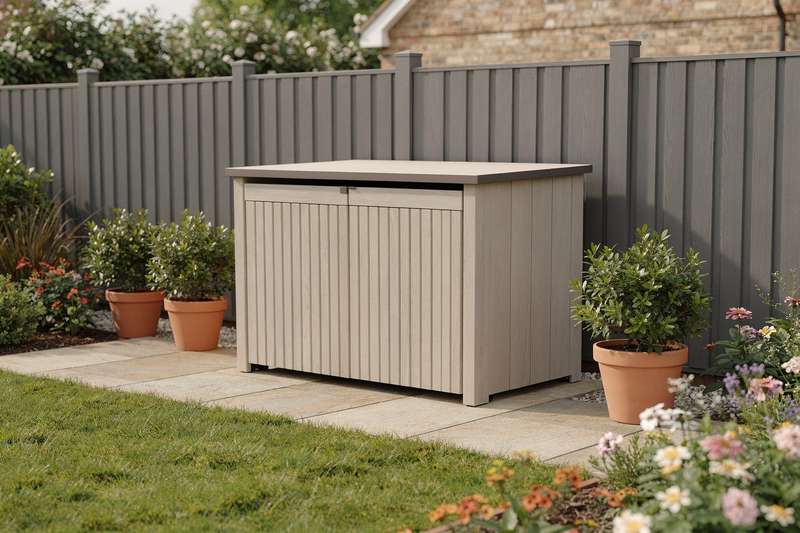
Your front garden is the first thing visitors and neighbours see. You’ve put effort into the borders, maybe added a trellis or a couple of well-chosen planters. Then there are the bins — three of them, in varying shades of council-issue grey, green, and blue, hunched against the side return with a torn liner draped across the nearest lid. The fox has been at it again. The recycling bin still has last week’s flattened cardboard box sticking out at an angle because someone in the household couldn’t quite be bothered to push it down. On collection morning you drag them all to the kerb, and for the remaining six days they just sit there, undoing every bit of gardening effort you’ve managed to put in.
You’ve tried angling a fence panel in front of them. You’ve wedged a large planter between the gate post and the nearest bin. You’ve looked at those rope-tied bundle screens and quickly moved on. What you actually want is a proper wheelie bin hideaway — something purpose-built that conceals the bins, keeps foxes and gulls out, survives British weather without warping or corroding into an eyesore of its own, and is easy enough to open on collection morning when you’re still half-asleep with a bin bag in each hand.
This guide cuts through the noise. Whether you need to hide one bin or three, prefer natural timber or a low-maintenance metal solution, the picks below cover the realistic options currently available on Amazon UK — with honest assessments of where each one succeeds and where it falls short.
How These Picks Were Chosen
Shortlisting these wheelie bin hideaways involved a consistent set of criteria. First: compatibility with the standard UK 240L wheelie bin, the size issued by the vast majority of English, Welsh, and Scottish councils. Beyond that, each unit was assessed on how many bins it accommodates, material durability under a damp temperate climate with seasonal wind and UV exposure, the practicality of access on collection day, and whether the design includes lockable doors or a secured lid to deter wildlife.
Where a product carries a meaningful number of verified buyer reviews, those patterns were examined — particularly around assembly experience, first-winter performance, and whether stated dimensions match real-world fit. For products with very limited review data, that limitation is flagged clearly and specification analysis fills the gap, so you can weigh the risk accordingly. No product with zero reviews is included in this guide.
Best for Most UK Households: Olsen & Smith 1170L XL Wheelie Bin Storage Shed
The Olsen & Smith 1170L XL Wheelie Bin Storage Shed & Outdoor Garden Box is the most widely reviewed wheelie bin hideaway in this guide, with over 500 verified buyers sharing their experience. That breadth of feedback settles at 3.9 out of 5 — which, in the context of large flat-pack outdoor storage where assembly frustrations can pull ratings downward, represents a solid real-world endorsement. When more than 500 people have bought and reviewed the same product, you’re not relying on a handful of satisfied early adopters; you’re seeing a pattern.
The 1170L capacity indicates a generously proportioned unit. It’s positioned as an XL storage shed suitable for wheelie bins alongside broader outdoor storage — gardening gloves, a small composter lid, windscreen wash — making it versatile for households that want to tidy an entire side-return area rather than simply screen a couple of bins. If your garden has a reasonably wide side passage, this can serve as a multi-purpose outdoor tidy rather than a single-function bin screen.
Buyers consistently highlight the overall size and the tidying effect on a cluttered driveway corner. Where feedback diverges is on assembly: some owners describe a smooth build with clear instructions, while others note the process takes longer than anticipated and benefits significantly from a second pair of hands. This is fairly typical for flat-pack outdoor storage at this scale. The key is to square up the frame carefully before tightening any fasteners — rushing that step is the most common cause of panels sitting slightly out of true. Allow yourself a clear couple of hours and rope in someone to hold panels upright while you work.
Before ordering, check the internal bay width and depth against your actual council-issued bins. Most standard 240L bins are around 58cm wide and 74cm deep, but different contractors supply bins with slightly different body dimensions, and a 5cm discrepancy can prevent the bin from wheeling in cleanly. If your authority issues slightly oversized containers, or you’re trying to accommodate a 360L commercial bin, measure carefully first.
For most households managing two or three bins and wanting a unit backed by a substantial body of real-world experience, this Olsen & Smith model is the sensible starting point. The review volume alone provides meaningful confidence that what you see in the listing photographs reflects what arrives at your door.
Best Metal Hideaway for Two Bins: Olsen & Smith 1490L 3x5ft Metal Wheelie Bin Storage Shed
If your priority is a structured, metal-built enclosure designed specifically around two standard 240L wheelie bins, the Olsen & Smith 1490L 3x5ft Metal Wheelie Bin Storage Shed for 2x 240L Bins is worth a close look. With 98 reviews averaging 4.0 stars, it has earned a quieter but consistent reputation — particularly among buyers who specifically wanted a rigid, weather-hardy enclosure rather than a timber-clad or resin alternative.
The 3x5ft footprint makes the ground plan easier to picture than volume figures alone. This is a compact but functional shed-style hideaway built with two standard 240L bins explicitly in mind. Metal construction holds its shape through wet winters without the warping or swelling risk that affects timber in sustained damp. Once properly anchored, metal sheds also tend to be more wind-stable than lighter designs — useful if your bin storage area sits at the end of a narrow side passage that channels a draught.
The 4.0 rating across nearly 100 reviews suggests buyers are broadly satisfied after the initial assembly hurdle. Metal shed assembly is typically more involved than timber-framed units because the panels are heavier and the fastening sequence matters more for structural alignment. Working on a flat, level surface and having someone hold panels upright while you secure them will make the process considerably less frustrating. Several reviewers note that the instructions could be clearer — working from the product images alongside any written steps helps fill in the gaps.
Where metal wins against timber is longevity with minimal ongoing maintenance. There’s no annual re-sealing or re-treating required; a wipe-down after a muddy winter is usually sufficient. The trade-off is aesthetic: metal bin stores have a more utilitarian look than a natural timber unit. If your garden leans towards a cottage-style scheme with planting and a timber fence, the metal finish can be harder to integrate. In a contemporary garden with clean lines and a minimal design, it fits considerably more naturally.
This model also suits households where the bin area doubles as a spot for a small lawnmower or garden tools — the 1490L capacity allows some flexibility beyond the bins themselves. For those who want a robust, low-maintenance enclosure with genuine staying power across multiple seasons, this is one of the stronger arguments in the current market for dual-bin households.
Best Traditional Timber Store: Triple Wooden Wheelie Bin Store
The Triple Wooden Wheelie Bin Store Outdoor Garden Lockable Latched Dustbin Cover Storage Wood Timber Shed Unit Hinged Lid offers the classic British garden bin store aesthetic — pressure-treated timber boarding, a hinged lid, and lockable latches on the front — backed by 87 reviews at a 4.0 rating. That’s a meaningful body of evidence, and the pattern in buyer feedback is consistent: households wanting a traditional-looking unit that blends with a timber fence or wooden garden building tend to come away pleased.
The triple configuration houses three wheelie bins side by side, which is increasingly relevant for UK households as councils add further bin streams — food waste, garden waste, a small recycling caddy. Having all three containers neatly enclosed in a single unit makes collection morning considerably more organised, and the lockable latches mean wildlife can’t redistribute your recycling overnight. If you currently have bins scattered across a driveway corner, the difference a triple store makes to the look of the space is substantial.
The hinged lid on this unit deserves attention. Rather than front-opening doors only, the lid lifts to let you drop waste directly into the bins during the week — so you’re not unlatching the full front panel every time you take the recycling out. When collection day comes, the front opens to let you wheel the bins to the kerb. This two-mode access approach works well for both daily use and weekly collection. A number of buyers note that the lid hinges benefit from a spray of lubricant after the first winter to keep them moving freely — a minor maintenance point worth building into your routine.
Being a timber unit, factor in the annual maintenance overhead. Pressure-treated wood handles sustained damp considerably better than untreated alternatives, but a yearly coat of exterior wood preserver or decking oil — particularly on the roof boards, base rail, and any end-grain cuts — will meaningfully extend the unit’s lifespan. This is the honest trade-off against a metal or resin unit: more attention needed, but the aesthetic return is considerable. A wooden triple bin store against a feather-edge fence looks intentional. A metal shed in the same position serves its function, but rarely looks designed.
Assembly feedback suggests this is a manageable afternoon project for two people, with lid hinge alignment being the step worth taking slowly. For households that need to conceal three bins and want a result that looks like it belongs in the garden rather than in front of it, this triple timber store is the most evidence-backed wooden option currently available in this guide.
Best Premium Aluminium Option: Premium Alumnium Triple Wheelie Bin Store
The Premium Alumnium Triple wheelie Bin Store 110L-240L sits at the low-maintenance end of the market, offering triple-bin capacity in an aluminium-framed construction. With five reviews currently averaging 5.0 stars, the sample size is small enough that you should treat this as indicative rather than definitive — five households don’t represent a statistically reliable picture. That said, all five are positive, and the material rationale is sound regardless of review count.
Aluminium is a compelling material for a bin store you want to forget about after installation. Unlike steel, it doesn’t rust. Unlike timber, it doesn’t warp, swell, or need annual re-treating. Unlike resin, it doesn’t discolour to a patchy cream-grey after three summers of UV exposure. An aluminium enclosure in a damp British side passage can sit through several winters and emerge structurally unaffected. The ongoing maintenance is essentially zero — hose it down if it gets grimy, and you’re done. If you’ve bought a timber outdoor unit before and watched it deteriorate beyond its useful life within five or six years, that longevity argument is tangible.
The 110L–240L compatibility range is a practical detail: this unit accommodates both the smaller 140L or 180L bins some councils issue for flats and smaller properties, as well as standard 240L containers. If your household manages a mix of bin sizes — a smaller food waste caddy alongside two recycling bins — the flexibility is useful, and you won’t be trying to force undersized or oversized containers into bays designed around a single standard.
The premium build comes with a higher price point, and the honest trade-off is financial rather than practical. If budget is a primary consideration, the timber or metal alternatives in this guide offer real value at a lower outlay. Where aluminium justifies the investment is in long-term cost-of-ownership thinking: no maintenance materials, no repainting, no replacement in five years because the base has rotted. For a north-facing, persistently damp, or fully exposed position, aluminium is the material to reach for.
Given the limited review base, check current buyer feedback at the point of purchase. If the review count has grown and the average remains strongly positive, confidence in this pick rises accordingly. The fundamental material logic is solid, and the product is well-positioned for the quality-focused buyer — but with five data points currently, you’re relying on material knowledge more than accumulated field evidence.
Best for a Natural Wood Look: Deluxe 3-Bay Wooden Wheelie Bin Storage
The Deluxe 3-Bay Wooden Wheelie Bin Storage, Fits 3 x 240L Bins, Natural Wood Bin Hide with Hydraulic Arms & Lockable Doors, 196x85x127cm is the most specification-forward wooden entry in this guide. On paper, it reads impressively: hydraulic arms — the gas-strut mechanism that holds the lid open without requiring you to prop it manually — are a detail typically associated with premium garden buildings rather than standard bin stores. Add lockable doors, three-bay capacity for standard 240L bins, and a 196x85x127cm footprint, and the spec sheet makes a strong case.
The caveat is substantial and worth stating plainly. At the time of writing, this product has only three reviews averaging 2.8 stars. That is a very limited evidence base, and the below-midpoint rating suggests at least one buyer had a significantly below-expectation experience. Whether that reflects an isolated assembly issue, a quality-control inconsistency, or a more fundamental problem is impossible to determine from three data points. You are making a purchasing decision primarily on the specification sheet rather than accumulated real-world evidence.
What the spec suggests is a product designed for buyers who want a statement piece — a bin store that looks deliberate and considered rather than merely functional. Natural wood cladding with gas-strut lid support is a credible aesthetic proposition, and the stated dimensions indicate this unit would comfortably house three standard 240L bins without crowding. The lockable door mechanism adds meaningful security in areas with persistent fox activity or where bins sit in a shared passageway.
A grey-finish variant of the same product line is available under a separate listing, but it carries an even lower rating with fewer reviews, so neither colour has a clearly stronger track record. If you’re drawn to this product for its hydraulic arm feature and natural wood aesthetic, the pragmatic approach is to check current reviews at the point of purchase. If more feedback has accumulated and the average has improved, confidence rises. If the review count remains thin, the triple timber store reviewed earlier in this guide — 87 reviews at 4.0 — is a lower-risk route to comparable functionality.
This pick is included specifically for buyers who need the gas-strut lid feature and want a natural wood aesthetic. The hydraulic arm is genuinely useful for hands-free lid operation, and if you use the store daily, you’ll notice its absence on units without it. However, the limited and below-average review history means this is a product to approach with caution rather than confidence — checking updated feedback before purchasing is more important here than for any other pick in this guide.
Best with Individual Bay Access: Wooden Wheelie Bin Storage Triple Green
The Wooden Wheelie Bin Storage – Triple Doors with Individual Opening and Top with Separate Lock – Bin Not Included (Triple Door, Green) takes a different approach to access from most triple bin stores. Rather than a single hinged lid spanning the full width or a pair of front doors exposing all three bays simultaneously, this unit features individual front doors for each bay plus a separately lockable top section. On collection day, you open only the door for the specific bin you need — which can be useful in a narrow side passage where full-width door swing would obstruct the path.
The green finish is a colour option rarely seen across this product category, where charcoal, grey, and natural timber tones dominate. For gardens with substantial green planting, established hedgerows, or a dark fence backdrop, a green-finished unit can recede into the surroundings more convincingly than a natural wood or anthracite alternative. The colour choice can affect how much the unit draws the eye from across the garden — which is, after all, the whole point of a bin hideaway.
The caveat here demands the same directness as the previous pick: two reviews averaging 2.9 stars is not meaningful evidence. At this sample size, a single disappointed buyer moves the average significantly. You are buying primarily on the basis of the product concept rather than confirmed buyer experience, and that involves accepting a degree of uncertainty the more heavily-reviewed picks in this guide do not carry.
Practically, individual bay doors add complexity to the door furniture — more hinges, more latching points across the full width of a triple unit. Any flat-pack timber unit with multiple independent moving parts requires careful alignment during assembly. If the hinge positioning is slightly off, individual doors can catch or refuse to close cleanly in a way that a single-span lid or a shared-door design doesn’t. This isn’t a design flaw, but it does mean the assembly stage is one where patience and precision pay off more than usual.
This pick is included for buyers who specifically value the individual-bay access approach, or who need a green finish to integrate with a particular garden scheme and can’t achieve that match elsewhere. If neither feature is genuinely decisive for your situation, the triple timber store with 87 reviews and a 4.0 rating covers the same functional brief with far more purchase evidence behind it.
What to Look for in a Wheelie Bin Hideaway
- Internal bay dimensions vs your actual bins. Most products claim “240L compatibility” as though all 240L bins are identical — they are not. Different council contractors supply bins with slightly different body widths and heights. Measure your bins before ordering and compare those figures against the unit’s stated internal bay dimensions (not the external footprint). A 5cm discrepancy can prevent the bin from wheeling in cleanly.
- Number of bays. UK households increasingly manage three or four separate bin streams — general waste, recycling, food waste, garden waste. A single-bay hideaway that conceals one bin leaves the others exposed. A triple-bay unit future-proofs you if your council introduces an additional collection stream.
- Material and weather resistance. Pressure-treated timber blends into most garden styles but needs an annual coat of exterior preserver. Powder-coated steel is lower maintenance but needs a rust check after the first few winters. Aluminium will not rust and needs no treating. Resin is maintenance-free but can discolour with sustained UV. Choose based on how much ongoing attention you are actually willing to give.
- Lid or door design and access. Lift-up lids let you deposit waste daily without opening the full front; front doors make it easier to wheel bins out on collection day. The best designs combine both. Gas struts or hydraulic arms hold the lid open hands-free — a practical advantage when you are carrying two bin bags and need both hands.
- Security and wildlife deterrence. If foxes, gulls, or seagulls are regular visitors, a positive-action latch — one requiring deliberate pressure to release — is significantly more effective than a magnetic or simple press-fit closure. Check whether the lock is integrated or whether you need to source a padlock separately.
- Ground anchoring provision. A large bin store in a wind-exposed position can act as a sail. Look for units that include anchor points or fixing plates in the base frame. If not included, ground stakes driven through the base frame or L-bracket fixings into a paved surface are practical alternatives. This is an often-overlooked detail that matters considerably through winter.
- Ventilation. Wheelie bins generate odour, particularly through summer. A hideaway with no ventilation traps that smell inside. Look for designs with slatted side panels, louvred sections, or deliberate gaps between boards that allow airflow without creating entry points for pests.
Verdict
For most UK households — managing two or three bins, wanting a unit backed by hundreds of real buyers, and looking for a balance of value and reliability — the Olsen & Smith 1170L XL Wheelie Bin Storage Shed & Outdoor Garden Box is the natural starting point. More than 500 reviews at 3.9 stars provides the kind of purchase evidence that takes uncertainty out of the equation in a way that thinner listings simply cannot match.
If you specifically need a metal-built unit designed around two 240L bins with lower long-term maintenance, the Olsen & Smith 1490L Metal Wheelie Bin Storage Shed is the logical step up. Three bins and a timber aesthetic? The Triple Wooden Wheelie Bin Store carries the best combination of evidence and traditional styling in this guide. And if you want a unit that needs zero ongoing maintenance regardless of what the British weather delivers — and you’re willing to wait until more buyers have weighed in — the aluminium triple store is the long-game choice.
The two picks with very limited review histories (the Deluxe natural wood and the triple green) are included for buyers with specific feature or colour requirements, but both carry more uncertainty than the other picks. For most readers, one of the first three recommendations will cover your needs without that uncertainty.
We were not paid to feature any specific product in this guide. All opinions are independent and based on publicly available specifications, verified buyer feedback patterns, and category research.
Quick Comparison Table


FAQ
Will a standard wheelie bin hideaway fit my council-issued bins?
Most hideaways in this guide are designed around the standard UK 240L wheelie bin, the most common size issued by English, Welsh, and Scottish councils. However, bin body dimensions vary slightly between manufacturers, so measure your bins’ width and depth before ordering and compare them against the unit’s stated internal bay dimensions — not just the external footprint. If your council issues 140L or 180L bins, check the product’s compatibility range against your actual bin measurements before buying.
Do I need planning permission for a wheelie bin store in my front garden?
In most cases, no. A bin store that sits below fence or wall height and is not attached to the dwelling typically falls within permitted development rights for residential properties in England and Wales. Rules vary for listed buildings, conservation area properties, or homes where permitted development rights have been withdrawn. If you are uncertain, a quick check with your local planning department before purchasing is worthwhile.
How do I stop foxes getting into my bin store?
The most effective measure is a positive-action latch — one that requires deliberate upward or downward pressure to release — rather than a magnetic or simple press-fit closure. Foxes are persistent and capable with loose fastenings. A design with an integrated lock hasp where you can fit a padlock provides the highest level of deterrence. Even without a padlock, a spring-loaded or lever-action catch will defeat most wildlife that relies on nudging or nosing panels open.
What is the practical difference between a gas-strut lid and a standard hinged lid?
A standard hinged lid closes under its own weight the moment you let go, meaning you need to hold it open while depositing waste. A gas-strut lid stays open at whatever angle you raise it to, freeing both hands — useful when you are carrying full bin bags and need to lift the lid, place the bag, and close the lid without assistance. It makes a noticeable difference if you use the store daily, and matters less if the lid is only opened on collection day.
How do I maintain a wooden wheelie bin store?
Pressure-treated timber — the standard for outdoor bin stores — significantly reduces maintenance compared to untreated wood, but a yearly coat of exterior wood preserver, decking oil, or fence stain will meaningfully extend its usable life. Pay particular attention to the roof boards, base rail, and any end-grain cuts where water can wick in. Clear off algae or moss growth with a stiff brush and diluted exterior cleaner before re-treating. Skipping this for two or three consecutive years allows moisture ingress that shortens the unit’s life considerably.
Can I anchor a wheelie bin store to the ground?
Yes, and in a wind-exposed position you should. Look for units that include anchor plates or fixing points in the base frame — some do, some do not. For those without built-in anchoring, ground stakes driven through the base frame into soil or gravel, or L-bracket fixings into a paved surface, are practical alternatives. A large triple bin store in an unanchored, exposed position can shift or tip in strong winter winds, which is both a safety concern and a practical problem if it displaces the bins stored inside.