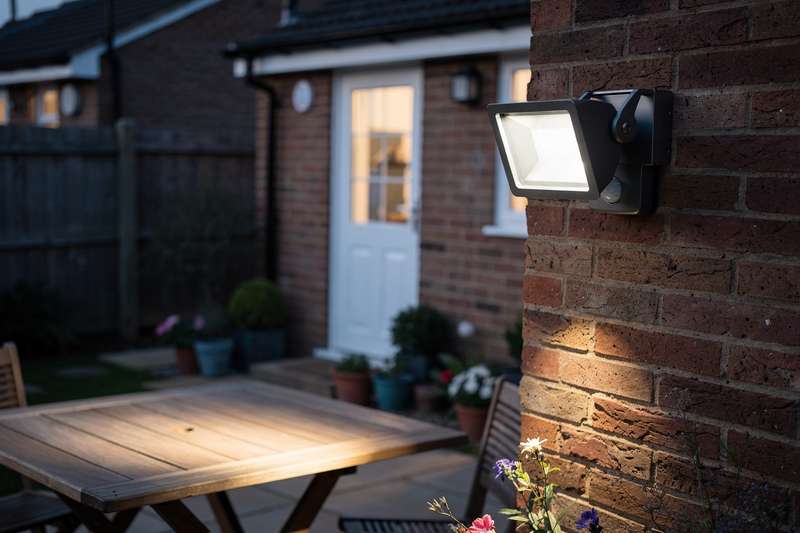
You’ve already had that sinking feeling — you glance out of the window at 11 pm and the side return is pitch black, or you come home to an unlit drive and have to fumble for your keys while squinting at your own front door. Maybe you’ve had a parcel go missing from the porch, or a neighbour mentioned someone was trying car door handles down the street. You’ve been meaning to sort security lighting for months, but every time you search online you hit the same wall: a swamp of near-identical floodlights with wildly inconsistent specs, confusing lumen claims, and reviews that seem to be written for the US market. You need something that actually works through a wet British winter, mounts cleanly on a rendered wall or a brick soffit, and doesn’t require an electrician’s callout fee every time you want to tweak the sensitivity.
The good news is that modern PIR security lights have improved enormously. The entry-level options are genuinely bright, the IP ratings are meaningful rather than marketing fluff, and the better mid-range lights now offer multi-mode operation — so you can have a low-level background glow all night with a full-blast burst when movement is detected. This guide cuts through the noise and points you to the lights that actually earn their keep outdoors.
How We Chose These Picks
Evaluating security lighting means thinking about more than raw wattage. For this guide, the criteria were: verified buyer review patterns (volume, recency, and the ratio of 1-star complaints that mentioned the same failure point), IP waterproofing rating (IP65 minimum for UK outdoor use, IP66 preferred for exposed locations), lumen output relative to wattage (efficiency matters — a 50W light should be meaningfully brighter than a 20W one), PIR sensor quality (detection angle, adjustable range, and false-trigger behaviour), ease of installation for a competent DIYer, and build quality signals from real-world reviewers. Where review counts were very low, that’s noted plainly in the relevant section. The shortlist spans budget single-head units up to premium twin-head options from established lighting brands, so there’s a realistic pick whatever your property or budget tier.
Best All-Round Security Light with Proven Reviews
The Philips 21W 3000 lm LED Security Light Outdoor w/PIR Motion Sensor is the standout choice for most UK households, and it’s not hard to see why — over 300 reviewers have given it a 4.6-star rating, which is the strongest combination of volume and score in this category. Philips isn’t just trading on brand recognition here; this light genuinely earns its score.
The twin-head design is one of its key practical advantages. Two independently adjustable heads mean you can angle one down the driveway and tilt the other to cover a side gate without needing two separate fittings. At 3,000 lumens from 21W, the efficiency is solid — you’re getting real-world brightness that’s noticeable rather than the inflated lumen claims some budget brands use. The 5,000K daylight colour temperature is clean and white, which makes it easier to identify detail in security footage if you have a camera nearby, compared to the slightly eerie blue-tinged cold white of some competitors.
The four operating modes are a genuinely useful feature that cheaper lights skip entirely. You can run it as a standard PIR-triggered flood, set it to dusk-to-dawn ambient mode, combine both, or run full-time. That flexibility means it’s equally at home lighting a covered porch (where you might want continuous low light) or a back garden (where you only want activation on movement). The IP65 waterproofing is appropriate for UK conditions, though if your fitting position is truly exposed — think a gable end with no overhang — you might want to consider an IP66-rated alternative.
Installation uses a standard junction box footprint and the wiring is straightforward for anyone comfortable with basic mains work. Reviewers consistently mention that the PIR sensitivity and duration dials are accessible and responsive — not the stiff, fiddly adjusters you find on budget fittings. The main trade-off: at the premium tier, you’re paying noticeably more than bare-bones alternatives. If you just need a basic triggered flood for a low-priority corner of the garden, that premium may not be justified. But for your front door, driveway, or main entrance — where reliability and build quality actually matter — this is the light to fit.
Best Three-Head Option for Wide Coverage
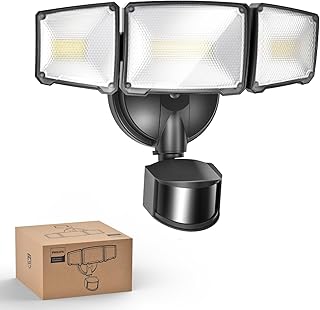
If you have a large driveway, a wide gable end, or a corner position that demands broad coverage, the Philips 24W 3500LM LED Security Lights w/PIR Motion Sensor Outdoor steps up with three independently adjustable heads and a 4.5-star rating from 175 reviewers — a strong showing that gives you real confidence in the consistency of the product.
The headline spec is 3,500 lumens from 24W across three heads, which gives you meaningful flexibility in coverage angle that a twin-head simply can’t match. Position one head straight down, angle the second across the drive, and tilt the third toward a side path — and you’ve essentially covered a 180-degree arc from a single fitting point. The aluminium housing is a practical choice for heat dissipation; LED floodlights that run warm over long periods benefit from metal construction, and reviewers note that even after extended dusk-to-dawn use the casing stays cool to touch.
The 5,000K output and dusk-to-dawn capability mirror the twin-head model above, so you get the same multi-mode flexibility. Waterproofing is rated for outdoor use and the build quality reflects Philips’ commercial lighting heritage. Where this light can feel like overkill is on a compact property — three adjustable heads on a small semi-detached porch would be physically crowded and visually imposing. It’s a light that suits houses with genuine space to cover: detached properties, wide frontages, or commercial premises where one fitting point needs to do the work of two or three cheaper units. Installation is mains-wired and follows the same approach as its sibling, so if you’re comfortable with the twin-head, fitting this one is no more complex.
The main trade-off versus the twin-head is marginal: the three-head unit is slightly larger on the wall, and the extra head adds a small amount of weight that you’ll want to account for on older rendered surfaces. But for genuine wide-area coverage, the added lumen output and third head are worth it — this is the light that replaces two cheaper fittings and does a better job than either.
Best Budget PIR Floodlight Under £20
The CLY 50W Security Lights Outdoor Motion Sensor punches well above its price point and has 169 reviews sitting at 4.3 stars — enough buyer feedback to have meaningful confidence this isn’t a one-batch wonder. At 4,700 lumens from 50W, it’s the highest raw lumen output of any light in this guide, and that’s immediately apparent when you mount it and trigger it for the first time.
The 6,500K cold white output is the tradeoff you accept for that brightness at this price. Cold white can feel harsh and slightly blue-tinged, which is fine for a purely functional security application (driveway, back gate, bin store) but less pleasant if the light is visible from a sitting room window or a bedroom. The IP66 waterproofing is better than the IP65 minimum you’ll find on pricier options, making it a strong choice for genuinely exposed locations — a north-facing wall, an outbuilding with no overhang, or a coastal property where driving rain is frequent.
The single-head design keeps installation simple, but it does mean you have less flexibility in coverage angle compared to twin or triple-head alternatives. Most buyers mount it pointing down-and-forward and find that adequate for a standard driveway or back garden, but if you need to split coverage across two directions, you’d need two units. At this price that’s entirely reasonable — two of these cost less than one premium twin-head fitting and cover more total ground. The PIR sensor adjustments are basic but functional: you can set sensitivity and duration via the dials on the unit, and reviewers report that false triggers (wind-blown foliage, passing cars on a nearby road) are manageable once sensitivity is dialled down slightly from maximum.
Build quality is honest for the category — the housing is plastic rather than aluminium, which is a practical concession at this price but means the light runs slightly warmer during extended use. For a triggered PIR application where it’s only fully active for 30–60 seconds at a time, this isn’t a problem in practice. Where it would concern me more is if you were running it in constant-on mode for long periods; for that use case, step up to a metal-housed alternative.
Best Compact Twin-Head Security Light from a Design Brand
The LUTEC Shrimp 12W PIR LED Security Light earns its place in this guide on the back of 65 reviews at 4.6 stars — the joint-highest rating of any product here — and a design sensibility that most security lights completely ignore. Where the majority of PIR floodlights look purely industrial, this one is compact, clean-lined, and genuinely presentable on the front of a house where aesthetics matter.
At 12W and 1,250 lumens the output is lower than the high-wattage options above, and that’s worth being honest about: this light won’t illuminate a 20-metre driveway from a gable end. What it does brilliantly is cover a front door porch, a back door step, a pathway entrance, or a garage access point at close to medium range — situations where a 50W nuclear option would be wildly excessive and visually oppressive. The twin-head layout gives you directional flexibility that the single-head CLY can’t offer, and the integrated mains-powered design means no batteries or solar panels to manage.
The 5,000K output is cleaner and warmer-feeling than 6,500K cold white, sitting in a daylight zone that reads as bright without looking clinical. LUTEC is a brand with a serious outdoor lighting catalogue rather than a commodity label, and that shows in the junction box footprint, the quality of the wiring tails, and the overall rigidity of the housing. Reviewers specifically call out the sensor reliability and the absence of false triggers — a common frustration with cheaper PIR units where a passing cat or even a large moth can set them off repeatedly through the night.
The honest limitation here is the lower lumen output. If your property has a long approach, a large garden, or a dark outbuilding at any distance, this light won’t have the throw to cover it effectively. But for close-range applications where you want something that looks considered rather than bolted-on, this is the most design-conscious choice in the category. It also suits situations where planning conditions or landlord agreements limit the visual impact of any fitting.
Best Single-Head Budget Light for a First-Time Buyer
The paul russells 10W Motion Sensor Outdoor Lights is the entry point of this guide — 83 reviews at 4.5 stars makes it well-validated for a compact single-head unit. At 10W and 1,000 lumens, it’s the lowest-output option here, but that’s not a disqualification: for many applications, 1,000 lumens is genuinely plenty.
Think about where this light makes sense: a back door you want lit when you take the bins out, a side gate that’s currently completely dark, a garden shed, or a small porch over a secondary entrance. In all these scenarios, a 50W floodlight would be wasteful, glaring, and potentially irritating to neighbours. A compact 10W unit that fires for 30 seconds when you walk past covers the use case cleanly, costs very little to run, and is straightforward enough for a confident DIYer to fit in under an hour.
The 6,500K daylight output is crisp, and the IP65 waterproofing is appropriate for UK outdoor use in a sheltered or semi-sheltered position. The paul russells brand has a growing presence in the UK electrical market and the product reflects that — the fitting is better finished than pure commodity imports, with decent cable tails and a housing that doesn’t feel brittle. The PIR sensor covers a standard detection arc and reviewers report reliable triggering without excessive false activations, which at this price is genuinely impressive.
The trade-off is straightforward: one head, modest output, no multi-mode operation. You’re not getting dusk-to-dawn capability, adjustable colour temperature, or twin-head flexibility. What you’re getting is a reliable, well-reviewed, compact PIR flood that does exactly what it says. If this is your first security light installation, or if you need to cover a secondary location on a tight budget, this is the most sensible starting point in the guide.
Best Ultra-Slim Design for Tight Mounting Positions
The Lepro Security Lights Outdoor Motion Sensor is the thinnest unit in this guide at 20W and 2,000 lumens, and its ultra-thin profile solves a specific problem that bulkier floodlights can’t: tight mounting positions where a projecting fixture would look awkward or physically obstruct movement. This ASIN currently has no published review count in the live data, so it’s included here on the strength of Lepro’s established outdoor lighting reputation and the specification credentials — treat it as a considered pick, but check current reviews before purchasing.
The slim form factor is genuinely useful for soffit mounting, for fitting under a narrow canopy, or for positioning in a recessed area where a standard flood housing would stick out uncomfortably. The PIR sensor is integrated into the slim body rather than protruding separately, which contributes to the clean appearance. IP65 waterproofing is appropriate for the UK climate in a typical mounting position.
At 2,000 lumens from 20W, the output sits between the budget 10W options and the high-wattage 50W units — a middle ground that’s useful if you want real coverage without the clinical brightness of a maximum-output flood. The 20W draw also means it runs cooler than higher-wattage alternatives, which matters if you’re mounting in a position with limited air circulation. The tradeoff is that without a substantial verified review base here, you’re relying more on spec and brand track record than on accumulated buyer experience. Lepro has a consistent presence in the UK outdoor lighting market, which provides some reassurance, but verified post-purchase feedback is the gold standard — check the listing for current reviews before committing.
What to Look For When Buying Security Lighting
- IP Rating: The IP (Ingress Protection) rating tells you how well a light resists water and dust. For UK outdoor use, IP65 is the minimum — it means the unit is protected against water jets from any direction. IP66 offers stronger protection against more powerful water ingress and is worth prioritising for exposed or coastal locations. Anything below IP65 is not suitable for permanent outdoor mounting in the UK climate.
- Lumen Output vs. Wattage: Lumens measure actual light output; watts measure energy consumption. A well-designed LED should produce around 80–100 lumens per watt. Be sceptical of lights claiming very high lumen counts from low wattages — manufacturers sometimes inflate lumen figures. Cross-reference with real buyer photos and reviews to get a sense of genuine brightness.
- PIR Sensor Quality: Look for adjustable sensitivity, adjustable duration (how long the light stays on after triggering), and a wide detection angle — 180 degrees is standard for a security light. Cheaper sensors are prone to false triggering from vegetation movement, passing vehicle headlights, or small animals. Reviewers will flag this consistently if it’s a problem.
- Single Head vs. Twin or Triple Head: A single head is simpler, cheaper, and adequate for most applications. Twin and triple heads allow you to cover multiple angles from one fitting point, which is valuable for corners, driveways with wide frontages, or large outdoor areas. More heads also mean slightly more complex installation and a larger footprint on the wall.
- Colour Temperature: 5,000K–6,500K is standard for security lighting. Warmer temperatures (around 3,000K) are less harsh but provide lower contrast, making it slightly harder to distinguish detail at range. Daylight temperatures (5,000K+) are better for identification purposes if you’re using a security camera alongside the light.
- Operating Modes: Basic PIR-only lights trigger on movement and turn off after a set duration. Better lights add dusk-to-dawn operation (a photocell keeps the light on at low level all night), combined modes, and sometimes adjustable brightness. If you want the light to provide any passive deterrence without requiring movement, dusk-to-dawn capability matters.
- Mains-Wired vs. Solar: Mains-wired lights offer consistent, reliable output regardless of weather — important through UK winters when solar panels may generate very little. Solar is genuinely useful in summer or for locations where running cable is impractical (outbuildings, perimeter fences), but solar security lights almost universally dim significantly in low-light conditions. Mains wiring is the professional-grade choice for your primary security locations.
Verdict
For the majority of UK homeowners fitting a security light on a driveway, front door, or main entrance, the Philips 21W 3000 lm LED Security Light Outdoor w/PIR Motion Sensor is the right choice. It has the largest verified review base of any light here, the highest combined rating-and-review score in the category, twin adjustable heads for flexible coverage, four operating modes, and a brand with genuine standing in professional lighting. You’re not paying a premium for a logo — you’re paying for a light that reviewers have tested through British winters and found consistently reliable.
If your budget is tighter and your coverage needs are modest, the paul russells 10W light is the honest entry-level pick, and the CLY 50W option is the best choice when raw brightness and IP66 waterproofing are the priority over finesse. For aesthetics and close-range precision, the LUTEC Shrimp is the most design-considered option in the guide. And if you have a wide frontage that genuinely needs 180-degree coverage from one fitting point, the Philips three-head unit is the natural step up. There’s a genuinely useful light for every property here — the key is matching the output and format to your actual installation, not just reaching for the highest wattage on the page.
We were not paid to feature any specific product in this guide. All opinions are independent and based on publicly available specifications, verified buyer feedback patterns, and category research.
Quick Comparison Table


FAQ
What is the best wattage for a security light in a typical UK garden?
For a standard driveway or back garden up to around 15 metres in depth, 20W–30W is generally sufficient — that equates to roughly 2,000–3,000 lumens from a quality LED. Higher-wattage lights (50W+) are better suited to large open areas, car parks, or wide gable ends where maximum throw is needed. Oversizing the wattage on a small property creates glare and can irritate neighbours.
Do I need an electrician to fit a mains-powered security light?
In England and Wales, replacing a like-for-like outdoor light fitting is generally considered minor electrical work that a confident DIYer can undertake, provided the circuit is isolated properly during the work. However, running a new circuit outdoors, installing a new spur from a consumer unit, or any work in a bathroom or kitchen must be done by a Part P-registered electrician. If in doubt, engage a qualified tradesperson — the cost is modest and the safety margin is significant.
What does the IP rating on a security light mean?
IP stands for Ingress Protection. The first digit (6 in IP65 or IP66) refers to dust protection — 6 means fully dust-tight. The second digit refers to water resistance: 5 means protected against water jets, 6 means protected against powerful water jets. For permanently mounted outdoor lights in the UK, IP65 is the minimum acceptable; IP66 is preferable for exposed or coastal positions. Avoid anything rated IP44 or lower for outdoor use.
Is a PIR motion sensor better than a camera-activated light?
PIR sensors detect infrared heat from moving objects and are faster to trigger, more reliable in all weather conditions, and require no network connection or subscription. Camera-activated lights (like those from Ring or Eufy) add video recording and app alerts but depend on Wi-Fi, can have processing latency, and introduce ongoing subscription costs for cloud storage. For pure deterrence and reliable illumination, a quality PIR sensor is harder to beat — many homeowners use both together for maximum coverage.
Can security lights deter burglars?
Security research consistently shows that outdoor lighting is a meaningful deterrent — intruders prefer to operate unobserved, and a bright triggered light removes that anonymity. The deterrence effect is strongest when lights are combined with other visible security measures such as cameras and signage. Lights with dusk-to-dawn capability (continuous low-level illumination) can be marginally more effective than PIR-only units because they prevent an intruder from working out the detection perimeter in advance.
How should I position a security light for maximum coverage?
Mount the light at around 2.4–3 metres above ground level — high enough to prevent casual interference but low enough that the PIR sensor can reliably detect movement at ground level. For driveways, position the light so the PIR arc covers the approach from the gate or road. Avoid pointing the beam directly into neighbouring windows or onto a public footpath where it could dazzle pedestrians. Angling the head slightly downward rather than horizontal maximises ground-level coverage and reduces light pollution.