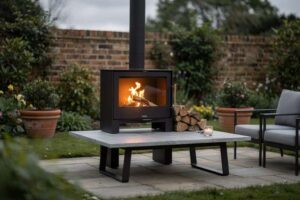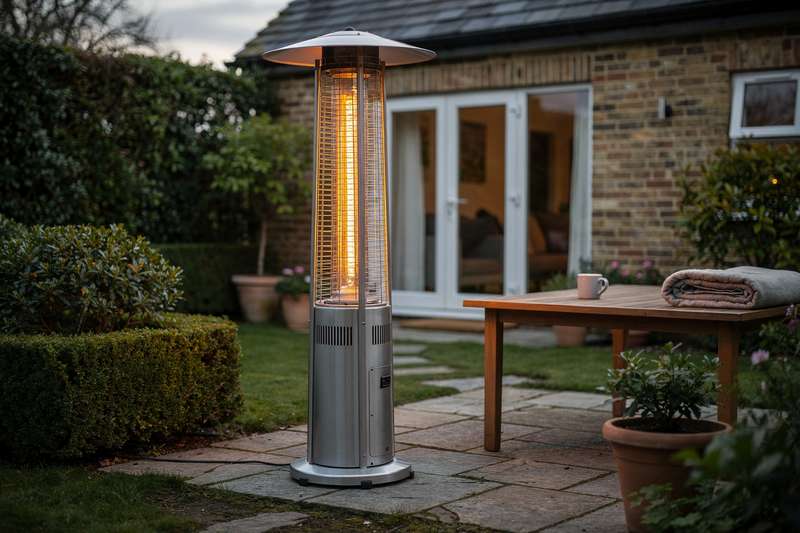
Picture this: it’s a Friday evening in October, your garden lights are on, the table is set, and your friends are due in an hour. You step outside to check on things and the temperature has dropped to 9°C. Last year you managed with blankets and a bit of wine, but this time you want something that actually works. You’ve looked at the gas mushroom heaters people use outside pub gardens, but your terrace isn’t big enough — and dragging a propane cylinder around every weekend sounds like a chore. You’ve also noticed that cheap electric heaters from discount shops tend to rust after one season and throw heat in roughly the right direction, but never quite where you need it.
That frustration is exactly what this guide addresses. Whether you have a small paved courtyard, a covered pergola, or a larger decked area, there’s an electric patio heater that will actually extend your outdoor season by weeks. The UK market skews strongly towards electric models — practical, no gas canisters, easy to mount or position — and that’s what the live product data here reflects. Below you’ll find five carefully selected picks, each suited to a different setup, with a frank look at where each one excels and where it falls short.
How These Picks Were Chosen
Every product in this guide was assessed against the same set of criteria: heat output relative to size, weatherproofing rating (IP rating), mounting flexibility, ease of installation or assembly, remote-control convenience, and the pattern of verified buyer feedback on Amazon UK. Where a product had fewer than around 250 reviews, that was factored into how confidently any claims about long-term durability could be made.
Products that are genuine variants of the same model (for example, the same unit sold in two colour finishes) were treated as a single product, and only the better-reviewed listing was included. One product in the live block — a replacement reflector shield — is an accessory rather than a heater, so it was excluded entirely. The Daewoo listing with a single 1-star review was considered but ultimately omitted given the complete absence of meaningful buyer feedback. The remaining five picks represent distinct products at different price tiers and installation styles, giving you a realistic shortlist rather than an artificially padded one.
Best Freestanding Electric Patio Heater
The DONYER POWER Electric Quartz Patio Heater Garden Heater Waterproof Outdoor Free Standing 2000W is the most widely reviewed freestanding electric option in this guide, with over 430 ratings on Amazon UK at a score of 4.2 out of 5 — a solid sign that most buyers are genuinely happy once it’s set up and running.
This is a tall, pole-style freestanding heater that uses a quartz heating element rated at 2000W. Quartz infrared heats objects and people directly rather than warming the surrounding air, which means it feels effective even in a light breeze — unlike convection heaters that lose their warmth the moment wind arrives. The unit is waterproof, which in practice means you can leave it outside in typical British weather without packing it away at every sign of cloud. That alone puts it ahead of many cheaper alternatives.
The freestanding design is its biggest practical advantage: no drilling, no wall required, and you can reposition it as needed — push it closer to the seating area when the temperature drops, or angle it towards guests at the far end of the table. The base is wide enough to be reasonably stable, but on uneven decking or paving you’ll want to double-check it hasn’t shifted before leaving it unattended.
Where it struggles is directional precision. A freestanding pole heater at this price point has a fixed head angle, so you’ll need to physically rotate the whole unit if your guests move. It also doesn’t oscillate automatically. At 2000W it draws a full 2kW from a standard socket, so running costs add up on longer evenings — bear that in mind if you’re planning to use it nightly through autumn.
For most people with a medium-sized patio who want something they can move around without permanent installation, this is a dependable, well-proven choice. The reviews consistently praise quick heat-up time and ease of use, and the waterproofing means it genuinely handles the UK climate rather than needing babying.
Best Wall-Mounted Patio Heater with Remote
If you have a wall, fence, or pergola post to mount to, the Pro Breeze 2000W IP65 Waterproof Outdoor Halogen Infrared Patio Heater Wall Mounted Electric Heater With Remote Control for Garden is one of the more refined options available on Amazon UK. It carries an IP65 weatherproof rating — higher than many competitors at this tier — which means it’s rated to handle dust ingress completely and jets of water from any direction. That’s meaningful reassurance in a country where rain can arrive sideways.
The Pro Breeze wall-mounted unit uses halogen infrared tubes rather than quartz. Both technologies produce radiant heat, but halogen tubes tend to emit a visible orange glow when running. Some people find this atmospheric; others find it distracting at night. It’s worth knowing before you buy if you’re planning to use it during evening gatherings where ambience matters.
The remote control is a genuine quality-of-life feature — you can adjust heat settings from the sofa without getting up, which sounds minor but becomes genuinely useful when you’re mid-conversation and just want to nudge the warmth up. The bracket allows you to tilt the head downward to focus heat on the seating area below, and once it’s mounted at the right angle, you rarely need to touch it again.
Installation does require drilling into a solid surface and routing a cable to a weatherproof outdoor socket. If your garden doesn’t already have outdoor electrics, that’s a real cost to factor in. The unit itself is straightforward to mount once you have the fixings in the right place, and the bracket is robust enough for long-term outdoor use. With 306 reviews at 4.2 stars, buyers broadly confirm it works as described — the most common complaint is around the brightness of the glow rather than the heat output, which tells you the heating itself isn’t the weak point.
This is best suited to someone with a covered outdoor space — a lean-to, a pergola with a roof, or an extension with an outdoor overhang — where a permanent mount makes sense. If you entertain in a fixed spot regularly, having the heater wall-mounted and ready to switch on with a remote is far more convenient than repositioning a freestanding unit each time.
Best Budget-Friendly Patio Heater
The DONYER POWER Outdoor Heaters for Garden Patio Heaters Halogen Heater 800W&2000W Electric Heater for Greenhouse Tent offers a two-power-setting design — 800W and 2000W — which is more versatile than it might first appear. On a mild evening in September you can run it at the lower setting and keep running costs modest; on a cold November night you have the full 2000W available.
At this price tier you’re getting a halogen heating element in a bracket-mounted or freestanding format (the listing supports both configurations), and the build quality reflects the price — this isn’t a premium unit, and the finish won’t look as polished as the Pro Breeze over time. However, with 284 reviews at 4.1 stars, buyers consistently report that it does what it says: it gets hot quickly, the two-setting design is practical, and it copes with outdoor use across multiple seasons.
The dual wattage option is particularly useful in a greenhouse or garden room where you want background warmth rather than full-blast heat. Many buyers use this exact model in unheated outbuildings, and it performs well in those enclosed or semi-enclosed settings where the heat can accumulate rather than disperse into open air.
The tradeoffs are predictable: no remote control, no oscillation, and the build materials are functional rather than attractive. The halogen glow is fairly pronounced, which can be distracting in darker settings. If you’re planning to use this on an open, exposed patio on a windy evening, you’ll notice its limitations — infrared at this power level without good directional focus loses effectiveness quickly in a stiff breeze. But for sheltered spots, patios with walls, or garden outbuildings, it delivers strong value per pound spent.
If you’re new to patio heaters and want to try one before committing to a more expensive permanent installation, this is a sensible starting point. It’s honest about what it is, and buyers who understand its intended environment tend to come away satisfied.
Best Ceiling-Mounted Patio Heater
The DONYER POWER Garden Heaters Outdoors Patio Heater Halogen Heater Ceiling Mounted, 800W&2000W Greenhouse Infrared Heaters solves a specific problem that the other picks in this guide don’t address: what do you do when you have no wall space, but you do have a pergola or covered structure with overhead beams? Ceiling mounting keeps the heater completely out of the way, directs heat downward onto people rather than outward into the air, and eliminates the risk of someone walking into a bracket-mounted unit.
The core heating technology is the same dual-wattage halogen infrared setup as the freestanding DONYER POWER model above, so the heat output characteristics are familiar. What changes is the installation approach: the unit is designed to be fixed overhead and angled downward. For a covered outdoor dining area — a pergola, a gazebo with solid cross-beams, or a covered veranda — this is genuinely the most efficient layout. Heat rises, but infrared radiation travels in a straight line, so mounting overhead and angling downward means the warmth lands directly on seated guests rather than escaping into the air above them.
With 263 reviews at 4.1 stars, the feedback pattern closely mirrors the freestanding version: buyers who install it in the right environment (enclosed or semi-enclosed, overhead mounting possible) are happy; those who expected it to heat an entirely open space are less so. That context is important — ceiling mounting is powerful precisely because it works in tandem with a sheltered space, not instead of shelter.
Installation requires overhead fixing points rated to take the weight of the unit, plus a cable route to a weatherproof socket. If you’re handy with basic DIY and already have an outdoor socket nearby, this is straightforward. If you’re not confident with overhead electrical work, factor in an electrician. The end result — a tidy, out-of-the-way heat source that doesn’t occupy floor space or wall real estate — is genuinely worth the effort for the right setup.
Best Feature-Rich Tower Patio Heater
The Senelux 2000W Infrared Tower Patio Heater with Remote Control, 9 Heat Levels, 24-Hour Timer, Oscillating, Water-Resistant Electric Heater is the most fully featured electric patio heater in this guide, packing in a set of controls that you’d normally expect to find on premium indoor tower fans rather than outdoor heaters. Nine discrete heat levels, a 24-hour programmable timer, oscillation, and a remote — all in a freestanding tower format — make this a noticeably different proposition from the simpler one or two-setting units above.
The oscillation feature is worth dwelling on. If you’re hosting a group spread across a wide table or seating area, a static heater warms whoever is directly in front of it and leaves everyone else noticeably cooler. An oscillating heater sweeps the warmth across a broader arc, which is a meaningful practical advantage in a social setting. It’s not a substitute for raw power, but it distributes the available 2000W more evenly across a group.
The 24-hour timer is useful if you want the heater to warm up a space before you step outside — set it to come on twenty minutes before dinner, and the patio is already comfortable when you arrive. Equally, you can set it to switch off automatically so you don’t have to remember to turn it off when you head inside.
At 49 reviews and 4.2 stars, the sample size is smaller than the DONYER POWER units, so there’s less accumulated long-term durability data. The reviews that exist are broadly positive, praising the ease of the remote and the range of settings. Water resistance rather than full waterproofing (the listing specifies water-resistant rather than a hard IP rating) means this one is better suited to a sheltered spot than an exposed one — don’t leave it out in heavy rain without cover.
If you want the most control over your outdoor warmth and are willing to take a modest risk on a newer listing, the Senelux tower heater is the pick with the most functionality. It’s best suited to covered patios, outdoor dining rooms, or any space where you want set-and-forget convenience without constantly adjusting the heater manually.
What to Look For When Buying a Patio Heater
- Wattage and heat output: For outdoor use, 2000W is the practical minimum for heating a seating area in UK autumn temperatures. Lower wattage units (800W–1500W) work well in enclosed or semi-enclosed spaces but will struggle on open, exposed patios. If you have a large open area, consider whether a single unit is enough or whether two lower-wattage units placed strategically would serve better.
- IP weatherproof rating: The IP rating tells you how resistant the unit is to water and dust. IP44 handles splashing water; IP65 is rated for jets of water from any direction. For an exposed UK garden, aim for IP55 or higher. For a covered pergola or veranda, IP44 may suffice. Always check the rating rather than relying on vague “weatherproof” marketing language.
- Infrared technology — halogen vs quartz: Halogen tubes heat up almost instantly and emit a visible orange glow. Quartz tubes also heat rapidly but emit a slightly warmer, less glare-heavy light. Both use radiant infrared heating, which warms people and objects directly rather than air — important for outdoor use where air warmth disperses quickly. The glow difference comes down to personal preference and how much it will bother you at night.
- Mounting style: Freestanding heaters offer flexibility but take up floor space and can be knocked over in high winds. Wall-mounted units are permanent but directionally adjustable. Ceiling-mounted units are the most space-efficient for covered areas and deliver heat from the most effective angle. Think about your specific space before deciding — a wall-mounted or ceiling-mounted unit is usually more effective per watt than a freestanding one in a fixed setting.
- Controls and convenience: Remote controls, multiple heat settings, and timers all add genuine value for regular outdoor entertaining. At minimum, look for at least two heat settings. A remote control becomes particularly useful when the heater is mounted overhead or on a wall out of easy reach. Timers save energy and mean you don’t have to remember to switch off.
- Oscillation: Useful for wide seating areas. A heater that sweeps through an arc heats a broader area and reduces the temperature difference between people sitting directly in front of it and those seated at the sides. Not all heaters offer this, and it’s worth paying a modest premium for if you regularly host groups of four or more.
- Cable length and outdoor electrics: All electric patio heaters need a power source. Check the cable length on your chosen unit and make sure you have a suitable outdoor weatherproof socket within reach. Avoid extension leads that aren’t rated for outdoor use — this is a genuine safety concern, not a minor technicality. If you don’t have outdoor electrics, budget for installation by a qualified electrician before buying a wall or ceiling-mounted unit.
Verdict
For most UK readers — someone with a medium-sized patio, no existing outdoor electrics installed overhead, and a desire to host outdoors from April through October — the DONYER POWER Electric Quartz Patio Heater Garden Heater Waterproof Outdoor Free Standing 2000W is the most sensible starting point. It requires no installation, genuinely handles UK weather, and has the track record of 430-plus reviews to back up its reliability claims. You can move it where you need it, plug it in, and start using it the same day it arrives.
If you have a covered outdoor space and an existing outdoor socket, step up to the Pro Breeze 2000W IP65 Wall Mounted Electric Heater — the higher IP rating, remote control, and permanent-mount convenience make it the better long-term solution for a fixed entertaining area. For the widest feature set and the most control over how your outdoor space is heated, the Senelux tower heater is the one to consider, provided you have a sheltered spot to place it.
We were not paid to feature any specific product in this guide. All opinions are independent and based on publicly available specifications, verified buyer feedback patterns, and category research.
Quick Comparison Table


FAQ
Are electric patio heaters effective in a UK climate?
Yes, provided you choose the right type. Infrared electric heaters — both halogen and quartz — heat people and objects directly rather than warming the surrounding air, so wind has far less impact on their effectiveness than it would with a convection heater. For genuinely cold evenings below 5°C on a fully exposed patio, a single 2000W unit will take the edge off rather than recreate indoor warmth, but for the typical UK shoulder season (April–May and September–October), they work very well.
What IP rating do I need for an outdoor patio heater?
For a covered space such as a pergola or veranda, IP44 (splash-proof) is usually sufficient. For a more exposed position where rain can hit the unit directly, look for IP55 or IP65. The Pro Breeze wall-mounted unit in this guide, for example, is rated IP65, making it suitable for fully outdoor installation without a protective cover overhead.
Can I leave a patio heater outside permanently?
It depends on the IP rating and the manufacturer’s guidance for that specific unit. Units rated IP65 or above can generally be left outside in UK weather without a cover, though a purpose-made cover will extend the lifespan of any outdoor heater. Units described as “water-resistant” rather than fully waterproof — like the Senelux tower heater — should be covered or brought under shelter during heavy rain or when not in use for extended periods.
How much does it cost to run a 2000W patio heater?
At current UK electricity rates, a 2000W heater running at full power costs approximately 2kWh of electricity per hour. Running costs vary with the energy tariff you’re on, so check your pence-per-kWh rate and multiply by 2 for each hour of full-power use. Using a lower heat setting — where the unit offers one — roughly halves the running cost for that session.
Is a wall-mounted or freestanding patio heater better?
It depends on your setup. Wall-mounted heaters are better for fixed entertaining areas where you want a permanent, out-of-the-way solution — they free up floor space and can be angled precisely. Freestanding heaters are better if you want flexibility to move the heater to different parts of the garden, or if you rent your property and can’t drill into walls. For ceiling-mounted versions, a covered overhead structure is required, but they offer the most efficient heat direction (straight down onto seated guests).
Do patio heaters work in windy conditions?
Infrared radiant heaters perform much better in wind than convection-style heaters, because they warm people directly rather than relying on warmed air staying in place. That said, even radiant heat has limits in a strong wind — if gusts are consistently above 20–25mph, any outdoor heater will feel less effective. For exposed gardens, a wall or ceiling-mounted unit in a sheltered corner will outperform a freestanding unit in the open, regardless of the heater’s wattage rating.