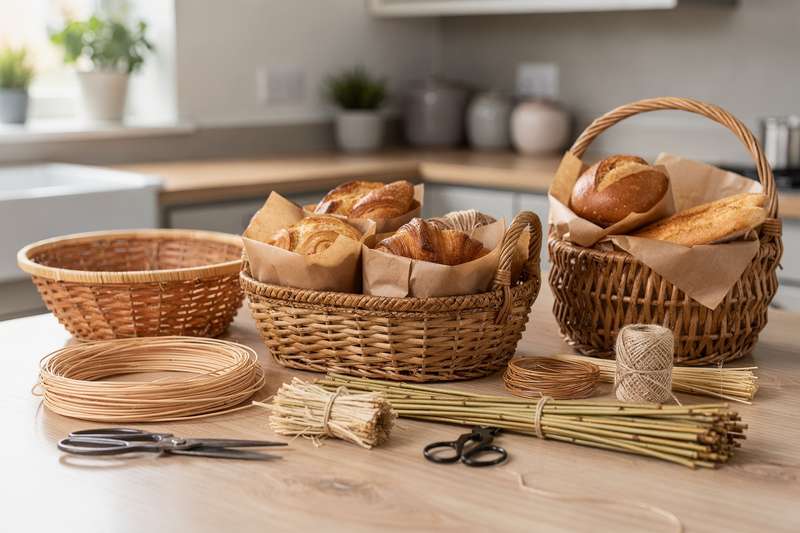
Picture this: you’ve searched “basket making” on Amazon and come back with a page that mixes rattan-weaving books, silicone bread tins, and wicker hamper kits. You’re not sure whether you want to learn the craft of weaving from scratch, start baking sourdough in a traditional proving basket, or simply assemble a beautiful gift hamper for a friend. All three are legitimate “basket making” pursuits — and all three require very different products.
This is the frustration most UK buyers face. The term covers a surprisingly wide territory. Someone learning traditional reed weaving needs a completely different starting point to someone who wants to proof their first sourdough loaf, or to someone assembling a Christmas hamper. Without knowing which territory you’re in, it’s easy to buy the wrong thing entirely: a beautiful book you can’t use without specialist materials, a proving basket that’s the wrong size for your recipe, or a hamper kit that falls apart when loaded.
This guide cuts through that confusion.
How We Evaluated These Picks
To put this guide together, I evaluated each product across five criteria relevant to UK buyers. First, fit for purpose — does the product actually serve the basket-making need it claims to? Second, instructional quality (for books and kits), including whether guidance is clear enough for a beginner. Third, material and build quality, assessed through verified buyer feedback patterns on Amazon. Fourth, versatility — can the product grow with you as your skills develop? Fifth, real-world usability based on review patterns: products with repeated complaints about sizing, durability, or misleading descriptions are flagged, regardless of headline ratings. I prioritised products with meaningful review counts where available, and noted where lower-reviewed products were included on the strength of their specifications and rating.
Best Overall Sourdough Basket Making Kit
The Sourdough Starter Kit, 2 PCS Bread Making Kit is the strongest all-round entry point for UK bakers who want to start using proving baskets seriously. Rated 4.4 out of 5 from 213 reviews — by far the most reviewed product in this comparison — it bundles a 9-inch round and a 10-inch oval proving basket with liners and covers, giving you two shapes to work with from day one.
The appeal of a two-basket bundle isn’t just about variety for variety’s sake. Round and oval bannetons produce visually distinct loaves, and many recipes are specifically optimised for one shape or the other. Having both means you can follow standard sourdough recipes without adapting them, and you can develop a genuine feel for how the different shapes affect crumb structure and crust development. The liners included are a practical bonus — bare baskets require more careful flouring and more experienced hands to release cleanly, while liners give beginners a more forgiving surface.
Build quality matters enormously with proving baskets. A banneton that absorbs moisture unevenly, develops mould quickly, or sheds fibres into your dough is worse than useless — it’s a health concern. Reviewers of this kit consistently mention durability and ease of cleaning as positives, which suggests the material selection is genuinely food-safe and practical for repeated weekly use. The covers (essentially shower-cap-style protectors) prevent the dough surface from drying out during its cold retard in the fridge, which is a crucial step for open-crumb sourdough.
Where this kit falls short is in explicit instruction. It’s a set of tools, not a course — you’ll still need a sourdough recipe and a basic understanding of fermentation timings. If you’re completely new to sourdough, pairing this with a dedicated bread-making book or online resource is advisable. The gift angle is also worth noting: the kit is presented cleanly and positions itself as a gift for bread bakers, and based on review patterns, it performs well in that role. Reviewers regularly mention gifting it and receiving positive feedback from recipients.
For UK bakers who already have some bread-making confidence and want to graduate from a standard loaf tin to proper shaped sourdough, this is the most sensible first purchase in this guide.
Best Book for Learning Traditional Basket Making
The Basic Basket Making: All the Skills and Tools You Need to Get Started is the standout choice if your interest in basket making is the craft itself — the weaving, the materials, the technique — rather than baking or gifting. Rated 4.6 out of 5 from 129 reviews, it’s a highly regarded instructional guide that has been used by beginners and established crafters alike.
The book covers the foundational techniques of traditional basket weaving: working with reed and rush, setting up a base, building walls, and finishing edges. For someone starting from scratch, this kind of structured, step-by-step reference is far more valuable than a standalone kit with minimal instructions, because it gives you context — why you soak materials, how tension affects the finished shape, and what tools you actually need before you spend money on supplies. Understanding the “why” behind each step is what separates people who finish their first basket from those who abandon it halfway through.
What distinguishes this title from a generic craft book is its practical, tool-focused approach. The subtitle “All the Skills and Tools You Need to Get Started” isn’t marketing vagueness — reviewers consistently note that the tools guidance is genuinely thorough. You’ll learn what to buy, why you need it, and in what order to use each tool for the various techniques covered. That kind of purchasing guidance is especially useful in the UK, where specialist basket-weaving supplies can be harder to source locally than in the US and online ordering requires upfront confidence in your choices.
The depth does have limits. This is a starter guide, not a comprehensive encyclopedia of weaving styles. Experienced weavers looking for advanced rib construction or complex coiling patterns may find themselves wanting more. But for the first year of basket weaving — which is genuinely where most people are — it covers far more ground than most competitors. The format is clear enough to follow without a teacher present, which makes it suitable for self-directed learners who prefer to work from a physical book rather than video tutorials.
If you’re looking to actually learn to make baskets with your hands, this is where your journey should start. Buy it before you buy any materials — it will tell you exactly what you need.
Best for Exploring Advanced Weaving Techniques
The Basket Making: How to Use Classic Basket-Making Techniques sits at a different level to the starter guide above. Rated 4.7 out of 5 from 4 reviews, this book is aimed squarely at weavers who have some foundational skills and want to push into more creative territory — combining traditional techniques with contemporary materials.
The premise is genuinely interesting for anyone who has completed a few basic projects: what happens when you apply classic reed-weaving structure to unusual fibres, unconventional shapes, or mixed-material constructions? The projects in the book explore design creativity rather than purely functional household pieces. For crafters who find standard round or oval shapes limiting, this is the kind of book that reignites enthusiasm and opens new directions.
Given the small review count, it would be dishonest to make strong claims about universal experience with this title. What the 4.7 rating and the strength of the reviews that do exist suggest is that the quality of the content is high — this doesn’t appear to be a generic reprint or padded-out beginner guide. The positioning indicates it’s part of a curated craft publishing programme, which generally correlates with thoughtful editorial standards and reliable photography (basket-making instructions are near-useless without clear step-by-step images).
The tradeoff with this book is specificity. Because projects use contemporary materials, you may need to source some supplies that aren’t standard basket-weaving staples. That means a bit more research and potentially more spend before your first project from this book is finished. It’s not a standalone kit — it’s an ideas resource that assumes you already know your way around weaving. Treat it as an expansion to your existing skill set rather than a foundation-layer purchase.
If you’ve worked through a beginner guide, completed a handful of projects, and are starting to feel like standard baskets are too straightforward, this is a sensible next step.
Best Large Oval Proving Basket
The Bread Proofing Basket, Silicone Sourdough Basket 10 Inch is worth considering if you specifically need an oval shape for longer, baguette-style sourdough loaves or recipes that call for a larger capacity proving vessel. Rated 4.2 out of 5 from 7 reviews, this is a silicone-based design rather than the traditional rattan construction — a distinction that significantly changes the practical experience.
Silicone proving baskets offer advantages that traditional woven baskets don’t: they’re dishwasher safe, they don’t absorb moisture (which eliminates mould risk), and the foldable construction means they store flat in a kitchen drawer. For someone with limited worktop space or who bakes only occasionally, these practical points matter. You’re not going to get the same beautiful spiral ring impression on your dough that a traditional rattan banneton gives, but if you primarily care about the proving function — holding the dough in shape while it ferments — silicone does the job reliably.
The 10-inch oval size is genuinely large. This suits recipes that yield a substantial loaf, and the oval shape lends itself well to batards (the elongated oval bread shape). If your usual recipe targets a smaller round loaf, this may feel oversized. Silicone baskets in this size category can also be slightly floppy when not supporting a dough mass, which some users find awkward to handle — the foldable design helps here because it reduces the structure when you need to store it, but it can feel less rigid than a traditional basket when in use.
Review feedback at this product’s rating level suggests it performs adequately for its stated purpose, though with fewer reviews than ideal, you’re drawing conclusions from a smaller sample. The design and material are clearly food-safe, and the foldable feature is a genuine innovation rather than a gimmick. For a baker who prioritises storage efficiency and easy cleaning over the traditional proving-basket aesthetic, this is a practical choice.
Best Compact Round Proving Basket
The Sourdough Proving Basket, 9 Inch Foldable Round brings the same silicone, foldable concept as the oval option above but in the standard 9-inch round format — the size and shape that the majority of sourdough recipes are written for. Rated 4.6 out of 5 from 3 reviews, the rating is promising if not yet statistically robust.
A 9-inch round banneton is the most versatile size for UK home bakers. Most standard sourdough recipes yield a loaf that fits comfortably in this diameter, and the round shape produces the classic boule (ball) form that most people picture when they think of artisan sourdough. The silicone construction means you get the foldable, easy-clean benefits discussed above, and the 9-inch size is compact enough to fit in the fridge alongside other items during a cold retard — the overnight step many UK sourdough bakers use to develop flavour.
Where silicone differs meaningfully from rattan is in the ring pattern it leaves (or doesn’t leave) on the dough surface. Traditional woven bannetons imprint a concentric spiral pattern that many bakers value aesthetically — it’s a visual indicator of handcraft. Silicone bannetons generally don’t create this same impression. If the decorative ring matters to you, a silicone option isn’t the right choice. If it doesn’t — or if you’re going to score a decorative pattern on top of the loaf anyway — the silicone format is strictly more convenient.
For a beginner sourdough baker who wants a no-faff, compact, easy-to-clean proving basket in the most useful size, this round silicone option is a practical starting point without major commitment in terms of cost or storage space.
Best for Gift Hamper Making — Twin Pack
The Micvtve 2 Set Empty Hamper Baskets Large Woven Bamboo approaches “basket making” from a completely different angle — this is about assembling handsome gift baskets rather than weaving or baking. Rated 3.9 out of 5 from 15 reviews, it offers a more complete starter picture than products with fewer reviews, and the feedback splits into useful categories.
The twin-pack format is genuinely useful for anyone preparing multiple gifts at once. Christmas hampers for two family members, matched gifts for a couple, thank-you baskets for two colleagues — the dual-basket configuration removes the logistical awkwardness of sourcing a single basket when you need two. Large woven bamboo is a natural-look material that reads as considered and premium to the recipient, even when the basket itself is budget-tier. The accompanying accessories — bows, shredded filler paper, gift bags, greeting cards — are the items that most home crafters forget to source until the last moment, and having them in a single kit removes that friction entirely.
The 3.9 rating deserves honest attention rather than dismissal. It sits just below the 4.0 threshold that typically signals consistent satisfaction, and with 15 reviews, there’s enough data to see patterns. The most consistent positive feedback centres on the bamboo weave appearance and the handles, which make the finished hamper easy to present and transport. The most common negative feedback relates to the quantities of accessories — specifically that the shredded paper and bows are more modest in volume than product images suggest. If your hamper is going to be fully packed and deeply layered, sourcing supplementary filler paper separately may be worth doing.
For someone assembling two gift baskets for a seasonal occasion, this kit removes most of the planning overhead. It’s not flawless, but it’s practical. Set your expectations appropriately for accessory quantities, fill it generously with quality contents, and the resulting hamper will look considerably more effort-intensive than the assembly time actually was.
Best Single Hamper Basket Kit
The Micvtve Empty Hamper Baskets Large Woven Bamboo is the single-basket version from the same range as the twin pack above. Sharing the same 3.9 rating from an overlapping review pool, it’s the straightforward choice when you only need one hamper rather than two.
The case for starting with a single basket is stronger than it might initially appear. Hamper assembly has a small but real learning curve in terms of visual presentation: how to layer items so shorter products aren’t hidden behind taller ones, how much filler paper to use to give depth without wasting material, how to angle the contents so the basket looks abundant when viewed from the front. Getting that right on one basket before scaling up to multiples saves material and prevents the frustration of a finished hamper that looks cluttered or sparse despite containing good-quality items.
The bamboo weave and handle construction are identical to the twin-pack variant. What changes is the accessory quantity — the bows, cards, and filler paper are provided for a single basket rather than two. This is exactly what you need for a one-off gift without leftover accessories cluttering a drawer. For a birthday, house-warming, or baby shower hamper where you’re making one carefully considered gift, the single kit is the cleaner option.
The honest framing for both hamper basket options in this guide is that the basket itself is the vehicle, not the gift. The quality of the food, skincare, or novelty items you place inside determines whether the recipient is genuinely pleased. If you’re working with a limited total budget, spend the majority on contents and treat the basket as a presentation tool rather than an end in itself. Done that way, even a budget bamboo hamper basket produces a gift that feels generous and personally assembled.
What to Look for When Buying Basket Making Products
The most important step before any purchase is identifying which type of “basket making” you’re actually interested in. The products in this guide span three genuinely different territories, and the buying criteria for each are distinct. Here’s what to evaluate:
- Clarify your goal first. Traditional basket weaving (the craft), bread proving, and hamper assembly share only a name. Before evaluating any specific product, be clear about which you’re buying for — it determines every other decision.
- For proving baskets, prioritise size match. A banneton that’s too large lets the dough spread and lose shape; too small and the dough climbs over the sides. Most UK sourdough recipes are written for a 9-inch round. Measure your fridge shelf before buying any oval basket larger than 9 inches.
- For proving baskets, decide on material before you shop. Rattan gives the traditional spiral ring impression and develops character over time, but requires careful drying after use. Silicone is dishwasher safe and foldable but doesn’t mark the dough. Neither is objectively better — choose based on how you value aesthetics versus convenience.
- For craft books, look for tool guidance alongside technique instruction. A basket-weaving book that doesn’t explain what to buy before you start is incomplete. The best beginner resources tell you exactly what tools and materials to purchase, in what quantities, and where variations in quality matter.
- For advanced books, check the project scope. If the book uses “modern” or “mixed” materials, some projects may require supplies beyond standard reed suppliers. This is fine if you’re an experienced crafter comfortable with sourcing — it’s a frustration if you’re expecting a self-contained resource.
- For hamper kits, check accessory quantities in the reviews. Product images often show more filler paper and more bows than are actually included. Reviewers reliably flag this when it’s an issue. Factor in whether you’ll need to supplement accessories before placing your order.
- Weight review volume alongside star rating. A 4.7 rating from 4 reviews carries far less statistical weight than a 4.4 rating from 213 reviews. Both the score and the sample size matter — treat very high ratings from very few reviewers as provisional rather than conclusive evidence of quality.
Verdict
For the majority of UK readers who arrive at this guide, the most useful single purchase is the Sourdough Starter Kit, 2 PCS Bread Making Kit. It has the strongest evidence base in this comparison — 213 reviews at 4.4 stars — and the dual-shape bundle with liners and covers makes it the most versatile and practical entry into sourdough basket proving. The gift positioning is well-executed, making it equally suitable as a purchase for yourself or as a considered gift for a baker.
If your interest is the hand craft of weaving rather than baking, the clear choice is Basic Basket Making: All the Skills and Tools You Need to Get Started. With 129 reviews at 4.6 stars, it’s the most thoroughly validated resource for anyone who wants to actually sit down with reed and raffia and learn how baskets are constructed from scratch. Buy this before you buy any materials — it will save you money on poorly chosen supplies.
The hamper kits and silicone proving baskets all serve more specific use cases. They’re worth considering if they match your exact situation, but they’re not the picks we’d put in front of a reader with a general interest in basket making.
We were not paid to feature any specific product in this guide. All opinions are independent and based on publicly available specifications, verified buyer feedback patterns, and category research.
Quick Comparison Table


Frequently Asked Questions
What is the difference between a banneton and a proving basket?
The terms are used interchangeably by most UK bakers — both refer to a basket used to hold shaped sourdough dough during its final proving stage before baking. Banneton is the French term, more common in professional baking contexts, while proving basket is the more general English description. Both do the same job: hold the dough in shape and absorb surface moisture for a better crust.
Do I need to season a rattan proving basket before first use?
Yes, it’s worth doing. Before first use, dust the inside of a rattan banneton thoroughly with a mixture of plain flour and rice flour, then tap out the excess. Repeat this two or three times before your first bake to build up a light coating on the fibres. After each use, allow the basket to dry completely before storing — never put it away damp, as mould can develop quickly in the woven structure.
What materials do I need to start basket weaving as a craft?
For traditional reed weaving, you’ll need flat reed in at least one width, a sharp tapestry needle, strong scissors, a bucket for soaking the reed, and clothespins to hold your work in place. A dedicated instruction book that covers material preparation is strongly recommended before you buy anything — it will specify exactly the reed widths and tool gauges suited to beginner projects, saving you money on mismatched supplies.
Can silicone proving baskets replace traditional rattan bannetons?
For the proving function itself — holding dough in shape during fermentation — yes, silicone works. The key thing you give up is the spiral ring impression that rattan leaves on the dough surface; silicone baskets produce a smooth exterior instead. If that aesthetic detail matters to you, rattan is the better choice. If you prioritise easy cleaning and flat storage, silicone is a practical alternative.
How do I clean a woven bamboo hamper basket after use?
Wipe the interior with a dry or very slightly damp cloth — soaking a bamboo-woven basket or submerging it in water will damage the weave and cause the material to swell and potentially split. For most hamper use cases, the basket won’t come into direct contact with food, so a dry wipe is usually sufficient. If it does get damp from condensation or a leaking product, allow it to air dry completely before storing.
Is basket weaving difficult to learn as a complete beginner?
The foundational techniques — particularly plaiting and basic coiling — are achievable by most adults within a few hours of focused practice. The difficulty comes from managing tension consistently throughout the weave, which takes a few projects to develop as a physical instinct. Starting with a well-illustrated beginner guide rather than raw materials and no instruction significantly shortens the learning curve. Most beginners complete a small functional basket within their first two to three sessions.