You’ve had the idea for months. Maybe you spotted a beaded bracelet at a craft fair and thought, “I could make that.” Or your daughter keeps asking for friendship bracelets and you’re tired of buying the same mass-produced ones. So you type “jewellery making kit” into Amazon, and suddenly you’re staring at dozens of listings — some looking suspiciously sparse, others claiming to contain literally thousands of pieces. You order one, it arrives, and within ten minutes you realise the pliers feel like they’re made of tinfoil, the wire is too thick to thread through most beads, and the instructions might as well be a riddle. The elastic snaps on your first bracelet. You put the box in a drawer and order a takeaway instead.
This is the moment most beginners give up — not because jewellery-making is hard, but because the wrong starter kit makes it feel impossible. Getting the right combination of tools, materials, and reference is the difference between making something you’re genuinely proud of on day one and quietly losing interest by day three. This guide cuts through the noise to show you exactly what’s worth buying at the budget end of the market, who each product suits best, and where the honest tradeoffs lie.
How We Evaluated These Picks
Every product here was assessed against five core criteria. First, completeness — does the kit actually give you everything you need to start, or does it assume you already own half the components? Second, tool quality — at the budget level, pliers and needles vary wildly; we prioritised picks where the tools hold up through repeated use rather than bending on first contact. Third, materials variety — a wider range of bead types, wire gauges, and findings means more creative flexibility for beginners still discovering what they like. Fourth, reviewer feedback patterns — star ratings alone tell you little; we looked at what verified buyers specifically praised and complained about across multiple reviews. Finally, value for the category — budget picks need to deliver genuine usefulness per pound, not just a low price on a box of unusable components.
Best All-in-One Starter Kit for Wire Wrapping
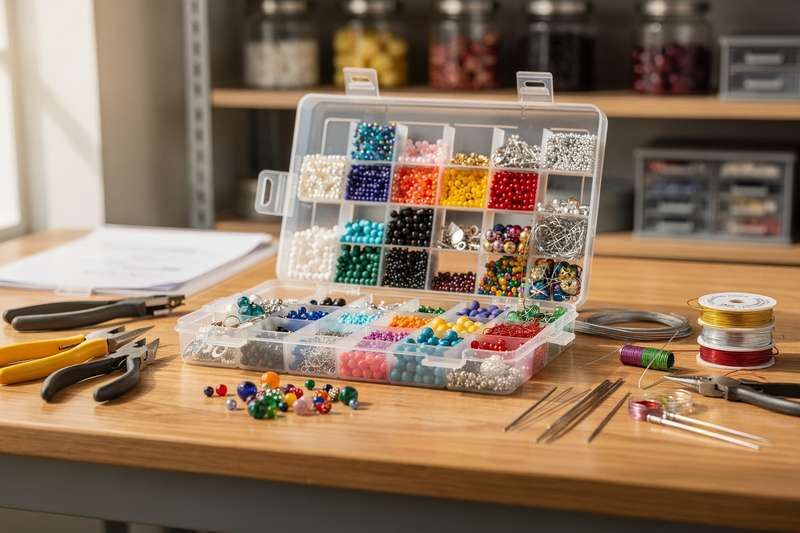
The Anezus Jewelry Making Tools Kit is the pick to reach for if you want a single purchase that covers the most ground for a beginner. It bundles wire wrapping pliers, beading needles, elastic string, and earring findings into one package — which sounds obvious until you realise most starter kits force you to buy tools and materials separately. Having everything arrive together means you can sit down and actually make something on the same day the parcel lands.
The pliers in this kit are the real reason to choose it over cheaper alternatives. Wire wrapping demands a round-nose plier for forming loops and a flat-nose plier for gripping and flattening — and the Anezus set includes both at a quality level that’s noticeably above what you’d find in a purely budget-focused pack. The spring-tension mechanism on the handles reduces hand fatigue if you’re doing a long session, which matters more than most beginners expect. The included elastic string is thick enough to feel sturdy but fine enough to pass through most seed beads and gemstone chips — a balance that’s harder to find than it sounds.
The earring findings (hooks, jump rings, and closures) are a practical touch that lets you complete a finished piece rather than leaving half-made components sitting on your desk. The variety isn’t huge, but for learning technique, having even a small stock of findings is far more useful than a larger pile of just one type. Reviewers consistently highlight that the kit feels like a genuine starting point rather than a token gesture towards completeness.
Where it falls short: if your primary interest is bead stringing rather than wire work, some of the pliers here are more specialised than you’ll need early on, and you’d be better served by a findings-and-wire kit instead. The beads themselves are not included — this is a tools-and-findings set, so you’ll need to pair it with a bead supply separately. It’s rated 4.5 stars and is particularly well-suited to anyone who’s watched a few wire-wrapping tutorials online and wants to move from watching to doing.
Best Entry-Level Kit for Total Beginners
If you’ve never touched a pair of jewellery pliers before and you want the gentlest possible on-ramp, the Kuuqa Jewelry Making Kit is the most sensible place to start. This 15-piece findings and tools set comes with four different beading wires and is specifically pitched at adults who are new to the craft — and that focus on simplicity is reflected in how the kit is organised and packaged.
The four beading wires cover different thicknesses, which teaches you early on why wire gauge matters. Thicker wire holds its shape better in structural pieces, while thinner wire passes easily through small-hole beads and works well for delicate stringing. Having all four in front of you from day one means you can experiment and develop an instinct for which to reach for in different situations — something that would otherwise take weeks of trial and error to figure out independently.
The 15-piece findings set is a practical assortment of clasps, crimp beads, jump rings, and end caps — the small components that turn a string of beads into a finished, wearable piece. These are things that many beginner crafters forget to buy until they’re halfway through a project, so having them included removes that frustration. The pliers included are basic but functional; they’ll handle light work without complaint, though they’re not the tools you’d reach for when you’ve progressed to more technical wire work.
The honest tradeoff here is that this kit is deliberately simple. It won’t satisfy anyone who wants to move quickly into more advanced techniques, and the findings variety is modest compared to larger kits. It also doesn’t include beads — again, you’ll need to source those separately. But for the person who wants to understand the fundamentals without being overwhelmed, the Kuuqa kit at its mid-range tier is an excellent starting point. It carries a 4.4-star rating, which reflects buyers who came in with realistic expectations and found them met.
Best Value Findings and Accessories Bundle
The 800 Pcs Jewelry Making Supplies Kit is the pick for anyone who already has tools but is running low on the small components that you burn through surprisingly quickly once you’re making regularly. With 84 verified reviews and a 4.5-star rating, this findings starter kit has enough real-world feedback to trust — and the pattern in those reviews is consistent: buyers are pleased by how many usable components are packed in at the budget tier.
Eight hundred pieces sounds like marketing hyperbole until you start a project and realise you’ve used twelve crimp beads before you’ve even finished one necklace. The kit covers jump rings in multiple sizes, lobster clasps, head pins, eye pins, crimp beads, and end caps — all the connective tissue of jewellery making that rarely gets discussed in beginner tutorials but that you genuinely cannot do without. The variety of clasp styles is particularly useful because different projects call for different closures: a lobster clasp suits a necklace, a toggle clasp suits a chunky bracelet, and toggle-style closures look better on some designs than a spring ring would.
The components themselves are silver-toned brass alloy, which is standard at this price point. They won’t pass as sterling silver, but for practice pieces and gifts, the finish is clean and consistent. Some reviewers note that a handful of the jump rings arrive slightly open, which means a quick adjustment with your pliers before use — not a dealbreaker, but worth knowing so you’re not confused when a ring doesn’t sit flush immediately.
What this kit doesn’t include is anything to string beads on — no wire, no thread, no elastic — so it works best as a complement to a separate materials purchase rather than a standalone kit. If you’re building up a craft stash piecemeal, this is one of the most efficient ways to stock up on findings without spending on individual components you’ll inevitably run short of at the worst moment.
Best Budget Pliers and Repair Tools Set
The FEPITO Jewelry Making Kit occupies a slightly different niche from the other tools picks here: it’s optimised for repair as much as creation, which makes it the smarter choice if you need to fix existing jewellery as well as make new pieces. The kit includes pliers suited to gripping, opening rings, and flattening crimp beads — the specific tasks that come up when a beloved necklace breaks and you need to restring it without losing all the beads.
The plier set covers the three most useful types for beginners: round-nose, flat-nose, and wire cutters. Round-nose pliers are for forming loops at the end of head pins and eye pins — those small teardrop shapes that let you attach a bead to a chain without it sliding off. Flat-nose pliers grip jump rings while you open and close them, which is a task that sounds trivial until you’ve tried to do it barehanded and bent the ring into a useless oval. Wire cutters at the budget level do a competent job on soft jewellery wire, though they’ll struggle with anything heavier-gauge.
The DIY craft supplies included — typically a mix of findings, wire, and a storage organiser — are functional rather than exceptional. At this tier, you’re really paying for the pliers; the additional components are a bonus rather than a selling point. That said, reviewers consistently note that the pliers perform above expectations for the price, holding their alignment through repeated use without the wobble that afflicts the very cheapest options on the market.
The FEPITO kit is rated 4.4 stars and is a solid pick if you’re buying for a teenager or a partner who’s expressed interest in making jewellery, because the repair element means the kit stays useful even if active crafting interest waxes and wanes. Everyone has a piece of jewellery that needs fixing — this kit handles that job as naturally as it handles a new creation.
Best Beading Needle Set
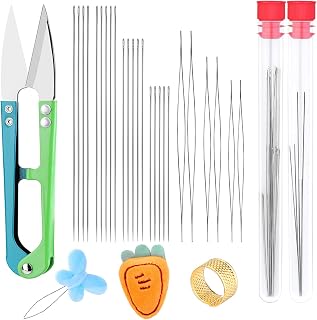
Needles get underestimated by almost every beginner, and the SUVSOON 29 Pcs Beading Needles Set is the most complete affordable needle collection available on Amazon UK right now. Rated 4.4 stars from 90 reviews, it covers a range that most beginners don’t realise they need until they’re in the middle of a project: 19 big-eye needles, 6 long straight needles, a pair of scissors, and a thimble.
Big-eye needles are worth a moment of explanation if you haven’t encountered them before. Rather than a fixed eye at the top like a sewing needle, big-eye needles split down most of their length, creating an opening that’s almost as long as the needle itself. This makes threading even the finest beading thread effortless, which matters enormously when you’re working with seed beads or delica beads where the thread hole is barely wider than a hair. If you’ve struggled to thread a standard needle and given up on bead weaving as a result, this type of needle is the solution.
The long straight needles in the set are suited to bead stringing and loom work, where you need a needle that can pass through a full sequence of beads in a single stroke without bending. The included scissors are small but sharp — sharp enough for cutting beading thread cleanly without fraying the end, which matters because a frayed thread end won’t pass through a small bead hole. The thimble is a practical addition for anyone doing intensive hand-stitching work.
The limitation of this set is obvious: it’s needles and cutting tools, not a complete kit. You’ll need to pair it with thread, beads, and findings separately. But if you already have some materials and your bottleneck is the right needles, this 29-piece set solves that problem thoroughly at a very low price point. It’s also an excellent addition to any kit that comes with pliers but skips the needles — which is most of them.
Best Crystal Bead Kit for Colour Work
The HONGTEYA 28 Colors Crystal Jewellery Making Kit is the standout bead-focused pick in this guide, and its 4.5-star rating from 779 reviews makes it one of the most confidently recommended options here. If your goal is to make colourful, sparkly pieces — rings, earrings, beaded necklaces — rather than wire-wrapped or loom-woven designs, this is where to start.
The headline is the 1,630 crystal gemstone beads across 28 colours. That colour range is genuinely useful, not just impressive on paper. When you’re designing a piece, having a full spectrum available means you can work from a colour scheme rather than being forced to work around whatever limited palette a smaller kit provides. The crystal-cut beads catch light well and photograph nicely — which matters if you’re making pieces to sell or give as gifts, because presentation is half the battle.
The bead shapes in the kit include round, faceted, and bicone styles, which lend themselves to different design aesthetics. Round beads are the most versatile for stringing; faceted beads add visual texture to a strand; bicones (the double-cone shape associated with Czech and Austrian crystal beads) are the standard for most earring and ring designs. Having all three styles available lets you experiment with mixed-shape designs from the start, rather than being locked into one look.
The tradeoff is that this kit focuses heavily on materials rather than tools. You’ll need to supply your own pliers, wire, and findings — it’s a bead pack, not an all-in-one kit. If you’re starting completely from scratch, pair it with the Anezus tools kit or the findings bundle reviewed elsewhere in this guide. For someone who already has the basics and wants a serious colour-and-variety bead upgrade, the HONGTEYA kit is hard to beat at the mid-range price tier.
Best Beginner’s Instruction Book
Bead Jewelry Making for Beginners: Step-by-Step Instructions for Beautiful Designs earns its place in this guide because no kit, however well-equipped, teaches you technique. Rated 4.5 stars, this book is aimed squarely at people who want to understand what they’re doing rather than just following a single pattern and hitting a wall the moment they try something different.
The step-by-step format is the key strength here. Each technique is broken down visually, which matters in jewellery making because the difference between a loop that closes neatly and one that springs open is a matter of hand position that’s almost impossible to convey in text alone. The projects progress logically from simple to more involved, which means you’re building on each success rather than being dropped into complex techniques before you have the motor memory for the basics.
The book covers a range of styles — not just stringing but also wire wrapping, knotting, and working with findings — which gives it a longer useful life than a single-technique manual. If you complete the projects in order, you’ll finish with a grounded understanding of what jewellery making actually involves, rather than a collection of half-finished experiments. It’s also a good companion gift if you’re buying a kit for someone else: pairing a tools-and-materials set with a solid instructional book removes the “where do I even start?” barrier entirely.
The honest limitation is that any book goes out of date relative to current trends in bead styles and jewellery fashion, and some of the materials referenced may be slightly different to what you find on Amazon UK today. But technique is technique — the fundamentals covered here don’t change with trends, and this is a foundation text rather than a trend guide.
Best Reference Book for Wider Creative Range
Best Book of Beading: Jewelry, Bottles, Purses & Accessories is the most unusual pick in this guide, and it earns its place precisely because it goes well beyond necklaces and bracelets. Rated 3.8 stars from 18 reviews, it’s the lowest-rated pick here — and that rating reflects its slightly more niche audience rather than poor quality.
The scope of this book is its defining feature. Most beading books focus on wearable jewellery, but this one extends into beaded bottles, purses, and home accessories — areas that experienced crafters often explore once they’ve mastered the core techniques and want to apply them differently. If you have any interest in decorative beading beyond jewellery, this is the book that opens that door. The projects that involve beading onto fabric and surface-decorating everyday objects are hard to find in most beginner-focused publications.
The 3.8-star rating comes with context. Reviewers who wanted a strict jewellery-making manual found it broader than expected. Those who wanted creative inspiration across multiple beading applications found it genuinely useful. The illustrations are older in style, which some readers find dated — but the techniques demonstrated are sound, and dated photography doesn’t affect the accuracy of an overhand knot.
This is not the first book to buy if you’re a complete beginner — the step-by-step instructions book reviewed above is the better entry point. But once you’ve got the basics down and you’re looking to expand your creative range, this reference adds real value. It’s particularly useful as a second book once you’ve worked through a more structured beginner text, or as a gift for someone who’s already been making jewellery for a while and is looking for new directions.
What to Look For When Buying Budget Beading and Jewellery-Making Supplies
- Tool quality over quantity: A kit advertising 50 pieces that includes thin, spring-loaded pliers you can bend with one hand is worse than a kit with 15 pieces where the pliers actually grip. Prioritise kits that describe the plier mechanisms (spring-loaded, non-slip grips) and that come from brands with enough reviews to reveal tool durability over time. Round-nose, flat-nose, and wire cutters are the three types you genuinely need; everything else is optional at the start.
- Wire gauge range: Jewellery wire is measured in gauges — finer gauges (higher numbers) pass through smaller bead holes; heavier gauges (lower numbers) hold structural shapes. A kit that includes only one wire thickness will limit you to a narrow range of projects. Look for kits that include at least two or three thicknesses, or buy a multi-gauge set separately.
- Findings variety: Findings are the functional components — clasps, crimp beads, jump rings, head pins, eye pins. These are what you run out of fastest once you’re making regularly, and they’re also what determines whether a finished piece looks professional or amateurish. A kit strong on beads but thin on findings will frustrate you quickly. Look for a reasonable spread of clasp types and multiple sizes of jump rings.
- Needle type for your technique: Not all beading needles suit all techniques. Big-eye needles are best for seed beads and fine thread work; long straight needles suit loom and stringing work; short curved needles are used in bead embroidery. If you know which style of making you want to pursue, buy accordingly — a generic needle set that covers multiple types is a safer starting bet for beginners.
- Bead hole size and thread compatibility: This is the compatibility issue most beginners don’t think about until they’re stuck. Seed beads have very small holes; crystal beads and gemstone beads usually have larger ones. Make sure your chosen thread, elastic, or wire will actually pass through the beads you plan to use. If in doubt, buy beading thread rather than standard thread — it’s thinner and purpose-designed for the task.
- Storage and organisation: If your kit arrives in a bag, you’ll spend twenty minutes every session hunting for a specific crimp bead. Kits that include a storage box — even a basic compartmentalised tray — are worth slightly more because they keep components sorted and usable rather than jumbled. This sounds trivial until you’ve spilled 200 seed beads across a carpet once.
- Instructional support: A kit with no instructions assumes you already know what to do with the components, which most beginners don’t. Look for kits that include at least a basic guide card, or pair your kit purchase with a dedicated beginner’s instruction book. YouTube tutorials complement both well, but having printed reference you can keep beside your workspace is consistently more useful than pausing a video every thirty seconds.
Verdict
For the modal reader of this guide — someone who’s curious about jewellery making, wants to get started without spending heavily, and would like to be making something wearable within their first session — the combination approach works better than any single kit. Start with the Anezus Jewelry Making Tools Kit for your pliers and wire fundamentals, add the 800 Pcs Jewelry Making Supplies Kit for a comprehensive findings stock, and pair both with the HONGTEYA 28 Colors Crystal Jewellery Making Kit for beads that actually inspire creativity.
If you want a single, no-fuss starting point — particularly as a gift — the Anezus wire wrapping kit covers the most ground in one box and has the tool quality to keep you coming back to it rather than reaching for replacements after your first project. Add the Bead Jewelry Making for Beginners book alongside it, and you have a setup that will take a complete newcomer from confused to confident in a weekend.
We were not paid to feature any specific product in this guide. All opinions are independent and based on publicly available specifications, verified buyer feedback patterns, and category research.
Quick Comparison Table



FAQ
What do I actually need to start making jewellery at home?
At minimum, you need three things: round-nose pliers and flat-nose pliers for manipulating wire and jump rings, some beading wire or elastic cord to string your beads onto, and a selection of findings (clasps, crimp beads, jump rings) to finish your pieces. Beads themselves are optional to start if you’re practising wire work, but most beginners want to add beads immediately. A wire cutter is the fourth essential tool — many kits include all four together.
Is elastic cord or beading wire better for a beginner?
Elastic cord is more forgiving for absolute beginners because it doesn’t require crimp beads or clasps — you simply tie a knot and the bracelet stretches over your hand. The tradeoff is that elastic eventually breaks with wear, and knots can slip if not secured with jewellery glue. Beading wire (typically nylon-coated stainless steel) makes more durable, professional-looking pieces but requires crimping tools and a crimp bead to finish securely. Start with elastic for bracelets while you’re learning, and move to wire as your confidence grows.
What’s the difference between findings and beads?
Beads are the decorative elements you string, weave, or wire-wrap — the visible, colourful part of a piece. Findings are the functional metal components that hold everything together: clasps that fasten necklaces, jump rings that connect components, head pins that anchor beads to chains, crimp beads that secure wire ends. You cannot complete a finished, wearable piece without findings, but they’re often underrepresented or missing entirely from cheaply packaged beginner kits.
Can I start making jewellery to sell after completing a beginner kit?
Technically yes, but realistically you’ll want to practise more before committing to selling. Buyer expectations for handmade jewellery — even at low price points on Etsy — include neat finishes, secure closures, and consistent quality. A beginner kit gives you the technical foundation, but consistent results come with practice. Work through at least ten to fifteen pieces before you evaluate whether your output is at a sellable standard, and focus on learning to close jump rings neatly and crimp beads securely — these are the details buyers notice.
Are crystal beads the same as gemstone beads?
No. Crystal beads are typically glass with a faceted cut that refracts light — they’re often described as Czech or Austrian crystal and are entirely manufactured rather than mined. Gemstone beads are made from actual mineral stones (amethyst, turquoise, jade, and so on) and vary in quality, dye treatment, and sourcing. Crystal beads are more uniform in size and colour, making them easier for beginners to work with consistently. Gemstone beads add a natural, organic quality to pieces but can vary in hole size and weight in ways that require slightly more experience to accommodate.
How do I stop beads from slipping off while I’m working?
The most common fix is a bead stopper — a small spiral spring clip that grips the wire end and prevents beads from sliding off while you string the rest. You can improvise with a piece of masking tape folded over the wire end, or by threading through a larger bead and pinching it temporarily. For elastic cord work, holding the end between your fingers or securing it to your work surface with a clothes peg works well. Once you’ve finished stringing, crimp beads (for wire) or a secure double knot with a dab of jewellery glue (for elastic) keeps everything in place permanently.