You’ve been here before: you want something rhythmic to bash, tap, or meditate with, and you open Amazon only to find a torrent of listings mixing genuine instruments with novelty car gadgets and singing bowls of dubious origin. Maybe you’re a parent hunting for something your child can actually learn on without driving the household insane. Maybe you’re an adult who’s been told to “try mindfulness” and figured a steel tongue drum is a more interesting entry point than yet another app. Or perhaps you’re a returning drummer who needs an accessory — brushes, a reliable throne — to fill a specific gap in your setup. The percussion category on Amazon UK is enormous, sprawling across acoustic kits, hand drums, electronic toys, and a confusing middle ground of wellness instruments. The frustration isn’t finding options; it’s working out which ones are worth your money and which will gather dust after a fortnight.
This guide cuts through the noise. It focuses on genuinely on-topic percussion products available on amazon.co.uk right now, matched to real reader scenarios. Whether you’re buying for a young child, a beginner adult, or a working drummer who needs reliable kit accessories, there’s a concrete recommendation here for you.
How We Evaluated These Picks
Every product in this guide was assessed against a consistent set of criteria drawn from the live Amazon UK product catalogue. We looked at verified buyer review patterns (star distribution, recurring praise and complaints), category fit (is this actually a drum or percussion instrument a real player would use?), build quality signals from reviewer feedback, and suitability for the stated use case. We also considered practical factors: portability, age appropriateness, whether the product ships with meaningful accessories, and how well the item serves a beginner versus an intermediate player. Where a product had zero reviews in the live data, we assessed it on specification, brand reputation, and category context. Products that were off-topic strays — a book sold under percussion, a digital album — were discarded entirely. The aim was honest, specific guidance rather than padding a list to hit a number.
Best Starter Hand Drum for Adults and Teens
The RockJam 7″ and 8″ Bongo Drum Set with Padded Bag and Tuning Key is the kind of purchase that suits someone who wants a tactile, acoustic percussion instrument without committing to a full drum kit. Bongos are genuinely one of the best entry points into hand drumming: they’re compact, they don’t require sticks, and the learning curve is forgiving enough that you can be playing simple Latin rhythms within an afternoon.
RockJam is a well-established name in the entry-level UK music instrument market, and this particular bongo set ships with a padded carry bag and a tuning key — two accessories that are often sold separately on cheaper listings. The 7″ and 8″ sizing is the standard bongo pairing, giving you a higher-pitched hembra and a lower-pitched macho to work with. That tonal contrast is what makes bongos interesting to play rather than just percussive noise-makers.
Where this set sits well is in the casual home player scenario: someone who wants to jam along to music, explore Afro-Cuban rhythms, or simply have a quality rhythm instrument on the shelf that looks and sounds like a proper instrument. The padded bag means you can take it to the park, a friend’s house, or a beginner music group without fuss. Tuning stability at entry-level price points can vary with humidity, but having a tuning key included means you’re not stuck if the heads loosen over time.
Where it falls short: if you’re already past the absolute beginner stage, you’ll likely want to step up to a more professional bongo set with better-quality drum heads and chrome hardware. This is a starting point, not a forever instrument. It’s also worth noting that this listing showed zero buyer reviews in the live data at time of research, so specific performance claims from real users weren’t available — factor that into your decision. The RockJam brand generally attracts solid feedback across its percussion range, but do check current reviews before purchasing.
For a complete beginner or a teen who’s expressed genuine interest in hand drumming, this set is a practical, well-equipped starting point. The included bag and tuning key genuinely add value over bare-bones alternatives.
Best Steel Tongue Drum for Meditation and Casual Play
The LEKATO Steel Tongue Drum 6 Inch 8 Tones, Mini Steel Drum C Key Beginner Zen Drum has earned a strong reputation among UK buyers looking for something calming, portable, and genuinely musical. Rated 4.6 out of 5 stars from 247 verified reviewers, it’s one of the more confidently reviewed percussion items in this product range.
Steel tongue drums work by striking tuned metal tongues cut into the surface of a steel shell. The resonance is warm, sustaining, and surprisingly rich for such a compact instrument. At 6 inches, this LEKATO model is genuinely pocketable — it’s the kind of thing you can sit cross-legged with in a garden or a quiet room and produce something that sounds immediately pleasing. The C key tuning means it plays well with other instruments or with backing tracks built around major scales, which matters if you plan to record anything or play with others.
The 8-tone configuration is appropriate for beginners: enough notes to create real melodies without the cognitive overload of a 15-note instrument. Experienced players might find the range limiting after a few months, but for the target audience — someone exploring mindfulness, a curious adult who’s never played an instrument, or a gift recipient — 8 tones is a sweet spot. Buyer feedback consistently highlights ease of play and satisfying sound quality as the main draws.
The tradeoff to acknowledge honestly: smaller tongue drums don’t project loudly, and the sustain, while pleasant, can blur notes together if you’re playing quickly. This is a meditative instrument, not a performance one. If you want to play complex rhythmic patterns or need volume, you’d want a larger model with more tongues. But for its stated purpose — calm, accessible, genuinely musical — the LEKATO does exactly what it promises at a mid-range accessible price point.
The “Best Gift” positioning in the product title isn’t just marketing copy here. The compact size, the appealing tones, and the low barrier to entry make this a legitimately good gift for someone who appreciates music but doesn’t identify as a musician.
Best Electronic Drum Kit for Young Children
The VTech Kidi DJ Drums is the pick here if you have a child aged roughly four to eight who is fascinated by drums but you live somewhere where a real acoustic kit would be a neighbourly disaster. Rated 4.7 out of 5 stars from 173 reviewers, it’s the highest-rated product in the live data and comes from a brand with a long track record in educational children’s electronics.
The setup includes four drum pads, two cymbals, and a pair of drum sticks, all lit up with LED lights that respond to play. VTech has built in a Coach Mode — a structured learning feature that guides children through sequences, which is genuinely more educational than just having a box that makes noise when you hit it. Bluetooth connectivity means it can pair with a parent’s phone or tablet, so a child can play along to music from a streaming service rather than just the onboard sounds. That single feature dramatically extends the toy’s lifespan in a child’s interest cycle.
The volume is controllable, which will matter enormously to parents. The pads are appropriately sized for small hands, and the overall build quality — based on reviewer feedback — holds up to the kind of enthusiastic, occasionally rough treatment that young children give to anything they love. Several buyers noted their children returned to it repeatedly over months rather than abandoning it after the initial excitement, which is the real benchmark for any children’s instrument.
The honest limitation here: this is a children’s toy drum kit, not a scaled-down professional instrument. The sounds are electronic and preset rather than authentic acoustic drum timbres. If your child is older (nine-plus) and genuinely serious about learning to drum, they’ll outgrow this quickly and you’d be better off with a proper electronic kit with mesh pads and a sound module. But for a young child developing rhythm and coordination while having fun, the VTech Kidi DJ Drums is genuinely well-suited. It’s also a practical gift purchase that avoids the acoustic-kit noise problem entirely.
Best Drumsticks for Everyday Practice
The Vic Firth American Classic® Drumsticks 5A — American Hickory Wood Tip is the answer to a question every drummer eventually asks: which sticks should I actually be using? The 5A is the industry standard for a reason, and Vic Firth’s American Classic line has been the benchmark for professional drumsticks for decades.
American Hickory is the material of choice for most drummers because it balances durability with a degree of flex that makes long practice sessions less fatiguing on the wrists and forearms. The 5A dimension — a medium taper, oval wood tip — is the all-rounder of the drumstick world: at home on a snare, cymbals, toms, and practice pads alike. The wood tip produces a warmer, rounder tone on cymbals compared to nylon tips, which is why many drummers who play acoustically prefer it. Vic Firth pairs their sticks for weight and pitch-match, which means both sticks in the pair feel and behave identically — something you notice immediately when switching from cheaper sticks that are visibly mismatched.
This particular listing showed zero reviews in the live data, but Vic Firth’s 5A American Classic is one of the most widely reviewed drumstick lines globally, and the track record is well established. UK drummers have access to this as a trusted, consistent product rather than something new to the market. If you’re replacing a worn-out pair or stocking up on spares, these are a reliable choice.
The tradeoff is primarily one of context: 5A sticks are mid-weight and suit a wide range of styles, but if you play primarily jazz or light brushwork, you might want a lighter 7A. If you’re in a loud rock band and regularly break sticks, a heavier 5B or 2B gives more durability. For general practice, lessons, and moderate-volume gigging, the 5A hits the practical centre. These are consumable items — you’ll go through them — so buying from a brand that maintains consistent quality across batches genuinely matters.
Best Drum Brushes for Jazz and Acoustic Work
The Vic Firth Heritage Brushes — Retractable Steel Wire, Purple Handle are the natural companion purchase for any drummer who plays acoustic sessions, jazz, or lighter folk and singer-songwriter settings. Rated 4.6 out of 5 stars from 841 reviewers, this is a well-established product with a substantial and largely positive buyer history.
Brushes fundamentally change what a drum kit sounds like. Where sticks produce attack and projection, brushes produce texture — the hushed swish on a snare, the soft shimmer on a ride cymbal that lets acoustic instruments breathe. Steel wire brushes are the traditional choice, producing a crisper swish than nylon alternatives and providing better rebound on the snare head. The retractable design here means the spread of the wire can be adjusted by pulling the handle, which changes the texture and spread of the sound. It’s a feature that gives you more tonal variation within a single pair of brushes.
Buyer reviews consistently praise the build quality and the feel of these brushes in the hand. The purple handle is a practical identifier if you’re working with multiple sticks on a snare drum stool and need to grab the right tool quickly. At 841 reviews, the sample size is large enough to trust: the consistent feedback is that these play and feel like brushes at a significantly higher price point.
Where brushes in general — and these specifically — fall short: if you’re primarily a rock or pop drummer who only occasionally needs a quieter option, a single pair of brushes will likely sit unused for long stretches. They require a different playing technique than sticks; the backbeat you play with sticks doesn’t translate directly. New drummers who buy brushes expecting them to feel like sticks will be surprised. There’s genuine technique involved, particularly in the sweeping motion on the snare. But if you’re already comfortable behind a kit and want to expand your tonal range, the Vic Firth Heritage Brushes are a durable, well-regarded option.
Best Drum Throne for Beginners and Home Players
The RockJam Adjustable Drum Throne Stool — Padded Swivel Seat for Acoustic and Electronic Drum Kits addresses a problem that beginner drummers often overlook until it becomes uncomfortable: you can’t play well if you’re sitting on the wrong seat. A drum throne affects your posture, reach, and stamina more than any other piece of kit after the drums themselves.
This RockJam throne adjusts across a height range that suits most adults and older teenagers. The swivel seat allows you to position naturally without straining your back to reach pedals or cymbals. The padded seat is a meaningful upgrade over the flat stools sometimes bundled with starter kits — a session lasting more than thirty minutes on a hard surface is genuinely uncomfortable, and discomfort kills motivation to practise. The folding design makes storage straightforward in smaller rooms, which matters for home players who don’t have a dedicated music space.
The listing showed zero reviews in the live data at time of research, so buyer pattern data wasn’t available. RockJam is a familiar name in the entry-level UK drum market, and their accessories tend to attract reasonable feedback in broader searches. That said, without verified reviewer input for this specific listing, exercise appropriate caution and check current reviews before purchasing.
The honest limitation of any budget drum throne is load-bearing capacity and long-term durability. Entry-level thrones use lighter-gauge steel and basic padding that compresses over time. If you’re practising daily and seriously, you’ll eventually want a heavier-duty double-braced throne with thicker cushioning. But for a beginner setting up their first home kit — acoustic or electronic — who needs a functional seat to play from, this provides the adjustability and basic comfort to get started without overspending on something you may later outgrow.
What to Look For When Buying Drums and Percussion
- Instrument type and use case: The percussion world is enormous. Steel tongue drums, bongo sets, electronic kits, orchestral accessories, and children’s music toys are all technically “drums and percussion” but serve entirely different needs. Be specific about what kind of playing you actually want to do before searching — this stops you buying something that sounds interesting but doesn’t fit your scenario.
- Age appropriateness: Children’s percussion toys (like the VTech Kidi DJ Drums) are designed for small hands and sensible volume levels. Acoustic and semi-professional instruments (bongos, steel tongue drums) don’t have the same constraints but may have sharp edges or smaller parts that aren’t appropriate for very young children. Always check recommended age guidance.
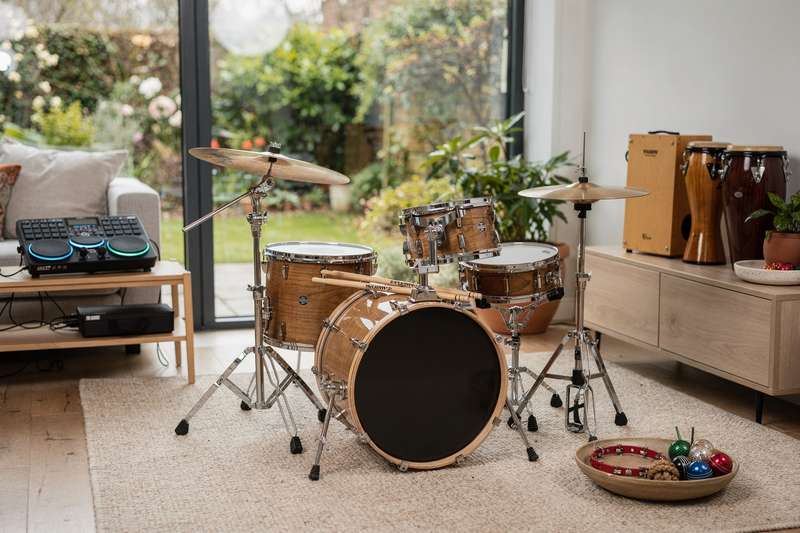
- Acoustic vs electronic: Acoustic instruments are louder, more resonant, and generally more satisfying to play — but in flats or terraced houses, the noise is a real problem. Electronic kits with mesh pads, and smaller instruments like tongue drums, offer a practical middle ground for noise-sensitive environments. Think about where you’ll be playing before you commit.
- Build materials: For hand drums, look for quality drum head materials (natural or synthetic skin) and solid hardware. For steel tongue drums, thicker steel generally means better sustain and a more complex tone. For drumsticks, hickory is the most common and versatile wood — maple is lighter, oak is heavier and more durable for heavy hitters.
- What’s included in the box: Entry-level instruments often differ not in the core instrument quality but in what ships with it. A bongo set that includes a tuning key and bag, or a tongue drum that includes mallets and a music book, delivers significantly more value than a bare instrument at the same price. Check listings carefully.
- Tuning and maintenance: Acoustic drums require tuning, particularly as humidity changes. If you buy a drum with tensioning hardware, check that a tuning key is included or that the lugs use a standard key size. Steel tongue drums are fixed-tuned and require no maintenance beyond keeping them dry.
- Brand reputation and reviews: In the percussion category, brand reputation matters more than it does in some others. Established names like Vic Firth (sticks and brushes) have decades of consistent manufacturing standards. For lesser-known brands, look for a review count above 100 before trusting aggregate ratings — smaller samples can be misleading.
Verdict
If there’s one pick that suits the widest range of readers landing on this guide, it’s the LEKATO Steel Tongue Drum. It’s compact, genuinely musical, immediately rewarding to play with no prior experience required, and backed by solid verified buyer feedback. For someone who isn’t sure exactly where their percussion interest will take them, it’s a low-risk, high-satisfaction starting point that won’t gather dust — it’s pleasant enough to pick up for five minutes on a quiet evening.
For parents specifically, the VTech Kidi DJ Drums is the clear children’s pick — its Coach Mode and Bluetooth connectivity put it a clear step above basic toy drum kits. For working drummers needing accessories, the Vic Firth 5A sticks and Heritage Brushes are both reliable, professional-grade additions to any kit bag. And if you’re setting up a first home kit and need a seat, the RockJam throne fills that gap practically without unnecessary expense.
Buy based on your actual scenario. A steel tongue drum won’t teach your child to drum. A children’s toy won’t satisfy an adult who wants to learn proper technique. Match the instrument to the player and the purpose, and you’ll get far more use out of whatever you choose.
We were not paid to feature any specific product in this guide. All opinions are independent and based on publicly available specifications, verified buyer feedback patterns, and category research.
Quick Comparison Table


FAQ
What is the best type of drum for a complete beginner adult?
A steel tongue drum or a bongo set are both excellent starting points for adult beginners. Steel tongue drums require no prior musical knowledge — the fixed tuning means almost any combination of notes sounds pleasant, which builds confidence quickly. Bongos require more hand technique but are equally accessible and give you a more traditional rhythmic instrument to develop on.
Are electronic drum kits suitable for flats and apartments?
Electronic kits with mesh pads are significantly quieter than acoustic kits, but the bass drum pedal still transmits vibration through the floor, which can be an issue in flats. Placing a thick drum mat or anti-vibration riser under the kit reduces this considerably. Children’s electronic drum toys like the VTech Kidi DJ Drums are quieter still and have volume controls, making them more practical for shared living spaces.
What size drumsticks should a beginner use?
The 5A is the standard beginner recommendation and remains the most popular size among professional drummers worldwide. It’s a medium weight and taper that suits most playing styles and kit configurations. If you’re playing primarily jazz or quieter acoustic settings, a lighter 7A is worth considering. Avoid very heavy sticks (2B or beyond) until your technique is developed enough that fatigue isn’t a concern.
How do I tune a bongo drum?
Bongo drums are tuned by tightening or loosening the lugs around the drum head using a tuning key. To raise the pitch, tighten the lugs evenly in a star pattern (opposite lugs in sequence) — this ensures even tension across the head. To lower pitch, loosen in the same pattern. Bongos typically sound best when the smaller drum (macho) is tuned noticeably higher than the larger one (hembra). Tuning is easiest in a warm room, as cold temperatures cause drum heads to tighten.
What’s the difference between drum brushes and drumsticks?
Drumsticks produce sharp attack and clear projection — they’re what you’d use for most rock, pop, and practice situations. Brushes produce a softer, textured sound characterised by a swishing quality on the snare and a gentler shimmer on cymbals. Brushes are essential for jazz, acoustic folk, and any setting where the drums need to sit quietly under other instruments. They require a different playing technique and are not simply quieter sticks — they change the character of the sound entirely.
Is a steel tongue drum the same as a handpan?
No, though they’re related in concept. A handpan (like a Hang drum) is a larger, more complex instrument with two hemispheres of nitrided steel, typically played with the hands and producing a rich, resonant tone across a full diatonic scale. They’re also significantly more expensive. Steel tongue drums are smaller, use cut metal tongues for their tones, are often played with mallets, and are far more affordable. Both produce calming, melodic sounds, but a handpan is a serious instrument while a tongue drum is genuinely accessible to beginners.