Picture this: it’s a grey Saturday morning and your seven-year-old is crouched at the bottom of the garden, shaking a stick at something under a log. You’ve suggested going inside three times. You haven’t succeeded. What’s missing isn’t enthusiasm — your child has that in abundance — it’s the right tools to channel all that restless curiosity into something that lasts longer than ten minutes and doesn’t end with a muddy stick abandoned on the patio.
Maybe you’ve already tried to fix this. There was the magnifying glass that arrived cracked in the packaging. The so-called nature explorer backpack from a gift shop that contained a broken compass, a map so small it was useless, and binoculars so poorly made they might as well have been cardboard tubes. Or the science kit that promised the world and delivered one test tube and a leaflet about condensation. Every time, the toy shelf fills up a little more and the curiosity outside goes unsatisfied.
Here’s what those purchases got wrong: they focused on the look of exploration rather than the function of it. A good explorer toy gives a child a genuine mission — something to catch, something to observe up close, something to document — with tools that actually work in small hands. Done right, this category keeps kids outdoors and engaged for real stretches of time, builds attention and observation skills, and gives you the occasional excuse to crouch in the hedge and peer at a beetle without anyone questioning your sanity. This guide skips the packaging aesthetics and focuses on what actually works.
How We Chose These Picks
Each pick in this guide was assessed against five criteria. Age-appropriateness: do the tools actually function for the hands they’re aimed at, without constant adult intervention? Durability: outdoor toys get dropped, dragged through hedges, and left damp in rucksacks — build quality matters enormously here. Set completeness: the best explorer kits give a child everything they need for an expedition without requiring follow-up purchases to become useful. Ease of use: a butterfly net that requires assembly instructions is a butterfly net that will never get used. And sustained play value: does the kit maintain interest past the first afternoon, or does it live in the toy box after a week?
Where Amazon UK buyer reviews were available, I cross-referenced feedback patterns — particularly what parents noted about durability failures, age-rating accuracy, and how long children actually stayed engaged. Two products in this guide are newer listings with no customer reviews at the time of writing; their sections flag this clearly, and assessments draw on product specifications and kit contents rather than verified buyer experience.
Best All-in-One Starter Set for Young Explorers
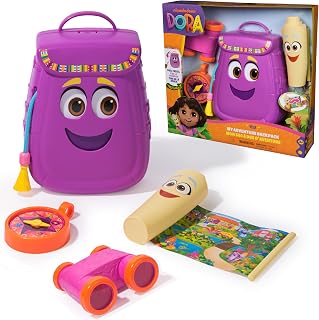
The Dora My Adventure Backpack is the pick for parents of three-to-five-year-olds who want everything bundled into a format their child can carry independently. It pulls in the recognisable Dora the Explorer character — which, for a child in the right age bracket who knows the show, immediately gives the whole set a narrative frame. That matters more than it sounds: children play better with things they feel ownership of, and character-branded gear tends to go on adventures more willingly than generic kit.
The set pairs a child-sized backpack with a retractable map, toy binoculars, and a compass. For a three-year-old, this is a substantial explorer vocabulary in one package. The binoculars won’t deliver the magnification of adult optics, but at this age that isn’t the point — the point is having something to look through, to point at birds, clouds, and suspicious rustlings in the undergrowth. The compass introduces directional awareness without requiring the child to understand it fully. The retractable map is the kind of prop that turns a walk around the block into a proper expedition with a destination.
With 163 verified buyers giving this a 4.6-out-of-5 rating on Amazon UK, the feedback is consistent: parents of young children rate it highly for keeping small ones engaged during outdoor time. Reviews suggest the backpack is well-sized for a toddler or reception-age child, and that the accessories hold together through regular use rather than falling apart in the first week — which is a real differentiator at this end of the market, where fragile joins and loose parts are a common complaint.
The tradeoff to be honest about: the character branding has a limited shelf life. If your child is already past the Dora phase, or has never engaged with the show, the set loses much of its immediate appeal. For a six-year-old who considers themselves too old for Dora, you’d be better placed with one of the more tool-forward sets in this guide. This is also not the pick for a child who wants serious bug hunting — the accessories here are more about orientation and observation than hands-on wildlife interaction. Think of it as an introduction to the concept of exploring, packaged in something a toddler will actually want to carry.
The backpack format is worth a specific mention because it changes the whole play dynamic. A child who carries their own explorer gear is a child who feels responsible for the mission. Parents who’ve tried giving children a separate bag for their tools often find it becomes the parent’s bag within five minutes. The integrated design sidesteps that entirely, and for younger children just beginning to enjoy independent outdoor time, that sense of autonomy is significant.
Best STEM Explorer Gadget
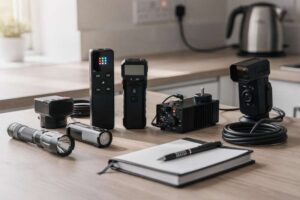
The Endoscope for Kids, Snake Camera Toy with Lights is the most technically interesting pick in this guide — and the one most likely to produce jaw-dropping moments the first time a child uses it. The premise is simple: a flexible snake-style camera with built-in LED lighting that lets children see into spaces that are normally entirely inaccessible — down rabbit holes, under the shed floor, into tree hollows, behind the garage wall, deep into the base of hedgerows. What the camera reveals opens up a dimension of exploration that no other tool in this category can match.
This is the right pick for children aged roughly six and upwards who have moved beyond surface-level looking and want to investigate the spaces they cannot physically reach. It combines genuine exploration with a STEM framing — children who use this regularly start asking questions about why certain creatures live in dark enclosed spaces, what conditions different insects require, and how light behaves in confined environments. Those are genuinely educational outcomes that emerge naturally from play rather than from a worksheet, which is a rare quality. The product holds a 4.5-out-of-5 rating from 466 Amazon UK reviewers — a solid sample for a specialist children’s gadget.
The reviewer feedback is worth close attention. Parents repeatedly note that this is one of the few tech-forward toy products children return to repeatedly rather than abandoning once the novelty fades. The LED lighting works well for genuinely dark spaces, and the flexible cable design means children can navigate corners and angles in cramped outdoor environments. Setup is described as manageable without heavy adult involvement once the basics have been covered, though some reviewers note that children at the younger end — particularly five-to-six-year-olds — benefit from a brief adult introduction before going independent with it.
The honest limitation: the camera cable needs reasonable care to avoid kinking damage, which is a fair ask of an eight-year-old but less realistic for a four-year-old. It is also specifically a single gadget rather than a broad explorer kit — it pairs well with other tools in this guide but doesn’t replace a butterfly net or binoculars. Think of it as the specialist instrument in a wider explorer toolkit rather than a standalone solution for all outdoor curiosity. For children drawn to screen-based interaction but whom you want pointing that instinct at the natural world, this is an unusually effective bridge.
The STEM positioning here is genuine rather than a marketing label. Children with real curiosity will use it to investigate soil layers, root systems, small animal habitats, and the underside of surfaces they walk past every day. That kind of close-range environmental awareness is the foundation of scientific thinking, made accessible without any formal instruction. As a birthday or Christmas gift for a child who always wants to know how things work, it’s a strong and distinctive choice.
Best Bug Hunting Kit
The Dreamon Bug Hunting Kits for Children is the pick specifically for families where outdoor time reliably ends with someone excited about a beetle. This set leans into bug interaction more than anything else in this guide, combining a butterfly net, a bug vacuum for safe capture, a wooden bug cage for observation, and a storage bag — plus an explorer costume element that gives the whole activity a role-play dimension alongside the practical tools.
The wooden bug cage is what separates this from cheaper plastic alternatives in the category. Plastic bug containers have a habit of cracking at the hinge or losing their latch at the worst possible moment — usually when a child has just caught something interesting. Wood handles the outdoors better and is a more sustainable material choice. The cage uses mesh sides for ventilation, so captured insects remain alive during observation before being released, which is an important design detail for teaching children to handle wildlife responsibly.
The bug vacuum deserves a specific mention because it sounds slightly absurd but works well in practice. It lets children capture a spider or ladybird into a transparent chamber for a close look without direct handling, removing the anxiety barrier that stops many young explorers from engaging with what they’ve found. Parents report in reviews that this is often the first tool children reach for, and that it transforms a passing interest in insects into a sustained, structured activity. The vacuum works most reliably with medium-sized insects — beetles, ladybirds, caterpillars — and somewhat less so with very small mites or ants, which is a real limitation worth knowing before purchase.
The 4.2-out-of-5 rating from 97 reviewers sits slightly lower than the 4.5-plus scores on other reviewed picks, and the feedback suggests this primarily reflects the bug vacuum’s performance with small insects and the fact that the butterfly net is functional rather than premium — adequate for garden butterflies and moths but not designed for rapid deployment on fast-movers. These are real tradeoffs, not dealbreakers. The overall kit is well-balanced and the wooden cage in particular receives consistent positive feedback for holding up through outdoor use.
The explorer costume included shifts the whole activity from playing in the garden to going on an expedition. Children who might resist outdoor time often engage more readily when a costume establishes a clear identity for the activity. For children who respond strongly to imaginative role-play, this detail genuinely changes how much time they spend outside. The set suits ages four and upwards, and based on contents and buyer feedback, it’s most naturally at home with the five-to-nine bracket.
Best Value Multi-Tool Kit
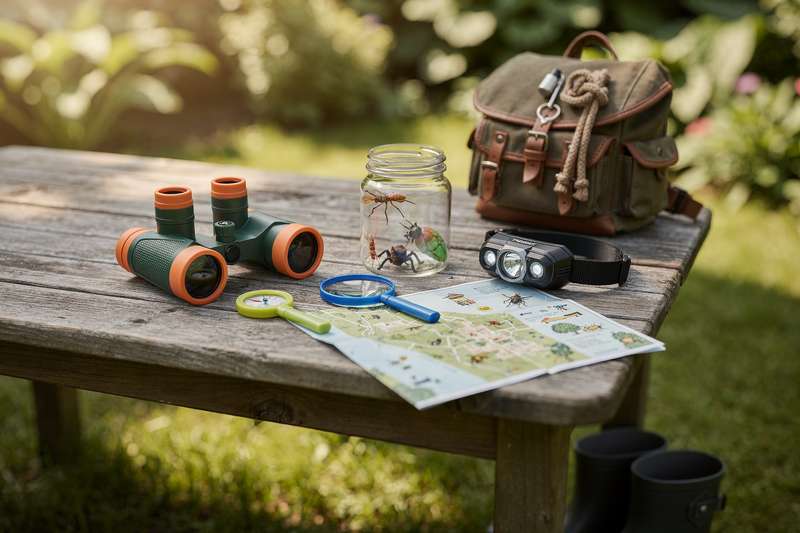
The Kiztoys Outdoor Explorer Kit takes a broad-coverage approach: 22 pieces in a single adventure set that touches most of the core explorer activities in one go — binoculars, bug hunting tools, and a map among them. If you want to give a child the full toolkit rather than specialising in one direction, this is the pick to consider as a foundation.
The 22-piece count is worth being precise about. In this format, that typically means a combination of observation tools (binoculars, magnifying glass), capture and containment tools (nets, containers, tweezers), and documentation props (notepad, map, pencils). That spread means a child has tools for whatever they encounter outdoors — birds in the distance requiring binoculars, insects underfoot requiring close-range gear, or a found object worth examining and recording. That versatility is useful when you don’t yet know which aspect of outdoor exploration a particular child will gravitate towards.
There’s a caveat that needs stating clearly: this product carries no customer reviews on Amazon UK at the time of writing. It appears to be a newer listing, which means durability and play-value assessments here draw on product specifications and the track record of comparable multi-piece explorer kits rather than verified buyer experience. If you need confidence backed by real buyer feedback, the Dora Adventure Backpack, the Endoscope, or the Dreamon Bug Kit all have that. The Kiztoys kit’s specification and contents suggest a well-rounded set for children aged four and upwards, but the absence of review data is a real limitation that should inform your decision.
The value case is the main draw. Getting binoculars, bug hunting tools, a map, and multiple capture instruments in a single purchase avoids buying pieces separately — and children’s binoculars alone can account for a meaningful portion of what this full set costs. For gift-givers who want something that covers genuine explorer bases without requiring specialist knowledge of what the child enjoys, the multi-piece format has obvious appeal. The typical tradeoff for breadth over depth is that quality is spread across 22 items rather than concentrated in two or three — that’s the architecture of this category and worth factoring in.
The Kiztoys kit works best for children who haven’t developed a specific outdoor interest yet and benefit from having options. Once a child reveals that bugs are their particular passion — or that they prefer birds, or plants — you can supplement with a more specialist pick from this guide. Think of this as the foundational set that reveals what a child actually cares about, after which more targeted investment makes sense.
Best Explorer Costume Set
The Cheerful Children Toys Kids Explorer Kit for Age 3-7 takes a different approach to every other pick in this guide: it puts the costume front and centre, with the explorer vest, hat, and role-play accessories leading the experience rather than supporting it. This is the right pick when your child’s outdoor play is primarily driven by imaginative frameworks — when they need to be an explorer before they can explore.
The set includes a vest and hat styled after a safari or zoo keeper guide, alongside bug hunting tools, all in a green colourway that reads visually as nature adventure. The costume element is not a gimmick in this context. For children aged three to seven, the imaginative framing of who they are during play significantly affects how long they stay engaged and how much initiative they take. Children who drift away from a generic set of tools after twenty minutes will often sustain interest for far longer when a costume gives the activity a clear identity.
At the time of writing, this product carries no customer reviews on Amazon UK — it appears to be a relatively new listing. The assessment here is therefore based on the product’s described contents and the well-established effectiveness of costume-led explorer play for the under-sevens, rather than on verified buyer experience. This is worth knowing before purchasing; checking the Amazon listing for updated reviews and examining the product images for detail on kit contents before you buy is advisable.
The dual zoo-keeper and explorer framing widens the range of imaginative scenarios available. A child can be investigating insects as a nature explorer in one session and running a wildlife centre in the back garden the next — the costume’s flexible identity keeps play from becoming repetitive. For households with multiple children in the three-to-seven bracket, this is the kind of kit that multiple children can share a narrative around, with one as the explorer and one as the scientist recording findings back at base camp.
Where this kit is less suited: children who have moved past costume-led play, and older children who want functional tools they take seriously, will find the balance skewed too far toward dressing up at the expense of equipment quality. For a seven-year-old developing systematic curiosity about the natural world, the Dreamon bug kit or the Endoscope gadget will be more satisfying. The Cheerful Children kit is best understood as imaginative outdoor play with explorer tools — exactly the right framing for its target age range of three to seven.
What to Look For When Buying Explorer Toys
- Age range accuracy: Explorer toy age ratings are not always reliable in practice. A binocular marketed as suitable from age three may be physically manageable but optically useless because a three-year-old cannot yet coordinate eye focus with both hands simultaneously. Check whether the tools require fine motor skills your child has actually developed, not just the minimum age printed on the packaging.
- Outdoor durability: Tools used outside get wet, dropped on tarmac, and dragged through hedgerows. Look for kits that use reinforced plastics or wooden components — particularly for bug cages and handles — and metal fittings where possible rather than plastic tabs that snap. In reviews, comments specifically about durability are far more predictive of long-term satisfaction than any marketing description.
- Set completeness: The best kits hand a child everything they need from day one. Sets that require immediate supplementary purchases — a net sold without a container, binoculars without a strap — are less satisfying and more expensive in practice than they appear at checkout. A genuinely complete set also means a child can head outside independently, which is half the point.
- Safety compliance: Look for UK toy safety standards (EN71 marking) on any explorer kit. Bug vacuums and capture tools should have no sharp edges accessible to small hands, and small-parts warnings should correspond accurately to your child’s age. Nets and cages should have no pinch points at hinges or joints that could trap fingers.
- Storage and portability: Sets that include a dedicated bag, backpack, or container keeping everything together get used far more often than sets where pieces scatter into different drawers. Portability matters beyond the back garden — a kit that fits into a rucksack goes on every country walk and family trip, not just weekend garden sessions.
- Relevance to UK wildlife: The best explorer kits for UK children connect naturally to what they’ll actually encounter — local insects, common garden birds, hedgerow plants, pond life. Sets with identification guides or activity cards oriented toward UK or European species are more practically useful than sets designed around tropical wildlife a British child is unlikely to meet.
- Costume and role-play framing: For children under seven, imaginative framing directly affects how long they stay engaged outdoors. A vest or hat that establishes an explorer identity is often what makes a child want to go outside rather than needing to be persuaded. For older children, this matters less, and functional tool quality and range matter more.
Our Verdict
For the widest range of families with children in the five-to-nine age bracket, the Endoscope for Kids, Snake Camera Toy with Lights is the pick that consistently outperforms expectations. With 466 Amazon UK reviews at 4.5 out of 5, it has real evidence behind it, and parents repeatedly report it’s the toy children return to rather than abandoning after the initial novelty. The ability to see into spaces that are physically inaccessible — tree hollows, under rocks, behind garden structures — opens up a dimension of exploration that no other tool in this category can replicate, and it does so with a STEM framing that gives the activity genuine educational weight.
That said, age and play style should shape your choice. For under-fives who respond to character branding, the Dora My Adventure Backpack is the stronger option — 163 reviews at 4.6 out of 5, an all-in-one format a small child can carry independently, and a character framing that makes the kit feel like it belongs to them. For families where bug hunting is already the main outdoor activity, the Dreamon kit’s wooden cage and bug vacuum combination gives the most complete and honest bug-focused toolkit in this guide.
Resist the temptation to over-buy at the start. One well-matched explorer kit will get far more use than a collection of mediocre tools bought all at once. Start with the set that fits your child’s current age and observed interests, see which specific activity captivates them most, and build from there with a more specialist purchase. That approach consistently produces better outcomes than arriving home with a box of everything.
We were not paid to feature any specific product in this guide. All opinions are independent and based on publicly available specifications, verified buyer feedback patterns, and category research.
Quick Comparison Table


![[2 Pack] Genialba 8.5 inch LCD Drawing Tablet for Kids Colorful Screen Writing Board Toddler Toys Learning Educational Stocking Fillers Kids Gifts for for 3 4 5 6 7 Year Old Boys Girls, (Pink&Blue)](https://m.media-amazon.com/images/I/81aWHdRhZnL._AC_UL320_.jpg)


FAQ
What age range are explorer toys suitable for?
Most explorer toy sets are designed for children aged three to ten, though the right pick depends on what’s inside. Sets with binoculars, maps, and costume elements tend to work well from age three onwards. Bug hunting kits with vacuums and tweezers are better suited from age four or five, when fine motor skills are more developed. STEM gadgets such as endoscope cameras are best from age six, when children can handle equipment more carefully and deliberately.
Are explorer kits suitable for indoor use as well?
Several tools in a typical explorer kit translate well indoors — magnifying glasses for examining household objects, bug containers for briefly observing found insects, and snake cameras for investigating under furniture or behind appliances. That said, the core value of explorer toys is encouraging direct engagement with nature and outdoor environments. Indoor use works well as a secondary option on rainy days, but it should supplement rather than replace the outdoor use these kits are designed around.
How durable are children’s explorer kits?
Durability varies significantly by price tier and materials. Kits using wooden components — particularly bug cages — and reinforced plastics tend to outlast cheaper all-plastic sets by a considerable margin. The weakest points in most kits are butterfly net joints, binocular focus mechanisms, and container latches — these are the first things to check in buyer reviews before purchasing. Spending a little more on a well-reviewed kit generally repays itself over several months of regular garden use.
What should a complete explorer kit include?
At minimum: an observation tool (binoculars or magnifying glass), a capture tool such as a net or bug vacuum for safely interacting with wildlife, a container (bug cage or lidded jar) for brief observation before release, and ideally a map or activity guide to give sessions a clear direction. Storage that keeps everything together in a bag or backpack is a practical bonus that is often underestimated — it’s the difference between a kit used every weekend and one that stays on a shelf.
Do explorer toys genuinely support child development?
Used consistently, explorer toys build skills that are hard to develop through screen-based activities: sustained attention, close observation, patience in watching for wildlife behaviour, and basic scientific thinking — forming a hypothesis, making an observation, recording what you found. For children who tend to rush through activities, the slow-paced nature of insect observation or bird-watching is particularly beneficial. The key is choosing tools that suit the child’s current developmental stage rather than buying above their abilities and creating frustration.
Should I buy a bug hunting kit or a general explorer set first?
If you’re not yet sure what your child gravitates towards outdoors, start with a general multi-tool set that covers binoculars, a magnifying glass, and a basic capture tool. After a few outdoor sessions, children reveal their preferences quickly — some head straight for the bugs, others are drawn to birds or plants. Once you know, a specialist kit becomes a far more targeted and satisfying purchase than buying specific gear before you understand what the child actually enjoys.