You’ve been sitting behind the rods since first light, waiting. Then the right-hand bite alarm screams and your rod tip hammers down. Twenty minutes later, a solid double-figure common is in the net — your best fish of the season. You lift it onto the bank, reach for your unhooking mat, and realise it’s a thin, waterlogged rectangle of compressed foam you’ve been dragging to sessions for four years. The padding has collapsed in the middle, the cover is splitting along one seam, and the fish is already twitching on a surface that barely separates it from the rough, stony ground beneath.
That scenario plays out on lakes and rivers across the UK every weekend. The landing mat is the most underappreciated piece of kit in an angler’s setup. Rods, reels, and terminal tackle absorb the bulk of the budget; the mat is an afterthought. Yet it is the one item that directly determines how well your catch is cared for in those critical seconds between netting and returning the fish. Most UK fisheries now explicitly list a suitable unhooking mat as a mandatory condition of fishing — some check on arrival and will turn you away without one.
This guide works through the best fishing landing mats currently available on Amazon UK, covering everything from entry-level flat mats to cushioned cradle-style designs. Whether you’re a dedicated carp angler, a pleasure fisher targeting a variety of species, or someone building their first proper kit, there’s a mat here that fits your bag, your budget, and your style of fishing.
How These Picks Were Chosen
Evaluating fishing landing mats means looking past the product photographs. The primary criteria were foam depth and density — a thin mat that bottoms out under a heavy fish offers no meaningful protection, regardless of what the cover looks like. Cover material was assessed for both fish safety and practical durability: waterproof or water-resistant surfaces are far more sensible on wet banks, easier to wipe clean between sessions, and won’t have you hauling a soaked dead weight home after every trip.
Size was evaluated against the species each mat realistically suits, with common UK fishery rules used as a practical benchmark. Portability and fold design were assessed as real-world factors — a mat you can’t fit into your kit is one you leave behind. For each pick, verified buyer review patterns were studied, with weight given to feedback from repeat purchasers and anglers commenting on long-term foam performance. Reviews flagging early compression, seam failures, or cover delamination were treated as durability signals rather than one-off complaints.
Best Overall Landing Mat
The Angling Pursuits Unhooking Mat for Carp Coarse Fishing 100cm x 60cm Landing Mat is the pick that most UK carp and coarse anglers will want to start with, and the 4.4-star rating across more than 645 verified reviews backs that up convincingly. It hits the 100cm x 60cm dimensions that have become the de facto standard recommended for carp fishing in the UK, giving you enough surface area to lay out a double-figure fish without the tail hanging over bare ground.
The foam core is the main talking point in buyer feedback. Unlike the paper-thin mats that often appear at the cheaper end of the market, reviewers consistently note that this one holds its shape through repeated use and doesn’t compress into nothing after a handful of sessions. That matters because a mat that bottoms out — where you can feel the ground through the foam under the fish’s weight — offers no meaningful protection. When a 20lb carp lands and immediately thrashes, you need something that absorbs and distributes that impact rather than transmits it straight to whatever lies beneath.
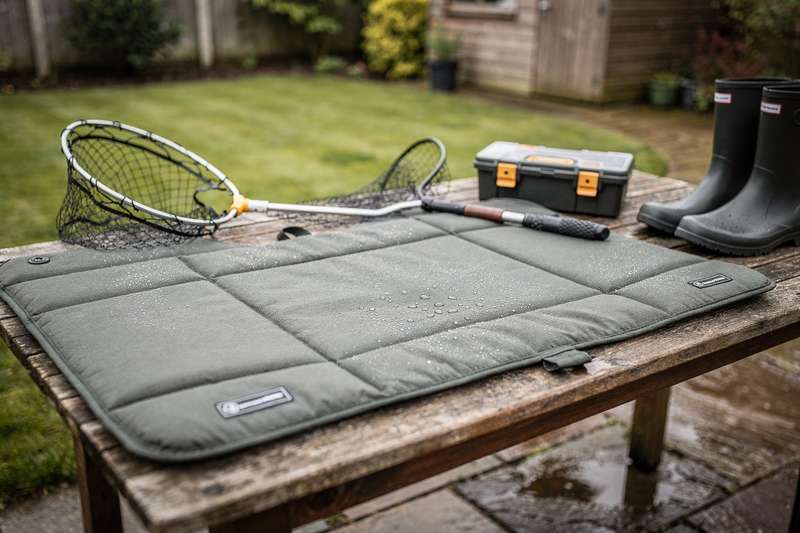
In practical terms, the mat folds for transport, making it manageable to strap to a barrow, slide into a carryall, or secure under the lid of a large bag. The green colouring is standard for bankside kit. The cover surface is smooth enough to avoid abrasion against scales — which matters more than many anglers initially appreciate. Rough or worn cover materials can strip a fish’s protective slime coat even during careful handling, leaving it susceptible to infection after release.
Where this mat has honest limitations: it’s a flat-style design, which means a particularly lively fish can flip off the sides if you’re not paying close attention during unhooking. A cradle-style mat with raised edges offers better containment for active fish. But for the majority of sessions — where you net, unhook, photograph, and return fairly promptly — the flat design is simpler and faster to work with. You flip out the mat, lift the fish, get the hook out, and return without fiddling with straps or enclosures.
The depth of the review base is reassuring here. Over 600 buyers is a large enough sample to look past both enthusiastic early reviews and occasional one-star outliers. The consistent message from anglers is that this mat does what it says without drama. If you fish a range of UK commercial and natural venues, need a mat that satisfies fishery bailiff checks, and want something that will last a reasonable number of seasons, this is the sensible starting point.
Best Budget Pick
The 100 X 60 X 1cm Budget ‘Quick Fish’ Unhooking Mat occupies a specific niche that not every angler needs, but for the right person it makes complete sense. The 100cm x 60cm footprint matches the standard recommended for carp fishing, so you get full-length coverage for most fish. The honest trade-off is the 1cm foam thickness, and that needs to be understood clearly before you buy.
A 1cm profile is thin for a cushioned unhooking mat. On firm, flat grass or a smooth bankside surface, it provides a moisture barrier and a contact surface that won’t abrade scales. However, on stony, uneven, or particularly hard ground, the foam doesn’t have the depth to absorb impact or smooth out irregularities beneath. This is not the right choice for anglers who regularly fish rocky lake margins, gravel pits with compacted banks, or exposed river swims with irregular surfaces. If your fishing takes you to soft grass-banked club lakes or canal towpaths, the performance gap narrows considerably.
The ‘Quick Fish’ label in the name is telling: this mat is designed for anglers who prioritise a fast, low-fuss unhooking routine. It rolls or folds into a very small package, takes up minimal space in a shoulder bag, and can be wiped clean in seconds. For pleasure fishing sessions where you’re targeting a variety of species across multiple swims — moving around rather than sitting in one spot all day — the lightweight format is practical where a bulkier padded mat would become a genuine inconvenience to carry.
The 424 reviews at 4.3 stars are instructive. Despite the acknowledged thin profile, buyers rate it positively — which suggests expectations are well-matched to the product’s actual purpose. Problems appear in reviews where someone expected heavy cushioning from a 1cm mat; that’s an expectations issue rather than a product failure. If you understand you’re buying a slim, portable mat rather than a serious foam crash pad, you’ll get exactly what you paid for.
For a young angler’s first kit, a pleasure fisher who wants something that lives permanently in a shoulder bag, or someone who primarily targets smaller species and uses the landing net to settle fish before a brief transfer to the mat, this is a viable entry point. For dedicated carp anglers handling larger fish at venues with strict welfare requirements, step up to a thicker option elsewhere in this list.
Best Compact Option for Light Travellers
The Leeda Folding Unhooking Mat Green from established UK fishing brand Leeda comes in at compact dimensions of roughly 46cm by 36cm, with a foam depth of approximately 6.8cm. That combination of smaller footprint and meaningful padding depth makes it a distinctly different proposition from the 100x60cm flat mats elsewhere in this list, and whether it suits you comes down almost entirely to what and where you fish.
For the river angler wading between swims, the walker doing a roving session along a canal, or the lighter-tackle enthusiast targeting barbel, chub, and roach rather than specimen carp, a mat this size is genuinely more convenient. It tucks into a rucksack without dominating the space, deploys on any bank in seconds, and the foam depth provides solid cushioning relative to the fish size you’re most likely to encounter. Leeda has a long track record in UK fishing tackle, and the 4.5 stars from 349 reviewers is a healthy signal that build quality holds up across regular use rather than just the first few sessions.
The folding mechanism is the other practical advantage. Bank sessions typically involve wet conditions, mud, and carrying kit across awkward terrain. A mat that folds flat and stays compact in transit is one you’ll actually bring with you rather than leaving in the car because it’s awkward to pack. This one delivers that convenience without the compromises sometimes found in very compact mats — the foam doesn’t appear to be skimped on despite the small overall size, which is the usual place manufacturers cut corners.
The honest limitation is that 46cm by 36cm is not adequate for a large carp. If a twenty-pound fish lands on this mat, significant portions of the fish will be over bare ground, which defeats the purpose. If you predominantly target carp at commercial or syndicate waters with explicit fish care rules specifying minimum mat dimensions, this won’t satisfy those requirements. Most UK carp fishery rules specify a minimum surface area that typically exceeds this mat’s footprint, and a bailiff with a tape measure will notice.
But if your fishing genuinely involves smaller species, you do a lot of roving and travelling light, and the largest fish you realistically expect is a river barbel or a modest carp from a general licence water, the Leeda mat gives you proper foam cushioning in a compact format that suits roving anglers. It’s the kind of mat that ends up permanently living at the bottom of a day bag because it never gets in the way.
Best for Bankside Security
The Carp Fishing Unhooking Mat Folding With Peg Eyelets & Drying Hook addresses two specific frustrations that experienced bankside anglers will recognise immediately. The first is mat movement: when a big fish lands and thrashes on a flat mat, the mat can slide around on soft grass or wet ground, making controlled unhooking harder and creating the risk of the fish rolling off the edge. Peg eyelets solve this by letting you drive banksticks or small pegs through anchor points at the mat’s edges, pinning it firmly to the ground. The difference in stability during an active unhooking session is noticeable — the mat stays exactly where you placed it.
The second feature is the drying hook, which sounds minor but is appreciated by anyone who fishes regularly. Keeping an unhooking mat clean is part of responsible fish care; contaminants from one session can transfer to fish handled in the next. A hook that lets you hang the mat for drying and airing at home, rather than leaving it damp in a bag all week, helps with both hygiene and longevity. Neither feature adds significant bulk or weight to the mat; they’re practical additions to an otherwise standard folding design.
The 4.5-star rating from 296 buyers puts this mat at the higher end of the ratings across this roundup. Feedback consistently mentions the practical extras as a positive, and there are enough reviews to have reasonable confidence in the durability picture. The cover material appears smooth enough for fish safety, and the folding design keeps it manageable on a loaded barrow.
Being realistic about the limitations: the peg eyelets are only useful if you carry banksticks or small ground pegs, which most session carp anglers have as a matter of course but roving pleasure fishers may not pack. If you fish from permanent platforms, pontoons, or hard-surfaced pegs, the pegging function is entirely irrelevant. In those situations you’d be paying for a feature you can’t use, and a simpler mat would work equally well. The drying hook remains useful regardless of where you fish.
For the structured session carp angler who sets up properly at a fixed swim, fishes soft grass banks, and wants a mat that won’t shift around during fish care, this is a worthwhile step up from a plain flat mat. The combination of bankside security and hygiene features makes it a considered choice for anyone who fishes the same waters regularly and wants their bank routine to be a little smoother each time.
Best Cradle-Style Unhooking Mat
The Actiaspet Carp Fishing Cradle Unhooking Mat Sling takes a fundamentally different approach to fish care than the flat mats elsewhere in this guide. At 85cm x 50cm with 15cm of depth, the raised-sided cradle design means the foam walls around the perimeter contain the fish rather than simply providing a padded surface for it to land on. For anglers who find active fish rolling off flat mats during unhooking — a real problem with a lively fish — the cradle format is a meaningful improvement in fish safety.
The sling element in the name reflects that cradle-style mats often double as weighing slings. Rather than transferring a fish from an unhooking mat to a separate weighing cradle — which involves additional handling steps and more opportunities for things to go wrong — a mat-sling combination lets you unhook on the mat and weigh from the same piece of kit. For specimen anglers who record weights carefully, this reduces total handling time, which is the most direct benefit you can offer a carp that’s already stressed from the fight.
The 15cm foam depth at the sides provides substantially more cushioning than most flat mats in this category. A carp arriving on the mat after a spirited fight benefits from that extra absorbency. The 4.4-star rating across 61 reviews is a solid signal, though worth noting this is a smaller sample than the most established picks here. Feedback consistently highlights fish care performance as a positive, and the cradle concept is well understood by carp anglers — reviews tend to reflect people who know exactly what they’re buying.
The trade-off with cradle designs is handling complexity. Setting one up takes a few seconds more than flicking out a flat mat, and accessing the hook from inside the enclosure means reaching over the foam sides. For experienced carp anglers this becomes second nature quickly, but beginners may initially find flat mats more intuitive. The 85cm x 50cm dimensions are adequate for most carp, though very large fish above around thirty pounds may feel slightly confined.
If you regularly photograph your catches, the contained format helps here too: fish tend to stay roughly central on the mat rather than slipping towards the edge while you’re handling the camera. For anglers at pressured commercial carp fisheries where fish welfare standards are high and bailiff checks are thorough, a quality cradle mat is often the preferred format and signals that you take fish care seriously.
Best for Measuring Your Catch
The Unhooking Mats for Fishing, Fishing Mat with Measurement, 98 x 30.5cm Folding Unhooking Mats brings an 80cm measurement scale printed directly onto the mat surface — a practical feature for anglers who log catch lengths alongside, or instead of, weight. At 98cm long by 30.5cm wide, the mat provides plenty of length for measuring, and the folding design keeps it compact enough to carry without effort.
The built-in scale is the defining feature. Rather than searching for a separate tape measure or estimating length while the fish is on the mat, you lay the fish alongside the scale and read off the measurement directly. For match anglers logging individual catch data, junior fishers building their first catch records, or anyone targeting species where length tracking is standard practice — pike and barbel are common examples in UK angling — this removes a step from the bank routine and cuts the time the fish spends out of water.
The narrow width of 30.5cm is the limitation to flag clearly. Compared to the 60cm width of the standard carp mats on this list, this is notably narrow. A large, round-bellied carp will overhang the sides considerably, which becomes a welfare concern if the bank surface beneath is rough. This mat is better suited to longer, leaner species — pike, barbel, perch, bream — where the body profile doesn’t require wide lateral support. Carp anglers should note that the narrow width may not satisfy fishery rules specifying minimum mat dimensions.
A note of caution specific to this pick: at the time of research it had 8 reviews, compared to the hundreds behind the other products in this list. That’s a small sample, and it limits how confidently you can draw conclusions about long-term durability or consistent performance. The folding construction and waterproof material description are consistent across those reviews, and the measurement scale concept addresses a genuine practical need — but you’re making a more speculative choice here than with the better-established picks.
For the right angler — targeting species where 30.5cm of width is adequate, wanting to log lengths without carrying extra equipment, and prioritising compact kit — this addresses a real gap in the market. Go in with clear expectations about the width limitation and the limited review base, and it can be a useful tool. If you’re a carp angler looking for a convenient extra feature alongside proper fish care dimensions, look elsewhere in this list.
What to Look For in a Fishing Landing Mat
- Foam depth and density: This is the most important specification after size. Foam under around 3cm tends to compress quickly under the weight of a fish and offers minimal protection on anything other than a perfectly soft, flat surface. For carp fishing, look for at least 5–6cm of foam depth, or a cradle design where raised side walls provide additional containment. Foam density matters too: foam that collapses immediately on contact provides far less protection than moderately firm foam that absorbs and distributes impact gradually.
- Size matched to your target species: The standard minimum for carp fishing in the UK is broadly 100cm x 60cm, which covers most common and mirror carp adequately. For smaller species — roach, perch, bream, tench, river fish generally — a smaller mat is appropriate and considerably easier to transport. Match the mat to the fish you actually catch, but err towards larger for carp where fishery rules are increasingly specific about minimum dimensions.
- Cover material and fish safety: The surface contacting the fish should be smooth enough not to abrade scales or strip the slime coat. Rough textures, coarse stitching, or cracked vinyl that’s past its best can all damage a fish’s protective mucus layer. Wetting the mat surface before placing any fish on it is standard practice — a dry mat can pull moisture from a fish’s skin on contact.
- Waterproof or water-resistant construction: Mats that absorb water become heavy, retain contaminants between sessions, and take far longer to dry at home. Waterproof or water-resistant covers are more practical for regular bank use, easier to wipe clean, and won’t leave you carrying a sodden weight in a bag that then smells for a week.
- Fold design and how it packs: How a mat folds — and how compact it becomes — determines whether you’ll actually bring it to the water every time. A mat that doesn’t fit conveniently in your barrow bag, rucksack, or carryall is one that gets left behind. Bi-fold and tri-fold designs are most common; some mats roll instead. Think about how it attaches to or fits inside your usual kit setup before buying.
- Useful extra features: Peg eyelets for anchoring to soft banks are practical for session anglers. A drying hook supports hygiene maintenance between trips. A built-in measurement scale suits anglers who log catch lengths. A cradle-sling combination removes the need for a separate weighing sling. None of these features are essential, but the right one for your style of fishing makes the bank routine less complicated.
- Fishery compliance: Before purchasing, check the specific rules of the waters you fish most often. Some fisheries specify minimum foam thickness, minimum mat dimensions, or particular design types. Buying a mat that doesn’t satisfy your main venue’s rules means buying twice.
Verdict
For the majority of UK carp and coarse anglers, the Angling Pursuits Unhooking Mat for Carp Coarse Fishing 100cm x 60cm Landing Mat is the sensible first choice. It hits the right dimensions for standard carp fishing in the UK, has a large and consistent review base, and provides reliable cushioning without a significant financial commitment. It will satisfy most fishery bailiff checks and suits the widest range of carp and coarse fishing situations you’re likely to encounter.
If you fish lighter tackle and move around regularly, the Leeda Folding Unhooking Mat offers proper foam depth in a compact format that suits roving anglers. For the session carp angler who fishes soft grass banks and wants extra stability during fish care, the peg-eyelets design is a practical upgrade. Specimen anglers handling large, active fish regularly will find the Actiaspet cradle design gives better containment and removes the need for a separate weighing sling.
The Quick Fish budget mat is worth considering if you fish lighter species and need something that sits permanently in a shoulder bag — just go in clear-eyed about the foam depth and the surfaces it will and won’t perform adequately on. And if logging fish measurements is part of your bank routine, the mat with a built-in scale removes one item from your kit, provided the narrow width suits the species you target.
The single biggest mistake to avoid is buying on price alone without checking foam depth and dimensions against the fish you actually catch and the rules of the venues you fish. A mat that fails on either of those points isn’t protecting fish regardless of what it cost.
We were not paid to feature any specific product in this guide. All opinions are independent and based on publicly available specifications, verified buyer feedback patterns, and category research.
Quick Comparison Table


FAQ
What size unhooking mat do I need for carp fishing?
Most UK carp fishing guidelines recommend a minimum mat size of around 100cm x 60cm to fully support an average-sized carp. Some fisheries specify their own minimum dimensions, so checking venue rules before purchasing is sensible. For larger fish above twenty pounds, ensure the mat is long enough that the tail is not left resting on bare ground during unhooking or photography.
Do I have to use an unhooking mat by law when fishing in the UK?
There is no single national legal requirement, but the vast majority of commercial carp fisheries, syndicate waters, and club waters include a suitable unhooking mat as a mandatory condition of their rules. Fishing without one can result in being asked to leave or having your permit revoked. Beyond compliance, using a proper mat is considered standard responsible practice by UK angling organisations.
How should I clean and maintain a fishing landing mat?
Rinse the mat with fresh water after each session to remove fish slime, blood, and debris. Allow it to dry fully before storing — damp mats packed away in bags can develop mildew and harbour contaminants that may be transferred to fish at the next session. If your water participates in biosecurity schemes to prevent the spread of fish diseases, follow the specific drying and disinfection guidelines associated with that scheme.
What is the difference between an unhooking mat and a weighing sling?
An unhooking mat is a padded surface placed on the bank for the fish to rest on during unhooking and photography. A weighing sling is a separate mesh or fabric cradle used to suspend the fish from scales for weighing. Some cradle-style mats combine both functions, allowing you to unhook on the mat and then clip it directly to scales — which reduces handling steps and the total time the fish spends out of water.
Are cradle-style mats better than flat mats for carp fishing?
Cradle mats provide better containment for lively fish and reduce the chance of a carp rolling off during unhooking. They also typically offer greater foam depth at the sides. However, they take slightly longer to set up and some anglers find flat mats faster when speed of return is the priority. The right choice depends on how active the fish you handle tend to be and your personal preference for containment versus simplicity.
Can I use a general purpose foam mat instead of a dedicated fishing landing mat?
General purpose foam mats — including exercise or gym mats — are not suitable substitutes for a proper fishing landing mat. They are typically made from materials that may abrade fish scales or strip the protective slime coat, are not designed for wet outdoor conditions, and may not satisfy fishery rules. A dedicated fishing landing mat uses cover materials chosen to be safe for fish and foam specified for bankside use in all weathers.