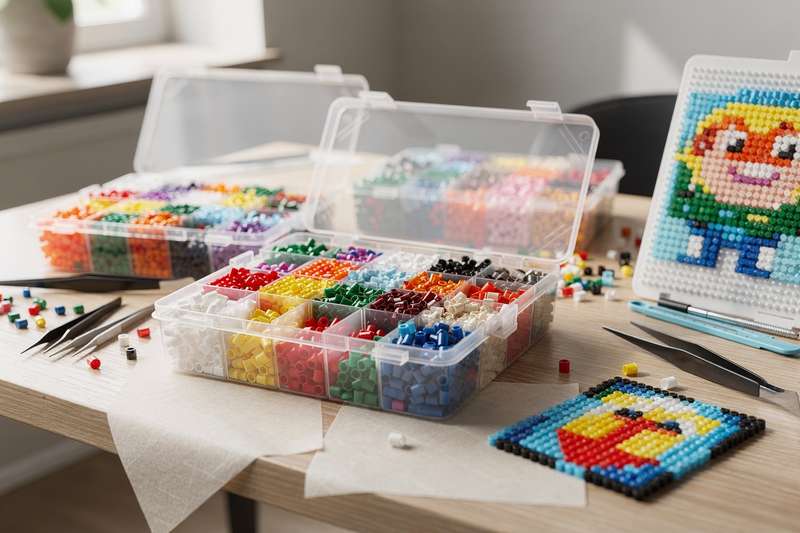
Your child has just watched a friend create a pixel-art dragon using fuse beads — those small plastic tubes you arrange on a spiked pegboard, then bond permanently together using a household iron — and now every other craft activity seems dull by comparison. You order a starter bag from the first affordable-looking listing you find. It arrives, and the problems follow almost immediately: there are only six colours, the ironing paper tears before you are halfway through your first pattern, and the beads do not fuse cleanly. You end up with a bumpy, patchy surface that looks nothing like the polished finished pieces on the tutorial videos that inspired all of this in the first place.
Adults hit a completely different wall. You want to recreate a retro game sprite as a coaster or wall piece. You buy a large multi-colour kit that photographs impressively in the product listing. Then you discover the colours iron out muddier than they looked in the bag, you run out of black beads mid-outline, and sourcing a compatible refill means waiting another week for delivery. What should have been a satisfying afternoon project drags on across multiple days.
Whether you are buying for a six-year-old or for your own desk crafting, the quality difference between a well-made fuse bead kit and a substandard one is significant — and the worst of it only becomes obvious when the iron comes out. This guide covers the best options available on Amazon UK right now, chosen through real buyer feedback rather than product listing claims.
How These Picks Were Chosen
Every kit in this guide was evaluated against the same set of criteria: bead count and colour variety, bead size (standard 5mm for children and beginners versus the finer 2.6mm for detailed adult pixel art), the quality of pegboards and ironing paper included, what accessories come in the box, and how consistently the kit delivers on what the listing promises. I filtered on both review volume and rating — because a strong average across twenty reviews carries a very different weight from the same average across five hundred. Where products have limited review counts, that is flagged clearly so you can factor it into your decision. The picks span a range of use cases: first-time child crafters, families burning through beads quickly, adult hobbyists wanting finer detail, and crafters who need more working surface without a full new kit.
Best for Beginners
The Fuse Beads Kit 24 Colors 5mm Iron Beads for Kids is the pick I would hand to anyone new to fuse beads — child or adult alike — and it backs that recommendation with 754 reviews at 4.6 out of 5 stars, which is both a large enough sample to trust and a high enough rating to act on confidently.
What makes this kit work so well for beginners is how balanced it is. Twenty-four colours of 5mm beads gives a new crafter enough variety to work on a wide range of patterns without the choice becoming overwhelming. The bead count is substantial enough to complete multiple projects without running out in the first session. Beyond the beads themselves, the kit includes pegboards, tweezers, ironing papers, and — a detail worth highlighting — keyrings. The inclusion of keyrings might seem minor, but it gives a younger crafter something immediate and wearable to show for their effort: a small finished charm to clip onto a bag or pencil case. That tangible reward goes a long way toward keeping interest in the hobby alive past the first afternoon.
The 5mm bead size is the correct starting point for almost every new user. They are large enough to place with fingers — even smaller hands — and the standard pegboard spacing is forgiving enough that patterns come together without excessive correction. The mini 2.6mm beads used in more advanced kits produce finer detail, but they demand tweezers, specific pegboards, and considerably more patience. Starting at 5mm and building technique before upgrading is always the more sensible path.
In buyer feedback, the consistent positives are bead quality — they fuse cleanly at standard iron settings without requiring a particular technique — and the reliability of the ironing paper. The sheets included are noticeably thicker than what comes with cheaper alternatives, which matters for two reasons: thicker paper is easier to reposition without tearing, and it is less likely to stick to the beads if you apply slightly too much heat. That quality difference prevents one of the most common beginner frustrations: ruining a finished piece because the ironing paper bonded to the surface.
The pegboards hold their shape under ironing, which is a fundamental requirement that budget kits frequently fail to meet. A board that warps mid-iron distorts the whole piece, and there is no correcting that once it has happened. Buyers repeatedly mention the boards staying flat, which aligns with the kit’s overall high rating and makes this a safe choice where pegboard quality is concerned.
Where this kit has natural limits: 24 colours is right for a beginner, but will feel restrictive once a crafter starts working from specific patterns that require precise shades. Certain mid-range blues, particular greens, and most skin-tone variations are not available at this colour count. That is not a criticism of a kit pitched at this level — it is simply a natural prompt to move to a larger kit once the interest is established and the basics are confident. For a first purchase, or for a gift, this is the safest option in this guide.
Best Large-Quantity Starter Kit
Once a child has worked through their first kit and is clearly committed to the hobby, the Ophy Fuse Beads Kit — 15,000 beads across 20 colours, six pegboards, and a full accessory bundle — offers a meaningful step up in scale without requiring an entirely separate equipment purchase. It holds 508 reviews at 4.3 out of 5 stars, which is a substantial and reliable feedback base.
The 15,000-bead count is the headline figure. To put it in context: a small to medium pattern might use 300 to 600 beads; a larger, more complex piece can consume well over a thousand. At 15,000 beads across 20 colours, you have genuine working room across many sessions and multiple projects before restocking becomes necessary. That is a meaningful shift from a 1,000-bead starter bag, where running out mid-project in the first week is a real possibility.
Six pegboards is a practical advantage for busy households. If you have more than one child interested in fuse beads, or you want to work alongside them on a separate piece, having six boards available means multiple projects can be in progress simultaneously. You can also join square boards edge-to-edge to build larger canvases for ambitious pieces, which opens up project sizes that a single small board cannot accommodate.
The 20-colour palette is where this kit makes its main tradeoff. Twenty colours covers the primary and secondary families well — reds, blues, greens, yellows, black, white, and a selection of pastels and mid-tones — but it does not have the nuanced shade variation of larger-palette kits. If colour accuracy matters for a specific pattern (recreating a character’s particular shade of orange, for instance), you may find a shade missing. For free-form creative play, school-age crafting, and learning pattern design from scratch, 20 colours is more than workable.
One thing the Ophy kit handles better than several alternatives is organisation on arrival. With 15,000 beads, receiving them sorted rather than loose in a single undivided bag is not a small convenience — sorting them manually by colour is not how anyone wants to start a craft session. The included pattern book covers 16 designs at different difficulty levels, giving a child structured targets to work toward rather than facing a blank pegboard with no starting point. Buyers specifically mention both the storage and the pattern book as positives, and that practical thoughtfulness is reflected in the solid 4.3-star average.
The minor gap between this kit’s 4.3 rating and the beginner kit’s 4.6 rating shows up in feedback about the colour range feeling limiting after extended use — which is a natural consequence of the lower colour count rather than a product fault. This kit works best as a step-up purchase for an established young crafter, or as a more ambitious first purchase for a family confident that fuse beads will get regular use.
Best for Colour Variety
When colour range is the priority — because you are working from specific patterns that require precise shades, or because a crafter insists on having the exact right tone of teal — the Fuse Beads Kit 72 Colors 5mm Fuse Bead Set is the most comprehensive 5mm option in this guide. It carries 268 reviews at 4.6 out of 5 stars — a high rating maintained across a review count that is large enough to be meaningful.
Seventy-two colours is a substantial palette. At that range, you are not just getting a few extra shades per colour family — you have dark teal and light teal as separate entries, multiple greys spanning near-white to near-black, distinct skin-tone options that single-colour-family kits routinely skip, and a collection of neons, pastels, and mid-tones that simply do not exist in 20- or 24-colour kits. For anyone recreating retro game sprites, anime characters, or detailed illustrated designs, that additional colour depth shows in the finished piece in ways that mixing what you have cannot replicate.
The kit arrives organised in three separate boxes, each covering a section of the colour spectrum. That structure is more useful in practice than it might look in a listing description: when you need a specific shade mid-project, you know roughly which box to reach for without searching through everything. Combined with divided storage within each box, this makes colour changes during a session faster and less disruptive. The three-box format also makes the total kit easier to store between sessions without things getting mixed together.
Standard 5mm compatibility means this kit works with the same pegboards as virtually every other fuse bead product on the UK market, including all the other kits in this guide. If you already own fuse bead equipment from a previous purchase, you can treat this kit as a colour-extension purchase rather than a fresh start — your existing boards accept these beads without any adaptation.
The key tradeoff to understand before buying is per-colour bead quantity. With 72 shades distributed across the total count, each individual colour has fewer beads than you would find in a kit of comparable total size focused on 20 or 24 colours. For small, intricate designs with frequent colour changes, this is rarely a problem. For large background fills — a wide expanse of sky blue or a solid-colour border around a large piece — you may run short on the specific shade before the piece is complete. The practical fix is to buy a single-colour refill pack of whichever shade you are using most heavily, which is straightforward to source separately. That is a minor operational consideration rather than a reason to avoid the kit, but it is worth planning for if you regularly work on large pieces.
Best for Detailed Pixel Art
The YueXing 2.6mm Fuse Beads Set — 29,200 beads across 72 colours at the smaller 2.6mm bead size — is the option for adult crafters who want finer resolution in their finished work than standard 5mm beads allow. Before going further: this product has only 19 reviews at 3.7 out of 5 stars at the time of writing. That is a limited and mixed signal, and I am including it because it occupies a distinct and genuinely useful category — mini fuse beads — rather than because the rating inspires unqualified confidence. Read the current reviews carefully before purchasing.
The practical argument for 2.6mm beads comes down to geometry. Because each bead is roughly half the diameter of a standard 5mm bead, you can fit approximately four times as many into the same physical space. That allows much finer detail — sharper outlines, more nuanced colour gradients, smaller legible text — without the piece needing to be enormous. A pixel-art portrait that would require a very large board at 5mm can be recreated at a manageable, frameable size using 2.6mm beads, which makes displaying the finished work considerably more practical.
The YueXing set includes a pegboard, keyrings, and storage alongside the 29,200 beads in 72 colours. The colour range matches the breadth of the 72-colour 5mm kit described above, meaning you are not sacrificing palette by choosing the smaller bead size. The bead count of nearly 30,000 is a real advantage at this scale: mini beads disappear fast, particularly when filling large background areas, and running out mid-project is more disruptive at 2.6mm because the per-bead visual contribution to the image is so much finer.
The 3.7-star average, viewed against the patterns in the current reviews, points primarily to the ironing stage rather than the beads themselves. Mini beads are significantly more sensitive to heat variation than 5mm beads — the window between under-fused and melted flat is narrower, and an iron that is not perfectly even across its surface can produce patchy results. Expect an adjustment period while you find the right heat setting and movement technique for your specific iron. That learning curve is inherent to the bead size and not unique to this product, but it does mean the technique barrier is higher than at 5mm.
This pick is for experienced fuse bead crafters who are ready to move to mini beads and understand the higher skill requirement involved. It is not appropriate for children, beginners, or anyone who found the ironing step challenging with standard 5mm beads. Start with one of the 5mm kits in this guide and move up to mini beads once you have consistent, reliable ironing technique established. The limited review count also means the current feedback picture may shift — check the latest reviews before committing.
Best Pegboard Expansion Set
The 6Pcs 5mm Fuse Beads Boards is the pick for anyone who already has beads but has run out of working surface. It is a set of six clear, transparent pegboards in round and square formats, designed for standard 5mm fuse beads. The review base is small — 10 reviews at 4.5 stars — so take that with proportionate caution. The feedback from those who have reviewed it is consistent and positive, with the transparency of the boards repeatedly mentioned as the standout feature.
The case for a dedicated pegboard set is more practical than it first sounds. Most starter kits bundle one or two boards — enough to begin, but not enough to run two projects at once in a busy household, or to work on a larger piece that spans multiple boards joined together. Six boards changes both of those scenarios. Two children can each have two boards in active use simultaneously with boards to spare. An adult crafter can assemble a multi-board canvas for large-scale work without waiting for one piece to be ironed and cleared before starting the next section.
The transparency of these boards is the feature that deserves the most attention. Clear pegboards let you place a printed pattern sheet underneath the board and see it directly through the surface while you place beads — a significantly more accurate and less frustrating method than constantly glancing between a separate pattern sheet and an opaque white board. Counting row positions is easier, colour matching is easier, and errors happen less often. If you have ever had to unpick and redo sections because you miscounted a row on an opaque board, transparent boards are likely to improve that considerably.
The round and square combination covers most project types. Square boards handle rectangular sprite patterns, landscape-format art, and large background fills. Round boards suit coasters, decorative medallions, and circular portrait designs. Standard-size square boards can also be connected edge-to-edge using connector clips — sold separately — to create a larger unified canvas, which is a useful technique for ambitious large-format pieces.
This set does not include beads, ironing paper, or tweezers — it is a boards-only purchase, and it only makes sense if you already have those elements from a previous kit. If you are starting from scratch, one of the complete kits above is the more logical entry point. For someone who has been doing fuse beads for a while and keeps wishing for more working surface, this is a clean, focused solution. The 5mm compatibility means it pairs directly with every other kit in this guide without any adaptation required.
What to Look For When Buying Fuse Beads
- Bead size (5mm vs 2.6mm): Standard 5mm beads are the correct starting point for children and beginners — easier to handle, more forgiving during ironing, and compatible with the widest range of pegboards and patterns. Mini 2.6mm beads produce finer detail but require tweezers, 2.6mm-specific pegboards, and more careful ironing technique. Do not start a child on 2.6mm beads; the frustration risk is high and the skill requirement is real.
- Colour range versus per-colour quantity: A kit with 72 colours spread across the same total bead count has fewer beads per shade than a kit with 20 colours. Think about what you will actually use the kit for: free-form creative play benefits from variety; specific pattern recreation benefits from depth in the colours that appear most in that pattern. For large background fills, per-colour quantity matters more than total colour count.
- Accessories included: A complete kit should include pegboards, ironing paper, and ideally tweezers. Ironing paper quality varies considerably — thin paper tears easily and can stick to finished pieces. Look for kits that include multiple sheets. Tweezers make accurate placement far easier and are effectively essential for anyone using 2.6mm beads.
- Pegboard quality: Cheap pegboards warp under ironing heat, distorting the finished piece. Look for buyer feedback that specifically mentions boards staying flat during ironing. Transparent boards offer the additional advantage of letting you place a pattern underneath and trace it directly, which substantially reduces placement errors.
- Review volume and rating: A high average rating based on 20 reviews carries a very different weight from the same rating on 500 reviews. For a category where quality varies as much as fuse beads, prioritise kits with at least 100 to 200 verified reviews before fully trusting the star score. Where counts are low, this guide flags it clearly.
- Storage organisation: Fuse beads are small, numerous, and easy to mix accidentally. Kits that arrive with divided storage boxes or labelled compartments save real time when sourcing a specific colour mid-project. Loose-bag-only packaging is manageable for small bead counts, but becomes a genuine operational problem at 10,000 beads or more.
- Brand compatibility: Most 5mm fuse beads from different brands work together on the same pegboard and fuse at similar temperatures, making top-ups and cross-kit mixing straightforward. Mini 2.6mm beads, however, require 2.6mm-specific pegboards — standard 5mm boards will not work. Buying the wrong board for your bead size is a common and entirely avoidable mistake.
Verdict
For the majority of readers arriving at this guide — whether buying for a child’s first fuse bead experience or looking for a reliable creative kit for yourself — the Fuse Beads Kit 24 Colors 5mm Iron Beads for Kids is the straightforward recommendation. Its review base is the largest in this guide, its rating is the highest at 4.6 stars, and it includes everything needed to start immediately — pegboards, ironing paper, tweezers, and keyrings. The 5mm size is right for almost every new user, the 24-colour range covers the basics thoroughly, and the pegboard quality holds up to ironing without warping.
If the hobby takes hold and quantity becomes the constraint, the Ophy Fuse Beads Kit scales up sensibly with 15,000 beads, six boards, and organised storage. If colour depth is the limiting factor for more ambitious patterns, the 72-colour 5mm set is the natural upgrade — a high rating across a solid review base, with enough colour variation to handle detailed work accurately. For crafters ready to move to mini bead pixel art, the YueXing 2.6mm set is the full-kit option in this guide for that size — but check the current reviews carefully given the limited feedback count. And if working surface is the bottleneck rather than bead supply, the six-board transparent pegboard set is a targeted, practical solution that pairs with any of the above kits without modification.
We were not paid to feature any specific product in this guide. All opinions are independent and based on publicly available specifications, verified buyer feedback patterns, and category research.
Quick Comparison Table


FAQ
What age are fuse beads suitable for?
Most fuse bead kits are designed for ages 6 and up. The beads are small enough to be a choking hazard for children under three, and the ironing step should always be managed by an adult regardless of the child’s age. Older children can assist during ironing with close supervision, but the iron itself should remain under adult control throughout.
What is the difference between 5mm and 2.6mm fuse beads?
Standard 5mm beads are larger, easier to handle with fingers, and compatible with the widest range of pegboards and pattern templates. They are the correct starting point for children and beginners. Mini 2.6mm beads are roughly half the diameter, allowing finer detail in finished designs — useful for adult pixel art and complex illustrations. The two sizes require different pegboards and are not interchangeable on the same board, so check your board’s peg spacing before mixing sizes.
Can I mix fuse beads from different brands?
Generally yes — most 5mm fuse beads from reputable brands are compatible on the same pegboard and fuse at similar temperatures. Some budget-brand colour batches can behave inconsistently, so if you are mixing brands for the first time, test a small patch before committing to a large piece. Mini 2.6mm beads from different brands are also broadly compatible with each other, but always confirm that your pegboard is specifically designed for 2.6mm peg spacing.
What iron setting should I use for fuse beads?
A medium heat setting — roughly equivalent to the synthetic or wool setting on a domestic iron — works well for standard 5mm beads. Apply the iron in slow, gentle circular movements over the ironing paper rather than pressing hard in a single spot. You want the beads to bond together while retaining some dimensional texture; overheating melts them completely flat. Mini 2.6mm beads are more sensitive to heat and often need a slightly lower setting or shorter ironing duration — expect some trial and error when working with them for the first time.
How do I prevent my pegboard from warping during ironing?
Warping happens when heat is applied unevenly across the board surface. Move the iron slowly and consistently rather than lingering in one area. Once the top surface is fused and the piece holds together, let it cool on the board for a minute, then carefully flip it and apply the iron briefly to the reverse side — this balances the heat across both faces and helps the board retain its flat shape. Ironing on a firm, flat surface rather than a padded ironing board cover also reduces warping significantly.
Can fuse beads be separated or corrected after ironing?
Once fully fused, the bond is permanent — the plastic has melted together and cannot be cleanly undone. If you notice an error early in the ironing process before the piece is completely set, you may be able to peel it from the board while still warm and reposition beads that have not fully bonded yet, but that window is short. The practical approach is to check your design carefully before applying the iron, since mistakes are very difficult to reverse once ironing is complete.