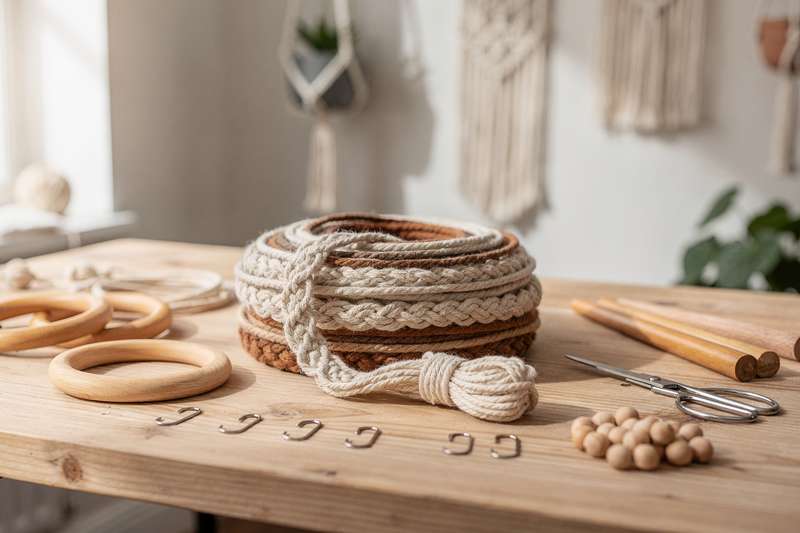
You’ve spotted a beautiful macrame wall hanging somewhere online, watched three tutorials back-to-back, and declared this the weekend you finally give it a proper go. You order the first cord bundle that shows up in search and a generic beginner kit that looks decent enough in the thumbnail. A few days later the package arrives: the cord is stiffer than expected, the wooden rings wobble off-centre, and the single page of instructions is essentially a diagram of a square knot you already knew. By Sunday evening you’ve pulled the same section apart four times, the cord is starting to pill, and you’re genuinely unsure whether macrame is harder than it looks or whether you’ve just picked the wrong supplies.
The answer is almost always the latter. Macrame itself is approachable — the core knots take minutes to learn and a few sessions to make second nature. But the quality and compatibility of your cord, beads, rings, and tools make a real difference to how the work feels under your fingers and how the finished piece holds up over time. Whether you’re after a first plant hanger, a wall hanging for the living room, or a set of keyrings to give as gifts, this guide cuts through the noise on Amazon UK and tells you exactly what to buy.
How These Picks Were Selected
These picks were drawn from eight products currently listed on Amazon UK, assessed across several key criteria: cord construction (twist style and ply count, since these affect knot quality and fringing), what accessories are included and whether they’re practical for real projects, instruction clarity for complete beginners, and how well-rounded each kit’s project scope is. A kit designed around a single wall hanging design scores lower than one that covers hangers, keyrings, and decorative pieces. For cord-only products, thickness, texture, and the pattern of buyer feedback were the deciding factors. Review counts and ratings were treated as supporting evidence rather than the sole deciding factor — a product with 900 reviews at 4.5 stars tells a clearer story than one with nine at 4.6, though both have merit when the product addresses a genuine gap in the catalogue.
Best Overall Starter Kit
If you’re new to macrame and want a single purchase that gets you through your first several projects, the DIY Macrame Kit, 656 Feet Macrame Cord Kit for Beginners Adults is the most-reviewed option in this guide and consistently draws positive feedback for hitting the right balance between cord quantity, accessory range, and instruction quality. With 892 ratings averaging 4.5 stars, it has a track record that most competitors at this price point simply cannot match.
The kit ships with 656 feet — roughly 200 metres — of natural cotton cord, along with wood rings, wooden sticks, and coloured beads. That cord quantity matters more than it might seem: beginners routinely underestimate how much cord macrame consumes, especially for wall hangings where each strand is cut at three to four times the finished length. At 200 metres you have enough to attempt a plant hanger, a small wall piece, and a couple of practice keyrings without running out mid-session and having to pause everything to reorder.
The included cord is 3mm natural cotton — the most widely recommended starting thickness. It’s soft enough to work with bare hands for extended sessions without the skin irritation that rougher synthetic rope can cause, and pliable enough to undo a misplaced knot without permanently creasing the fibres. The instructions cover multiple project types, which is unusual at this price tier; most beginner kits give you one diagram and leave you to piece the rest together from video tutorials.
Where this kit falls slightly short is in the hardware precision. The wooden rings are functional but not precision-cut, so if you’re planning a decorative piece where ring uniformity matters for the finished look, you may want to supplement with rings sourced separately. The coloured beads are a nice design touch, but not all of them thread easily onto 3mm cord — checking the bead hole diameter against your cord thickness is worth doing before you plan a bead-heavy project. These are minor criticisms of a kit that, overall, does what it promises for the price.
This kit is the right call for absolute beginners who want one box to open and start immediately, and for those buying it as a gift for someone who has expressed interest in craft. If you already know your knots and simply need more cord, the standalone cord option later in this guide will serve you better. But for someone starting from scratch, this is the one to shortlist first.
Best Macrame Cord for Regular Makers
Once you’ve worked through a starter kit and confirmed that macrame is your thing, the smartest next purchase is a reliable standalone cord supply — and the 3 Rolls Premium Macrame Cord, 3mm x 100m Braided Macrame Rope Twisted Cord Yarn is the highest-rated product in this guide, sitting at 4.7 stars from 959 reviewers. That combination of rating and volume puts it in a different category of confidence from anything else here.
The listing gives you three rolls of 100m each, totalling 300 metres of 3mm braided cord. That’s a meaningful quantity for anyone working on larger pieces: a medium wall hanging might consume 60 to 80 metres alone, so having 300m lets you plan ambitiously without rationing. The braided construction — as opposed to single-twist — tends to hold knots more crisply and resists unravelling mid-project, which matters when you’re working on anything with repeating knot patterns or close-set square knots.
The cord is made from twisted cotton yarn, giving it a soft texture that works well for fringing. When you brush out the ends after completing a piece, the fibres separate cleanly rather than splitting or fraying messily — and that clean separation is what distinguishes a professional-looking fringe from an untidy edge. Buyers frequently note in reviews that the cord holds its colour well over months of display and doesn’t shed excessively, both useful qualities for pieces that will hang long-term.
The tradeoff is straightforward: this is cord only. There are no rings, no beads, no dowels, and no instructions. If you’re a complete beginner without those accessories already, pair this with the BENECREAT finishing tools set reviewed later in this guide, or source rings and a dowel separately before starting. For someone who has already worked through a starter kit, or who is experienced and simply restocking a core consumable, this three-roll set is the most sensible cord purchase here. The 4.7-star average across nearly 1,000 reviews is a strong signal that quality is consistent between batches — and batch consistency is the variable that matters most when you buy the same cord repeatedly.
The 3mm diameter is the most versatile choice for general macrame work. If you’re planning a very large structural piece such as a hammock or a woven chair seat, you’d want 5mm or thicker cord. But for plant hangers, wall art, keyrings, and decorative pieces up to medium size, 3mm handles almost everything. This is the cord to keep in stock once you know you’ll keep making.
Best Budget Starter Kit
For those who want the lowest possible entry cost to find out whether macrame is for them, the Macrame Kit for Adults Beginners with Instructions covers the basics for a first attempt at a plant hanger, wall hanging, or keychain, and with 149 reviews it has enough buyer feedback to give you a fair picture of what to expect.
The kit is honest about its positioning: it’s a set designed for people who want to make a specific collection of small projects rather than an open-ended supply haul. The cord included is natural cotton, the instructions cover the projects listed on the packaging, and the accessories are matched to those specific designs. That’s actually useful for a true beginner — having a defined goal rather than a box of materials and no direction makes it much easier to complete a first project and build the confidence to move on to more ambitious work.
Where it shows its budget credentials is in cord quantity. This is a make-one-thing kit rather than a make-several-things kit; once you’ve used the included cord, you’ll need to buy more before your next project. The 4.1-star average is the lowest in this guide and worth acknowledging honestly: some buyers mention that the instructions could be more detailed, and a small number flag that the cord is thinner than anticipated from the listing photography. Neither issue is a dealbreaker at this price point, but going in with realistic expectations is sensible — this will not feel identical to a more comprehensive kit.
The best use case for this kit is as a low-commitment entry point — a gift for someone curious about crafts, a way to spend a rainy afternoon without significant investment, or a first purchase for a teenager wanting to try something creative. If you’re already reasonably confident that macrame will become a regular hobby, one of the more comprehensive kits in this guide will serve you better from the start. But if you just want to find out what the craft involves without much outlay, this covers that purpose cleanly.
One practical tip regardless of which kit you choose: pair your starter kit with a pair of sharp scissors and a fine-tooth metal comb for fringing. Neither typically comes included in budget kits, both are inexpensive, and both make a noticeable difference to the neatness of your finished pieces even at the very beginning.
Best Specialist Finishing Tools
Most products in this guide are cord-based kits, but the BENECREAT 4pc Macrame Supplies Set, Wooden Macrame Comb & 3 Leaf-Shaped Feather Tassel Molds does something different: it focuses on finishing and shaping tools that beginners and improvers often struggle to find as a dedicated product. Rated 4.4 stars from 84 reviewers, it’s a niche but well-regarded set that complements any cord or kit purchase.
The set contains a wooden macrame comb and three leaf-shaped feather tassel molds. The comb is the standout item. If you’ve ever tried to brush out cord ends into a fluffy fringe using a regular comb or your fingers, you’ll understand why a dedicated macrame comb changes the results — the tines separate cotton fibres cleanly and evenly without pulling the cord apart at the root. The outcome is fringe that looks deliberate and uniform, which is one of the clearest visual markers separating early-stage work from something you’d confidently hang on the wall.
The feather molds are less universally needed but clever for anyone making macrame feathers — a popular project type for keyrings, wall hangings, and decorative garlands. The molds give you a consistent leaf or feather outline to work around, so all three feathers in a matched set come out the same size and taper. Without a mold, achieving consistent feather shapes relies on experience and a good eye, which takes time to develop. With one, even a relative newcomer can produce a tidy, symmetrical result.
Be clear on what this set is not: there is no cord, no rings, no beads. You need to own those already before this set adds any value. Think of it as a complement to your main kit or cord purchase rather than a starting point in itself. If you’ve worked through a starter kit and have been brushing out fringe with improvised tools, this is a worthwhile upgrade that will visibly improve your finished pieces with very little extra effort.
Buy this alongside the standalone cord pick or as an add-on to whichever starter kit you choose — particularly if you’re drawn to projects featuring fringe, tassels, or feather shapes. The wooden handles are comfortable during extended brushing sessions, and the molds are reusable across many projects. The 4.4-star rating from 84 buyers indicates consistent quality control, which matters for a wooden tool product where tine-loss or warping can be issues with cheaper versions.
Best Mid-Range Kit for Growing Skills
The ZEAYEA 102 Pcs Macrame Kits for Beginners, 3mm x 220 Yards Natural Cotton Cord with Wooden Beads, Wooden Sticks, Wood Rings and Metal Rings bridges the gap between a bare-bones starter set and a serious supplies investment. With 102 pieces including both wood and metal rings, it’s one of the more complete accessory packages in this guide, and its 4.6-star rating from 33 buyers points to a positive early track record.
The headline item is 220 yards — roughly 200 metres — of 3mm natural cotton cord, enough for several projects. Where this kit differentiates itself from similarly-priced competitors is the accessory variety. Crucially, it includes both wooden and metal rings. Metal rings matter for structural applications: plant hangers holding soil-heavy pots add meaningful weight over time, and a metal ring handles that load more reliably than wood over months of use. Having both ring types in one kit lets you choose the appropriate hardware for each project rather than working around a limitation.
The 3mm cotton cord is soft and forgiving, well suited to beginners still building their tension consistency. At 220 yards you have enough material for a plant hanger, a medium wall hanging, and a few smaller pieces before you need to restock. The range of accessories means you can attempt a wider variety of project types from a single purchase, which is the main practical advantage over the budget kits in this guide.
The honest caveat is the review count. Thirty-three reviews is enough to indicate the product isn’t failing in obvious ways, but it doesn’t provide the depth of pattern-spotting that 800-plus reviews gives you. There’s less data on how the cord holds up after months of display, or whether bead quality is consistent across different order batches. If reliability across repeat purchases is your priority, the higher-reviewed kits will feel more reassuring. If you’re comfortable with a newer listing and the accessory breadth appeals, this is a solid mid-range choice.
This kit works best for someone who has completed a project or two and knows they want to continue, but wants to explore different project types — a plant hanger one week, a wall piece the next, a few decorative keyrings as gifts. The combination of cord volume and accessory variety supports that kind of varied approach without requiring you to collect individual supplies piecemeal.
Best Kit for Monochrome Projects
The Mardatt 134 Pcs Macrame Kit With 218 Yards 3mm White & Black Cord, Wooden Beads, Rings and Stick for Wall Hanging, Plant Hangers, Crafts has a specific design identity that sets it apart from everything else in this guide: it provides both white and black cord in a single kit, making it the most relevant pick for anyone drawn to contemporary, high-contrast, or Scandinavian-influenced macrame aesthetics.
The 218 yards of cord is split between white and black, giving you materials to create two-tone pieces — wall hangings with alternating cord sections, plant hangers with black accent details, or matched pairs of decorative items in contrasting colours. In a market dominated by natural beige and undyed cream cord, that immediately opens up a different set of design possibilities without requiring two separate purchases. The kit also includes wooden beads, rings, and a stick for wall hanging headers, covering the hardware you need for the most common beginner projects.
With 134 pieces and 4.6 stars from 20 reviewers, the Mardatt kit sits at the newer end of the reviewed market. The review count is low enough that you’re working with a smaller sample than the top-reviewed kits, so approach it with slightly more caution than you would a bestseller. That said, 4.6 stars from 20 reviews with no obvious cluster of critical feedback is a reasonable early indicator. The choice to include both cord colours — rather than treating black and white as two separate purchases — reflects thoughtful product planning for a specific customer.
The main tradeoff is cord quantity per colour. If the 218 yards is split roughly evenly, you have around 100 yards (approximately 90 metres) of each colour — enough for a plant hanger or a small wall hanging in one colour, but not a larger, more ambitious piece. If your project calls for a primarily black piece with white accents, you’ll likely need to supplement with additional black cord. Think of this as a starter palette for monochrome work rather than a complete supply for a large single-colour project.
This is the right pick if your home aesthetic leans towards dark-and-light contrasts, if you want to experiment with colour contrast without buying two separate kits, or if you’re making gifts for someone whose taste runs to modern rather than purely rustic. There’s a real gap in the macrame supply market for kits that work well alongside contemporary interiors, and this one addresses it better than any other option in this guide.
Best Kit with Generous Cord Supply
The Macrame Kit for Adults, Featuring 3mm Macrame Cord 200M, 110PCS Wooden Beads, 20PCS Wood Rings, 4PCS Wood Sticks, 4PCS Metal Rings & Others packs the most substantial hardware count of any kit in this guide: 110 wooden beads, 20 wood rings, 4 wood sticks, and 4 metal rings, all alongside 200 metres of cord. It’s the pick for someone who wants to make multiple projects from a single purchase without running short on accessories part-way through a session.
200 metres of 3mm cord is a serious quantity for a kit. A single plant hanger typically uses 20 to 35 metres; a medium wall hanging might consume 60 to 80 metres. With 200 metres you can plan ambitiously — two or three different project types, several gifts, or one large piece with cord to spare for practice runs. The 110-bead count is similarly generous: you can plan bead-heavy designs without rationing, which removes the creative constraint that limited bead counts impose on beginners and intermediates alike.
The 20 wood rings and 4 metal rings provide hardware for multiple plant hangers and decorative frames simultaneously. If you’re the sort of maker who likes to work on two or three pieces at once — one drying while you start the next — this kit supports that working style naturally without a pause to reorder. The 4 wood sticks provide dowels for up to four small-to-medium wall hangings, which aligns sensibly with the cord and bead quantities rather than leaving any single accessory category as the bottleneck.
The honest caveat here is the review count: with 9 reviews at 4.6 stars, this is the newest listing in this guide with the least buyer feedback. You’re making a judgement call based on specs and a small early sample rather than the bedrock of hundreds of verified purchaser opinions. Nothing in the early feedback is alarming, but if you strongly prefer the reassurance of an established track record, the Best Overall Starter Kit or the standalone cord pick will provide more confidence. If the accessory-heavy specification is what you’re after and you’re comfortable with a newer product, this is worth shortlisting.
Best suited to someone who has confirmed they love macrame and wants a substantial supplies investment — enough for a productive making weekend, a batch of handmade gifts, or a well-stocked craft table ready for impromptu sessions. The quantity emphasis also makes it practical if you’re introducing a friend or partner to macrame and want enough materials for two people working at the same time.
What to Look For in Macrame Supplies
- Cord thickness and construction: 3mm is the standard starting thickness and works for plant hangers, wall hangings, and keyrings. Thinner cord (1–2mm) suits jewellery and fine-detail work; thicker cord (5mm and above) handles large structural pieces. Beyond thickness, twisted cord separates into individual fibres beautifully for fringing, while braided cord holds knot shapes more crisply — choose based on whether your project emphasises fringe or knotwork.
- Natural cotton vs synthetic: Cotton is the right choice for almost all beginner and intermediate work. It’s soft on hands during long sessions, knots cleanly, fringes well, and takes fabric dye if you want to customise colour. Synthetic rope such as nylon or polypropylene is tougher and more water-resistant — useful for outdoor pieces — but harder on hands and less attractive when fringed.
- Rings: wood vs metal: Wood rings suit decorative purposes and lighter projects. Metal rings are preferable where the piece will bear sustained weight — a plant hanger holding a heavy pot uses structural loading that wood rings can degrade under over months of use. Also check ring diameter: one that’s too small constrains your knot spacing, while one too large can look out of proportion with finer cord.
- Bead hole diameter: One of the most common compatibility mistakes in macrame. A 3mm cord needs a bead with a hole diameter of at least 4mm to thread without force — ideally 5mm for an easy, relaxed fit. Check the product listing details or Q&A section before assuming all beads in a kit will suit your cord thickness.
- Cord quantity vs accessory variety: These two things trade off against each other in most kits. A kit with 300m of cord and few accessories favours someone making larger pieces repeatedly; a kit with 100m of cord but 110 beads and 20 rings favours someone trying several different small project types. Match the balance to your actual intended use.
- Instruction scope: Beginner kits vary enormously in how useful their instructions are. The best include step-by-step guides for multiple project types with clear photographs or diagrams. The weakest provide a single knot reference card. If instructions matter to you, check the Q&A section and recent reviews before buying — buyers regularly comment on instruction quality specifically, and it’s one of the hardest things to assess from a product image alone.
- Review count alongside star rating: A 4.7-star average from 950 reviews is meaningfully more reliable than 4.7 stars from 9. Use both numbers, not just the rating, to calibrate how much confidence to place in the aggregate score — especially for supplies you plan to reorder repeatedly.
Verdict
For most people reading this guide — new to macrame, wanting to get started without immediately placing a second order — the DIY Macrame Kit, 656 Feet Macrame Cord Kit for Beginners Adults is the one to shortlist first. The 656 feet of natural cotton cord covers your first several projects, the accessories are well-chosen for real use, and 892 buyers at 4.5 stars is as reliable a signal as you’ll find in this category at this price point. It’s not flashy, but it works consistently.
If you’ve already worked through a starter kit and simply need more cord, switch your budget to the 3 Rolls Premium Macrame Cord — 300 metres of 4.7-star braided cotton is the kind of reliable core supply that regular makers should keep in stock. Add the BENECREAT 4pc Macrame Supplies Set for fringing and feather molds once you’re producing finished pieces you’re proud of, and you’ll notice the quality lift in your fringe immediately.
For more specific needs: if your home aesthetic leans towards contemporary high-contrast design, the Mardatt white-and-black kit is the logical pick; if you want generous hardware for working on multiple pieces simultaneously, the kit with 200m of cord and 110 wooden beads covers that; if you want a low-risk entry point at a tighter budget, the beginners kit with instructions gets you through a first project or two; and the ZEAYEA kit sits comfortably in the mid-range for anyone ready to step up from entry-level supplies without a significant outlay.
We were not paid to feature any specific product in this guide. All opinions are independent and based on publicly available specifications, verified buyer feedback patterns, and category research.
Quick Comparison Table


FAQ
What cord do I need to start macrame?
For most beginner projects — plant hangers, wall hangings, keyrings — 3mm natural cotton cord is the standard starting point. It’s soft enough to work with comfortably for extended sessions, holds knots well, and unravels cleanly if you make a mistake. Single-twist cotton is the most forgiving option for learning; braided cord produces slightly crisper finished knot patterns once you’re past the basics.
How much macrame cord do I need for a plant hanger?
A basic plant hanger typically requires 20 to 35 metres of 3mm cord, depending on the design and your intended hanging length. Always cut individual strands longer than you think necessary — you can trim down after knotting, but you can’t add length to a strand once it’s attached to the work. Most beginner kits include enough cord for at least one complete hanger.
Do I need to buy a macrame kit, or can I just buy cord?
If you have no accessories at all — no rings, no dowels, no beads — a kit is the more practical starting point because it bundles everything in one purchase. If you already have rings and dowels from a previous project, buying standalone cord gives you more material for your money. Many makers start with a kit and restock with cord-only purchases thereafter, which is a sensible progression as you build your accessories collection over time.
What’s the difference between twisted and braided macrame cord?
Twisted cord has a visible spiral structure that separates easily into individual fibres when brushed, making it the better choice for fringe, tassels, and feather effects. Braided cord has a tighter, more uniform construction that holds its form under the knot and resists unravelling between sessions. For projects where fringe is the main decorative element, twisted cord is preferable; for projects emphasising clean knotwork, braided cord tends to look crisper.
Do I need special scissors for macrame?
Standard sharp fabric scissors handle 3mm cotton cord without difficulty. Avoid blunt or serrated scissors — they fray the cut end and make fringe separation untidy. For very thick rope (5mm and above), fabric shears with a long blade are more comfortable during extended cutting sessions. Small sharp craft scissors or embroidery scissors give better control for precision fringe trimming and shaped tassel ends.
Can I dye macrame cord at home?
Yes — natural cotton cord takes fabric dye well, and home dyeing is a popular way to customise project colours. Cold-water or reactive dyes designed for natural fibres give the most consistent results. Always check your cord is 100% natural cotton before dyeing; synthetic blends resist most home dyes and can produce uneven, patchy results. Dip-dyeing for an ombré effect is one of the easiest techniques to try at home as a first foray into cord colouring.