
You bought your guitar months ago, played it hard, and somewhere along the way the tone went dull. The high E snapped mid-chord. You ordered a cheap replacement pack from a supermarket, fitted them in a hurry, and they sounded fine for about two weeks before that same lifeless, rubbery feel crept back in. Sound familiar? Picking the right guitar strings is one of those decisions that feels trivial on the surface but genuinely shapes how much you enjoy playing. The wrong gauge leaves your fingers aching; the wrong material turns a warm acoustic into something that sounds like a biscuit tin. And with dozens of brands, gauges, materials, and coatings competing for your attention on Amazon, it’s easy to reach for whatever shows up first and hope for the best.
This guide is for the guitarist who wants to stop guessing. Whether you play an acoustic at home on weekends, gig a Stratocaster through a valve amp, or practise classical fingerstyle late in the evening, the strings you fit matter more than most players realise. The picks below cover electric, acoustic, classical, and coated options — all available on amazon.co.uk — so you can find the right set for your instrument and playing style without wading through marketing copy.
How These Picks Were Evaluated
Every recommendation here is based on a combination of real-world guitar knowledge, verified buyer feedback patterns from Amazon reviewers, and well-established category research across guitar publications and player communities. The criteria used to assess each set included: tonal character (brightness, warmth, balance across the frequency range), playability (tension, feel under the fingers, ease of bending), longevity (how quickly strings lose their tone or oxidise), gauge availability, and suitability for a specific playing style or instrument type. Where a set excels in one area but has a genuine tradeoff, that’s flagged honestly. The goal is to match you with the right strings for your actual situation, not to sell you the most expensive option.
Best All-Round Electric Guitar Strings: Ernie Ball Regular Slinky
If you play electric guitar and have never tried the Ernie Ball Regular Slinky Nickel Wound Electric Guitar Strings – 10-46 Gauge, you’ve been missing a benchmark. The 10-46 gauge is arguably the most widely used electric string gauge in the world, and for good reason: it sits in a sweet spot between playability and tone. Light enough to bend without straining your fingers, heavy enough to give the notes body and sustain, and the nickel winding keeps the tone balanced — warm in the mids, without going muddy in the low end.
These strings suit a broad range of playing styles and guitar types. Whether you’re playing a Les Paul through a Marshall or a Telecaster into a Fender combo, the Regular Slinky stays honest to your guitar’s natural character without colouring it aggressively in any direction. That neutrality is a virtue for players still developing their tone — you’ll hear your guitar and amp, not the strings.
The nickel-plated steel construction is standard for electric strings, and Ernie Ball has refined this process over decades. In practice, you get a consistent set from packet to packet, which matters if you’re the kind of player who gets used to a particular feel and doesn’t want surprises. They’re not coated, so they won’t last as long as a treated set if you have acidic sweat — expect a few weeks of peak tone before they start to dull, faster if you play daily. Wiping the strings down after every session extends that noticeably.
Where they struggle: if you’re regularly downtuning below D or play with a heavy picking attack, the tension of a 10-46 can feel a little loose, and you may want to look at heavier gauges or dedicated downtuning strings. But for standard tuning across rock, blues, pop, country, and everything in between, these remain the reference point. Highly rated by buyers and consistently reordered — this is the set most guitarists end up coming back to.
Best for Light-Touch Electric Playing: Ernie Ball Super Slinky
The Ernie Ball Super Slinky Nickel Wound Electric Guitar Strings – 9-42 Gauge is the go-to choice for players who prioritise easy bends, fluid lead playing, or anyone who finds a 10-gauge set uncomfortably stiff. The 9-42 gauge means lower string tension across the board, and that translates directly to how the guitar feels under your hands — strings yield with less effort, and you can pull off wide bends without jamming your fingers.
These strings are particularly popular among players who favour lead work over rhythm, especially in blues, classic rock, and high-energy pop. The lighter gauge naturally emphasises the upper mids and treble frequencies, giving the guitar a slightly brighter, more cutting character. On a Strat with single-coil pickups, that brightness can be electrifying. On a darker-voiced guitar like a humbucker-equipped Les Paul, it adds welcome definition to what can otherwise become a thick, compressed tone.
The tradeoff is durability and stability. Lighter strings are thinner, and thinner strings break more easily under aggressive picking, especially at the bridge saddle or nut if those aren’t properly filed. They’re also slightly more prone to going out of tune under heavy vibrato use — not dramatically, but enough to notice if tuning stability matters to you. If you play in a band context where stopping mid-set to retune is an issue, be mindful of that.
For beginners, the Super Slinky is often recommended as a starting gauge because the reduced tension makes the physical act of pressing strings down much more forgiving on fingertips. You’re less likely to quit in frustration in the early weeks, which counts for a lot. Like the Regular Slinky, these are uncoated, so the lifespan follows the same pattern — excellent tone for a few weeks, then gradual degradation. At their price point and availability on Amazon, buying in bulk and changing regularly is a sensible approach.
Best for Drop Tuning and Heavy Styles: D’Addario EXL117
The D’Addario EXL117 Nickel Wound Electric Guitar Strings, Medium Top/Extra-Heavy Bottom, 11-56 is one of the most practical solutions available for guitarists who spend time in lower tunings. With over 720 verified reviews on Amazon and a 4.6-star rating, this isn’t a niche product — it’s a proven workhorse for anyone playing hard rock, metal, or drop-tuned styles where string tension and clarity in the low register really matter.
The “medium top/extra-heavy bottom” designation is precisely what makes this set useful. The treble strings (11 gauge at the high E) are firm enough to keep your bends controlled without the excess tension of a full heavy gauge across the whole set, while the wound strings step up significantly towards the low end, culminating in a 56-gauge low E. That thicker low string maintains tension and focus when you tune down — drop D, drop C, or even B standard — preventing the woolliness that plagues lighter-gauge strings at those tunings.
In real-world use, these strings deliver a tighter, more defined low end than a standard 10-46 or 11-49 set when downtuned. Palm muting retains its percussive clarity, and open power chords don’t collapse into mush. The nickel winding keeps the midrange articulate, which is important for riff-heavy playing where individual note definition makes or breaks the sound.
The compromise here is that the heavier bottom strings require a properly set-up guitar. If your truss rod, nut slots, and saddle intonation aren’t adjusted for heavier gauges, you may notice intonation issues or fret buzz. Don’t fit a set of 11-56s on a guitar set up for 9s without a setup check — or at least a truss rod tweak. For players already comfortable with medium-heavy gauges, this set is a strong choice that holds its tone well and doesn’t require constant restringing.
Best Acoustic Strings for Beginners and Everyday Playing: Adagio Professional Acoustic Guitar Strings
The Adagio Professional Acoustic Guitar Strings Full Set/Pack – Gauge 10-47 Phosphor Bronze represents excellent value for acoustic players who want a reliable, consistent set without committing to a premium price. Phosphor bronze is the most popular winding material for acoustic strings, and for good reason: it delivers a warm, balanced tone with enough brightness in the upper register to make strumming and fingerpicking sound full and musical.
The 10-47 gauge sits lighter than the standard 12-53 acoustic set, which makes a genuine difference for players with smaller hands, beginners building up finger strength, or those playing a parlour or smaller-bodied guitar where a heavier set might over-tension the top. Lower tension strings are also easier on vintage instruments with older bridges — something worth considering if you’re playing a guitar with any age to it.
Tonally, phosphor bronze strings warm up quickly and lose that metallic zingy brightness within a day or two of playing, settling into a rounder, more natural character that suits fingerstyle arrangements and singer-songwriter material well. They’re not the most projecting strings if you need volume for an unamplified performance, but for home practice and recording, the tone is pleasant and musical from the first session.
Where these strings fall short: they won’t last as long as a coated set, and the lighter gauge means you’re sacrificing some of the volume and projection that heavier acoustic strings provide. If you play in open-mic settings or need to project acoustically in a room, consider stepping up to a 12-53 or 13-56 set. But for daily practice, home use, and players still developing their fretting-hand strength, the Adagio set is a sensible, low-risk starting point that earns its high Amazon rating.
Best Standard Acoustic Strings: D’Addario EJ16 Phosphor Bronze
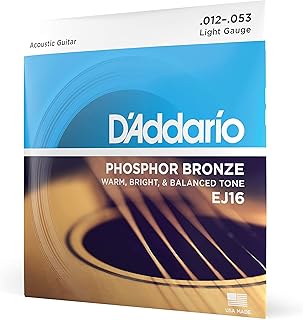
The D’Addario Guitar Strings – Phosphor Bronze Acoustic Guitar Strings – EJ16 – Rich, Full Tonal Spectrum – For 6 String Guitars – 12-53 Light is the acoustic string that most intermediate players graduate to once they’ve been playing long enough to have an opinion. The 12-53 light gauge is the standard specification for acoustic guitars in the UK and US, and D’Addario’s phosphor bronze formulation has become something of an industry reference.
What separates the EJ16 from budget acoustic strings is consistency and tonal balance. D’Addario manufactures its strings in the USA with tight quality control, and you can feel and hear that in the result: the tone is balanced across the frequency spectrum, with warmth in the bass, presence in the mids, and controlled brightness in the treble. It’s not a string that pushes any one frequency aggressively — instead, it lets your guitar speak. On a dreadnought with a spruce top, the result is authoritative and full; on a cedar-topped guitar, it adds welcome brightness without harshness.
The 12-53 gauge provides noticeably more tension than lighter gauges, which translates to greater volume and projection, more sustain, and a sense of physical resistance under the fingers that many players find satisfying once their technique is established. Strumming chords feels purposeful; fingerpicking patterns have a solid, defined attack. Beginners may find the tension demanding at first, but the playing experience it unlocks is worth the adjustment period.
These strings are uncoated, so they’ll oxidise over time — typically four to six weeks before the tone starts to dull noticeably if you play regularly. D’Addario also makes a coated version (the XS range) for extended life, which is discussed below. For the price and the sound quality, the EJ16 is hard to argue against — it’s the acoustic string that most guitar teachers reach for when their students ask what to put on their guitar.
Best Coated Acoustic Strings for Longevity: D’Addario XS Phosphor Bronze
The D’Addario Acoustic Guitar Strings, XS Phosphor Bronze Coated, XSAPB1253, Light Gauge 12-53, 6-String Set, Pack of 1 takes everything that makes the EJ16 a trustworthy acoustic string and adds a micro-thin coating to extend its lifespan significantly. If you’ve ever put on a new set of strings on a Monday and noticed they sounded flat by the following weekend, the XS range is the answer to that frustration.
D’Addario’s XS coating is one of the thinner coatings on the market, which matters because thick coatings can dampen resonance and give strings an artificial, slightly plasticky feel. The XS treatment is designed to protect against sweat, oils, and environmental humidity without compromising the natural feel of the string or its tonal character. In practice, the difference in tone between a fresh set of EJ16s and a fresh set of XS strings is minimal — both deliver that warm, balanced phosphor bronze sound. But three weeks in, the XS set still sounds like week one, while uncoated strings start showing their age.
This makes the XS range particularly valuable for players who don’t change strings often — whether that’s due to time, budget, or simply forgetting. It’s also the smarter choice if your guitar lives in a dry environment (dry air accelerates oxidisation) or if you tend to sweat heavily when playing. The coating won’t make the strings invincible, but it meaningfully extends the window in which they sound their best.
The tradeoff is cost: coated strings carry a premium over their uncoated equivalents, so if you’re the kind of player who changes strings every two weeks anyway, the economics are less compelling. There’s also a small subset of players who find that any coating changes the feel under the fingers just enough to bother them — if you’re one of those, stick with the EJ16. But for most acoustic players who want to fit a set and not think about it for a couple of months, the XS Phosphor Bronze delivers genuinely impressive longevity.
Best Acoustic Strings for a Bright, Open Sound: Ernie Ball Earthwood Extra Light
The Ernie Ball Earthwood Extra Light 80/20 Bronze Acoustic Guitar Strings – 10-50 Gauge occupies a different tonal territory to phosphor bronze strings. The 80/20 bronze alloy — eighty percent copper, twenty percent zinc — produces a brighter, more immediate sound with enhanced treble response. Where phosphor bronze tends to be warm and rounded, 80/20 bronze strings cut through with a crisper, more articulate character.
The extra-light gauge (10-50) means the tension is very low, making this set ideal for players with sensitive fingertips, small hands, or those recovering from an injury who need reduced physical demand. On steel-string acoustic guitars, this gauge is about as gentle as you can get while still producing a usable acoustic tone. It’s particularly well-suited to fingerpicking styles where the pick attack is delicate and note separation is more important than volume.
Tonally, the 80/20 bronze alloy gives these strings a characteristic shimmer in the high register that works beautifully for open-tuning styles, folk, and Celtic music where the treble strings carry melodic lines. Strummed chords have an immediacy and brightness that sounds lively and present. The flip side is that this brightness can tip into harshness on guitars that are already bright-voiced — on a guitar with a maple back and sides, for example, 80/20 strings might feel a little too punchy. On warmer-toned guitars, they add exactly the brightness that’s often missing.
One consideration with 80/20 bronze strings is that they tend to lose their tone slightly faster than phosphor bronze, as the zinc content oxidises more readily. You’ll get peak brightness for a week or two, then the tone softens — some players actually prefer the slightly broken-in sound that follows. Either way, this is a set worth trying if your acoustic has always felt a little dark or you want a livelier playing experience without making any structural changes to your instrument.
Best Classical Guitar Strings: D’Addario Pro-Arté EJ45
The D’Addario Pro Arté Nylon Classical Guitar Strings, EJ45, Normal Tension, 6-String Set, Pack of 1 is the standard reference for classical and fingerstyle nylon-string guitar, used by students, teachers, and professional players alike. If you play a classical guitar — or a flamenco, nylon-string acoustic, or crossover instrument — these are the strings to start with before exploring alternatives.
Classical guitar strings are a completely different world to steel strings. The treble strings (G, B, and high E) are made from clear nylon, while the bass strings (E, A, and D) use nylon filament wrapped in silver-plated copper wire. That construction produces the warm, rounded tone that defines the classical guitar sound — no metallic attack, no steel brightness, just a full, complex resonance that projects beautifully when played fingerstyle.
The EJ45 normal tension sits in the middle of D’Addario’s classical range, making it versatile and appropriate for most players. Normal tension strings are comfortable to play without being floppy, and they generate enough volume for solo performance and practice without excessive strain on the guitar’s top. If you find normal tension strings feel a bit loose or lack projection, D’Addario’s hard tension version offers more resistance; if you want an easier playing experience, the EJ43 light tension is a gentler option.
One thing to be aware of with nylon strings: they require a significant stretch-in period before they hold tune reliably. A new set of nylon strings will detune repeatedly for the first day or two of playing as the nylon fibres settle. This isn’t a defect — it’s the nature of the material. Stretching them manually by gently pulling each string away from the fretboard accelerates the process. Once settled, they’re stable and consistent. For classical players who haven’t yet found their string of choice, the EJ45 is the logical starting point — they’re used in conservatoires and teaching studios globally for very good reason.
What to Look for When Buying Guitar Strings
- Gauge: String gauge refers to the thickness of the strings, measured in thousandths of an inch. Lighter gauges (9-42 or 10-47) are easier to play but produce less volume and sustain. Heavier gauges (12-53 or 13-56) require more finger pressure but deliver fuller tone and projection. Match your gauge to your playing style and physical comfort — there’s no universally correct answer.
- Material: For electric guitars, nickel-wound strings are the standard — they balance brightness with warmth and feel smooth under the fingers. For acoustic steel-string guitars, phosphor bronze is the most popular choice for its warm, balanced tone, while 80/20 bronze is brighter and more immediate. Classical guitars require nylon strings — never fit steel strings on a classical guitar, as the tension can damage the instrument.
- Coating: Coated strings have a micro-thin treatment applied to the windings, protecting them from sweat, oils, and oxidisation. They last significantly longer than uncoated strings but carry a cost premium. If you play daily or have acidic sweat that kills strings quickly, coated strings often represent better long-term value. If you change strings regularly anyway, uncoated strings give you maximum tonal openness at lower cost.
- Core shape: Most modern strings use a round core wire, which gives a warmer, more flexible feel. Hex core strings are stiffer and brighter and are used in most mass-market sets. Some players have strong preferences here, but for most it’s a secondary consideration unless you’re pursuing a specific vintage tone.
- Tuning and tension requirements: If you play in standard tuning, a normal gauge set will work perfectly. If you regularly downtune, consider a set designed for the purpose — medium-top/extra-heavy-bottom sets like the D’Addario EXL117 maintain appropriate tension in the low register at lower pitches, preventing the floppiness that ruins low-end clarity.
- Instrument compatibility: Never put acoustic steel strings on a classical guitar. Don’t fit classical nylon strings on a steel-string acoustic. And check whether your acoustic requires a ball-end or loop-end string if you’re in any doubt — most steel-string acoustics use ball-end, while some folk instruments (particularly lutes and certain 12-frets) use loop-end.
- String winding method: Roundwound strings (standard for most electric and acoustic sets) have a textured feel that produces finger noise when sliding. Flatwound or half-round strings (available in some acoustic and electric sets) feel smoother and reduce that noise, which is useful for jazz and fingerstyle, though they sacrifice some brightness in the process.
Verdict
For most electric guitarists in standard or near-standard tuning, the Ernie Ball Regular Slinky 10-46 is the logical default — it’s the most proven, consistently available, and well-rounded electric string at an accessible price. For acoustic players, the D’Addario EJ16 Phosphor Bronze 12-53 is the equivalent reference point, delivering balanced tone, reliable quality, and a gauge that suits most acoustic guitars and playing situations.
If longevity is your priority — because you play irregularly, or you simply want to restring less often — the D’Addario XS Phosphor Bronze coated strings are worth the extra outlay. The coating genuinely extends peak tone life without the tonal compromise that plagues cheaper coated alternatives.
For players with specific needs: heavy strings and lower tunings point clearly to the D’Addario EXL117; nylon-string players should go straight to the D’Addario Pro-Arté EJ45; beginners or players with lighter touch will appreciate the Ernie Ball Super Slinky or the Adagio 10-47 acoustic set. The important thing is to match the string to your instrument, your playing style, and your hands — then change them more often than you think you need to. Fresh strings transform how a guitar sounds and plays, and that experience is worth seeking out regularly.
This guide was produced independently. We were not paid to feature any specific product in this guide. All opinions are independent and based on publicly available specifications, verified buyer feedback patterns, and category research.
Quick Comparison Table


FAQ
How often should I change my guitar strings?
For regular players (daily or near-daily practice), changing strings every three to four weeks is a reasonable guideline for uncoated strings. If you use coated strings, every six to eight weeks is often workable. Players who perform live should change strings before every significant gig — dead strings are particularly obvious through a PA or amplifier. Even if strings haven’t broken, oxidised strings lose treble response and can feel rough under the fingers.
What gauge of strings should a beginner start with?
Beginners on electric guitar typically find 9-42 (super slinky) or 10-46 (regular slinky) gauge strings the most comfortable. On acoustic guitar, a 10-47 or 11-52 set is gentler on fingertips than the standard 12-53. Once your fingertips have toughened up and your technique is more established, you can experiment with heavier gauges to see whether you prefer the extra volume and sustain they provide.
What is the difference between phosphor bronze and 80/20 bronze acoustic strings?
Phosphor bronze strings (copper, zinc, and a small amount of phosphor) produce a warm, balanced tone with good sustain — the most popular acoustic string material for most styles. 80/20 bronze strings (80% copper, 20% zinc) are brighter and more immediate sounding, with enhanced treble response. 80/20 strings tend to lose their brightness slightly faster, while phosphor bronze maintains a fuller tone for longer. The right choice depends on your guitar’s natural voice and the style of music you play.
Do coated strings really sound as good as uncoated strings?
High-quality coated strings from reputable brands use very thin coatings that have minimal effect on tone and feel. Budget coated strings can sound slightly muted and feel plasticky. The key advantage of coated strings is longevity — they resist sweat and oil much more effectively. If you’ve tried coated strings before and disliked them, try a different brand or a thinner-coating formulation before writing them off entirely.
Can I put any type of strings on any guitar?
No — the type of strings must match your guitar’s design. Classical guitars are built for nylon strings and should never have steel strings fitted, as the higher tension can crack the top or damage the neck. Steel-string acoustic guitars need ball-end steel strings (acoustic or electro-acoustic sets). Electric guitars require electric strings. Fitting the wrong type can damage your instrument and will certainly sound poor.
Why do my new strings keep going out of tune?
New strings — especially nylon strings — need a break-in period during which the strings stretch and settle at their correct tension. With steel strings, this usually takes a few hours of playing and retuning; with nylon strings, it can take a full day or two. You can speed the process by gently pulling each string away from the fretboard a few times after restringing, then retuning. Once the strings have settled, they should hold their tuning well between sessions.