You’ve got a sketchbook full of pencil outlines — delicate fern fronds, rose hips, a sprawling hellebore — and you know exactly what you want them to look like finished. The problem is that every time you reach for your paints, something lets you down. Your current set bleeds into garish, flat colour with no transparency. The greens are either too cold and artificial or so muted they disappear. The reds turn muddy the moment you try to layer over a wash. Or perhaps you’ve been working from a large tube palette that’s perfectly fine at a desk, but you want to take your botanical work outside — into the garden, to a National Trust property, to a woodland — and lugging a full studio setup just isn’t realistic.
Half-pan watercolour sets solve most of these problems in one go. They’re compact enough to slip into a shoulder bag, they dry out between sessions without waste, and the best ones use the same professional-grade pigments as their tube equivalents. But not all half-pan sets are created equal, and for botanical illustration specifically — a discipline that demands precise, luminous washes over fine linework, believable greens in a dozen different temperatures, and the ability to layer without lifting — you need to choose carefully. This guide walks you through the strongest options currently available on Amazon UK.
How We Evaluated These Sets
Every set in this guide was assessed against a consistent set of criteria designed specifically for botanical illustration rather than general watercolour painting. The key factors: pigment quality and transparency (botanical work depends on luminous layered washes, so muddy or opaque pigments are a problem); colour range with particular attention to the green family (botanical artists need warm, cool, and mid-range greens without having to perform acrobatic mixing every time); pan size and refillability (half pans should be replaceable individually); the quality and usability of the tin or case (does it double as a mixing palette? does it close securely?); and the inclusion of a travel brush. We also looked closely at verified buyer review patterns on Amazon UK, paying particular attention to comments from artists who specifically mention detailed or illustrative work rather than loose expressive painting.
Best All-Round Starter Pick: Winsor & Newton Cotman Watercolour ‘Sketchers’ Pocket Set
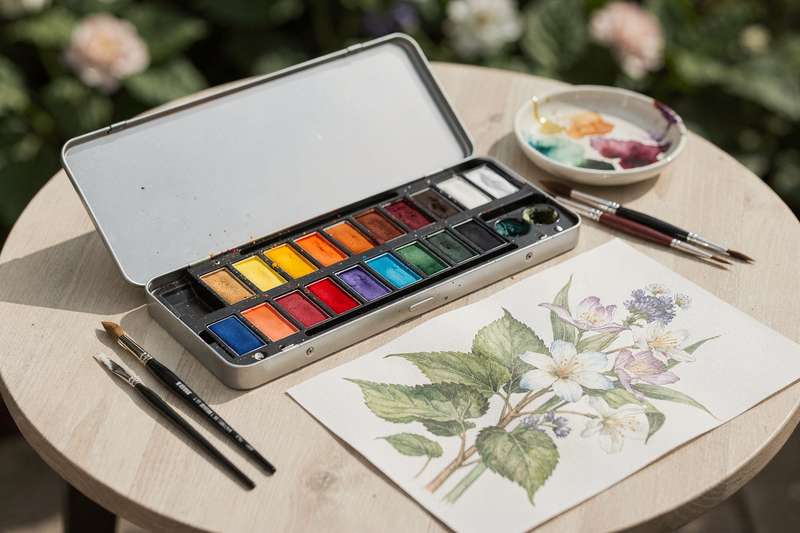
The Winsor & Newton Cotman Watercolour ‘Sketchers’ Pocket Set is, without much argument, the most sensible starting point for a botanical illustrator who wants a reliable, portable half-pan set without overcomplicating things. It holds twelve half pans in a compact metal tin with a fold-out lid that works as a mixing palette, and it comes with a travel brush — so you can genuinely pick it up and walk out the door.
The twelve-colour selection covers the essentials: you get warm and cool blues, a rose, a cadmium yellow hue, yellow ochre, a viridian hue, and a selection of earth tones. For botanical illustration, the viridian hue and the cadmium yellow together give you a reasonable working green, and the rose (which behaves much like a quinacridone pink) mixes convincingly into pinks, purples, and soft corals when combined with the blue. The cadmium yellow hue is warm enough for stamens and sunlit petals without being so opaque it fights with washes underneath.
Where Cotman sits below artist grade is in depth of saturation — if you’re painting very intense blooms like deep magenta peonies or rich violet irises, you’ll find the colours slightly restrained compared to full artist-grade paints. The pigment concentrations are lower, which means you need slightly more paint to reach the same intensity. That said, the transparency is genuinely good, and Cotman washes layer predictably, which matters enormously when you’re building up botanical detail over three or four sessions.
The tin itself deserves a mention: it’s sturdy, closes with a satisfying snap, and the pans click in and out cleanly so you can swap or replace individual colours as they run down. Winsor & Newton sells Cotman half pans individually, which keeps the long-term cost of the set sensible. The travel brush included is a short-handled round that’s perfectly adequate for field work, though committed botanical illustrators will likely swap it for a longer-handled quality brush at the desk.
This is the pick for botanical illustrators who are working at an intermediate level, want something they can take into the garden without anxiety, and don’t yet need the full complexity of an artist-grade range. It rewards careful mixing and punishes lazy technique — which, for a discipline as demanding as botanical illustration, is actually a feature rather than a flaw.
Best for Expanding Your Range: Winsor & Newton Cotman ‘Complete Pocket Set’ 16 Half Pans
If twelve colours feels limiting — and for botanical illustration, it sometimes does — the Winsor & Newton Cotman Watercolour ‘Complete Pocket Set’ with 16 Half Pans adds four more carefully chosen colours to the Sketchers palette, includes a travel brush, a kneaded eraser, and a pencil, making it a more complete botanical kit in a single purchase.
Those extra four colours aren’t token additions. In practical terms, they extend your green mixing range and give you a broader base for rendering the kind of colour variety you encounter in real botanical subjects — the difference between a cool blue-green eucalyptus leaf and a warm olive sage leaf, for instance, becomes much easier to handle when you have slightly more flexibility in the palette. The pencil and eraser included are basic but genuinely useful if you’re doing botanical sketching on location before applying washes.
The physical format is slightly larger than the Sketchers set to accommodate the extra pans, but it still fits in a coat pocket or a small bag without difficulty. The mixing lid works on the same principle — fold it out and you have a reasonable mixing area. Serious botanical illustrators working on complex compositions often find that sixteen colours is closer to the minimum they want for a travel palette, since the green family alone can eat through several pan slots when you’re working on foliage-heavy subjects like ferns, ivy, or woodland floor scenes.
The honest tradeoff here versus the Sketchers set is simply size and complexity. If you’re a newer artist who finds too many colours in front of you overwhelming, start with twelve and build up. If you already know your way around a palette and you’re frustrated by mixing limitations on location, the sixteen-pan version is the better choice and represents good value for what you get. The kneaded eraser is a genuinely thoughtful addition — it lifts graphite without lifting paper fibres, which matters when you’re painting over a pencil outline you might want to adjust.
Best Compact Option: Winsor & Newton Watercolour Half Pan Compact Set
The Winsor & Newton Watercolour Half Pan Compact Set takes the Cotman range and packages it into the smallest possible tin format — genuinely shirt-pocket sized, with eight half pans and a fold-flat brush. If portability is your primary concern and you’re happy to do more mixing from a leaner palette, this is worth serious consideration.
Eight colours might sound restrictive, but experienced botanical illustrators often argue that a tightly curated small palette teaches you more about colour mixing than a large set where you can always reach for the ‘right’ colour directly. The selection covers primary and secondary hues with reasonable botanical coverage: you have warm and cool primaries, which means you can mix clean secondaries and a workable range of greens. The key is understanding which colours in the set lean warm and which lean cool — once you’ve mapped that, an eight-pan palette becomes surprisingly versatile for leaf and petal work.
Where this compact set genuinely struggles is in representing the full tonal range of botanical subjects in a single session. Painting a detailed botanical plate with multiple species, each requiring different green temperatures and different petal tones, pushes an eight-colour palette quite hard. You’ll spend more time at the mixing stage and you’ll need to be methodical about mixing enough of each colour before you start a section, because re-mixing the exact same tone mid-session is tricky with such a small starting palette.
That said, the Cotman pigment quality is the same as in the larger sets, so the transparency and layering behaviour you get here is consistent with the rest of the range. The tin is exceptionally light — noticeably lighter than the larger sets — which makes it the right pick if you’re walking long distances between painting spots or travelling by air and watching bag weight. Think of it as a specialist location tool rather than a full studio replacement.
Best for Serious Ambition: Winsor & Newton Cotman Set of 36 Half Pan Special Edition
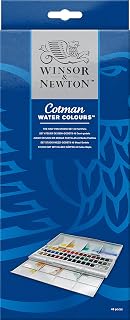
The Winsor & Newton Cotman Set of 36 Half Pan Special Edition is the point at which a half-pan set stops being a portable convenience and starts being a genuinely comprehensive working palette. Rated 4.6 stars from over 500 verified reviews on Amazon UK, this is the most reviewed option in this guide and one of the most consistently praised Cotman sets available.
Thirty-six colours gives you a full spectrum with multiple versions of most hue families — you get several greens (including viridian, hooker’s green, sap green, and terre verte), multiple blues at different temperatures, a range of earth colours from raw sienna through to burnt umber, and several pinks and violets. For botanical illustration, this breadth is genuinely useful rather than just impressive on paper. When you’re painting a detailed botanical plate with ten or twelve different plant species — each with subtly different leaf colour, stem colour, and flower tone — having the right green or the right earthy brown directly available without complex mixing saves significant time and reduces the risk of mixing inconsistency across a long session.
The special edition aspect is worth noting: two of the thirty-six pans in this set are artist-quality rather than Cotman student-grade, giving you a taste of the upper tier within the familiar Cotman format. This is a smart addition — it lets you see and feel the difference between the ranges, and it puts genuinely high-performance pigments in the two slots where quality matters most for botanical work (typically the primary blue and one of the pinks).
The tradeoff is obvious: a thirty-six pan tin is not a pockets item. It’s a large format set that works brilliantly at a dedicated desk or in a roomy bag, but loses the ‘grab-and-go’ quality of the smaller sets. The mixing surface in the lid is correspondingly larger, which is useful when you’re mixing large washes for backgrounds, but the overall format is closer to a studio set than a field kit. If you want the full Cotman range and you’re primarily working at home or in a comfortable outdoor setup with a table, this is the version to choose.
Best for Dedicated Botanical Colour Range: Rosa Gallery Botanical Unique Palette Watercolours
The Rosa Gallery Set of Watercolors Botanical Unique Palette, Full Pans 2.5ml, Metal Case, Extra Fine Professional Watercolours (14 Full Pans) is the most botanically specific option in this guide. It’s the only set here curated explicitly for botanical subject matter — the fourteen colours have been chosen with leaves, petals, stems, and earth tones in mind, rather than being a general-purpose spectrum.
Rosa Gallery is a Ukrainian brand with a growing reputation in the European watercolour market, and their extra fine professional range uses strong pigment concentrations with good transparency ratings. The full pan format here (rather than half pan) gives you 2.5ml per colour, which is generous — you won’t burn through the earth tones and greens at the rate you might with half pans on a detailed botanical project. The metal case is well-made and doubles as a mixing surface in the lid.
With 8 reviews and a 4.3-star rating on Amazon UK, this is the least-reviewed product in this guide, which means there’s less verified buyer data to draw on than with the established Winsor & Newton sets. The reviews that do exist are positive and specifically mention the colour selection and pigment quality, but if you’re the kind of buyer who relies on a large pool of verified feedback before committing, the lower review count is worth factoring in. That said, Rosa Gallery’s wider range is well-regarded in European botanical art communities, and the colour selection here — which reportedly includes botanically useful tones like warm and cool greens, earthy neutrals, and floral pinks — is intelligently put together.
The main thing to be aware of is that this is technically a full-pan set rather than half-pan, which gives you more paint per colour but also means the tin is slightly larger than a comparable half-pan set. For a home studio setup where you want a dedicated botanical palette that can sit on the desk between sessions, this is a compelling option. For field work where you want something truly pocketable, it’s slightly less convenient than the half-pan Cotman sets.
Best for Artists Who Want Professional Detail: Derwent Watercolour Paint Pan 12 Set
The Derwent Watercolour Paint Pan 12 Set, Set of 12, Half Pan Size, Water-Soluble, Ideal for Painting, Professional Quality, Travel Size brings a different character to the category. Derwent is best known for coloured pencils, but their watercolour range has developed steadily, and this twelve-pan half-pan set has a 4.5-star rating from 217 verified reviews on Amazon UK — a meaningful sample size.
The colour selection in the Derwent set leans slightly more towards illustrative and fine-art use than the Cotman range. Reviewers consistently note the colours’ behaviour when used for detailed work over pencil or ink linework — the pigments sit cleanly on the paper surface without bleeding unpredictably, which is exactly what you want when you’re painting over a precise botanical line drawing. The twelve-colour selection is broad enough for basic botanical work, covering the primary and secondary spectrum with enough variety to mix a reasonable range of greens and floral tones.
Where Derwent’s set stands apart is in its handling characteristics. If you’re primarily a Derwent coloured pencil artist who’s looking to introduce watercolour washes into your botanical work — perhaps painting loose background washes and then adding pencil detail over the top, or using the two media in combination — the Derwent watercolour pans are a natural extension of a toolkit you’re already familiar with. The pigments are consistent with Derwent’s broader colour philosophy, so the colours you know from their pencil ranges translate relatively predictably to the pan format.
The honest caveat: Derwent’s watercolour pans don’t have quite the depth of range or the transparency of the best Cotman offerings at their worst-case comparison. For pure, transparent layered botanical washes, the Cotman viridian or rose tones are slightly more luminous. But if you’re working in a mixed-media context, or if the Derwent brand is already part of your art supply world, this is a genuinely capable twelve-pan set that will serve botanical illustration well and has the verified reviews to back it up.
Best Value for a Large Botanical Palette: Daler-Rowney Aquafine Watercolour Travel Half Pan Set 24 Colours
The Daler-Rowney Aquafine Watercolour Travel Half Pan Paint Set, 24 Assorted Colours + 1 Watercolour Brush gives you twenty-four half pans in a travel-format tin at a price point that makes it one of the best value large-palette options in this guide. Rated 4.7 stars, it shares Cotman’s top rating across the sets reviewed here, which is a good signal.
Aquafine is Daler-Rowney’s student-grade range, positioned similarly to Cotman but with a slightly different pigment selection and character. For botanical illustration, the twenty-four colour range is broad enough to cover the full spectrum of subjects you’re likely to encounter — multiple greens, a good selection of earth tones for stems and bark, a range of pinks and violets for floral work, and neutrals for cast shadows and subtle background tones. The included brush is a serviceable travel round that will get you through a field session.
The practical tradeoff with Aquafine versus Cotman is pigment consistency. Aquafine uses a slightly higher proportion of hue substitutes — pigment blends that approximate a colour — than Cotman does at a comparable point in the range. This doesn’t show up dramatically in casual painting, but in botanical illustration where you’re building five or six layers of wash and expecting consistent colour mixing across a long project, the slight unpredictability of some pigment blends can become noticeable. Specifically, some of the earth tones in Aquafine can shift in temperature when diluted, which takes some getting used to.
That said, for a botanical illustrator who’s still developing their watercolour skills and wants a large palette to experiment with — to find out which greens and pinks they reach for most often before investing in a more expensive set — Aquafine is an excellent starting point. The twenty-four colour spread gives you the room to discover your own botanical colour preferences without restricting you to a minimum palette. Once you know which ten or twelve colours you actually use, you can use that knowledge to build a more targeted professional set.
What to Look for in a Half-Pan Set for Botanical Illustration
- Pigment transparency: Botanical illustration depends on luminous layered washes — you need to see through each layer to the one beneath. Check that the set includes genuinely transparent pigments. Look for transparency ratings on the manufacturer’s website: a full circle means opaque, an empty circle means transparent, and most botanical work benefits from the latter. Avoid sets that rely heavily on opaque pigments like cadmium or white-based colours for their main tones.
- Green family coverage: You will use greens more than anything else in botanical work. A good set should give you — or let you mix — at least four or five distinct greens: a bright spring green, a warm olive, a cool blue-green, a deep forest green, and a muted sage. If a set has only one or two green pans, check that the included yellows and blues are transparent and mix-friendly enough to build the rest.
- Individual pan refillability: Half pans run out at different rates — your most-used greens and your botanical rose will empty faster than your ochre. Before buying, confirm that the brand sells individual replacement half pans. Winsor & Newton Cotman does; not every brand does. A set you can top up colour by colour is far more economical over two or three years than one you have to replace wholesale.
- Metal tin with integrated mixing palette: The tin lid should fold out to create a usable mixing area. Plastic trays crack with use and don’t clean as cleanly between colours. A metal tin also protects pans during travel — dried watercolour can chip if pans rattle against each other in a flimsy case.
- Pan adhesion and rewetting: Professional-quality half pans should rewet quickly and cleanly with a damp brush. Some cheaper sets leave you scrubbing at a dried pan for ten seconds before you get enough pigment — which matters when you’re working quickly to capture the right light outdoors. Read reviews specifically for comments on rewetting speed.
- Colour lightfastness: Botanical illustration is often framed and displayed, or submitted to exhibitions and publications. Lightfastness ratings (I or II on the ASTM scale) tell you how long a colour will resist fading in light. Fugitive pigments — particularly some cheaper violets and pinks — can fade noticeably over months. Check that key colours in your chosen set have good lightfastness ratings.
- Number of pans versus your working style: More pans isn’t always better. Eight to twelve pans encourages disciplined mixing and a coherent colour harmony across a piece. Twenty-four or thirty-six pans gives you more direct colour access but can make a set unwieldy in the field and can lead to less cohesive colour choices if you always reach for the ‘right’ colour rather than mixing it. Be honest about how you work before defaulting to the largest option.
Verdict
For the majority of botanical illustrators shopping in the UK — whether you’re working at an intermediate level, painting on location as well as at a desk, and want a set that rewards careful technique without requiring you to spend at the very top of the market — the Winsor & Newton Cotman Set of 36 Half Pan Special Edition is the pick to reach for. The thirty-six colour range covers the full botanical spectrum without gaps, the two artist-quality pans included give you a genuine upgrade where it matters most, and the 500-plus verified reviews confirm this is a set that performs in real-world use rather than just on a spec sheet.
If you’re starting out and want something genuinely pocketable that you can take into any garden or field setting without worrying about it, the Winsor & Newton Cotman Sketchers’ Pocket Set is the smarter and more portable starting point — the twelve-colour range is enough to learn botanical colour mixing properly, and the format genuinely goes anywhere. Step up to the thirty-six pan set once you know which colours you use most and what your palette gaps are.
We were not paid to feature any specific product in this guide. All opinions are independent and based on publicly available specifications, verified buyer feedback patterns, and category research.
Quick Comparison Table




Frequently Asked Questions
Are half pans or tubes better for botanical illustration?
Half pans are generally the better choice for botanical illustration because they let you work with small, controlled amounts of colour, which suits the fine detail and precise layering the discipline requires. They also dry between sessions without waste, and the compact format means you can work outdoors or in a garden setting without a complicated setup. Tubes can offer richer initial washes if you need very large areas of flat colour, but for the intricate, small-scale work typical of botanical art, half pans give you better day-to-day control.
How many colours do I actually need in a botanical half-pan set?
For botanical illustration, twelve to sixteen colours is a practical sweet spot. You need at least two yellows (one warm, one cooler), a reliable rose or magenta, a phthalo or ultramarine blue, and a range of greens — ideally both a warm olive-leaning green and a cooler blue-green. Sets with fewer than twelve colours tend to leave gaps in the green family that are difficult to mix convincingly. Sets with more than thirty-six colours are often repetitive and harder to manage in a portable format.
What makes a watercolour ‘professional quality’ versus student grade?
Professional-grade watercolours use higher pigment concentrations, more single-pigment formulations, and finer grinding than student ranges. In practice this means richer colour from smaller amounts of paint, greater transparency when diluted (essential for the luminous layered look in botanical work), and better lightfastness so finished pieces don’t fade. Student sets often use hue substitutes — cheaper pigment blends that approximate a colour — which can look dull when layered. Ranges like Cotman sit in an informed middle ground: not fully professional but using better pigments than cheap hobby sets.
Can I replace individual half pans when they run out?
This depends entirely on the brand. Winsor & Newton Cotman pans, for example, are sold individually and can be popped in and out of the metal tin, so you can replace only the colours you use most. Derwent and Daler-Rowney also sell replacement pans, though availability varies by retailer. Before committing to any set, check whether individual replacement pans are sold separately on Amazon UK — a set that can’t be restocked is much less economical over time.
Is the Winsor & Newton Cotman range good enough for botanical illustration, or do I need artist-grade paints?
Cotman is genuinely capable for botanical illustration, especially for beginners and intermediate artists. The pigments are well-chosen, the transparency is good, and the tins are practical and refillable. Where Cotman does fall slightly short of artist grade is in deep, saturated colours — very intense quinacridone pinks or granulating earthy tones require full artist-grade pigments. That said, many skilled botanical illustrators use Cotman throughout their careers and achieve outstanding results, particularly when they understand its mixing characteristics.
What paper should I use alongside a half-pan botanical set?
For botanical illustration, 100% cotton watercolour paper rated at 300gsm or above is the standard choice — it handles repeated wet layers, lifting, and fine detail without buckling or pilling. Cold-pressed (NOT) surface is most popular because it has just enough texture to give delicate washes some life without obscuring fine linework. Hot-pressed paper is completely smooth and suits very precise botanical rendering where texture is unwanted. Avoid wood-pulp papers, which yellow over time and don’t respond as cleanly to layering.