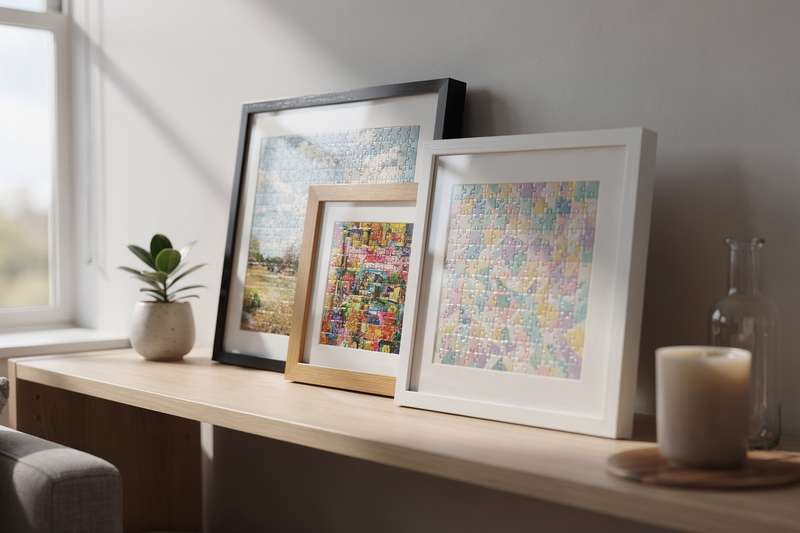
You’ve spent three evenings hunched over a 1000-piece puzzle, finally clicking that last piece into place. Then comes the question every puzzle enthusiast faces: what now? You could disassemble it and start again, but that feels like throwing away a small masterpiece. You’ve tried rolling it up on a felt mat, but pieces keep sliding. You’ve thought about gluing it, only to find the adhesive warped the cardboard. What you actually want is a proper frame — something that holds the puzzle flat, protects the surface, and looks good on the wall without requiring a degree in carpentry to assemble.
The UK market for puzzle frames is surprisingly varied. Fixed-size frames suit anyone who knows exactly which puzzle they want to display. Adjustable frames work if you rotate between different puzzle sizes. Storage boards with sorting trays solve a different problem entirely — keeping a half-finished puzzle safe between sessions. Adhesive sheets give you an inexpensive way to consolidate a puzzle before it goes into any frame. Knowing which product solves your specific problem is the difference between a satisfying wall display and a frustrating afternoon with a frame that doesn’t quite fit.
This guide cuts through the confusion by matching specific products to specific scenarios, based on the real products available on Amazon UK right now.
How These Picks Were Evaluated
Every product in this guide was assessed against five criteria: fit accuracy (does the stated size genuinely suit standard UK puzzle dimensions?), build quality signals drawn from verified buyer feedback patterns, ease of assembly for someone working alone, versatility across orientations and puzzle sizes, and suitability for the intended use case — whether that’s wall display, active storage, or flat preservation. Products were drawn from the live Amazon UK catalogue. The MCS Puzzle Frame carries zero verified buyer reviews on the UK listing, so that section clearly notes this limitation rather than pretending review data exists. Where a product had fewer than ten reviews, the rating is treated cautiously. The Ravensburger Underwater Friends puzzle-in-a-frame was identified as a children’s jigsaw puzzle toy rather than a standalone frame product, so it has been excluded — including an off-topic children’s toy in a guide about display and storage frames would mislead you. All remaining picks are genuinely on-topic and serve distinct use cases.
Best Flat-Frame for Standard 1000-Piece Puzzles: 50x70cm Black Frame
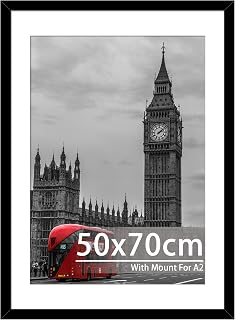
The 50x70cm Black Frame is the most straightforward answer if you have a completed standard 1000-piece puzzle and want it on the wall with minimum fuss. At 4.4 stars from 430 verified buyers on Amazon UK, this is the most-reviewed dedicated frame-style product in this guide, which gives you meaningful confidence that real people are using it successfully.
The construction is engineered wood with a plexiglass front rather than glass — a sensible choice for a puzzle frame, since you’re not going to be swapping content frequently and plexiglass is lighter and safer to handle during mounting. The A2 mount included means your puzzle sits centrally with a clean white border, which actually suits completed puzzles nicely by giving them a gallery-print feel. It’s wall-mountable in both portrait and landscape, so whether your 1000-piece puzzle is wider than it is tall or vice versa, you’re covered.
The tradeoff is that this frame is fixed to 50x70cm. That’s a standard size for many European jigsaw puzzles, but not universal. Before buying, measure your completed puzzle rather than relying on the box claim — puzzle dimensions can vary slightly by manufacturer, and a few millimetres of difference matters when you’re trying to slide a glued or preserved puzzle into a snug frame. Buyers with non-standard puzzles have reported needing to trim the mount, which is manageable but worth knowing in advance.
Assembly is consistently described as straightforward in the review pattern. The frame arrives flat-packed, clips together without specialist tools, and the plexiglass panel wipes clean easily. For anyone displaying a completed puzzle as a piece of wall art — particularly the classic 50x70cm Ravensburger or similar European brand puzzles — this frame hits a sensible balance between quality, practicality, and value for money. The black finish is neutral enough to suit most wall colours and décor styles.
One thing to note: because the cover is plexiglass rather than UV-filtering glass, it won’t provide long-term UV protection against colour fading if your wall gets direct sunlight. For a puzzle displayed in a bright south-facing room, that’s worth factoring in. For a shaded wall or a hallway display, it’s a non-issue in practical terms.
Best Adjustable Frame for Multiple Puzzle Sizes: ikkle Adjustable Puzzle Frame
The ikkle Adjustable Puzzle Frame for 1000/1500/2000 Piece Puzzles takes a different approach to the fixed-frame problem by offering adjustable sizing across three of the most common puzzle piece counts. This is genuinely useful if you work through puzzles at a pace and want to rotate what’s displayed on your wall without buying a new frame each time.
A word of transparency upfront: at the time of writing, this listing has only two verified buyer reviews on Amazon UK, giving it a 5.0-star rating. That’s a statistically meaningless sample — two happy buyers doesn’t confirm consistent quality. You’re buying a relatively new product here with limited real-world feedback to draw on. The design concept is sound, and the adjustable mechanism for wall-mounted puzzle frames is a genuinely useful category, but if you prefer to buy based on proven track records, the 50x70cm Fixed Frame above or the Jigsaw Puzzle Board below may suit you better.
That said, the specifications are appealing. The frame is described as lightweight, which matters when you’re mounting something on a wall solo. It handles horizontal and vertical orientation, and the adjustable range covering 1000, 1500, and 2000-piece puzzles means you’re not locked into a single format. For someone who completes puzzles regularly across different piece counts and wants an ongoing display solution, the concept makes sense.
The design also works for posters and pictures beyond puzzles, which adds flexibility if you eventually want to repurpose the frame. Mounting hardware is included, though with only two reviews it’s hard to gauge how user-friendly the installation process actually is in practice. If you go for this one, budget a little extra time for getting the fit right the first time, and keep the packaging in case you need to make adjustments.
For puzzle enthusiasts who regularly work through different puzzle sizes and want a single wall-display solution that adapts to their collection, the ikkle Adjustable Frame is the most logical option in this guide. Just go in with open eyes about the limited review history.
Best Puzzle Storage Board for Active Puzzlers: Jigsaw Puzzle Board 1000 Pieces
The Jigsaw Puzzle Board 1000 Pieces, 32 x 22in Puzzle Board solves a completely different problem from the wall-frame picks above. This is for the active puzzler — the person who works on a puzzle over several days or weeks, needs to store it safely between sessions, and doesn’t have a dedicated table to leave it on. At 4.6 stars from 327 reviews, it’s the highest-rated product by score in this guide with a meaningful review count, which is a strong signal.
The board is 32 x 22 inches, which comfortably accommodates most 1000-piece puzzles and stretches to 500-piece puzzles too. The non-slip felt surface is the key functional feature — it holds puzzle pieces in place while you’re working and keeps them from sliding when you pick up the board. The cover that comes with it means you can close everything up, move the board to a cupboard or under a bed, and come back to exactly the arrangement you left. The six sorting trays for grouping edge pieces, colour sections, or patterns are a practical addition that many buyers highlight as genuinely useful rather than marketing filler.
The tradeoff is that this is a working surface, not a display solution. Once your puzzle is complete, this board doesn’t transform into a wall frame. If your goal is to display a finished puzzle, you’ll want one of the frame picks. But if your frustration is keeping a partially-completed puzzle intact between sessions — especially in a household where table space is contested — this board addresses that specific pain point better than any fixed frame.
Build quality feedback in the reviews consistently mentions the felt surface holding up well over time and the board being sturdy without being heavy. The cover mechanism is described as secure. For puzzle enthusiasts who prioritise the process of completing a puzzle as much as the end result, this is likely the most useful purchase in the guide.
Best for Larger Puzzles in Storage: Felt Puzzle Board for 1500 Pieces
The Felt Puzzle Board for 1500 Pieces Jigsaw Puzzles fills the gap for anyone working on larger-format puzzles that the 1000-piece board above simply won’t accommodate. At 95 x 65 cm — significantly larger than the 32 x 22in board — it’s designed for 1500-piece puzzles and provides the same non-slip felt surface and roll-up storage concept. It carries 4.5 stars from 103 reviews, a smaller but still meaningful sample.
The roll-up design is this board’s defining feature. Rather than a rigid board you slide under furniture, this felt mat rolls up with your puzzle on it, secured by straps or ties, and stores upright in a corner or in a wardrobe. It comes with eight sorting trays — more than the 1000-piece board — which reflects the greater organisational complexity of a 1500-piece puzzle. Reviewers working on large-format Ravensburger and Clementoni puzzles specifically mention this board in positive terms.
The roll-up approach does introduce one real limitation: rolling up a partially-completed puzzle inevitably causes some pieces to shift, particularly those that haven’t been fitted tightly together. The felt grips well, but gravity and the rolling motion will displace a few pieces each time. Most buyers accept this as a reasonable tradeoff for the storage convenience, but if you’re a perfectionist about maintaining exact piece positions between sessions, a rigid board with a cover (like the 1000-piece board above) would frustrate you less. For 1500-piece puzzles specifically, a rigid board option at this size would be significantly heavier and more awkward, so the roll-up design is the more practical engineering choice at this scale.
If you regularly tackle puzzles above 1000 pieces and need a way to keep them safe between sessions without dedicating a table permanently, this felt board is the practical solution. The lightweight design also makes it easy to carry to a different room if needed, which the heavier rigid alternatives can’t match.
Best Budget Preservation Solution: Save My Puzzle! Adhesive Sheets
The Save My Puzzle! Peel and Stick Adhesive Sheets occupies a distinct niche in this guide: it’s not a frame or a storage board, but a preservation method that makes framing possible in the first place. At 4.5 stars from 250 reviews, it has a solid track record. The concept is simple — peel-and-stick adhesive sheets that you apply to the back of a completed puzzle to bond all the pieces together, giving you a rigid, unified surface that can then be slipped into any standard frame.
This is the most budget-friendly entry in the guide and arguably the most versatile, because it works with whichever frame you already have or plan to buy. The sheets are designed for standard puzzle sizes and applied to the back rather than the front, which means you don’t risk obscuring the puzzle image or creating a cloudy surface finish. Buyers consistently note that the adhesive is strong enough to hold pieces securely without the warping problems that liquid puzzle glue can cause.
The limitation is that the sheets come in a fixed size — 15 inches by 7.5 inches each — so you’ll need multiple sheets for a full 1000-piece puzzle, and aligning them neatly across the back takes a bit of care. The odd-shaped dimensions mean some trimming and overlap is involved. A small number of reviews mention that the adhesive isn’t quite strong enough for particularly thick puzzle pieces, so if you’re working with premium-quality puzzle boards rather than standard consumer puzzles, do a test on a corner before committing the whole back of your puzzle.
For anyone who wants to frame a puzzle using a general-purpose picture frame they already own — or who wants the most economical route to a fixed, displayable puzzle — these adhesive sheets are the sensible starting point. Apply them, let everything set, then slide the bonded puzzle into the 50x70cm Black Frame or the MCS frame depending on your size requirements.
Best Fixed Frame with Zero-Review Caveat: MCS Puzzle Frame 51×68.5cm
The MCS Puzzle Frame 51×68.5 cm (20×27 in) Black for Finished Puzzles is the most well-known name in dedicated puzzle framing — MCS is an established picture frame brand with a long history, and this specific frame has accumulated a strong reputation on the US Amazon marketplace. However, on the UK Amazon listing specifically, there are currently zero verified buyer reviews.
This is a genuine limitation and it’s worth stating plainly. Zero reviews on a UK listing means you cannot draw on buyer experience data to confirm quality, assembly ease, or accurate sizing. The frame’s reputation from other markets is encouraging — the reversible black-and-white background is a genuinely useful feature that lets you choose which colour provides better contrast for your specific puzzle image, and the clear cover and hinged hanging hardware for both portrait and landscape display are well-documented features. The MDF woodgrain construction is standard for this price tier and provides reasonable sturdiness without excessive weight.
The specification that makes this frame stand out is the reversible background, which no other product in this guide offers. For a puzzle with predominantly dark colours, a white background creates better definition at the edges. For a bright, colourful puzzle, the black background gives a more gallery-like presentation. If you’ve used MCS frames before and trust the brand, this remains a credible choice. If you’re making a first purchase in this category and want the reassurance of real buyer feedback from UK customers, the 50x70cm Black Frame with its 430 reviews is the safer option at a comparable price point.
The 51×68.5cm (20×27 inch) size covers most standard 1000-piece puzzle formats and includes a clear front cover to protect against dust. Assembly is described in the product listing as straightforward, with included mounting hardware for wall display. Treat this as a considered choice from an established brand rather than a community-validated recommendation, and you’ll be going in with accurate expectations.
Best Puzzle Storage Organiser for Multi-Puzzle Collectors: Puzzle Storage Folder
The Puzzle Storage Folder with 25 Transparent Pockets is the most left-field pick in this guide, and deliberately so — it solves a problem that frames and boards entirely ignore. If you have a collection of puzzles on the go simultaneously, or you regularly disassemble completed puzzles to attempt them again later, storing sorted pieces by colour or section is a genuine organisational headache. This folder addresses it directly.
The concept is a binder-style folder with 25 transparent pockets, each large enough to hold sorted puzzle pieces from a 1000-piece puzzle. At 4.2 stars from 385 reviews, it has meaningful buyer feedback. The transparent pockets mean you can see what’s inside without emptying each one, which saves significant time when you’re picking up a half-finished puzzle and trying to remember where you left off. The dustproof design keeps pieces clean during storage, and the portable format means it’s far more manageable than a bulky board when space is at a premium.
The tradeoff is that this is a storage solution, not a display solution. If your goal is a finished puzzle on the wall, this folder doesn’t contribute to that goal directly — it helps you manage the sorting and storage process during the work-in-progress phase. It’s also positioned at a higher price point than some of the frame options, which may surprise buyers who expect storage accessories to be inexpensive.
Where this folder genuinely earns its place is for collectors who own multiple puzzles at different stages of completion, or for people who gift puzzles and want an organised way to ensure all pieces travel safely. It also works well in combination with the adhesive sheets — sort and store your pieces in the folder during the build process, then apply the Save My Puzzle sheets once complete and slide into a fixed frame. That workflow transforms three separate problems (sorting, storage, display) into a manageable system.
What to Look For When Buying a Jigsaw Puzzle Frame
- Accurate sizing: Always measure your completed puzzle before buying a frame. Standard 1000-piece puzzles from major brands typically measure around 50x70cm (19.7×27.6 inches), but this varies between manufacturers. A frame that’s 2cm too small will leave you unable to fit the puzzle; 2cm too large leaves unsightly gaps. When in doubt, size up and use a mount to fill the margin.
- Glass vs plexiglass vs no cover: Glass provides the clearest viewing experience and some types offer UV protection, but it’s heavy and fragile. Plexiglass (acrylic) is lighter and safer, though it can scratch more easily. No-cover frames allow easier access for puzzles you plan to swap in and out, but provide no dust protection. Choose based on how permanently you intend to display the puzzle.
- Mounting orientation: Most puzzle frames are designed for both portrait and landscape orientation, but confirm this before buying. Some budget frames have hardware attached at a fixed orientation, limiting your display options.
- Fixed vs adjustable: Fixed frames are simpler, sturdier, and generally better value if you always work with the same puzzle size. Adjustable frames are more versatile but introduce more complexity in setup and potentially less rigidity once adjusted.
- Board vs frame: If you want to display a completed puzzle, you need a frame. If you want to store a work-in-progress, you need a board with a cover or a roll-up mat. These are different products solving different problems — mixing them up is the most common buying mistake in this category.
- Preserve before framing: Unless a frame is specifically designed to grip puzzle pieces mechanically (rare), you’ll typically need to glue or use adhesive sheets to bond the puzzle before it goes into a general-purpose frame. Liquid puzzle glue and peel-and-stick sheets both work; sheets tend to cause less warping.
- Review count vs rating: In this product category, a frame with 400 reviews at 4.4 stars is meaningfully more trustworthy than a frame with 2 reviews at 5.0 stars. Pay attention to both numbers, not just the star rating.
Verdict
For most UK puzzle enthusiasts who want to display a completed 1000-piece puzzle on the wall, the 50x70cm Black Frame is the most practical starting point. It has the strongest real-world buyer validation of any frame in this guide, it fits the most common standard puzzle size, and the plexiglass cover keeps your display clean without adding excessive weight. Combine it with the Save My Puzzle adhesive sheets if your puzzle isn’t already glued, and you have a complete display solution for a reasonable outlay.
If you’re an active puzzler who spends more time building than displaying, the Jigsaw Puzzle Board 1000 Pieces is the better central purchase — the non-slip felt, cover, and sorting trays turn puzzle-building from a logistical challenge into a structured hobby. And if you regularly work on larger 1500-piece puzzles, the Felt Puzzle Board for 1500 Pieces is the obvious scale-up choice.
The ikkle Adjustable Frame is worth watching if you rotate through different puzzle sizes, but wait for its review count to build before committing to it as your primary display solution.
We were not paid to feature any specific product in this guide. All opinions are independent and based on publicly available specifications, verified buyer feedback patterns, and category research.
Quick Comparison Table



FAQ
What size frame do I need for a 1000-piece jigsaw puzzle?
Most 1000-piece puzzles from major brands measure approximately 50x70cm (around 19.7×27.6 inches), but this varies between manufacturers. Always measure your completed puzzle before ordering a frame rather than relying solely on the box dimensions. A small discrepancy of even one centimetre can mean the puzzle won’t sit properly in the frame.
Do I need to glue my puzzle before putting it in a frame?
It depends on the frame. Frames specifically designed for puzzles sometimes use a mechanical grip or backing pressure to hold pieces in place, but most general-purpose picture frames will not keep loose puzzle pieces from shifting. Using peel-and-stick adhesive sheets or liquid puzzle glue on the back of the completed puzzle before framing is the most reliable way to ensure pieces stay fixed. Adhesive sheets tend to cause less warping than liquid glue.
Can I use a standard picture frame for a jigsaw puzzle?
Yes, provided the dimensions match your completed puzzle and you’ve bonded the pieces together first with adhesive. The 50x70cm frame in this guide is a standard picture frame size that happens to coincide with the most common 1000-piece puzzle dimensions. The key is ensuring the internal opening of the frame (not the external dimensions) matches your puzzle size.
What’s the difference between a puzzle board and a puzzle frame?
A puzzle board is a working surface for building and storing a puzzle in progress — it typically features a non-slip felt surface, a cover to protect the work between sessions, and sometimes sorting trays. A puzzle frame is a display solution for a completed puzzle, designed to hang on the wall. They solve different problems, and you may want both depending on your habits.
How do I store a jigsaw puzzle I haven’t finished yet?
A rigid puzzle board with a fitted cover is the most reliable option, as it allows you to pick up and move the board without pieces shifting. Roll-up felt mats are lighter and suit larger puzzles, though rolling inevitably displaces some loose pieces. A puzzle storage folder with transparent pockets works well for organised piece sorting when you need to clear your work surface entirely between sessions.
Are adjustable puzzle frames worth buying?
Adjustable frames are worth considering if you regularly complete puzzles of different sizes and want a single display solution that works across your collection. The tradeoff is that adjustable mechanisms add assembly complexity and can introduce less rigidity than a fixed frame once set. For most people who work predominantly with one puzzle size, a well-rated fixed frame is simpler and more reliable. If you do go adjustable, look for one with meaningful buyer reviews before committing.