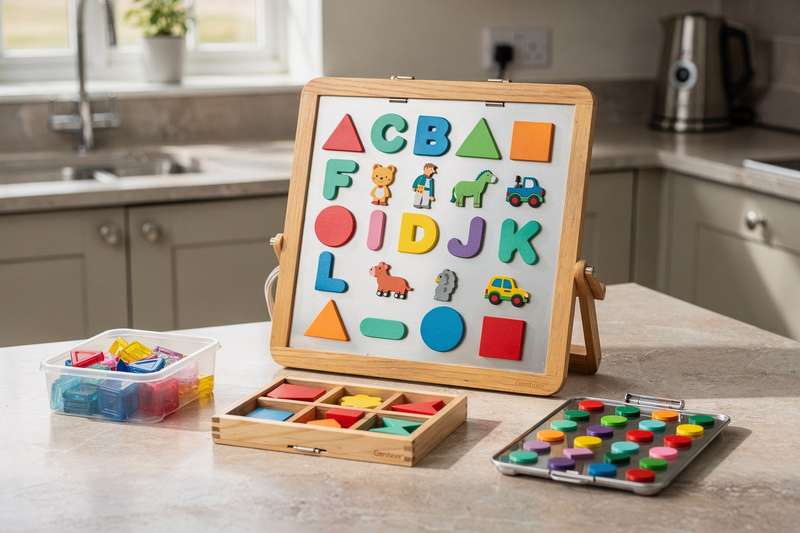
Picture this: it’s 5pm on a wet Saturday, your 4-year-old has already worked through the colouring pencils, rejected the Play-Doh because “it smells wrong”, and sent a tower of wooden blocks skidding across the kitchen floor for the second time in an hour. You need something that holds their attention for more than seven minutes — and something that holds itself together when they get enthusiastic. You’ve probably glanced at magnetic toys before and wondered whether they’re simply a pricier version of fridge magnets. The truth is the category has moved on considerably. Modern magnetic playboards, tile sets, and learning boards give children a tactile, hands-on way to build, sort, spell, count, and create, while the magnets do the hard work of keeping pieces in position and builds stable against small knocks. This guide covers the best options currently available on Amazon UK, matched to specific ages and play scenarios, so you can choose the right set rather than just the most popular one.
How These Picks Were Selected
Selections here were drawn from products currently listed on Amazon UK across the magnetic toys and playboards category. Criteria for evaluation included: educational scope — what cognitive or motor skill the toy genuinely develops — build materials and safety standards appropriate for each stated age group, storage and clean-up practicality, and buyer review patterns where a meaningful sample existed. Two picks in this guide, the Magnetic Colour Sorting Set and the Flexible Rubber Magnetic Men, have very small review bases at the time of writing. For those products, assessment leaned on product design, stated specifications, and comparison with similar established toys in the same category rather than aggregated buyer consensus. Age-appropriate safety considerations are flagged wherever the design warrants it.
Best Overall Magnetic Learning Board
If you’re buying one magnetic toy to start with, the 130 PCS Wooden Magnetic Puzzle covers the most ground for young children. With 925 reviews averaging 4.5 out of 5 stars on Amazon UK, it’s the most widely validated product in this round-up, and the feedback tells a consistent story: parents and grandparents find it keeps 3–7 year olds occupied without requiring constant adult direction.
The set centres on a wooden magnetic puzzle board with a double-sided layout, featuring animal and fruit pattern pieces that children match to their outlines on the board. The double-sided design effectively doubles the play value without doubling the storage footprint. One side gives younger children a simpler matching task; the reverse offers older children a more complex arrangement of pieces. With 130 pieces the set is substantial, though it’s worth checking periodically that everything is accounted for, since small magnetic pieces have a talent for migrating under sofas.
What makes this outperform cheaper plastic alternatives is the wooden construction. Wooden magnetic puzzle pieces tend to be heavier and more satisfying to handle than thin plastic; they sit flatter on the board and resist warping or cracking under the kind of daily use a 4-year-old delivers. The magnetic backing on each piece provides immediate self-correcting feedback — the piece sits correctly in place or it doesn’t — which is exactly the mechanism Montessori-style learning principles are built on. Children figure out their errors without adult intervention, which sustains focus longer than toys that require constant prompting.
The main limitation to know going in: this is fundamentally a structured puzzle rather than an open-ended construction toy. A child who has mastered all the matching combinations will move on, whereas a magnetic tile set offers infinite recombination. For children aged 3–6 who are in the pattern-recognition and shape-matching developmental phase, this is excellent value. For older children wanting true freeform building, look to the tile sets later in this guide. Storage also warrants planning: 130 pieces is a significant count, and you’ll want a dedicated bag or tray rather than leaving pieces loose in a drawer.
Real buyer feedback flags one consistent limitation: a small number of reviewers mention receiving a piece or two with weaker magnetic attachment than the rest. This is relatively uncommon but worth inspecting on first use. For a versatile magnetic learning board that handles pattern recognition, animal naming, and fine motor practice simultaneously, this is the right starting point for most families.
Best for Counting, Spelling, and Early Literacy
The Jaques of London Magnetic Count and Spell Board targets a specific developmental window: the ages of 3–5 when children are beginning to connect letters with sounds and numbers with quantities. Jaques of London is one of the oldest British toy brands still in operation, and the craftsmanship shows. The board itself is wooden, the magnetic tiles are chunky enough for small hands to manipulate confidently, and the overall design has a solidity that cheap alternatives from anonymous importers lack.
At 550 reviews and a 4.4-star rating, this has earned solid buyer confidence over time. The board holds magnetic letter and number pieces in a format that makes counting and spelling exercises feel natural rather than forced. The tactile satisfaction of pressing a letter tile onto the board and having it sit firmly in place is useful at this developmental stage — it keeps children focused on the task rather than wrestling with pieces that slide or fall off the surface.
The educational angle is direct: this is a support tool for early reading and numeracy, and it works well alongside phonics programmes like those used in UK reception classes. If your child is working through letter sounds, having a physical board where they can arrange, rearrange, and check their spelling attempts without penalty is a meaningful confidence-builder. The magnetic format also means the board can go vertical — on a fridge or a magnetic whiteboard — which opens up different play contexts compared to flat puzzle formats and lets children use it at the kitchen table, on the fridge, or propped up in the playroom.
Where it’s less strong: the board area is finite, so ambitious builders wanting to create long sentences or large number sequences will hit the edges of the available space quickly. The range of pieces is fixed, making it harder to expand the set if a child progresses quickly. And because this is a structured learning tool rather than open-ended play equipment, a child who isn’t yet motivated by letters and numbers specifically may not engage with it the way they would with a looser construction set. The structured format is a feature for focused learning but a limitation for pure play.
This works best for children at the pre-school and early primary stage — roughly 3–6 — particularly those who are starting to recognise letters and connect them to sounds. As a gift, it pairs well with a phonics workbook or reading scheme that gives the parent a prompt for what to spell out next. The Jaques of London brand connection also reassures buyers who want heritage credentials rather than an unmarked import.
Best Magnetic Calendar Board for Daily Routines
The Wisdom Learning Kids Magnetic Calendar Board answers a different question from the rest of this guide. Rather than open-ended play or puzzle solving, this 40x32cm board is designed to make abstract concepts — days of the week, months, seasons, weather — tangible and manageable for young children. With 393 reviews averaging 4.7 out of 5 stars, it’s the highest-rated pick in this round-up on a per-review basis.
The format uses moveable magnetic labels: the child (or parent with the child helping) repositions pieces each morning to reflect today’s day, month, weather, and season. It sounds simple, and it is — but that simplicity is precisely why it works with 3–7 year olds. Calendar awareness is one of those foundational concepts that can take months to establish, and having a physical interactive chart as part of a morning routine gives children a concrete reference point that abstract verbal explanations don’t. Several buyers specifically note that their children now ask to update the board each morning unprompted — which is the behaviour you want from any educational resource.
Build quality is consistently praised in the reviews: the magnets are strong enough that pieces don’t drift or fall during the day, the print quality on the board and pieces is clear and colourful without being garish, and the 40x32cm size is substantial enough to read from across a room without dominating a wall. The pieces are designed with child safety in mind for the stated age range, with no exposed small magnets in the standard configuration.
The tradeoff is purpose-specificity. This board does one thing well: it teaches calendar and weather concepts. Once your child has reliably mastered the days, months, and seasons — which typically happens within a school year — the board’s active learning role diminishes. Some families then repurpose it as a household organiser, which extends its useful life. But if you’re looking for something with broader educational applications, the wooden magnetic puzzle or the count-and-spell board above offer more diverse scope.
For UK home educators or parents whose children are encountering calendar learning for the first time, this is probably the most directly practical purchase in this guide. Position it in a kitchen or hallway where a daily-update routine fits naturally into morning activity. The 4.7-star rating from nearly 400 buyers is the clearest signal that this product does what it promises.
Best Magnetic Building Tiles Set
The 62 PCS Magnetic Building Blocks bring open-ended 3D construction into the picture — and this is where magnetic toys demonstrate their clearest advantage over conventional building blocks. With magnets embedded along the edges of each tile, pieces connect and hold without requiring a child to balance or align precisely. A 3-year-old can build a shape that actually stands up, which changes the play dynamic entirely compared to wooden blocks or standard Duplo bricks, which demand considerably more fine motor precision to use effectively.
At 88 reviews averaging 4.7 stars, this set hasn’t yet accumulated the review depth of the more established picks, but the feedback is consistently positive. The 62-piece count sits in a practical middle ground: substantial enough to build meaningful structures — houses, towers, simple enclosures — without being so large that storing the set becomes a daily chore. The pieces are transparent-coloured, which means light plays through them when used as windows or walls in a structure, adding visual interest that children aged 4–8 tend to notice and enjoy.
The STEM framing on magnetic tile packaging is accurate in this case. Children building with magnetic tiles are exploring shape, stability, and symmetry without the experience being explicitly instructional. A tower falls — they rebuild differently. A flat roof collapses inward — they experiment with support structures. This trial-and-error process builds spatial reasoning progressively and is self-motivating in a way that structured exercises aren’t. The toy scales well with ability: at age 3, children connect and stack; at age 7, they plan and engineer.
Worth knowing: magnet strength varies considerably between budget tile sets, and weaker sets frustrate young children when pieces slide apart under moderate pressure. The reviews available for this set suggest it avoids that problem, but check on arrival that every edge holds firmly when two pieces are pressed together. Note clearly: magnetic tile sets are not suitable for children under 3 due to small parts risk. Follow the manufacturer’s age guidance strictly.
If you already own a different magnetic tile set and want to know whether you can combine them: compatibility depends on edge height and magnet polarity conventions, which vary between manufacturers. This is not a guaranteed cross-brand compatible set. Buy it as your primary set and consider expanding within the same product range rather than mixing brands, which can result in incompatible edges that frustrate more than they help.
Best for Road and Town Imaginative Play
The Magnetic Tiles Road Set 48 PCS extends the magnetic tile concept in a specific direction: rather than generic geometric shapes for vertical construction, this set includes road and track pieces designed to be laid flat as a play surface for toy cars and vehicles. With 109 reviews at 4.4 stars, it has a reasonable feedback base for a newer product, and the pattern in those reviews is that children who are already comfortable with open-ended magnetic tile play take to this quickly.
The road format shifts play from vertical construction to horizontal landscape building. Children lay out roads, junctions, and track sections on a flat surface, then drive toy vehicles along them — which introduces narrative and role-play that pure construction sets don’t naturally prompt. This makes it particularly relevant for children aged 3–7 who are starting to build stories around their play rather than focusing purely on the act of construction itself. A town layout that a child has built themselves carries more imaginative weight than a pre-made play mat.
The magnetic format helps specifically here: the pieces stay connected even when a toy car is driven across a junction at speed — which, with a 4-year-old at the wheel, happens constantly. Traditional jigsaw-style road play sets in plastic frequently slide apart under enthusiastic play; the magnets keep the layout intact until the child deliberately disassembles it. That difference is more significant than it sounds — a layout that stays coherent sustains play for longer than one that disintegrates on the first lap.
Be clear about the distinction between this and the 62 PCS building tiles above: they address different play modes. The road set is flat-surface narrative play; the building tiles are 3D structural construction. They’re complementary rather than interchangeable, and many families in the 3–7 age bracket will eventually want both. As a standalone first purchase, this works best when a child already has toy cars or small vehicles to populate the roads; without them, the appeal is more limited than it first appears from the packaging.
Storage is one area where the magnetic design is practical. The tiles stack on themselves magnetically, so the 48-piece set compresses into a manageable footprint that’s easy for children to pack away themselves. Compared to loose jigsaw road sections that scatter in every direction at tidy-up time, this is a meaningful quality-of-life improvement for the adult supervising the process.
Best for Sensory and Fidget Play
The Magnets for Kids – 5PCS Flexible Rubber Magnetic Men is a different product type from the rest of this guide, and it requires a direct note: at the time of writing, this product has only 7 reviews on Amazon UK with a 3.9-star average. That’s a thin and mixed sample, and you should factor that into your decision. That said, it fills a specific gap the other picks don’t — sensory and fidget-focused magnetic play for children with sensory processing needs, ADHD, or autism, and for younger toddlers who benefit from malleable, bendable play materials.
The set consists of five flexible rubber magnetic figures that are bendable, poseable, and designed to stick to magnetic surfaces like fridges, whiteboards, or magnetic boards. The flexible rubber construction is the key differentiator from rigid magnetic tiles or wooden pieces: these can be bent, twisted, and repositioned without breaking. For children who need to keep their hands busy — a common need among children with ADHD or sensory-seeking tendencies — the combination of magnetic grip and malleable rubber creates a satisfying tactile loop that rigid toys don’t provide.
Unlike standard fridge letter magnets, which are rigid and designed primarily for display, these figures respond to manipulation and stay where they’re positioned without requiring fine motor precision. A child can prop one upside down on the fridge, bend another into a sitting position, and create a visual arrangement without needing small-muscle control. That distinction matters at ages 2–4, when fine motor development varies widely between individual children and precision-demanding toys can create frustration rather than engagement.
The fridge application is particularly practical for parents who need a child occupied in the kitchen during meal preparation. Flexible magnetic figures on the fridge door keep the child in sight and engaged without requiring active supervision — a simple concept that works well in a domestic context. The low piece count (five figures) also means tidy-up is a thirty-second task rather than a puzzle.
The honest reservation remains: 3.9 stars from 7 reviews doesn’t provide enough data to be confident about durability over months of daily use, or whether the rubber material holds up to sustained chewing or pulling. Supervision initially and regular inspection of the rubber construction is advisable for younger children. If the concept appeals and you’re comfortable with a limited review base, the lower price point makes this a low-risk trial. If you want more evidence before spending money, waiting for more reviews to accumulate is a reasonable choice.
Best Colour and Shape Sorting Magnetic Set
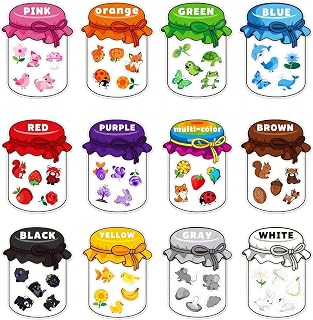
The Magnetic Colour Sorting Set arrives with the same caveat as the rubber magnetic men above: at the time of writing, this product has only 2 reviews on Amazon UK, and this assessment is based primarily on product design and specification rather than buyer consensus. With that stated clearly, the product itself addresses a specific niche in this category — early colour and shape sorting using magnetic pieces on a whiteboard or fridge surface.
The set includes 12 pieces alongside 60 vibrant learning shapes, providing a sorting task that combines colour recognition with physical categorisation. The magnetic format means shapes can be sorted onto a whiteboard or metal surface in a vertical standing position, offering a different physical experience from table-level sorting toys. Children work at eye level using a broader arm range, which some find more engaging than seated table play — particularly children who are drawn to activities they can approach while moving around rather than sitting still.
Colour sorting is one of those foundational early learning skills often addressed with plastic cups or ring stacks. The magnetic format has a specific practical advantage: shapes can be removed from one group and added to another without disturbing the rest of the arrangement. For children still working out that “red goes with red”, the ability to correct a mistake without cascading the whole layout onto the floor is a real improvement over physical sorting trays, where one nudge undoes everything.
The educational relevance goes beyond colour identification. Sorting activities at ages 2–4 build categorisation skills that underpin later mathematical thinking — grouping, classifying, and comparing sets of objects. Doing this on a magnetic surface also gives a parent a visual record of what a child sorted during a session, making it easier to spot where a child is uncertain and offer a prompt at the right moment rather than the wrong one.
The significant limitation is the minimal review base. With only 2 reviews, there’s insufficient evidence to assess magnet strength consistency across all 60 shapes, colour accuracy, or how the product holds up under sustained daily play. The concept and design are sound, and the multi-surface versatility adds flexibility. But if you’re risk-averse, one of the more reviewed picks in this guide is the safer choice. If you’re comfortable trying a newer product at a lower price point, this is worth a look.
What to Look for When Buying Magnetic Toys and Playboards
- Age-appropriate safety first. Strong magnets pose a serious ingestion risk if swallowed by young children — and the danger compounds if two magnets are swallowed separately, as they can attract each other through intestinal walls. Any magnetic toy for children under 3 should use fully encased magnets, sealed inside plastic or wood, rather than exposed individual magnets. Always follow the manufacturer’s stated age rating and inspect pieces regularly for damage that could expose a magnet.
- Magnet strength and consistency. Weak or inconsistent magnets are the fastest route to a toy that frustrates rather than engages. For construction tiles, press two pieces together and try to pull them apart gently — they should resist with noticeable force. For playboards, tilt the board with a piece attached: it should stay in place. A weakly magnetic set will disappoint your child within a week of use.
- Piece count matched to age. More pieces isn’t always better. A 3-year-old faced with 130 pieces confronts an overwhelming mess; a 7-year-old with 20 pieces runs out of combinations within one session. Roughly 40–60 pieces suits ages 3–5; 80–120 pieces suits ages 5–8 if you want the set to grow with the child over time.
- Material quality. Wooden magnetic toys tend to be more durable and safer than thin plastic equivalents but are heavier and less portable. Plastic tiles work well if the wall thickness is substantial — thinner pieces tend to crack under sustained use. Rubber or foam magnetic pieces suit the youngest children but degrade more quickly under vigorous handling or determined chewing.
- Storage practicality. The toy that gets used regularly is the one that can be put away without significant effort. Prioritise sets that stack or clip together magnetically for storage, come with a clearly structured storage tray, or pack into a bag or tin a child can manage independently. An awkwardly packaged set becomes a toy that stays in the cupboard.
- Educational scope versus open-endedness. Structured learning boards — calendar charts, count-and-spell boards — teach specific skills quickly but have a finite useful life once those skills are mastered. Open-ended construction sets grow with the child and reward ongoing creativity. Decide which fits your current situation: a targeted learning outcome, or a toy that’ll still come out regularly in two years.
- Cross-brand compatibility. If you already own magnetic tiles, check whether a new set uses the same edge height and magnet polarity convention before buying. Incompatible sets can’t be combined meaningfully, which limits play value and doubles storage requirements without adding much play benefit.
Verdict
For most families buying their first magnetic toy or playboard, the 130 PCS Wooden Magnetic Puzzle is the strongest starting point. It has the most validated review history of any product in this guide — 925 reviews at 4.5 stars — covers the widest range of early learning skills simultaneously, and the double-sided board gives it more longevity than a single-challenge format. For a child aged 3–6 working on pattern recognition, animal and shape naming, and fine motor skills, it does the job well and holds up to daily use.
If your child is specifically at the literacy and numeracy stage — roughly ages 4–6, starting to connect letters with sounds and numbers with amounts — the Jaques of London Magnetic Count and Spell Board is the more targeted pick, with genuine British brand heritage behind it. For 3D spatial construction that scales with ability well into primary school years, the 62 PCS Magnetic Building Blocks is the natural follow-on purchase once a child has worked through what a puzzle-format board can offer.
For most households starting out, the wooden magnetic puzzle board remains the right call: solid review evidence, broad educational scope, and a build quality that holds up to daily use by a 3–6 year old.
We were not paid to feature any specific product in this guide. All opinions are independent and based on publicly available specifications, verified buyer feedback patterns, and category research.
Quick Comparison Table




FAQ
Are magnetic toys safe for toddlers under 3?
Magnetic toys with fully encased or embedded magnets — such as wooden puzzle boards where the magnet is sealed inside each piece — are generally safer for toddlers than toys with exposed individual magnets. The critical risk is ingestion: swallowing two or more loose magnets can cause serious internal injury, as they can attract each other through intestinal walls. Always follow the manufacturer’s stated age rating and inspect pieces regularly for damage that could expose a magnet.
What’s the difference between magnetic tiles and a magnetic playboard?
Magnetic tiles are individual geometric pieces with magnets along the edges, designed to connect to each other and build 3D structures freeform. A magnetic playboard is a fixed surface onto which magnetic pieces — letters, numbers, shapes, or puzzle pieces — are placed and repositioned. Tiles are more open-ended and construction-focused; playboards are more structured and learning-oriented. Many families end up with both as children move through different developmental stages.
At what age do children get the most from magnetic building tiles?
Children can begin engaging with large magnetic tiles from around age 3, mostly connecting and stacking pieces without a specific goal in mind. Between ages 4 and 6, they start building intentional structures such as houses, enclosures, and simple vehicles. By ages 7–9, children with a substantial tile set can attempt more complex architectural forms, bridges, and symmetrical designs. Good-quality sets remain engaging well into primary school age.
Can different brands of magnetic tiles be used together?
Sometimes, but not reliably. Compatibility depends on whether tiles share the same edge height and magnet polarity conventions. Some popular tile brands use similar standards and will connect across brands, but there is no universal guarantee. Before buying a second brand to expand an existing set, check manufacturer compatibility notes or look for buyer comments specifically mentioning cross-brand use with the tiles you already own.
Are magnetic playboards good for children with ADHD or sensory processing needs?
Many practitioners recommend magnetic toys for children with ADHD or sensory processing differences because the tactile feedback of pieces clicking into place is satisfying and self-regulating, and the activity has a natural start-and-stop structure that suits shorter attention spans. Flexible rubber magnetic figures add a proprioceptive element through bending and manipulation. Individual children respond differently, so trialling a lower-cost option first before investing in a larger set is the sensible approach.
How should I store magnetic tiles to avoid a tangled mess?
Magnetic tiles tend to stack on themselves naturally because the magnets attract across flat surfaces, so a flat stack in a wide, shallow box or bag is the most practical storage method. Some sets come with a dedicated storage bag or tin designed around this stacking behaviour. Avoid mixing different-sized or different-brand tiles in the same stack, as mismatched edge heights create awkward clusters that are harder to separate at the start of the next play session.