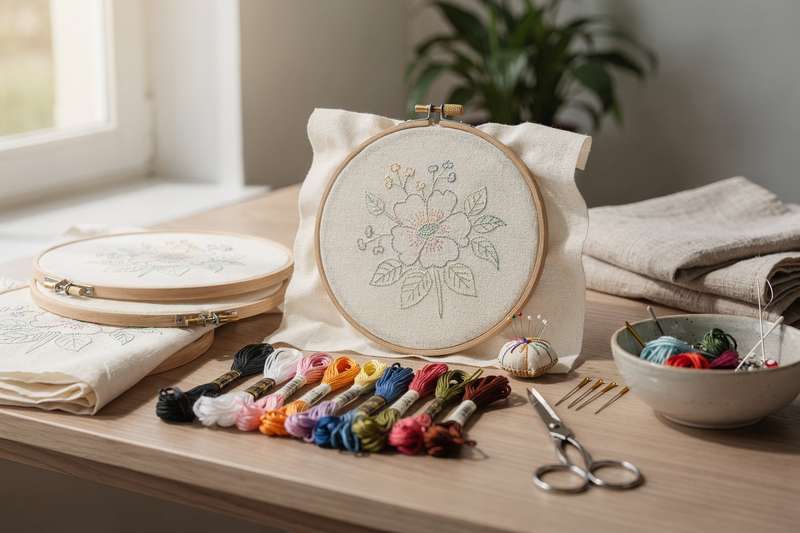
You’ve seen embroidery on social media and thought: that looks doable. So you ordered something labelled a beginner kit, excited by the packaging, and opened the box to find a sheet of plain linen, a printed paper pattern, and instructions that begin with “transfer the design to your fabric using a lightbox” — a lightbox that is definitely not included. You spent an hour holding paper against a window, pressing a water-soluble pen through linen that kept slipping, and by the end the design was smudged on one side and missing entirely on the other. The box went quietly back into the cupboard.
This is the single most common entry-point frustration in hand embroidery: kits that market themselves as beginner-friendly but quietly expect you to complete a non-trivial setup step before you make a single stitch. The solution is straightforward — a kit where the design is already printed directly on the fabric, so you open the box, read the instructions, and start. Every kit in this guide has the pattern on the cloth from the moment you open it. No tracing. No transfers. No preparation rituals. Just stitching.
How These Picks Were Selected
Eight criteria shaped the final selection: whether the pattern is genuinely pre-printed on the fabric rather than supplied as a separate transfer sheet; whether a hoop is included in the box; how many patterns come in the set; the range of stitches the instructions cover; fabric quality signals from buyer feedback; instruction format and clarity; thread quality based on reviewer comments about tangling and splitting; and the combination of star rating plus review volume on Amazon UK. Every kit here had enough reviews to establish a meaningful pattern of buyer experience — not a cluster of early ratings that smooth out over time. Where two kits target similar needs, instruction quality and beginner accessibility were the deciding factors.
Best Overall Beginner Kit
The Bradove Hand Embroidery Kit for Beginners is the all-rounder pick in this guide. With 446 reviews averaging 4.6/5 on Amazon UK, the feedback base is substantial enough to trust — a rating at that scale reflects consistent real-world experience, not a product that performs well on paper and disappoints in the box.
The pre-printed fabric is the starting point. The design arrives on the cloth, clearly marked, so there is no tracing, no transferring, and no preparation required before you sit down and actually work. For a complete beginner, removing that barrier is meaningful — it is precisely the kind of friction that causes people to put the box down before they have picked up a needle. Open the box, read the instruction book, and start.
What distinguishes this kit from others at a similar level is the inclusion of beads alongside the standard thread and needle set. That is not a cosmetic flourish — beads allow you to add three-dimensional texture to the finished piece in a way that flat thread alone cannot achieve. The result is a piece that looks layered and considered, and reviewers consistently describe the finished work as genuinely display-worthy. If you are doing this because you want to make something attractive enough to frame or give as a gift, that distinction matters.
The instruction book deserves specific attention. Most kits at this level include a single folded sheet of paper with small stitch diagrams in faint ink — workable in theory, frustrating in practice when you are actively stitching and need to cross-reference a technique quickly. Bradove’s bound booklet can be propped open on the table beside you and consulted without losing your place on the fabric. Techniques are introduced in a sensible order, so you are not expected to execute a French knot before you have had any practice with simpler stitches.
Honest tradeoffs: the scissors in the box are small and feel flimsy against thicker thread strands. If you already own a decent pair of embroidery scissors, use those instead. A few reviewers also note that the book works best when you read each section fully before starting that area of the design, rather than flipping through it while already threading your needle. That is a light demand, but worth knowing before you open the box expecting to dive straight in. For a beginner prepared to spend twenty minutes reading first, the payoff is a satisfying and polished finished piece.
The design complexity is right for an adult beginner working alone or alongside older children. There is enough variety in the project to stay engaging through completion, without any individual step becoming overwhelming before you have built some confidence. If you buy one kit and want the best possible first experience of hand embroidery, this is the one to start with.
Best for Learning Every Stitch
The Meyocky Embroidery Kit for Beginners to Learn 31 Basic Stitches with Video takes a structurally different approach from most kits in this category. Where a typical beginner pack focuses on one completed project, this four-piece set is designed as a learning programme — each of the four pieces targets a different group of techniques, and an accompanying video guide gives you moving instruction rather than static diagrams on a sheet.
With 238 reviews at 4.6/5 on Amazon UK, this kit has built a consistent reputation among buyers who come to embroidery wanting to understand the craft rather than simply complete a decorative piece. The headline figure — 31 basic stitches introduced across the four practice pieces — is the core value. By the time you have worked through the set, you will have encountered the running stitch, backstitch, satin stitch, stem stitch, French knot, and a range of filling and outlining techniques that form the practical foundation of most embroidery projects you might attempt independently afterwards.
The video guide is a genuine functional advantage. Written stitch diagrams, even good ones, can be ambiguous for stitches that require a specific angle of needle entry, a looping motion, or a particular sequence of over-under passes. A video resolves that ambiguity in seconds. The tutorial access is provided with the kit — typically via a QR code or included link — and covers each technique alongside the printed instructions. If you have previously tried to follow embroidery diagrams and found them harder to interpret than expected, this format addresses that directly.
Each piece in the four-pack arrives with the design pre-printed on the fabric, so setup stays frictionless throughout. Hoops, threads, and needles are all included. One honest note on format: because the emphasis is on learning rather than producing a single showcase piece, the individual practice sections are smaller and designed for technique reinforcement rather than framing. If your goal is a frameable display piece, the Bradove kit above serves that ambition better. But if you are serious about building embroidery as an ongoing skill — wanting to look at a pattern a month from now and understand confidently which stitch goes where — the structured approach here gives you something single-project kits cannot replicate.
A consistent thread across positive reviews is the confidence buyers describe after completing the full set — not just finishing the patterns, but genuinely understanding why each stitch is used in each context. If that knowledge-first outcome describes your motivation for picking up embroidery, this is the kit to prioritise over the alternatives.
Best Budget Pick
The HKLIOPU Stamped Cross Stitch Kit for Adults Beginners, 11CT Pre-Printed Embroidery Starter Set has the largest review base in this guide — 496 ratings at 4.3/5 on Amazon UK — which is, by itself, a meaningful reason to examine it closely. That volume of feedback smooths out outlier noise and gives you a reliable picture of what you are actually getting before you commit.
A note on terminology first, because it matters for expectation-setting: this is a stamped cross stitch kit, a subcategory of needlework rather than freehand embroidery. In cross stitch, you work a grid of X-shaped stitches on evenweave fabric, following a colour-coded guide already printed on the cloth. It is structured, repetitive in a meditative way, and arguably the most forgiving entry point into stitching for a complete beginner — every X looks tidy once you settle into a rhythm, because the stitch shape is always the same. The 11CT designation means 11 holes per inch: a workable scale that avoids the eye strain of finer counts without making the finished piece look coarse.
The stamped design means the colour areas and stitch positions are marked directly on the fabric surface. There is no counting from a separate chart, no squinting at a grid alongside the cloth, and no transferring. You follow the printed guide and fill in the marked sections. That frictionless setup is exactly the feature that makes the difference between a kit you complete and one that stalls before the first stitch.
Honest limitations: this is a budget-tier option, and reviewer feedback occasionally notes that the included thread covers a modest colour range. If you want a richly complex tonal palette in the finished piece, a mid-range kit will serve you better. The instructions are clear enough to get started but not the illustrated stitch guide you get with a more premium option — functional rather than educational.
What it does deliver is precisely what most complete beginners need: clearly pre-printed fabric, all required thread, a needle, a hoop, and instructions that do not overwhelm. For someone who is not yet certain whether stitching will stick as a hobby, or someone buying a low-stakes first gift, this is the sensible starting point. The 496 reviews and 4.3 average make it the most road-tested kit in this guide. Criticism tends to cluster around thread quantity for complex filled sections and the modest instruction depth — both predictable at this tier and neither a dealbreaker for a first project.
Best Multi-Pattern Floral Kit
The Herdiese Embroidery Kit for Beginners & Adults, 3PCS Floral Patterns takes a different approach from single-project kits: instead of one large piece to work through, it supplies three separate floral patterns, each with its own pre-printed fabric, threads, and hoop. The 4.7/5 rating is the highest in this guide, though the 32-review sample means you should treat it as a positive signal rather than a definitive verdict.
The three-pattern structure creates an advantage that single-project formats cannot replicate. If you are buying as a gift, having three design variations gives a better chance that at least one of them resonates with the recipient. If you are buying for yourself, working across three pieces gives you a natural arc: the first becomes a genuine learning run where mistakes are expected, the second lets you apply what you discovered, and the third gives you a chance to stitch with real confidence built over the previous two. That progression from tentative first attempt to more capable third piece is one of the most practically useful things a beginner kit can offer.
The floral themes are well-matched to foundational embroidery technique. Flower petals, leaves, and stems translate naturally into the stitches you learn earliest — satin stitch fills for petals, stem stitch for outlines and stalks, French knots for flower centres. The pre-printed fabric keeps the design clear and colour-coded, guiding you toward which thread goes where without requiring additional decision-making on your part.
Reviewers who comment on fabric quality describe the pre-printed cloth as smooth and firm enough to hold stitches without puckering, and the thread colours are noted as well-matched to the printed colour guide on the fabric — a basic requirement that cheaper kits sometimes miss, leaving you guessing which thread shade the diagram actually intends.
The honest caveat is the review count. A 4.7 average from 32 buyers can shift significantly as more feedback accumulates, and early reviews for newer products tend to skew toward the more enthusiastic end of the experience range. That is not a reason to dismiss the kit — the three-pack format and floral design approach are well-conceived for a beginner — but if you need maximum purchasing confidence, the kits with larger review bases elsewhere in this guide are the statistically safer option. If the format appeals and the uncertainty feels manageable, the risk here is low.
Best Four-Pack with Comprehensive Stitch Guide
The Dazhqp Embroidery Kit for Adult Beginners, 4-Pack Embroidery Starter Kit Including 38 Stitches Learning Step-by-Step Guide and Video is for the beginner who wants both multiple projects to work through and a comprehensive stitch reference to consult throughout. The headline claim covers 38 stitches across the step-by-step guide and companion video — an ambitious scope that, across 116 reviews at 4.3/5, has enough buyer feedback to assess with reasonable confidence.
The four-pack format is self-contained in the right way. Each piece in the set comes with its own pre-printed fabric and the corresponding threads, so you are not rationing one set of materials across four projects. Each piece is an independent unit — finish one, set it aside, and start the next without re-sorting anything. That clean structure keeps the experience enjoyable rather than administrative.
The stitch guide is the distinguishing feature here. Covering 38 stitches is meaningfully broader than the typical beginner kit, which introduces five to eight basic stitches and leaves you to discover the rest independently over time. The companion video adds moving instruction to written diagrams — particularly useful for stitches that require a precise over-under sequence or a looping motion that static images struggle to convey. If you have ever tried to follow a French knot diagram and come away confused, the video component addresses that problem directly.
The 4.3 average across 116 reviews is solid. The most consistent constructive feedback from buyers focuses on diagram quality in the printed guide — some of the more advanced stitch diagrams are small and less crisp than reviewers would prefer, making complex techniques harder to follow from the booklet alone. The video compensates for this, which means the kit functions better for someone comfortable toggling between a printed guide and a video tutorial than for someone who prefers to work exclusively from paper. If the latter describes you, the Bradove kit is the better fit for that preference.
Pre-printed fabric is standard across all four pieces, so no transfer work is required at any point. The designs across the set are varied enough that you are not repeating the same exercise four times, which keeps the experience engaging from first piece to last. Because the kit is oriented toward learning rather than display, the individual pieces are practice-sized — satisfying to complete but not the scale you would frame. If you want to build a solid stitch vocabulary before committing to a larger decorative project, this set gives you the reference library and the practice material to do that properly.
Best for Botanical and Bird Designs
The InteDesign Embroidery Kits for Adult Beginners, DIY Embroidery Starter Kit with Flowers Bird Pattern Instruction is the pick when the design on the fabric matters as much as the learning experience around it. Where most beginner kits lean toward generic florals or geometric prints, the bird-and-flower composition here is more considered — the kind of design you have seen on craft platforms and thought about attempting yourself.
With 72 reviews at 4.4/5 on Amazon UK, the feedback profile is modest but consistent. Reviews describing the finished piece regularly note it looks more polished than buyers expected from a starter kit. That is a useful signal: when a beginner produces a result they are pleased with, some of that credit belongs to the design itself carrying the aesthetic weight even as the technique is still developing. A well-composed pre-printed pattern is a real contributor to how satisfying the finished piece looks.
The bamboo hoop is a practical detail worth noting specifically. Bamboo is lighter than wooden or plastic alternatives and slightly more flexible, which makes it gentler on fabric during the tightening process. Beginners frequently over-tighten the screw mechanism when setting up — a natural instinct when you are trying to keep the fabric stable — and a bamboo hoop with a softer action is less likely to leave permanent marks on the cloth. The natural finish also means the hoop is display-ready: leaving the finished embroidery in the bamboo hoop and hanging it directly on the wall is one of the simplest display options available, and it suits the botanical theme particularly well.
Thread, needles, and the pre-printed fabric are all included, so the kit arrives complete from the box. The instruction sheet covers the stitches required for this specific design — stem stitch for the bird outline, satin stitch for broader petal fills, and a few detail techniques for leaves and finer elements. Reviewers with no prior embroidery experience describe the instructions as workable for completing this project, though the depth is functional rather than educational: you learn what you need for this piece, but the included materials are not attempting to give you a broader grounding in embroidery technique the way the Meyocky or Dazhqp sets do.
If your entry into embroidery is design-led — you want to produce a specific aesthetic result and you are less focused on systematic stitch education — this kit aligns well with that motivation. The pre-printed design is clear and well-proportioned on the fabric, and the colour scheme feels contemporary rather than dated. For a single satisfying project with a strong visual result and a natural display option, it is a sound choice. For a more structured approach to learning the craft, consider pairing it with additional tutorial resources or choosing one of the learning-focused kits in this guide instead.
What to Look for in a Beginner Embroidery Kit with Printed Pattern
- Pre-printed pattern on the fabric: The design should be printed or stamped directly on the cloth — not supplied as a separate paper or acetate sheet you trace or heat-transfer yourself. Transferring a pattern is a skill in its own right and a frustrating obstacle before you have started stitching. If a listing is ambiguous about whether the pattern is on the fabric or supplied separately, treat that as a warning sign.
- Hoop included: Many kits omit the hoop to keep the listed price lower. Always confirm a hoop is explicitly stated in the kit contents. Without one, you cannot maintain consistent fabric tension, and your stitches will pucker regardless of how carefully you work through each step.
- Fabric quality: Cotton and cotton-linen blend fabrics hold stitches cleanly, resist excessive fraying under repeated needle passes, and provide a stable base for both the printed design and the thread. Loose synthetic weaves photograph well but produce messier stitching results in practice — the thread can slide rather than sitting neatly where you place it.
- Thread organisation: Good kits supply thread already sorted by colour and matched to the pattern guide on the fabric. Loose, unsorted skeins are a frustrating starting point for someone who has not yet learned to wind and label thread onto bobbins or cards.
- Instruction format and stitch coverage: A prop-open booklet or a QR-code video guide gives you significantly better support than a small folded sheet while you are actively stitching. Also check how many stitches the instructions cover — a kit introducing five to ten basic stitches is well-pitched for a beginner; one that expects you to immediately attempt twenty-five unfamiliar techniques will frustrate you before the first section is done.
- Hoop size: A 6-inch or 7-inch hoop is the most manageable starting size. It lets you maintain consistent tension without constantly repositioning your hands and is easy to hold stable while you work through a section of the design.
- Review volume: A high rating from a small number of buyers is a positive signal, not a guarantee. Prioritise kits with at least 50–100 reviews to get a reliable picture of real-world experience — enough to reveal consistent issues that product photography and marketing copy tend to obscure.
Verdict
For a complete beginner buying their first embroidery kit, the Bradove Hand Embroidery Kit for Beginners is the safest and most satisfying starting point. The combination of pre-printed fabric, a bound instruction book, a complete tool set, and the distinctive inclusion of decorative beads gives it a level of completeness that most kits in this category do not reach. The 446 reviews at 4.6/5 back that up with the kind of feedback volume that reflects consistent real-world experience rather than early enthusiasm.
If structured learning is your priority — you want to understand embroidery technique rather than simply complete one project — the Meyocky four-piece kit with its 31-stitch video guide is the stronger choice. It builds craft knowledge rather than guiding you through a single finished piece, and that knowledge carries into every project you attempt afterwards.
For the budget-conscious beginner, or someone buying a first gift where the recipient’s level of commitment is uncertain, the HKLIOPU stamped cross stitch starter has the largest review base in this guide (496 ratings) and delivers exactly what a complete novice needs without overcomplicating the experience. Cross stitch is a forgiving and structured introduction to needlework, and the pre-printed format removes every setup obstacle from the start.
Start with one kit, work through it completely, and you will know within a few sessions whether embroidery is something you want to take further — and in which direction.
We were not paid to feature any specific product in this guide. All opinions are independent and based on publicly available specifications, verified buyer feedback patterns, and category research.
Quick Comparison Table


FAQ
What is the difference between a pre-printed embroidery kit and a transfer kit?
A pre-printed kit has the design already on the fabric when you open the box — you start stitching immediately without any setup. A transfer kit supplies a separate pattern you have to trace or heat-transfer onto blank fabric yourself, which adds a step that can go wrong, particularly for beginners who have not done it before. For your first kit, always choose pre-printed over transfer.
Is cross stitch the same as embroidery?
Cross stitch is a type of embroidery, but more structured than freehand hand embroidery. It works a grid of X-shaped stitches on evenweave fabric, following a colour-coded guide already printed on the cloth. General hand embroidery uses a broader variety of stitch types on plain woven fabric and gives more creative flexibility. Cross stitch is often considered slightly more forgiving for complete beginners because every stitch is the same shape — consistency comes naturally once you learn the motion.
What size embroidery hoop should a beginner use?
A 6-inch or 7-inch hoop is the most manageable starting size. It is compact enough to maintain consistent tension across the whole fabric without constantly repositioning your hands, and easy to hold stable while you stitch through each section. Once you are confident with tension control and stitch placement, moving to a larger hoop becomes significantly less daunting.
How long does it take to complete a beginner embroidery kit?
It depends on the design complexity and how often you sit down to stitch, but most beginner kits represent roughly four to ten hours of stitching spread across multiple sessions. A simple outline design can often be completed over a weekend; a multi-colour filled piece may take two to three weeks of occasional evenings. None of the kits in this guide require a level of commitment that should feel overwhelming at the beginner stage.
Can I display my finished embroidery in the hoop?
Yes — and it is one of the most straightforward display options. Once you have finished stitching, trim the excess fabric from around the back of the hoop, fold it neatly inward, and secure it with a few stitches or a dot of fabric glue. Leave the hoop in place and hang it directly on the wall. Natural bamboo and wooden hoops look particularly well displayed this way. Alternatively, remove the fabric from the hoop and frame it conventionally behind glass if you prefer a more traditional presentation.
Do I need any experience to use a beginner embroidery kit?
No prior experience is needed. Every kit in this guide is designed specifically for people who have never stitched before. If the kit includes a video tutorial — as several picks here do — that is often the easiest starting point, since watching a stitch being made removes most of the ambiguity that written diagrams can leave behind. Give yourself the first thirty minutes without time pressure, and most beginners find the core stitches become intuitive quite quickly.