When Your Knife Skills Just Won’t Cut It
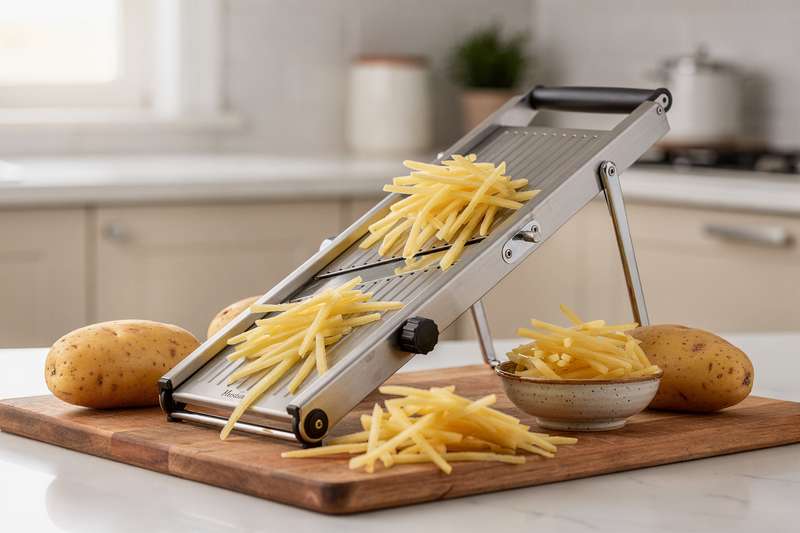
Picture this: you’re making a Vietnamese-style noodle salad, a Korean japchae, or simply a batch of crispy potato matchstick fries, and you reach for your chef’s knife. Twenty minutes later your “matchsticks” look more like irregular batons — some a centimetre wide, some paper-thin, none of them even remotely uniform. The thick ones stay raw in the middle while the thin ones burn. The whole point of julienne-cut potatoes — that delicate, almost lacey texture — is completely lost.
You’ve probably tried a box grater already. It works until it doesn’t: the holes are the wrong size, the potato disintegrates instead of holding its shape, and you end up with mush at the bottom and a grazed knuckle at the top. Maybe you’ve even looked at those clip-on julienne peelers, the Y-shaped ones. They’re fine for a single courgette in a salad, but try running a whole potato through one and you’ll be there all evening, and your arm will know about it the next morning.
A proper julienne mandoline solves all of this. The right one gives you 2–3mm matchsticks, every single pass, in a fraction of the time. The wrong one gives you a drawer full of plastic blades you never use and a trip to A&E. This guide exists to help you find the right one — for your kitchen size, your cooking style, and your budget — without any of the risk.
How We Evaluated These Picks
To put this guide together, we looked at the specific demands of julienne and matchstick cuts (not just general slicing), since not all mandolines handle fine julienne equally well. The criteria we weighted most heavily were: julienne blade quality and tooth spacing (2–3mm is ideal for potato matchsticks), thickness consistency across multiple passes, safety design (hand guard quality, blade exposure, non-slip base), ease of cleaning without cutting yourself on the blades, and build durability over repeated use. We also analysed verified buyer feedback patterns across hundreds of reviews, paying particular attention to negative reviews — because that’s where real-world failure modes show up. Finally, we considered storage footprint and value for money at each price tier, since UK kitchens are often short on drawer space.
Best Overall Value — The Multi-Blade Twist-Dial Mandoline (Under £30)
If you’re cooking at home a few times a week and you want one tool that handles both everyday slicing and proper julienne work, a multi-blade mandoline with a twist-dial thickness control is where most people should start. These units typically come with five interchangeable stainless steel blade inserts — a straight slicer, a wavy blade, a fine julienne (2–3mm), a coarser julienne (6mm+), and a grater insert — housed in a single folding frame that stands upright over a bowl or sits flat on a chopping board.
The thickness dial is the feature that matters most here. You want something that adjusts in clearly defined increments from around 1mm up to at least 9mm. For potato matchsticks specifically, you’ll typically set it to 3mm, then attach the fine julienne insert — the combination produces those slender, uniform sticks that cook evenly whether you’re roasting them, deep-frying, or using them raw in a slaw. Budget mandolines with loose dials or vague click-stops tend to drift mid-session, which means your matchsticks get thicker as you go. Look for a dial with firm, tactile stops.
The included hand guard is worth scrutinising before you buy. The better versions grip the potato firmly via short plastic teeth and keep your palm well away from the blade throughout the stroke. Cheaper hand guards have teeth that are too shallow to hold a smooth, wet potato surface — the food slips, you over-reach, and the blade finds your fingertip. If the product listing shows a hand guard that looks more like a flat paddle with no grip teeth, treat it as a warning sign.
Cleanup is where these multi-blade units can frustrate you. The blade inserts need to be washed carefully — starch from potato sticks to steel and dries quickly. The best designs have inserts you can rinse under a running tap without fumbling with sharp edges; top-rack dishwasher compatibility is a genuine plus here. One practical tip: rinse everything immediately after use rather than leaving it to dry with starch residue on the blades, which accelerates dulling. At this price point (around £18–£28), the blade steel isn’t quite hard enough to stay razor-sharp indefinitely, so treating it well extends its useful life considerably.
Best for Safety-First Cooks — The Hidden-Blade Enclosed Mandoline (£22–£35)
There’s a category of mandoline that has grown rapidly in recent years, designed specifically for people who find traditional flat mandolines genuinely nerve-wracking. These enclosed or “safe” mandolines place the blade entirely inside a housing; you push the food through a top aperture and it exits through a side or bottom slot, never exposing the blade to your fingers at any point in the stroke. If you’ve ever cut yourself on a mandoline — or watched someone else do it — this design solves the problem at source rather than just mitigating it.
The best of these units adjust thickness with a single twist mechanism, typically spanning from 0.1mm (essentially paper-thin, useful for cucumber or radish) through to 8mm (thick chips territory). For potato matchsticks, you want around 3mm on the thickness dial with the julienne mode selected — most models in this category offer at least four modes: thin slice, thick slice, julienne/matchstick, and a dice setting. Switching between modes usually involves a simple lever or ring rotation rather than removing and reinserting blades, which keeps your hands away from sharp edges throughout.
The trade-off with enclosed mandolines is feed port size. If you’re working with large potatoes — King Edwards, Maris Pipers — you may need to halve them lengthways to fit them through the aperture. Models with larger feed ports (some advertise fitting a whole medium potato) are worth the slight price premium if you do a lot of batch prep. The other limitation is that very long julienne strands can sometimes fold or break inside the housing before they exit cleanly; if you want truly long, elegant matchsticks (for a bistro-style potato nest, for example), a flat mandoline gives you more control over strand length.
Durability on these units varies noticeably. The blade material to look for is 420 stainless steel — it’s food-safe, rust-resistant, and holds an edge well. The housing is typically ABS plastic; the better versions feel solid and click together firmly, while cheaper ones flex under pressure, which causes inconsistent slice thickness. Check that the non-slip silicone base is substantial enough to actually grip a worktop, not just a thin strip of rubber. A 24-month warranty is a reasonable indicator that the manufacturer has confidence in the build quality.
Best Compact All-in-One — The Container-Integrated Mandoline (£20–£30)
Kitchen counter space and drawer depth are real constraints in many UK homes. If you’re working with a small kitchen — galley layout, limited storage — a mandoline that incorporates its own catch container changes the prep workflow entirely. You slice directly into a 1.2-litre box that serves as both a collection tray during use and a storage container afterwards; lid on, matchsticks in the fridge, no decanting required.
These units typically come with six blade options rather than five, the extra usually being a thicker shredding insert. The container format means the mandoline sits horizontally at a fixed angle over the box, which can feel slightly less natural than a traditional inclined frame for some people, but most users adapt within a session or two. The key practical advantage beyond storage is mess control: potato starch and juice stay in the container rather than spreading across your chopping board and countertop.
The julienne quality on container-style mandolines is generally solid at this price point — the 3mm julienne insert produces clean, even matchsticks on firm vegetables like potato, carrot, and celeriac. Where these units can struggle is with very thin slicing (sub-1mm) and with foods that have a lot of moisture, which can pool in the container and make subsequent matchsticks slightly soggy if you’re not emptying it regularly. For dry applications like potato matchstick fries or a rösti base, this is a non-issue.
Look for a non-slip base that wraps around the container perimeter — some designs only have feet at the corners, which is sufficient on a dry surface but less secure on a slightly wet countertop. The hand guard on container-integrated models tends to be well-designed since safety is a selling point of the format; the food pusher typically covers the full aperture width, reducing the risk of the food tilting mid-slice. At under £30, this style of mandoline represents very good value for space-conscious cooks who do moderate volumes of prep.
Best for Batch Prep — The Large-Feed-Port Enclosed Slicer (£25–£40)
If you’re meal-prepping for a family, running a supper club, or simply the kind of cook who processes large volumes of vegetables in a single session, a standard-sized mandoline quickly becomes a bottleneck. You spend as much time halving potatoes to fit through the aperture as you do actually slicing them. The solution is a large-feed-port mandoline — typically with an aperture wide and tall enough to accept a whole medium-to-large potato without any pre-cutting.
The best models in this category also offer the widest range of cut settings: some advertise over 40 thickness and cut combinations, achieved by combining a twist-dial thickness control (0.1–8mm) with interchangeable julienne, dice, and slice modes. For potato matchsticks, the large feed port means you can run a whole potato through in four or five smooth strokes and be done, rather than doing eight or ten passes with a half-potato. The time saving on a large batch is genuinely significant.
One feature to look for specifically in this tier is an auto-rebound or spring-loaded handle mechanism. This means the food pusher automatically returns to the top position after each downward stroke, so you maintain a steady rhythm without manually repositioning. It sounds like a small convenience, but over fifty or sixty strokes of julienning a bag of potatoes, it reduces fatigue noticeably. Combined with a broad silicone non-slip base, these units stay planted even during the rapid, repeated downward strokes of batch prep.
The primary concern with large-feed-port mandolines is structural rigidity. A wider aperture means more stress on the housing walls during use. Look for reinforced hinge points and a housing that doesn’t flex or wobble when you push firmly. Flex in the housing translates directly to inconsistent slice thickness — the kind of variation you’re specifically trying to eliminate by using a mandoline rather than a knife. Sticking to 420 stainless steel blades and solid ABS construction (rather than thin polypropylene) gives you the best chance of consistent results over time.
Best Japanese-Style Precision — The Lightweight Professional Flat Mandoline (£30–£55)
Japanese-style flat mandolines have been the benchmark for precision slicing in professional kitchens for decades, and for good reason. The blade geometry is different from most Western designs — typically a finely ground straight blade set at a very shallow angle, which produces slices with almost no tearing of the cell structure. For potato matchsticks, this means cleaner cuts, less starch release, and fries or rösti that hold their shape better during cooking.
These mandolines are considerably lighter than they look — the frame is usually high-impact plastic or lightweight composite, and the entire unit weighs under 400g in most cases. The compactness and low weight make them easy to hold over a bowl one-handed, which is how many Japanese home cooks use them. The julienne attachment is typically a separate insert that clicks into the main frame; the tooth spacing on quality Japanese mandolines is very precise, and the teeth stay sharp noticeably longer than on budget alternatives because the steel is harder.
The honest trade-off is that these units have a learning curve, particularly around the hand guard. Traditional Japanese mandoline hand guards are simpler affairs than the enclosed-blade designs — they do protect your fingers, but they require a consistent, controlled stroke rather than relying on the housing to keep your hand away from the blade. If you’re a confident cook who has used mandolines before, this is not an issue. If you’re new to mandoline work, spend a session or two with the guard firmly in place and a slow, deliberate stroke before you pick up speed.
Cleaning a flat mandoline is straightforward: a brush under running water, careful to stroke away from the blade edge. These units are rarely dishwasher-safe (the high heat can affect blade temper and warp plastic frames) so hand washing is the norm. The upside is that with good care they last for years; chefs use the same Japanese mandoline for a decade. At the £30–£55 price point in the UK, you’re getting professional-grade blade quality without the three-figure price tag of a full stainless steel French mandoline.
Best V-Blade for Everyday Use — The Ergonomic V-Blade Mandoline (£35–£55)
V-blade mandolines take a different approach to slicing: instead of a single straight blade perpendicular to the food’s path, two angled blades meet in a V-shape that effectively grips and guides the food as it passes over. The result is a slicing action that requires noticeably less downward force, which matters when you’re doing multiple passes with a dense root vegetable like a potato. Less effort per stroke means more consistent pressure throughout a session, which translates to more uniform matchstick thickness.
The ergonomic hand guard is a particular strength of the better V-blade models. The best designs have a guard that spans the full width of the food, keeps your palm horizontal (rather than curled over, which is less natural), and has grip teeth long enough to hold onto a potato even when it gets small. The point at which most mandoline injuries happen is when the food gets short — you’re down to the last 4–5cm of potato and the grip becomes uncertain. A well-designed hand guard with deep teeth significantly extends safe usable depth.
V-blade mandolines often come with a separate julienne attachment — a set of cross-cutting teeth that work in conjunction with the V-blade to produce the matchstick cut. On quality V-blade units, this produces very clean results because the food is already being guided centrally by the blade geometry before it hits the julienne teeth. The matchsticks tend to be very consistent in cross-section. The one area where V-blades can fall short of flat blades is for very thin slicing (under 1mm) — the geometry of the V can sometimes cause slight tearing on extremely thin slices of waxy vegetables, though for most cooking applications this is entirely academic.
Build quality on V-blade mandolines varies widely. The key components to evaluate are the thickness adjustment mechanism (look for a dial or lever with defined click-stops rather than a smooth friction adjustment) and the angle of the frame (a shallower angle requires less force; too steep and you end up pushing down rather than forward). At the £35–£55 price point, you should expect a non-slip folding leg or base, a sturdy hand guard with grip teeth, and at least one julienne insert included.
Best Professional-Grade Option — The Full Stainless Steel Mandoline (£80–£130)
At the top of the range, a full stainless steel mandoline is a completely different class of tool — heavier, more rigid, more expensive, and significantly more capable than any plastic-framed mandoline. These are the tools found in professional kitchens, and if you cook seriously and frequently, the investment pays off in longevity and precision that budget tools simply can’t match.
The construction is the defining feature: the frame, the bed, and the blade assembly are all stainless steel, which means zero flex under pressure. When the frame doesn’t flex, slice thickness is absolutely consistent throughout the stroke, and throughout the life of the tool. The blade inserts are typically thicker steel as well, meaning the edge geometry stays true for far longer before requiring sharpening. For julienne work specifically, the teeth on a professional stainless steel julienne insert are machined to tighter tolerances than on a budget plastic-frame unit — your potato matchsticks will be strikingly uniform.
Professional mandolines typically include multiple blade options as standard: a straight blade, a wavy/crinkle blade, and at least two julienne sizes (fine and coarse), sometimes more. The thickness adjustment uses a micrometer-style screw mechanism rather than a dial, allowing extremely precise setting — useful if you’re trying to recreate a specific cut you’ve done before. Setup and blade-swapping requires more care than on budget units; the blades are extremely sharp and the housing is unforgiving if you’re sloppy.
The practical trade-offs are weight, size, and price. A full stainless mandoline weighs 1.5–2.5kg and takes up real storage space. It requires confident handling and meticulous care (hand-wash only, dry immediately, oil any screw mechanisms occasionally). And at £80–£130+, it’s a significant outlay for a home cook. For most people doing occasional julienne work, this level of tool is overkill. But if you cook elaborate meals regularly, run a food business, or simply want to buy a mandoline once and never think about it again for a decade, this is where to spend your money.
What to Look for When Buying a Julienne Mandoline
- Julienne tooth spacing: For potato matchsticks, you want a fine julienne insert with 2–3mm tooth spacing. Coarser inserts (5–6mm) produce more of a chip batonnet than a true matchstick. Check product listings carefully — “julienne” is sometimes applied loosely to inserts that produce much thicker cuts.
- Thickness adjustment mechanism: Look for a dial or lever with defined click-stops rather than a smooth friction-fit adjustment. Friction adjustments drift during use; click-stop mechanisms hold their position stroke after stroke. For most potato matchstick applications, you’ll want 2.5–3.5mm thickness, so a mechanism that allows you to return to that setting reliably is worth paying for.
- Hand guard design: This is non-negotiable. The hand guard needs grip teeth long enough to hold a potato firmly — typically 8–12mm teeth spaced closely enough to stop the food rotating mid-stroke. Test it mentally: when your potato is down to a 4cm stub, will the guard still grip it safely? Budget hand guards often fail at this stage.
- Blade material: 420 stainless steel is the minimum worth considering for a julienne blade. Harder grades (such as those used in Japanese mandolines) stay sharper longer. Ceramic blades are an alternative — they’re extremely sharp and rust-proof, but they’re brittle and can chip if you hit a seed or use them on very dense root vegetables like beetroot.
- Non-slip base stability: A mandoline that slides on the worktop during use is a hazard. Silicone feet or a full-perimeter silicone base are more effective than rubber-tipped legs. If you’re considering a unit with only small rubber feet, pair it with a damp cloth under the frame during use.
- Ease of cleaning: Starch from potato dries quickly onto blades and increases the risk of a cut when you’re fumbling with a submerged insert in a washing-up bowl. Top-rack dishwasher compatibility is a real convenience; if hand-wash only, check that the blade insert can be rinsed without awkward handling. A dedicated cleaning brush included in the box is a good sign the manufacturer has thought about this.
- Storage footprint: Most UK kitchen drawers are 50–55cm deep. Foldable or collapsible mandolines that reduce to around 30–35cm store far more easily than rigid flat-frame models. Container-integrated models add a little bulk but replace a separate storage container, so net storage impact is minimal.
Verdict — Which One Should You Actually Buy?
For the majority of UK home cooks who want reliable, fine potato matchsticks without a complex learning curve, the multi-blade twist-dial mandoline at the £18–£28 mark is the right call. It covers the core use case well — fine julienne at 2–3mm, consistent thickness, dishwasher-safe cleanup — and the price means a replacement isn’t painful if a blade eventually dulls or a plastic component breaks.
If cutting yourself is a genuine concern (and it’s a reasonable concern — mandoline injuries are disproportionately common), spend the extra few pounds on an enclosed hidden-blade model. The slight limitation on strand length is a fair trade for never worrying about the blade at all.
Step up to a Japanese-style flat mandoline if you cook seriously and want genuinely superior blade quality that will outlast several budget units. And if you’re doing large-volume prep regularly — family cooking, batch meal prep, supper clubs — the large-feed-port enclosed slicer saves enough time and effort to be worth the modest price premium over the entry-level picks. The full stainless professional unit is excellent, but only worth the cost if this is a tool you’ll reach for multiple times a week for years.
Editorial note: This guide was produced independently. No manufacturer or retailer paid for inclusion or influenced the recommendations. All assessments are based on publicly available product specifications, category research, and verified buyer feedback patterns. Prices shown are approximate ranges accurate at time of writing and may vary.
Quick Comparison Table




FAQ
What size julienne setting do I need for potato matchsticks?
For classic potato matchsticks — the kind used in stir-fries, salads, and crispy fries — a 2–3mm julienne insert is the right choice. This produces thin, uniform sticks that cook quickly and evenly. A 5–6mm setting produces thicker batonnet-style cuts more suited to crudités or chunky fries. Check the product listing carefully, as “julienne” is sometimes used loosely to describe both sizes.
Are mandolines with hidden blades less precise than traditional flat ones?
For most home cooking applications, no — modern enclosed-blade mandolines produce results that are indistinguishable from flat models in everyday use. Where flat mandolines retain an edge is in producing very long, uninterrupted julienne strands (useful for presentation dishes) and in very thin slicing below 1mm. For potato matchstick fries or salad prep, an enclosed-blade model is entirely adequate and considerably safer.
Can I julienne sweet potatoes and other dense root vegetables on a mandoline?
Yes, but choose a mandoline with a sturdy, well-braced frame and a sharp julienne insert rather than a budget model with lightweight blades. Sweet potato and parsnip are denser than standard potato and put more lateral stress on the julienne teeth. Run the vegetable with the grain rather than across it where possible, and use firm, even strokes rather than fast jabbing — the latter can cause the vegetable to split rather than cut cleanly.
How do I stop the mandoline sliding on my worktop while julienning?
Place a damp folded tea towel or silicone baking mat under the mandoline if the base doesn’t grip well. Most quality mandolines have a silicone non-slip base built in, but over time the silicone can lose grip, especially if it’s been through the dishwasher repeatedly. A damp cloth is a simple, effective solution. Avoid using mandolines on smooth granite or polished marble surfaces without a grip layer, as these are particularly slippery when wet with vegetable juice.
How should I clean a julienne mandoline without cutting myself?
Never put your fingers directly on the blade surface during cleaning. For dishwasher-safe inserts, use the top rack and let the machine do the work. For hand washing, use the cleaning brush that comes with most models (or a stiff pastry brush) to stroke away from the blade edge under running water. If you need to handle the insert directly, fold a piece of kitchen roll several times and grip through that. Never leave blade inserts loose in a washing-up bowl full of soapy water — you can’t see them and will find them the wrong way.
How long do mandoline blades stay sharp?
It depends heavily on the blade steel quality and how the mandoline is stored and cleaned. Budget mandolines with thin steel blades may dull noticeably within 6–12 months of regular use; Japanese-style hard steel blades can stay razor-sharp for several years with proper care. The single biggest factor in blade longevity is avoiding the dishwasher if hand-wash is specified — high heat and harsh detergent accelerates corrosion and dulling on thinner steel. Store blades in their original housing or a blade guard rather than loose in a drawer.