Picture the scene: it’s a rainy Sunday afternoon, your child has exhausted their interest in every screen in the house, and you’re searching desperately for something that will actually hold their attention — something that fires up their imagination rather than just switching their brain off. You’ve already tried colouring books (abandoned after ten minutes), Lego sets (too many pieces for a four-year-old), and re-reading the same three picture books until you could recite them in your sleep. What you’re really looking for is a toy that makes your child the author of their own adventure — something that gets them talking, inventing, narrating, and playing without you having to orchestrate every moment.
Storytelling toys are exactly that: a category designed to put your child in the driving seat of their own narrative. But the term covers a huge range of products — audio players, creative activity kits, character figures, soft plush props, and early literacy play sets — and the quality gap between genuinely engaging picks and over-hyped packaging is significant. This guide cuts through the noise to help you find what will actually work in your home, for your child’s age and temperament.
How We Evaluated These Picks
Our assessment looked at five key dimensions: the degree to which a product actively encourages a child to create their own story (rather than just consume one passively); suitability for the UK market and availability on amazon.co.uk; age-appropriateness and developmental value; durability and ease of use for young children; and the pattern of verified buyer feedback where reviews existed. We also applied strict topic-fit criteria — only products that genuinely serve the storytelling and imaginative-play brief made the cut. That means this guide is shorter than most: you’ll find four honest picks here rather than eight padded ones. Every pick is different, covers a different use case, and links to a real, live listing on Amazon UK.
Best Hands-On Creative Storytelling Kit
The Skillmatics Activity Kit – Creative Storytelling & Skill Building with 150+ Reusable Stickers is the standout pick in this guide and the product that comes closest to delivering on the full promise of a storytelling toy. Aimed at preschool and kindergarten-age children (roughly three to seven years old), it centres on reusable sticker scenes that children arrange and rearrange to build their own narratives — there’s no single correct answer, no right story to tell, just a blank-canvas environment where imagination does the work.
What makes this kit genuinely useful is the reusability. Unlike activity books where stickers go down once and that’s the end of it, the sticker sheets here are designed to be peeled off and repositioned, so the same kit can generate dozens of different story sessions. The 150+ sticker count gives children plenty of characters, settings, props, and objects to work with — enough variety that their stories evolve over multiple play sessions rather than hitting a ceiling after the first sitting. Parents in the verified reviews (4.5 stars from 190 reviewers at time of research) consistently note that their children return to it independently, which is the mark of a product that earns its keep.
The educational angle is real rather than bolted on. Arranging stickers into scenes and then narrating what’s happening builds sequencing skills, vocabulary, and early comprehension — the same cognitive building blocks that underpin literacy development. It’s mess-free, which matters enormously for parents, and compact enough to use on a kitchen table or take in a bag. The activity is also adult-friendly in the sense that it’s easy to join in without dominating: you can ask open questions (“Why is the elephant wearing a hat? Where is she going?”) and let your child lead.
The honest limitation is that this is primarily a sit-down, table-top activity. Children who are more physically active or who prefer loud, kinetic play may need something alongside it rather than instead of other toys. It’s also best suited to children who are already comfortable with sticker play and can manage fine motor tasks — very young toddlers under three will likely need significant adult scaffolding. But for the target age range, this is the most directly on-brief storytelling product in this guide, and the reusability means the cost-per-use is genuinely low.
Best Character-Led Storytelling Figures
The Dora Best Friends Dora & Boots Doll & Toy Figure 2-Pack with Accessories serves a different but equally valid storytelling function: character-based imaginative play. At 4.7 stars from 639 reviews, this is the most-reviewed product in this guide, and the feedback pattern is clear — children who know and love the Dora the Explorer series take to these figures immediately, using them as prompts for re-enacting favourite story moments and inventing their own adventures.
The two-figure format is important. Storytelling is fundamentally relational — characters need someone to talk to, someone to rescue, someone to disagree with — and having both Dora and Boots in one pack means a child can voice both sides of a conversation without needing a second toy or a willing adult. The six-inch scale is large enough to be handled confidently by small hands, and the removable shoes and accessories give children control over the figures’ appearance, which adds another layer of narrative agency (“Today Boots is wearing different shoes because he’s going on a special mission”).
The accessories included vary by the specific listing, so check the product page carefully before purchasing. The main tradeoff with character-licensed figures in general is that their imaginative ceiling is partly set by the source material: children who don’t know Dora at all will get less from these than those who do, because the figures carry narrative context that unfamiliar children won’t share. If your child has never watched the show, you might find a more generic set of animal or fantasy figures gives them freer rein to invent. But for Dora fans aged roughly three to seven, these figures are a strong, durable, and well-priced storytelling prop.
From a practical standpoint, the figures appear well-constructed based on reviewer feedback, without small parts that would be a concern for children under three. They’re also easy to wipe clean, which is a real-world consideration for toys that spend time on floors, in bags, and occasionally in garden puddles.
Best Early Literacy Storytelling Toy for Babies and Toddlers
The LeapFrog Learning Friends 100 Words Baby Book Educational and Interactive Bilingual Playbook Toy sits at the youngest end of the storytelling toy spectrum. It’s worth being transparent: this listing had no verified reviews on Amazon UK at the time of research, so the assessment here is based on the product specification and LeapFrog’s established track record in the interactive learning toy category rather than aggregated buyer feedback. Factor that into your decision accordingly.
What the LeapFrog book does is bridge the gap between passive board-book reading and active play. It introduces vocabulary through interactive pages — children press on illustrated objects and hear the word spoken aloud — which plants the seeds of the narrative awareness that storytelling play requires later. The bilingual element (covering two languages) is a genuine differentiator for multilingual households. For children aged roughly six months to three years, this kind of interactive vocabulary exposure is developmentally appropriate scaffolding: before children can construct stories themselves, they need a bank of words and concepts to draw on.
The realistic tradeoff here is that this is more of a language-learning toy with a storytelling angle than a pure storytelling toy. Children aren’t yet inventing narratives with it — they’re building the vocabulary toolkit that will later fuel narrative play. If your child is already past the toddler phase and you’re looking for something that gets them actively creating stories, the Skillmatics kit or the Dora figures above will be a better fit. But as a gift for a baby shower, a first birthday, or a younger sibling when older children are already using storytelling toys, this earns a place in the category.
LeapFrog products in this style are typically robust — designed to survive the enthusiasm of small children — and the brand’s customer service has a generally positive reputation in the UK. The interactive format also means it tends to hold attention better than a standard board book, which has practical value during car journeys, waiting rooms, and the challenging pre-nap window.
Best Plush Prop for Imaginative Story Play
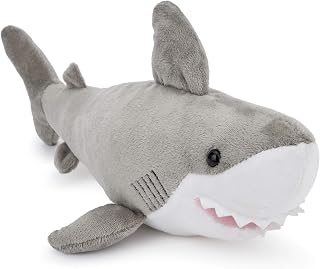
The Zappi Co Plush Children’s Stuffed Soft Cuddly Toy – Shark (31cm) represents the oldest and most fundamental type of storytelling toy: the soft character that becomes whatever a child decides it is. Rated 4.5 stars from 861 reviews, it’s a well-regarded plush in a category where quality varies significantly, and the shark format in particular has a strong track record with children who are drawn to ocean and adventure narratives.
The value of a quality plush in storytelling play is easy to underestimate. Children between roughly two and seven frequently use soft toys as the main characters in their self-directed narratives — the shark that goes on expeditions, has a name, gets tucked into bed, attends imaginary tea parties, or narrates its own underwater adventures. At 31cm, this one is large enough to be a substantial presence in play without being unwieldy for small arms to carry. The construction quality noted in reviews suggests it holds up to genuine daily use, which matters for a toy that may become a child’s primary story companion.
The honest limitation here is that a plush toy is the most open-ended product in this guide — it provides raw material for storytelling but no structure whatsoever. Some children thrive with that freedom; others need more scaffolding (characters, scenes, prompts) to get going. If your child already has a rich imaginative play life and just needs another character to add to their cast, this is excellent. If they struggle to initiate play independently, you’ll get more storytelling mileage from the Skillmatics kit or the Dora figures, which provide more explicit narrative context.
The Zappi Co range covers a wide variety of animals — beyond the shark, the Safari Animals Collection includes numerous characters — so if your child has a specific animal preference, it’s worth checking whether other options are available under the same brand. For ocean and sea-creature enthusiasts, the shark is a particularly imaginative choice that tends to inspire adventure-themed narratives rather than domestic ones, which can be a refreshing change of gear.
What to Look for When Buying Storytelling Toys
- Active creation vs passive consumption. The best storytelling toys put your child in the role of author, not just audience. Ask whether the toy requires the child to make choices, invent scenarios, or use their voice — or whether it simply plays content at them. Both have value, but they serve different developmental goals.
- Age-appropriateness and developmental stage. Storytelling play develops in stages: babies benefit from vocabulary exposure and sensory engagement; toddlers from character play and simple cause-and-effect; older preschoolers from scene-setting and sequential narrative; school-age children from role-play with rules and stakes. Match the toy to where your child actually is, not just the stated age range on the box.
- Open-endedness and replayability. A toy that generates one fixed story will be exhausted quickly. Look for toys that can produce different outcomes each time — reusable stickers, figures with interchangeable accessories, plush characters with no scripted narrative, or prompt tools that randomise elements. The longer the toy stays fresh, the better the value.
- Screen-free credentials. For many parents, the appeal of storytelling toys is precisely that they don’t require a screen. Check whether any digital or audio component is genuinely optional or central to the toy’s function — some toys that market themselves as screen-free still require an app or device to unlock key features.
- Durability for the age group. Children between two and six are not gentle with toys. Look for sturdy construction, machine-washable plush where relevant, and — for sticker or card-based products — laminated or reinforced materials that won’t disintegrate after a week of enthusiastic use.
- Solo vs social play. Some storytelling toys work best with a parent or sibling present; others are designed for independent play. Be realistic about your child’s play style and how much adult involvement you can realistically offer during play sessions.
- Storage and footprint. Storytelling kits with lots of loose pieces need somewhere to live. Consider whether the product comes with sensible storage (a box, a bag, a case) or whether you’ll need to improvise — lost pieces are the fastest route from “favourite toy” to “forgotten in a cupboard”.
Verdict
If you’re buying for a child aged three to seven and you want a single pick that best fulfils the promise of a storytelling toy — one that actively builds narrative thinking, vocabulary, and imaginative confidence — the Skillmatics Creative Storytelling Activity Kit is the strongest recommendation in this guide. It’s purpose-built for the storytelling brief, reusable across many sessions, and backed by a meaningful volume of positive buyer feedback. The mess-free format and compact size make it practical as well as genuinely educational.
If your child is a dedicated Dora fan, the Dora & Boots figure set will get used constantly and provides a strong character-led storytelling anchor. For younger toddlers and babies, the LeapFrog interactive book is a solid vocabulary-builder that lays the groundwork for later story play. And for a child who already loves imaginative play and just needs another character to weave into their adventures, the Zappi Co shark plush is durable, well-reviewed, and open to any story your child wants to tell.
The honest conclusion is that this category on UK Amazon currently has a thinner selection of dedicated storytelling toys than you’d find in a specialist toy shop — which makes researching carefully before you buy all the more worthwhile.
We were not paid to feature any specific product in this guide. All opinions are independent and based on publicly available specifications, verified buyer feedback patterns, and category research.
Quick Comparison Table



FAQ
What age are storytelling toys suitable for?
Storytelling toys span a wide age range, and the right type depends heavily on developmental stage. Interactive vocabulary books suit babies from around six months; character figures and simple plush props become engaging from about two years old; and sticker-scene or prompt-based kits that require children to construct their own narratives are best from around three to four years upwards. Always check whether a specific product’s complexity matches where your child actually is rather than their chronological age alone.
Do storytelling toys need batteries or a screen to work?
It depends entirely on the type. Creative activity kits like sticker scene sets and figure-based toys require no power at all — they’re genuinely screen-free. Interactive electronic books and audio-based toys typically need batteries. If screen-free play is a priority for you, look specifically for activity kits, plush toys, and figure sets rather than electronic play sets, and double-check product descriptions carefully since “screen-free” marketing can sometimes gloss over app or device requirements.
How do I know if a storytelling toy will actually hold my child’s attention?
The best indicator is whether the toy gives your child genuine choices and agency. Toys where the child can change the story — by repositioning stickers, choosing what a character does next, or inventing dialogue — tend to hold attention longer than toys that play a fixed audio or visual sequence. Also look at replayability in reviews: if multiple buyers mention their child returning to the toy independently over weeks or months, that’s a strong signal it has lasting engagement rather than just initial novelty appeal.
Are storytelling toys actually educational, or is it just marketing?
The developmental benefits are genuine when the toy requires active narrative construction rather than passive listening. Building stories exercises sequencing (what happens first, next, last), vocabulary, character perspective-taking (theory of mind), and early comprehension skills — all of which are directly linked to later reading ability. The distinction to draw is between toys that talk to children and toys that get children talking: the latter have a much stronger evidence base for literacy and language development.
Can storytelling toys work for children with speech or language delays?
Many speech-language therapists incorporate storytelling play tools — especially picture-scene kits, character figures, and prompt-based activities — into therapy because they provide low-pressure contexts for language use. A child doesn’t have to say anything “correctly” to engage with a sticker scene or a character figure, which reduces anxiety. That said, for children with specific speech or language needs, it’s worth discussing specific product choices with your child’s therapist or SENCO to ensure the toy’s format suits your child’s current communication style and goals.
What’s the difference between a storytelling toy and a regular book or audiobook?
The key distinction is who does the creating. A book or audiobook delivers a fixed story that the child receives; a storytelling toy — at its best — gives the child the raw materials to originate their own narrative. That shift from consumer to creator is developmentally significant: it builds executive function, imaginative confidence, and language-generation skills in ways that passive story consumption, however valuable, doesn’t replicate. The best approach for most children is a mix of both.