You’ve been down this road before. You find yourself scrolling through page after page of vaguely related results on Amazon, trying to pin down whether the book you’re eyeing is actually going to give you a basilisk with genuine visual menace, a kraken drawn with anatomical logic, or a phoenix rendered with enough symbolic weight to be useful — whether you’re an illustrator building a reference library, a parent hunting for something your child will actually read, or a fantasy reader who wants creatures that feel genuinely alive on the page. The problem is that the phrase “fantasy creatures” casts an absurdly wide net. You get colouring books shelved next to artist field guides, children’s picture books listed alongside dense mythology texts, and box sets that turn out to be urban paranormal romance with a dragon on the cover. You’ve wasted money on books that were either far too basic or aimed at a completely different age group. What you actually need is a clear-eyed breakdown of exactly what each book does well, who it’s genuinely for, and where it falls short — so you can click once and be confident.
How We Evaluated These Picks
To put this guide together, we looked at a shortlist of fantasy creature books currently available on amazon.co.uk, filtering by relevance to the actual topic — because the search results for this phrase throw up some genuine strays. Each pick was assessed against several criteria: the depth and variety of creature coverage (are you getting thirty cookie-cutter dragons or a genuine cross-cultural range?), the quality and quantity of illustrations or visual reference material, the suitability for the stated audience (artist, adult reader, child), the spread and credibility of buyer reviews, and the practical usefulness of the content beyond casual browsing. Where a book had very few or no reviews, we note that honestly. We’ve excluded anything that doesn’t genuinely belong in a guide about fantasy creatures — no matter how tempting it might be to pad the list.
Best Overall Artist’s Reference: Fantasy Characters & Creatures
If you’re building a serious reference library for fantasy illustration, Fantasy Characters & Creatures: An Artist’s Sourcebook is the place to start. Rated 4.8 out of 5 stars from 76 verified buyers, this is one of the strongest-reviewed books in the category, and the reason is immediately obvious once you understand its scope: over 600 illustrations covering whimsical beasts, anthropomorphic monsters, and hybrid creatures drawn from a wide range of traditions.
The book is structured as a proper sourcebook rather than a gallery. That distinction matters enormously for working illustrators and serious hobbyists. A gallery book shows you finished work and leaves you to reverse-engineer the process; a sourcebook breaks down proportions, gesture, anatomy variants, and design logic. If you’ve been trying to figure out why your chimera looks like a collection of mismatched parts rather than a coherent creature, this kind of systematic visual reference is exactly what fills that gap. The creature categories here go well beyond the usual European medieval suspects — you’ll find anthropomorphic monsters that draw on East Asian and South-East Asian folklore traditions, giving you a much richer palette than the standard griffin-and-dragon starter pack.
The tradeoff is that this book leans firmly toward the whimsical and stylised end of the spectrum. If you’re working on dark fantasy or horror-adjacent creature design, the aesthetic may feel too playful for your needs. The 600-plus illustrations also means the book is physically substantial — not something you’ll slip into a jacket pocket on the commute. But for anyone who wants a densely illustrated, culturally varied reference that they can open at any page and immediately find something useful, this is the strongest general-purpose pick in this shortlist. Buyers specifically praise the illustration density and the variety of creature types, with several noting it’s the book they return to most frequently in their workflow.
Worth being clear about who this suits best: it’s aimed at artists and those who want to learn to draw fantasy creatures rather than readers looking for mythological lore or narrative. The text is purposeful rather than expansive — you’re here for the visuals. If that’s your need, the 4.8 rating from a solid pool of buyers makes this a very safe purchase.
Best In-Depth Field Guide for Creature Designers
Mythical Beasts: An Artist’s Field Guide to Designing Fantasy Creatures takes a different approach to the same territory and, with 456 reviews at 4.7 out of 5 stars, it’s one of the most thoroughly vetted books in this entire category. Where the sourcebook above gives you raw visual reference material, this guide is structured more like a design manual — it walks you through the thinking behind creature design, not just the execution.
The “field guide” framing is genuinely apt. The book reads as though you’re cataloguing real animals in a fantastical ecosystem, which forces you to think about how a creature’s biology, environment, and behaviour all connect. A manticore isn’t just a lion with a human face and a scorpion tail bolted on — the field guide approach asks why those elements work together, what the creature eats, how it moves, what makes it threatening. That kind of analytical rigour is what separates creature designers who produce memorable, coherent beasts from those who produce technically competent but forgettable ones.
The review pool is large enough to trust the aggregate: buyers consistently describe this as a book that genuinely improves their design thinking rather than just giving them pretty pictures to copy. Several reviewers who work professionally in concept art, game design, and animation call it a core reference. That said, it does demand more from the reader — you need to be willing to engage with the analytical framework rather than just flicking through for inspiration. If you want quick visual fuel without the accompanying theory, you might find it denser than expected.
It’s also worth noting that this book skews toward creature design for digital and concept art contexts, so the creature roster tends toward the visually dramatic — dragons, wyverns, sea serpents, hybrid beasts. The softer end of the mythology catalogue (brownies, selkies, kappa) gets less attention. But for anyone serious about fantasy creature design at a professional or near-professional level, the 456-review endorsement at 4.7 stars is hard to argue with. This earns its place as the deepest technical pick in the list.
Best Adult Colouring Book for Fantasy Creatures
The Fantasy Creatures Coloring Book: Best Fantasy Creatures coloring book for Adults sits in a genuinely different category from the two artist guides above — and being honest about that distinction is important. This is a colouring book for adults who want a creative, relaxing activity rather than a design education. It currently holds a perfect 5.0 rating, though from only one verified review, so that rating carries very limited statistical weight and should be treated as provisional rather than definitive.
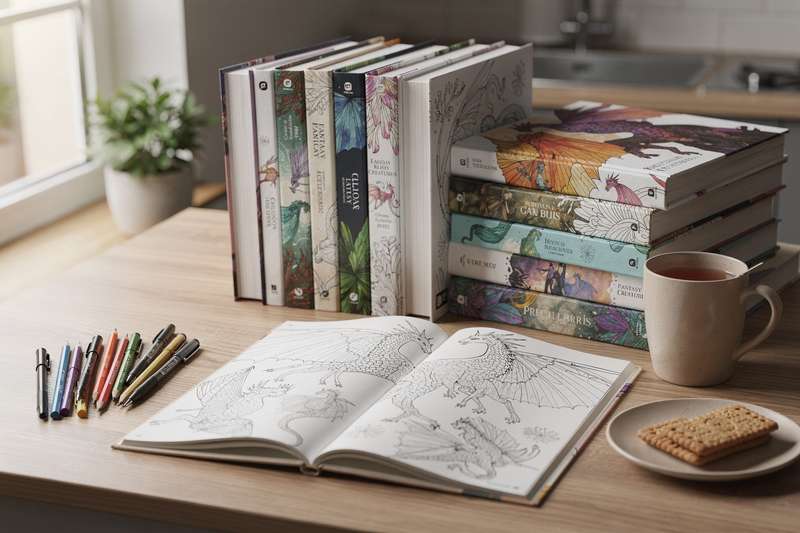
What you’re getting here is a selection of fantasy creature line art designed for adult colouring: intricate enough to be satisfying with coloured pencils or fine-tipped markers, but not so densely detailed that the pages become frustrating. The creature selection draws from the broad fantasy canon — expect dragons, phoenixes, unicorns, and the kind of hybrid creatures that appear across European mythological traditions. The appeal for this audience is the meditative quality of the activity rather than the educational content, and on that level the format delivers what it promises.
The honest caveat is that with a single review, you’re essentially making a judgement call based on the product description and the quality of the preview images rather than a genuine consensus. The price point is low enough that the risk is minimal, but if you’re looking for a colouring book with a well-established reputation and a large community of buyers sharing their completed pages, this isn’t there yet. It could become that — the design looks genuinely appealing — but right now you’re an early adopter rather than following a crowd.
Best suited to: adults who use colouring as a mindfulness or relaxation practice, or as a low-pressure way to experiment with colour before attempting original creature illustrations. Not suited to: anyone looking for mythological reference material, artist instruction, or a children’s activity book.
Best for Young Fantasy Fans: The Unicorns of Blossom Wood
The Unicorns of Blossom Wood: Best Friends is the only children’s fiction pick in this shortlist, and it earns its place specifically because the question “best fantasy creatures” is one that parents and grandparents also type when they’re looking for early chapter books for young readers who have shown an interest in magical animals. With 32 reviews at 4.5 out of 5 stars, it has a solid enough base to trust.
The book centres on a magical woodland where children transform into unicorns — which means the “fantasy creature” element is woven into the narrative rather than presented as reference material. For readers aged roughly five to eight, this is actually the most effective way to engage with fantastic creatures: through story, through characters you care about, through a world that feels internally consistent even if the magic is gentle and low-stakes. The Blossom Wood series has developed a genuine readership in the UK, and the series format means that once a child is hooked on the first book, there’s a natural path forward.
Where it falls short for some buyers: if you’re looking for a broader bestiary of fantasy creatures — something that introduces children to dragons, krakens, harpies, and phoenixes across different mythological traditions — a single-creature-focused early chapter book isn’t the right format. This is unicorns, and it’s very much unicorns. The tone is warm, the conflict is gentle, and the target age skews young. For a seven-year-old who adores horses and has recently discovered they like reading, it’s exactly right. For a ten-year-old who wants something with genuine peril and a wider creature roster, you’d be looking at a different kind of book entirely.
The 4.5 rating across 32 reviews suggests consistent satisfaction from the target audience, with buyers particularly noting that reluctant readers respond well to the format and pacing.
Best Box Set for Adult Fantasy Readers: Northern Creatures
The Northern Creatures Box Set One: Books 1-3 is a different proposition again. This is a fiction box set — three books collected together — rather than a reference or activity book, and it’s aimed squarely at adult fantasy readers who want narrative immersion in a world built around northern/Norse-influenced fantastic creatures. At 4.5 out of 5 stars from 22 reviews, the sample size is modest but the rating is consistent.
The “Northern Creatures” branding tells you something useful about the tone and mythological palette: you’re in the territory of Norse and Germanic folklore — frost giants, draugr, lindworms, shape-shifters — rather than the Mediterranean or East Asian traditions. That’s a meaningful distinction. The Norse mythological tradition has a particular texture: its creatures tend to be darker in temperament and more tied to cosmological stakes than, say, the playful tricksters of Celtic folklore or the benevolent water spirits of East Asian traditions. If that’s the flavour you prefer in your fantasy fiction, a box set is a practical way to commit to a series without buying one book at a time.
The honest tradeoff with any fiction box set at this price point is that you’re relying heavily on the reviews to judge quality, because you’re committing to three books upfront. Twenty-two reviews is enough to suggest the series has a genuine readership that found it worthwhile, but not enough to treat the 4.5 rating as a statistically robust consensus. Buyers describe the creature-building as genuinely immersive and the world-building as consistent, which are the things that matter most in this subgenre.
This is best suited to readers who already know they enjoy Norse or northern European fantasy settings and want a series to sink into rather than a standalone. If you’re a reader who finds the mythology sections of this article more interesting than the art instruction sections, this is the pick for you.
What to Look for When Buying Fantasy Creature Books
- Creature variety and cultural range: The best books go beyond the standard European medieval roster. Look for coverage of Japanese yokai, Hindu mythological creatures, Slavic spirits, and indigenous traditions from the Americas and Africa — these expand your visual and narrative vocabulary significantly compared to a book that gives you fifteen different dragons and calls it diversity.
- Audience fit: Be precise about who the book is actually for. An artist’s field guide with dense design theory is useless to a seven-year-old, and an early chapter book about unicorns won’t help a concept artist who needs to understand how hybrid anatomy works. Check the age range and stated purpose before buying.
- Illustration density and quality: For reference and art books, the illustration-to-page ratio matters. A book with 600 illustrations in 200 pages is functionally different from one with 60 illustrations spread across the same page count. Preview images on the product listing will give you a sense of the visual quality — look for clean linework, variety of poses and angles, and creatures shown in context rather than floating on white backgrounds.
- Instructional depth (for artist guides): Some books show you what creatures look like; others explain how to design them. If you’re an illustrator or concept artist, the analytical “how and why” content is more valuable than pure visual reference. Look for breakdown sequences, proportion guides, and design rationale rather than just finished illustrations.
- Review volume and recency: A 5.0 rating from one reviewer and a 4.7 rating from 400 reviewers are not equivalent. Prioritise books with at least 30-50 reviews before treating the rating as meaningful, and check whether recent reviews match older ones — a book’s quality doesn’t change, but its print runs sometimes do.
- Format suitability: Consider how you’ll actually use the book. A hardback reference that lives open on your drawing desk has different requirements from a paperback you’ll read on the train or a digital edition you want to zoom into. Colouring books need paper thick enough to handle your preferred medium — markers bleed through thin pages, while coloured pencils work on almost anything.
- Series potential: If you’re buying for a child who’s found a book they love, check whether it’s part of a series before you buy the first one. Getting a child invested in characters and a world only to discover the book is a standalone can be genuinely disappointing for young readers who want to know what happens next.
Verdict
For most readers landing on this guide, the pick that offers the broadest genuine value is Mythical Beasts: An Artist’s Field Guide to Designing Fantasy Creatures. Its 456-review base at 4.7 stars gives you the strongest statistical confidence of any book in this shortlist, and the field guide format means it works as both a visual reference and a genuine education in creature design thinking. Whether you’re an illustrator, a tabletop game designer, a writer who needs to understand your creatures from the inside out, or simply a fantasy enthusiast who wants to understand why certain creature designs endure across cultures while others feel derivative — this book earns its shelf space.
If you’re buying for a child, redirect to The Unicorns of Blossom Wood: Best Friends for young readers aged five to eight who love magical animals. And if your primary need is a rich visual illustration bank with over 600 images rather than design instruction, the Fantasy Characters & Creatures: An Artist’s Sourcebook at 4.8 stars is the stronger alternative.
We were not paid to feature any specific product in this guide. All opinions are independent and based on publicly available specifications, verified buyer feedback patterns, and category research.
Quick Comparison Table


FAQ
What’s the difference between an artist’s sourcebook and a field guide for fantasy creatures?
A sourcebook prioritises dense visual reference — hundreds of illustrations you can study and adapt in your own work. A field guide tends to go deeper on the analytical side, explaining the design logic behind creatures and how their anatomy, behaviour, and environment connect. Both are useful for illustrators, but if you want to understand the “why” behind creature design rather than just the “what”, a field guide format will serve you better long-term.
Are fantasy creature colouring books suitable for beginners who want to learn to draw?
Colouring books are great for developing colour theory instincts and learning how light and shadow work on complex organic forms, but they won’t teach you to construct a creature from scratch. If you want to learn to draw fantasy creatures, you’ll get more from an instructional sourcebook or field guide that breaks down proportions and anatomy. Colouring is a complementary activity, not a substitute for construction practice.
What age group are fantasy creature books aimed at?
It varies enormously by book type. Early chapter books like those in the Blossom Wood series target readers aged five to eight. Middle-grade fantasy with more complex creature worlds typically suits ages eight to twelve. Adult colouring books and artist’s reference guides are designed for teens and adults. Always check the stated age range on the product listing before buying as a gift.
Which mythological traditions produce the most interesting fantasy creatures for illustration?
East Asian traditions — particularly Japanese, Chinese, and Korean mythology — offer some of the most visually distinctive creature designs, from the nine-tailed fox and kirin to the terrifying gashadokuro. Norse mythology gives you cosmologically significant beasts with genuine menace. Hindu mythology has extraordinary hybrid creatures with rich symbolic depth. The most interesting reference books draw from multiple traditions rather than defaulting to the European medieval canon.
Is a box set worth buying over individual books for fantasy creature fiction?
A box set makes sense if you’re already reasonably confident you’ll enjoy the series — either because you’ve read the first book, because the premise strongly matches your established tastes, or because the reviews from a solid pool of buyers confirm the quality holds across the whole series. Buying three books upfront at a lower per-book cost is good value if you finish all three, but a poor investment if you abandon the series after the first. If you’re uncertain, buy the first book individually first.
Do fantasy creature art books work well as gifts for illustrators?
Yes, but the key is matching the book to the illustrator’s current level and focus. A beginner benefits most from a book with strong instructional content and step-by-step breakdowns. An intermediate or advanced illustrator may prefer a dense visual reference with broad cultural coverage. If you’re not sure of their level, the higher-reviewed books with large review pools (over 100 reviews) are a safer choice than newer titles with limited feedback.