You’ve cleared a corner of the kitchen table, sharpened a pencil, and stared at a blank page for ten minutes. Maybe you bought a pad of paper a few months back, scribbled a few shapes, felt vaguely embarrassed, and quietly put it away. Or perhaps you’re a parent hunting for something that will genuinely hold a restless child’s attention rather than gathering dust on a shelf. Either way, you’ve typed something along the lines of “best drawings” into Amazon UK and found yourself faced with an overwhelming range of options: colouring books, step-by-step guides, sketchpads, kids’ tablets, adult techniques manuals, all jumbled together with no clear sense of which is actually worth your money.
That confusion is understandable. Drawing sits at a peculiar crossroads: it’s simultaneously the most accessible creative skill (you need almost nothing to start) and one where poor-quality tools or the wrong instructional approach can kill your confidence before you’ve even begun. A sketchbook with paper that bleeds and pills makes everything look worse than it should. A technique book pitched at the wrong level leaves you either bored or lost. A kids’ drawing kit that’s all gimmick and no substance gets abandoned by lunchtime. This guide cuts through that noise so you can pick the right thing for your actual situation, whether you’re a complete beginner, a parent, a hobbyist who wants to push further, or someone who simply loves art and wants a beautiful book on the shelf.
How We Evaluated These Picks
The products selected here were assessed against a consistent set of criteria: the practical quality of the core product (paper weight and texture for sketchbooks; instructional clarity and progression for books; build quality and durability for physical kits); the credibility and track record of the author or publisher; patterns in verified buyer feedback, specifically looking for recurring positives and negatives rather than cherry-picked five-star quotes; suitability for the UK market and availability on Amazon UK; and how well each product serves a clearly defined user scenario rather than trying to be everything to everyone.
Where a product has a meaningful number of Amazon reviews, that review volume was incorporated into the assessment alongside the rating. Where ratings are high but review counts are low, that was noted honestly. The goal is to match you to the right pick for your specific situation, not to rank products in a vacuum.
Best Overall for Adult Beginners: Drawing on the Right Side of the Brain
Drawing on the Right Side of the Brain: A Course in Enhancing Creativity and Artistic Confidence (The Definitive 4th Edition) is the single most recommended drawing instruction book in the English-speaking world for a reason that goes beyond marketing: it actually works for people who believe they “can’t draw.” Betty Edwards’ central argument is that drawing is fundamentally a perceptual skill rather than a talent, and she structures her entire course around retraining how you see rather than how you move a pencil. This 4th edition, rated 4.6 out of 5 stars from over 700 Amazon UK reviewers, is the most refined version of a methodology that has been tested and developed over decades.
The approach is genuinely unusual and that’s why it’s effective. Edwards introduces exercises, drawing upside-down images, focusing on negative space, contour drawing, that bypass the symbol-making part of your brain (the part that draws a “house” or a “face” as a shorthand symbol rather than what you actually see). The result, for most people who commit to the exercises, is that they produce drawings that surprise them within a matter of weeks. That’s not a small thing when your previous experience is one of frustration and self-doubt.
Where this book is less suited is for anyone who already draws confidently and wants to move into specific technical areas such as perspective, figure anatomy, or colour theory. Edwards’ method is foundational, not comprehensive. You won’t find detailed lessons on hatching technique or how to render fabric here. Think of it as the course you take before other courses, or the book that answers the question “why can’t I draw what I see?” rather than “how do I draw a specific thing?”
The physical production of this edition is solid: good paper for the reproduction of artwork examples, clear diagrams, and an organised chapter structure that actually functions as a course you can work through systematically. If you’re buying one drawing book for an adult who wants to genuinely learn, this is the place to start. It’s a mid-range purchase that repays the time and attention it encourages many times over.
Best Sketchbook for Serious Practice: A4 Sketch Book for Artists Hardcover
The A4 Sketch Book for Artists Hardcover — 200GSM Very Thick Paper — Large Sketchbook Pad Art Book, Spiral Bound for Artists and Children addresses one of the most common but least-discussed frustrations in drawing: the paper itself getting in your way. At 200GSM, the pages here are genuinely thick, heavy enough to handle wet media like light watercolour washes, markers, or ink without immediately buckling or bleeding through to the next page. If you’ve been working in a standard pad where pencil strokes skate unpredictably across the surface and felt-tip bleeds through to the reverse, this is a meaningful step up.
The A4 format strikes a practical balance. It’s large enough to give you room to work freely, to draw a full figure study or an architectural sketch without feeling cramped, but small enough to use at a desk without rearranging your whole workspace. The spiral binding is a deliberate practical choice: the book lies flat regardless of which page you’re on, which sounds minor but makes a significant difference when you’re working on both sides of an opening or following a photo reference propped next to the pad.
The hardcover is worth noting separately. It means the book can double as its own drawing board, so you can use it on your lap, on a sofa, or standing without needing a separate rigid surface underneath. For anyone who doesn’t have a dedicated art desk, this matters. The combination of hardcover and thick paper makes this suitable as a portfolio sketchbook, somewhere you’re building a body of work rather than doing quick throwaway sketches.
The honest caveat: this is a sketchbook, not a specialist paper pad. If you’re working primarily with heavy-body acrylics or doing sustained oil pastel work, you’d want paper specifically designed for those media. For pencil, charcoal, pen and ink, light watercolour, and markers, the typical range of drawing media, it performs well above its price point. A reliable budget-to-mid-range pick for anyone who draws regularly and wants paper that keeps up with them.
Best for Young Artists and Children: Learn To Draw Cool Stuff For Young Artists
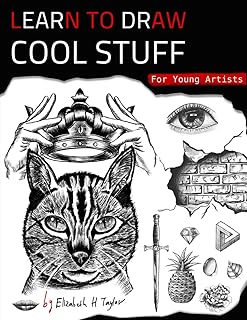
Learn To Draw Cool Stuff For Young Artists: A Drawing Gift With Fun, Easy Step-By-Step Practices & Techniques To Master In Less Than 21 Days is structured around a sensible premise: children learn drawing best through quick wins and variety rather than sustained drilling of a single technique. The 21-day framework gives the book a sense of momentum and purpose. Each session is self-contained enough to hold attention but connected to a larger progression, which helps children and their parents see genuine development over a short period.
The subject matter is well-chosen for the target age range. “Cool stuff” isn’t just marketing copy: the book covers the kinds of subjects children actually want to draw, animals, vehicles, characters, and objects from their world rather than classical still-life arrangements that mean nothing to a ten-year-old. Each subject is broken down into clear step-by-step stages, starting from simple geometric shapes and building to the finished drawing. This is the right approach because it demystifies the process, showing children that any drawing, however complex it looks, begins with shapes they already know how to make.
As a gift, this works particularly well because it’s self-contained and self-directed. A child can pick it up and use it without adult supervision, which is genuinely useful for parents who want to give a creative activity that doesn’t require them to sit alongside it throughout. The “gift” framing in the title is apt: it’s presented and produced to a quality that makes it feel special rather than generic.
The limitation to be honest about is that this is firmly a step-by-step instruction book rather than a creativity or observation-based approach. Children will learn to replicate the drawings in the book accurately, but may need additional prompting to take those skills into freehand, imaginative drawing. That’s not a criticism; it’s clarifying what the book is and isn’t. As an introduction to drawing for a young person who wants structured guidance, it’s a strong mid-range pick.
Best Art Reference Book for Your Shelf: Vitamin D3: Today’s Best in Contemporary Drawing
Vitamin D3: Today’s Best in Contemporary Drawing occupies a different category from the other picks here. It’s not an instruction manual; it’s a curated survey of the most compelling contemporary drawing practice happening across the world right now. Published by Phaidon, this is the third volume in their Vitamin D series, which has become a standard reference for anyone interested in drawing as a serious contemporary art form rather than solely as a preparatory or craft skill.
The book features a wide range of artists and approaches, from hyperrealist pencil work to gestural charcoal, from architectural line drawing to politically charged graphic illustration. What makes it valuable as a reference is precisely that breadth: it shows you that “drawing” as a discipline encompasses an extraordinary range of intentions, materials, and aesthetics. For a practising artist, spending time with this book recalibrates your sense of what’s possible. For someone who simply loves art and wants a visually rich book, it’s genuinely beautiful, the kind of thing that rewards slow looking rather than quick reading.
At 4.6 stars from over 200 reviewers, it has a meaningful critical mass of positive feedback. Buyers consistently note the production quality: Phaidon’s print standards are among the best in art publishing, and the reproduction of the artwork does justice to the originals. For a premium art book, it represents strong value for money and would make an excellent gift for someone with a serious interest in drawing or contemporary art more broadly.
Where it won’t help you is in direct skill development. There are no exercises, no step-by-step breakdowns, no technique explanations. It’s inspiration and context rather than instruction. Pair it with a more technique-focused book if you want to actively develop your drawing, but as a source of genuine artistic reference and motivation, it’s in a different class from most of what you’ll find on Amazon.
Best for Botanical and Floral Drawing: The Ultimate Flower Drawing Guide Book
The Ultimate Flower Drawing Guide Book: 50 Unique Flowers For Beginner & Intermediate Artists addresses a specific and very popular niche within drawing that often gets poorly served: botanical illustration and floral drawing. With 481 Amazon UK reviewers and a 4.6-star rating, this book has built a genuine following among people who want to draw flowers with accuracy and confidence but haven’t found a guide pitched at the right level.
The structure, 50 individual flowers each broken down methodically, is exactly what this subject requires. Floral drawing is both forgiving and demanding: plants don’t have the rigid proportional rules that human figures do, so small inaccuracies are less jarring, but capturing the specific character of a rose versus a dahlia versus a lily requires careful observation and a good reference. Having 50 distinct species covered means you’re building both a general skill set and a specific vocabulary of forms.
The beginner-to-intermediate pitch is well-judged. Complete beginners will find the step-by-step breakdowns accessible without feeling patronised, while intermediate artists will find enough technical depth in the rendering and shading guidance to push their work forward. It avoids the trap of either over-simplifying to the point of producing cartoon flowers or demanding a level of prior technical knowledge that would leave beginners stranded.
This is a strong gift choice for anyone who loves gardening, nature, or botanical art, or for someone who has been sketching casually and wants a focused subject area to develop their skills within. It works well alongside a good quality sketchbook (the A4 hardcover option above would pair well) for a combined gift that sets someone up to actually practise rather than just read about technique. The main limitation is its specificity: if flowers don’t particularly interest you as a subject, there’s no crossover value here.
Best for Relaxed Adults Who Prefer Structure: 100 Best Adult Color By Numbers
100 BEST Adult Color By Numbers: The best designs from Sunlife Drawing color by number coloring books is an honest and unapologetic offering for a specific type of person: adults who want the meditative, focused pleasure of working with colour and creating a finished image, but who find a blank page daunting or who simply don’t want the cognitive load of generating their own compositions. There’s no shame in this. Colour-by-number has seen a genuine resurgence among adults precisely because it delivers relaxation and a sense of achievement without requiring artistic skill.
This collection draws on designs from Sunlife Drawing’s catalogue, which means there’s a consistency of quality and style across the 100 designs. The range of subjects matters in a book like this: a collection heavy in one type of image (flowers only, or landscapes only) gets visually monotonous, so variety is an asset. With 100 designs, the book has enough content to last through a sustained hobby period rather than being completed in a weekend.
As the budget pick in this guide, it delivers good value for money relative to its price. It suits a commute, an evening wind-down, or a weekend afternoon. The colour-by-number format also makes it genuinely accessible for adults who have arthritis or other conditions that make freehand drawing uncomfortable, since the structured grid means you’re making small, contained marks rather than sustained strokes across a page.
The honest tradeoff: this is colouring, not drawing. If your goal is to develop drawing skills, this won’t help with that. But if your goal is creative engagement, relaxation, and the satisfaction of producing a finished piece, it delivers that reliably. Think of it as the drawing-adjacent option for people who want to dip into visual creativity without the pressure of a blank page.
Best for Kids Who Get Bored Quickly: LEYAOYAO 3 Pack LCD Writing Tablet for Kids
The LEYAOYAO 3 Pack LCD Writing Tablet for Kids, 8.5inch Colorful Screen Doodle Pad Drawing Board, Learning Educational Toys Gifts for 3 4 5 6 7 is included here specifically for parents of very young children (ages 3 to 7) who want to draw prolifically, whose parents prefer to avoid endless paper waste, and who respond enthusiastically to the bright, tactile experience of drawing on a screen. It sits outside the books-and-sketchbooks focus of most of this guide, but it addresses a real and practical need that other picks here don’t cover, namely what to buy for children too young to benefit from paper-based instruction.
The LCD tablet format works by using pressure-sensitive screen technology: children draw directly on the surface with the included stylus and the lines appear in colour. A single button wipe erases everything instantly. This makes it genuinely reusable and waste-free, which is a meaningful practical benefit compared to paper alternatives. The 3-pack format in this listing is well-suited for households with multiple children, for classrooms, or for sending one to a grandparent’s house without worrying about losing the only one.
The 8.5-inch size is genuinely usable for small hands, not so small that it feels like a toy, large enough to draw figures and scenes with reasonable space. The coloured screen (rather than the monochrome versions common in older LCD tablets) adds visual excitement that holds young children’s attention well. A 4.4-star rating from this product reflects good but not outstanding feedback: the main limitation raised by buyers is that the drawing lines are not as precise as a proper digital stylus tablet, which is accurate but somewhat misses the point at this age range and price level.
This is not a tool for developing serious drawing skills. It’s a creative toy that introduces the habit of drawing, keeps young children occupied on journeys or during quiet time, and does so without consuming materials. For that specific job, it works well and represents reasonable budget value, particularly as a three-pack.
Best for Aspiring Comic and Manga Artists: ComicCreator Drawing Kit
The ComicCreator – Create Your Own Comic Book in a Comic Book Drawing Kit – Learn How to Draw and Structure a Cartoon/Anime inc. World, Character takes a genuinely different approach to teaching drawing by tying it directly to storytelling. Rather than presenting drawing as an isolated skill, this kit frames it as the tool for creating something, a comic book, which is a far more motivating context for children and teenagers who are passionate about anime, manga, graphic novels, or superhero comics.
Rated 4.6 stars from 65 reviewers, this has a smaller review base than some other picks here but a consistently positive pattern in the feedback. Buyers note that the inclusion of both instruction on how to draw characters and guidance on how to structure panels, world-build, and develop a narrative gives it a completeness that single-skill drawing books lack. For a young person who devours manga or graphic novels, this is a far more engaging entry point than a generic step-by-step drawing manual.
The anime and cartoon focus is both its strength and its limitation. If a young person loves this aesthetic, the kit is genuinely excellent: the drawing style taught is directly applicable to the kind of art they want to make, which is the most powerful motivational factor possible. But if a child is more interested in realistic portraiture or landscape drawing, the comic-book framing will feel irrelevant.
As a gift for a child or teenager who is into anime, gaming, or graphic storytelling, this is one of the stronger picks in this list. It combines the tactile satisfaction of a kit (physical components, a sense of occasion) with genuinely useful instructional content, and it gives the recipient a creative project to work on rather than just a book to read. The mid-range price point feels well-justified for what’s included.
What to Look For When Buying Drawing Books, Sketchbooks and Kits
- Match the product to the actual skill level and goal. A beginner who buys an advanced anatomy manual will be lost; an intermediate artist who buys a children’s step-by-step book will be bored. Be honest about where you or the recipient actually are, and look for products that explicitly address that level. “Beginner” on a cover is not always accurate: check the table of contents or preview pages if available.
- Paper weight matters more than most people realise. For sketchbooks, look for GSM (grams per square metre) ratings. Standard copier paper is 80GSM, fine for quick sketches but prone to bleed-through and buckling. For serious drawing practice, look for 150GSM or above; for mixed media, 200GSM or higher. The paper texture (tooth) also affects how different media behave: smooth paper suits pen and ink, while a slight texture (grain) is better for pencil and charcoal.
- Binding type affects usability. Spiral-bound sketchbooks lie flat, which is essential for drawing across a double-page spread or when copying from a reference propped alongside. Glue-bound (like traditional notepads) can cause pages to lift and won’t open fully flat. Hardcover adds portability and means you don’t need a separate drawing board.
- For instructional books, look for a clear learning progression. The best drawing books don’t just explain techniques; they sequence them so that each exercise builds on the last. Flip through the chapter structure before buying: does it start with fundamentals and build, or does it jump around? A systematic approach produces better results than a collection of disconnected tips.
- Check the subject range for variety. Instruction books that teach only one type of subject (say, only portraits or only landscapes) are valuable for developing depth in that area but won’t help you become a more rounded artist. If breadth is what you’re after, look for books that explicitly cover multiple subjects and techniques.
- For children’s products, consider age-appropriateness honestly. A drawing kit marketed for ages 5 to 12 may well suit a motivated 8-year-old but frustrate a 5-year-old. Look at the dexterity and reading demands the product actually requires, not just the stated age range. Electronic drawing tablets are more forgiving for younger children; step-by-step books require enough reading ability to follow instructions.
- Review patterns tell you more than star ratings alone. A 4.7-star average from 12 reviews means less than a 4.5-star average from 500. Look for books and products with a meaningful review count, and read the one and two-star reviews: they often reveal specific, consistent weaknesses (paper bleed-through, instructions unclear, binding fails) that the average rating obscures.
Verdict
For most adults who are picking this up because they want to genuinely learn to draw, or rediscover an ability they think they lost somewhere between school and adulthood, Drawing on the Right Side of the Brain is the clear starting point. It has the most substantive instructional methodology of anything in this guide, the strongest verified review base, and a genuine track record of producing results for people who had given up on drawing as “not for them.” It’s the book that changes how you see before it changes how you draw, and that’s exactly the right order.
If you’re buying for a young person who loves anime and graphic storytelling, the ComicCreator Drawing Kit is the most targeted and engaging choice. For a premium art book that belongs on any serious artist’s shelf, Vitamin D3 is outstanding. And if you’re pairing any of these books with something to actually draw in, the A4 Hardcover Sketchbook with 200GSM paper is the most practical all-round sketchbook in the group. Together, a good instructional book and a quality sketchbook is genuinely all you need to start.
We were not paid to feature any specific product in this guide. All opinions are independent and based on publicly available specifications, verified buyer feedback patterns, and category research.
Quick Comparison Table




FAQ
What is the best drawing book for a complete beginner adult?
Drawing on the Right Side of the Brain by Betty Edwards is consistently recommended as the best starting point for adult beginners because it addresses why people struggle to draw accurately: it’s a perceptual problem, not a motor skill problem, and the book provides structured exercises to correct it. Most people who work through it systematically see noticeable improvement within a few weeks. It’s suitable for anyone who has tried and failed to draw realistically and wants to understand why.
What GSM paper should I look for in a sketchbook?
For pencil and dry media, 150GSM is a reasonable minimum, thick enough to avoid buckling and allow some erasing without damaging the surface. For pen and ink or light watercolour washes, 200GSM is more appropriate as it handles moisture without warping. Anything below 100GSM is effectively printer paper and not suitable for serious drawing practice.
Are drawing books a good gift for children?
Yes, but only if they’re pitched correctly. Step-by-step drawing books for children work best when the subjects match what the child actually wants to draw, such as animals, manga characters, or vehicles, rather than classical subjects. Age-appropriateness matters: look at the reading level required and the dexterity demands of the exercises, not just the stated age range on the cover. For children under five, physical drawing tablets with easy-wipe screens are more practical than paper books.
What’s the difference between a drawing book and a sketchbook?
A drawing book (in the instructional sense) is a printed guide with exercises, techniques, and examples: you read it and learn from it. A sketchbook is blank paper bound together and you draw in it. They serve completely different purposes and ideally you’d use both: the instructional book to learn, the sketchbook to practise. Some beginners make the mistake of buying only one or the other and wondering why their progress stalls.
Can adults learn to draw from scratch with just a book?
Yes, and many people have done exactly that, particularly using structured methodology-based books that focus on perceptual retraining rather than just technique instruction. Progress is faster when you combine a good instructional book with consistent daily practice, even if only for 15 to 20 minutes. You won’t match formal art school training, but you can reach a level of confident, expressive drawing that most people assume requires natural talent. The key is choosing a book with a genuine learning sequence rather than one that’s purely inspirational.
What drawing products work best for very young children aged 3 to 5?
At this age, the priority is freedom and lack of frustration rather than structured instruction. LCD writing tablets are particularly well-suited: they’re durable, endlessly reusable, and the instant-erase function removes the anxiety of making mistakes. Simple wax crayons and large-format paper also work well. Avoid fine-tip drawing tools or books with small, detailed step-by-step instructions, as the fine motor control required develops later. The goal at this stage is to make drawing feel natural and enjoyable, not correct.