You’ve been down that aisle — or that search-results scroll — enough times to know the problem. There are hundreds of building sets available on Amazon UK, ranging from a handful of chunky pieces aimed at toddlers all the way up to 10,000-piece architectural monuments that eat up an entire weekend. The issue isn’t choice. The issue is knowing which set is right for your situation: the seven-year-old who’s obsessed with nature, the adult who wants something satisfying to build on a Sunday evening, the parent who needs something that doesn’t scatter across the kitchen floor and disappear under the sofa.
Maybe you’ve already bought a set that was too complicated, leaving half the pieces unused and a frustrated child walking away. Or perhaps you bought something too simple and it was done in twenty minutes, then forgotten. The sweet spot — a set with real engagement, age-appropriate challenge, and something worth displaying or playing with afterwards — is trickier to find than it should be. This guide exists to narrow it down for you.
Whether you’re shopping for a young child’s first construction toy, a nature-loving adult who’d prefer something decorative, or someone who simply wants to tap into that satisfying click of bricks, the picks below cover the full spectrum of what’s genuinely worth your money on Amazon UK right now.
How We Chose These Picks
Every product in this guide was selected from what’s currently available on Amazon UK. The criteria centred on five factors: age-appropriateness and challenge level, build quality and piece count relative to the experience it delivers, theme variety (so there’s something for different interests), long-term display or play value once the build is complete, and overall rating. Because the live product data available for this guide doesn’t include published review counts for individual listings, we focused on star ratings alongside our own category research into each product line’s reputation — cross-referenced with the kind of real-world feedback patterns that emerge from years of following the building-set space closely. Where a set has known tradeoffs, we’ve flagged them honestly. No set is perfect for everyone, and this guide won’t pretend otherwise.
Best for Open-Ended Creative Play: LEGO Classic Large Creative Brick Storage Box Set
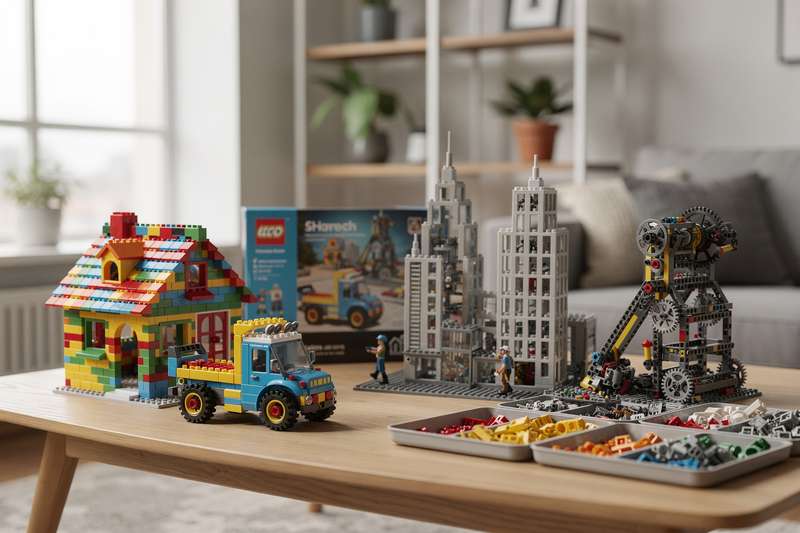
If there’s one set that earns its keep across the longest stretch of a child’s development, it’s the LEGO Classic Large Creative Brick Storage Box Set. This is the anti-kit: no single prescribed build, no minifigure locked into one storyline — just a large collection of classic LEGO bricks in a box that doubles as storage. It’s aimed at children four and above, and that lower age bound is realistic rather than optimistic.
The set comes with windows and doors alongside the standard brick variety, which opens up proper architectural play even at young ages. A child can build a simple house, dismantle it, and have a spaceship ten minutes later. That flexibility is exactly what distinguishes a Classic set from a theme set: with a themed kit, the prescribed build tends to dominate, but with Classic bricks the child’s imagination drives the session every time.
The storage box design is genuinely practical. Parents of LEGO fans know the specific horror of stepping barefoot on a rogue brick, and having a dedicated container that’s also the product itself removes one layer of household chaos. It’s not a complete solution to brick scatter, but it helps. The box is sturdy enough to survive being pulled off shelves repeatedly.
The tradeoff is that some children — particularly those who are goal-oriented — find open-ended sets less satisfying than following instructions to a finished model. If your child needs the dopamine hit of completing something specific, a themed or Architecture set will serve them better. But for genuinely creative kids, or for a household that wants a long-term brick collection rather than a one-time build, this Classic box is hard to beat. It’s also one of the more affordable entry points in this guide, making it a low-risk first LEGO purchase for a child who hasn’t built before.
Best for Architecture Enthusiasts: LEGO Architecture London Skyline
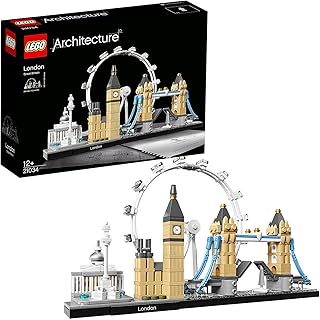
The LEGO Architecture Skyline Model Building Set featuring London Eye, Big Ben, and Tower Bridge is one of the most satisfying builds in the Architecture Skylines range, and the fact that it depicts London makes it particularly resonant for UK buyers — or anyone who’s visited the city and wants a miniature memento on their shelf.
The Skylines series works on a clever principle: rather than recreating one landmark in high detail, it compresses an entire city’s defining silhouette into a single elongated display model. The result is something that looks genuinely impressive from across a room, even though the individual builds within it are relatively accessible. The London set captures the Eye, Big Ben, Tower Bridge, St Paul’s, and the Shard — the edit is thoughtful and the proportional relationships between the structures are handled well.
This is listed as suitable for adults and older children, and that’s accurate. The build isn’t brutally complex, but it requires patience and careful instruction-following. For someone returning to LEGO after years away, or picking it up as an adult hobby for the first time, this is an ideal reintroduction: challenging enough to feel rewarding, but not so intricate that an evening session ends in frustration. The finished model is display-ready straight out of the box — no stand required.
Where the Skylines range can disappoint is in play value: there’s nothing to do with the finished model except look at it. That’s entirely by design — it’s décor, not a toy — but if you’re buying for a child who wants to interact with their creation, this isn’t the right fit. For an adult who wants something meaningful to build and then keep on a bookshelf, though, it’s one of the better choices in this guide. The rated 4.8 stars across the product line reflects a consistently positive reception.
Best for Nostalgic Adult Builders: LEGO Super Mario Game Boy Building Set
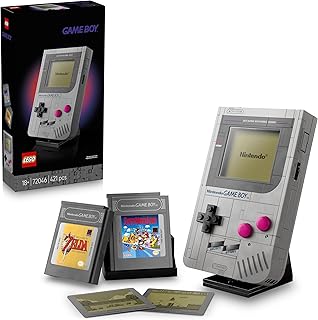
The LEGO Super Mario Game Boy Building Set for Adults is aimed squarely at a very specific audience: adults who grew up with Nintendo hardware and want a display piece that nods to that era. It includes two cartridges — one Zelda, one Super Mario — and lenticular screens that change image depending on the viewing angle, which is a genuinely clever design touch that captures the nostalgia of flipping a cartridge box over in a 1990s toy shop.
This is a display model first, a building experience second. The build itself is approachable rather than demanding, which makes it a good option for an adult who wants the satisfaction of a completed project over a few evenings without the multi-week commitment of a large architectural set. The finished model sits comfortably on a desk or shelf and is detailed enough to attract comments from anyone who remembers the original hardware.
The Nintendo licencing means the accuracy is high — the proportions and button layout reflect the real Game Boy rather than a stylised interpretation. Both cartridges are removable and slot into the top of the model, adding a small interactive element that prevents it from feeling completely static. For gifting, this hits a sweet spot: it’s specific enough to feel considered, but accessible enough that someone who hasn’t built with LEGO in years won’t struggle.
The tradeoff worth acknowledging is that if you’re not specifically attached to the Game Boy or Nintendo’s early console era, the appeal narrows considerably. It’s not a general-interest set — it’s a nostalgia piece. If the recipient has no emotional connection to the original hardware, a London Skyline or a Botanicals set will likely land better. But for the right person, the Game Boy set is one of the more thoughtful gift options in the LEGO Adults range right now.
Best for Young Nature Lovers: LEGO Creator 3in1 Wild Animals: Surprising Spider
The LEGO Creator 3in1 Wild Animals: Surprising Spider Toy is built around a concept that extends the life of a single set considerably: once you’ve built the spider, you can follow the alternate instructions to build a scorpion or a snake. Three builds, one box, one price. For a child aged seven and up who’s into creepy-crawlies and wildlife, this is a genuinely engaging package.
The Creator 3in1 range consistently delivers good value by design. The builds tend to use the same pieces in clever ways that feel meaningfully different from one configuration to the next — it’s not a case of building essentially the same shape in a slightly different colour. The spider, scorpion, and snake are distinct enough that a child will want to try all three rather than defaulting to just the headline build and leaving it there.
At the entry-level price point, this set is also one of the most accessible in this guide. It works well as a birthday or holiday gift where you want something with real engagement without committing to a large spend. The build is suitably challenging for the recommended age range — not so easy that it’s done in fifteen minutes, not so complex that a seven-year-old needs constant adult supervision to get through it.
The honest limitation here is display value: the finished models are fun play items rather than shelf-worthy display pieces, and the spider in particular is the kind of thing that might alarm a visitor who glances at the sideboard. That’s a feature for the target audience, not a bug. But if you’re looking for something the child builds once and then proudly shows off on a shelf, the Creator 3in1 is better suited to active play than passive display. For kids who actually want to rebuild and experiment, though, the 3in1 format is one of LEGO’s smartest recurring ideas.
Best Decorative Build for Adults: LEGO Botanicals Happy Plants
The LEGO Botanicals Happy Plants Toy sits in an interesting space: it’s technically a children’s product (it’s positioned as a crafts kit for kids), but the finished result — two artificial plants with colourful flower pots and interchangeable cartoon faces — has the kind of cheerful, shelf-friendly aesthetic that appeals to adults too. The Botanicals range has cultivated a strong following among LEGO builders who want something decorative rather than architectural.
The interchangeable cartoon faces are a detail worth noting: they allow the finished plants to be personalised or changed to reflect mood, which is a small but genuinely charming touch. It’s the kind of feature a child will revisit repeatedly, swapping expressions and creating little scenes, which extends the active engagement well beyond the initial build session.
As a mid-range entry point into the Botanicals line, Happy Plants is accessible to younger builders — the piece count and complexity are lower than the adult-targeted Botanicals sets, so this works for children who want to engage with the theme without the patience requirement of a larger build. For adults, it functions better as a secondary project or a quick build alongside something more substantial rather than a standalone evening activity.
The tradeoff is that the cheerful, cartoon-forward aesthetic won’t suit every home’s décor. If you’re looking for something realistic and botanical — closer to what you’d expect from a faux plant — this set’s exaggerated facial expressions place it firmly in the playful camp. For that more refined look, the adult-targeted Botanicals sets deliver a different visual register altogether. But if you want something that’ll make a child genuinely smile, and that looks fun rather than sophisticated on their shelf or windowsill, the Happy Plants set delivers on that promise reliably.
Best for Very Young Builders: Stickle Bricks Little Builder Construction Set
The Stickle Bricks Little Builder Construction Set with 30 Pieces is the earliest-stage building toy in this guide, and it earns its place by doing something the LEGO sets simply can’t: providing a genuinely safe, age-appropriate construction experience for toddlers and pre-schoolers. Stickle Bricks connect via a flexible, spiky surface that clicks together without requiring the pinch-grip precision that LEGO demands, making them accessible to small hands that aren’t yet ready for standard bricks.
The 30-piece count is right for the age group. Too many pieces overwhelm very young children; too few and the creative ceiling is hit immediately. The set positions itself around STEM principles — it’s billed as enhancing creativity and problem-solving skills — and while that language is often overused in children’s toy marketing, the underlying principle holds: construction play does build spatial reasoning and fine motor skills in early development, and Stickle Bricks have a decades-long track record of delivering that at the toddler level.
The pieces are durable and designed to survive the treatment young children give toys. They’re also easy to pull apart, which matters: a two-year-old who can’t separate stuck pieces will give up and move on, so the relatively forgiving connection mechanism is a practical feature rather than a compromise. Clean-up is straightforward, and the pieces are large enough that the lost-under-the-sofa problem is less acute than with standard LEGO.
The limitation is obvious: children will outgrow Stickle Bricks relatively quickly. By age five or six, most children are ready for standard LEGO Duplo or Classic bricks, and the Stickle Brick system doesn’t scale up with them. Think of this set as a foundation — the right tool for a specific developmental window — rather than a long-term investment. For the right age group, though, it’s one of the most age-appropriate building sets available at this price point, with a 4.6-star rating suggesting it delivers on its promises consistently.
Best Botanical Display Piece for Adults: LEGO Botanicals Chrysanthemum
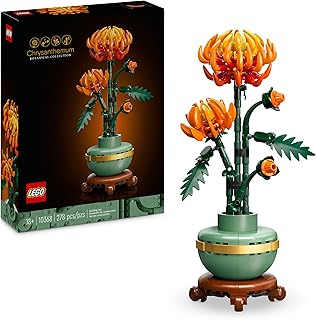
The LEGO Botanicals Chrysanthemum is everything the Happy Plants set isn’t: a realistic, sophisticated artificial flower model designed specifically for adults who want a build that results in something genuinely decorative. The Chrysanthemum is one of the more intricate Botanicals builds, and the level of petal detail achieved through LEGO’s piece design is genuinely impressive — it reads as a considered decorative object rather than a toy when displayed on a shelf.
The Botanicals adult range has positioned itself as an alternative to real house plants — something that looks organic and natural without requiring watering, sunlight, or the slow tragedy of watching something die in a north-facing flat. The Chrysanthemum captures this brief well. The colour palette is rich without being garish, and the proportions are realistic enough that guests routinely do a double-take before realising it’s constructed from bricks.
As a gift, this set works particularly well for adults who don’t identify as LEGO builders. It sidesteps the “isn’t that for kids?” response because the end product speaks for itself as a home décor piece. The building experience itself is meditative and satisfying — methodical, calming, and rewarding without demanding the multi-session commitment of a large architectural set. Most builders complete it comfortably in a single evening.
The tradeoff is that the build process is less varied than a themed or Creator set — you’re largely repeating petal-construction techniques across the full build, which is soothing for some builders and monotonous for others. If you want a building experience that keeps surprising you with new techniques and piece types, a larger set will serve you better. But if the goal is a finished object you’d genuinely be pleased to display in your home, the Chrysanthemum delivers that more reliably than almost anything else in this guide.
What to Look For When Buying a Building Set
- Age range accuracy: Manufacturers set age recommendations based on piece size, choking-hazard risk, and build complexity — not just developmental interest. A set listed for 18+ uses smaller pieces and assumes more dexterity and patience than a 4+ set. Take these ranges seriously, particularly at the lower end for safety and at the upper end for ensuring the build is actually challenging enough to be rewarding.
- Open-ended vs. prescribed builds: Classic and Creator sets offer flexibility (build whatever you want, or follow alternate instructions); themed and Architecture sets guide you to a single specific result. Neither is objectively better, but they suit different temperaments and purposes. Goal-oriented builders and display collectors tend to prefer prescribed builds; imaginative, experimental builders thrive with open-ended sets.
- Piece count vs. build experience: A higher piece count doesn’t automatically mean a more satisfying build. Some high-count sets involve repetitive techniques across thousands of nearly identical pieces; some lower-count sets are cleverly engineered and constantly surprising. Read descriptions carefully for mentions of technique variety, and consider whether you want a meditative repetitive build or a constantly evolving one.
- Display vs. play value: Architecture Skylines, adult Botanicals, and Icons sets are designed to be displayed and admired; Creator, Classic, and younger-targeted sets are designed to be played with and rebuilt. Buying a display set for a child who wants to play with their creation will lead to frustration; buying a play set for an adult who wants something for their shelf will disappoint.
- Compatibility and collection-building: Standard LEGO bricks are universal across the Classic, Creator, City, and most themed ranges — so pieces from one set can be combined with pieces from another. This matters if you’re building a long-term collection. Specialist systems like LEGO Technic or Botanicals use unique pieces that don’t integrate as freely with standard bricks.
- Gifting considerations: Licensed sets (Nintendo, Disney, architecture landmarks) tend to land better as gifts because the theme carries meaning beyond the build itself. Generic Classic or Creator sets are excellent purchases for the builder’s own collection but can feel less considered as gifts unless you know the recipient wants to build freely rather than collect specific subjects.
- Storage and packaging: Some sets come in storage-ready boxes (the Classic Large Brick Box is the obvious example); most come in standard cardboard that’s discarded after the build. If storage is a practical concern — especially with younger children — factor in whether you’ll need to source your own storage solution for the pieces.
Verdict
If you’re buying for the broadest possible audience — a household with a child aged four and up who wants something that will last through years of creative play — the LEGO Classic Large Creative Brick Storage Box Set is the pick to make. The open-ended format, the built-in storage solution, and the depth of creative possibilities across a long stretch of development make it the set that continues delivering long after any themed kit would have been completed, put on a shelf, and forgotten.
For adults building solo, the choice depends on what you want from the experience. If you want something to display, the LEGO Botanicals Chrysanthemum is the most refined option. If you want a meaningful piece of UK-relevant architecture, the London Skyline is the standout. And if you’re buying for a childhood-Nintendo fan, the Game Boy set is hard to resist.
The Creator 3in1 Spider earns a strong mention for the seven-to-ten age group — the three-builds-in-one format represents excellent value, and the nature theme gives it broad appeal among children who aren’t specifically into vehicles or cityscapes. For toddlers just beginning to build, Stickle Bricks remain the right first step before graduating to LEGO.
Buy for the builder in front of you, not for the set that sounds most impressive on paper. Match the build type to the temperament, and you’ll rarely go wrong.
We were not paid to feature any specific product in this guide. All opinions are independent and based on publicly available specifications, verified buyer feedback patterns, and category research.
Quick Comparison Table




FAQ
What age are LEGO Classic sets suitable for?
LEGO Classic sets are generally suitable for children aged four and above. The larger brick formats and simpler connections are designed with young children’s dexterity in mind, though the open-ended creative brief suits a much wider age range — plenty of adults build with Classic bricks too. Always check the specific age guidance on the box, as it reflects piece-size safety considerations as much as developmental complexity.
Are LEGO Architecture sets suitable for children?
Most LEGO Architecture sets are aimed at older builders — typically 12+ for the Skylines range and 18+ for larger landmark sets. They use smaller pieces, assume greater patience, and are designed to result in a display model rather than a play toy. They can work as a parent-child project for motivated younger builders, but they’re not designed with child-led independent building in mind.
What’s the difference between LEGO Creator 3in1 and standard themed sets?
LEGO Creator 3in1 sets include instructions for three distinct builds using the same pieces, giving you significantly more value per box. Standard themed sets (City, Star Wars, Harry Potter, etc.) guide you to one specific prescribed build with licensed characters and settings. Creator 3in1 suits builders who want to experiment and rebuild; themed sets suit collectors or fans of a specific licence who want a particular model.
Are Stickle Bricks compatible with LEGO?
No — Stickle Bricks use a completely different connection mechanism (flexible spiky surfaces rather than studs and tubes) and are not compatible with standard LEGO bricks. They’re designed as a standalone system for very young children, typically ages two to five, before children are developmentally ready for standard LEGO. Think of them as a precursor to LEGO rather than an alternative to it.
Can LEGO Botanicals sets be combined with regular LEGO bricks?
Technically yes — the stud-and-tube connection standard is the same — but in practice the Botanicals pieces are highly specialised and designed for botanical shapes rather than general construction. Most builders keep Botanicals sets as standalone display pieces rather than integrating them into a broader brick collection. The finished models are designed to look complete and refined on their own, not as components of a larger build.
What’s the best building set to buy as a gift for an adult who doesn’t normally build?
The LEGO Botanicals range — particularly the Chrysanthemum — tends to convert non-builders effectively because the finished product is something they’d genuinely want in their home. The London Architecture Skyline works well for someone with a connection to the city. Both result in a display piece that justifies itself on aesthetics alone, which sidesteps the “isn’t LEGO for kids?” hesitation that some adults have before they actually sit down to build.