Your child has announced — for the third time this week — that they want a proper tent in the bedroom. Not a blanket draped over two dining chairs that collapses at the slightest nudge, and not the pop-up laundry basket they have been repurposing as a hideout. They want a real den: four fabric walls, a proper entrance, somewhere to take their stuffed animals, their books, and their imagination. You have looked online and found yourself scrolling through rows of pink polyester structures wondering which ones will still be intact by February, which ones require engineering to fold back down, and which ones are actually sized for a child rather than a large doll. Meanwhile, your child is sitting inside a cardboard box looking at you expectantly and there is a growing pile of sofa cushions on the floor that used to be a fort. Play tents genuinely solve this problem — they give children a dedicated space that encourages independent and imaginative play, and they give parents back the sofa. The challenge is finding one that suits your child’s age and your room’s dimensions without becoming tomorrow’s clutter.
How We Chose These Picks
I evaluated eight current Amazon.co.uk listings, narrowing them down to five distinct products for this guide. The criteria were practical: ease of setup for one adult, floor footprint relative to usable interior space, fabric quality and how it holds up to daily use, whether a mat or floor padding was included, what extras came in the box, age suitability from toddler through to primary school, and how compactly the tent folds away for storage. I reviewed buyer feedback patterns across listings with between 77 and 194 verified reviews, paying close attention to recurring complaints as much as consistent praise. Where two listings appeared to be bundle variants of the same underlying tent construction, I selected only the better-reviewed version and noted the alternative within that same section.
Best for Quiet Indoor Play
The Wilwolfer Kids Play Tent Indoor with Mat, Cosy Playhouse, Peach Skin Fabric stands out in this category because it comes with an integrated floor mat — something many comparable tents skip entirely. If your child tends to drag a cushion or blanket into every small space they occupy, having the floor covering already sorted is a genuine quality-of-life improvement from day one.
The peach skin fabric is noticeably softer to the touch than the standard polyester used in most pop-up designs. Several reviewers specifically call this out as a differentiator, and with 194 reviews at 4.4 stars it is the most-reviewed option in this guide — which gives real confidence in the consistency of build quality across units. The double windows are a practical touch: children can look out without fully opening the entrance, which preserves the sense of enclosure even when they are curious about what is happening outside. Parents mention this specifically as something their children use intentionally, peeking out rather than going out.
This tent is designed as an indoor playhouse primarily for toddlers and pre-schoolers, best positioned as a semi-permanent feature in a bedroom or playroom corner. Because it uses a frame-style construction rather than a pop-up tension design, it has more structural presence once erected — it will not slide across a hard floor when a three-year-old bounces around inside. The integrated mat is thick enough to make sitting or lying down comfortable on laminate or tile, which matters considerably if your home has hard floors throughout.
The Wilwolfer suits children who gravitate towards contained, calm play — reading, drawing, or small-world play with figurines and toy sets. The enclosed fabric house design, combined with the soft texture and double windows, balances a child’s desire for privacy with a parent’s need for visibility. If your child often retreats to a corner when they need downtime, this structure supports that behaviour in a constructive way. For children who primarily want to run circuits between a ball pit, a tunnel, and a tent, one of the multi-piece sets reviewed later in this guide will be a better fit.
The tradeoff is portability. This is not a tent you will fold up every evening and carry to a different room — it works best as something that stays put for weeks at a time. Parents report that setup takes a few minutes longer than a true pop-up, though it is manageable as a solo adult task. The peach skin fabric does attract pet hair and lint, so households with cats or dogs should factor in occasional wipe-downs to keep it looking presentable.
Best with Built-In Fun Extras
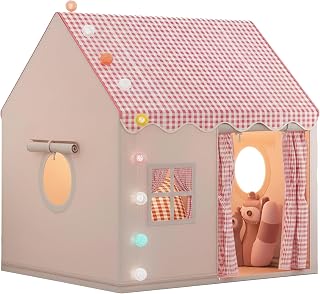
The Play Kids Tent for Girls; Multi-Coloured Ball Lights & Squishy Rainbow Frog is the pick when you want the tent to come with enough novelty to keep a child busy straight out of the box. The multi-coloured ball lights are strung inside the canopy and create a warm, atmospheric glow — reviewers consistently note that children are drawn to the lights first, sometimes before exploring the rest of the tent structure.
With 190 reviews at 4.3 stars, this is one of the most feedback-rich options in this category on Amazon.co.uk. The pattern of positive comments centres on it being a reliable gift for girls aged roughly three to six. The squishy rainbow frog bundled with the tent is a tactile toy rather than a headline feature, but children who received the set as a birthday or Christmas present tend to appreciate the completeness of the package — you are not handing over a bare tent and then immediately having to explain why there is nothing inside it.
The indoor/outdoor designation means it works in the garden on a dry day as well as in the living room. For UK conditions, that dual-use capability is worth having — on occasional sunny afternoons in summer you can shift it outside without needing a separate outdoor tent. Pop-up construction means it goes up quickly, though like all spring-loaded designs it requires a specific folding technique to pack back down (more on this in the FAQ section below).
Where this tent falls short is fabric thickness. Some reviewers note the material feels lighter than expected compared to more substantial options like the Wilwolfer above. For purely indoor use that is entirely manageable, but if you plan on using it repeatedly on grass or rough surfaces, the lighter fabric will show wear faster. There is no floor mat included, so put a blanket or soft foam mat underneath when using it on hard floors — otherwise it becomes uncomfortable for extended sessions fairly quickly.
The pink-and-purple colour palette and girls-focused branding will not suit every household. For parents who want the same ball lights tent aimed at both boys and girls — with a storage bag bundled in rather than a frog toy — the Kids Play Tent with Multi-Coloured Ball Lights & Storage Bag Pink is a close alternative from the same product family, with 35 reviews at 4.4 stars and a slightly more neutral colour application. For a gift specifically for a girl aged three to six, though, the 190-review version gives considerably more confidence in consistent quality.
Best Complete Princess Bundle
The 3PC Princess Tent for Girls with Kids Ball Pit, Kids Play Tent and Crawl Tunnel for Toddlers is the pick for families who want a complete activity setup rather than a standalone tent. The three-piece structure gives you a play tent, a ball pit section, and a crawl tunnel that can be arranged together into a connected play zone — or used independently if space is limited on a given day.
With a 4.5-star rating from 98 reviews, it is the highest-rated option in this guide. Buyers regularly single out the tunnel as the unexpected highlight — children who would otherwise use the tent for static sitting become mobile, crawling back and forth between the pit and the tent in circuits. That physical engagement is something a single structure cannot replicate, and it is a meaningful factor if your child benefits from movement being woven into their play rather than sitting still in one place.
The princess theming — crowns, a pink and purple palette, castle wall detailing — makes it most appealing for girls in roughly the one-to-five age range. The ball pit is designed to be filled with plastic ball-pool balls, which are not included in the set. This catches buyers off-guard more often than it should, so factor in the cost of purchasing a bag of ball-pool balls separately before ordering — otherwise you will have a pit-shaped frame with nothing in it on the day it arrives.
When all three pieces are deployed together, the footprint is sizeable. Think honestly about whether your room can accommodate the full connected arrangement, or whether you are comfortable cycling between individual pieces depending on how much floor space is available. Pop-up construction means each component opens quickly, making partial deployment practical on tighter days. All three pieces fold back to flat discs for storage, which is useful if you need to reclaim the floor at bedtime.
One honest caveat: the princess theming is vivid and specific. Children’s interests shift, often faster than parents expect, and a palace-decorated tent that delights a two-and-a-half-year-old may feel less relevant at four. For a toddler currently absorbed in princess role-play, though, the theming reinforces the imaginative scenario rather than just providing a generic space — and the 4.5-star rating suggests it delivers reliably on what it promises to its target audience.
Best Activity Play Set
The Kids Play Tent with Ball Pit+Play Tunnel+Teepee Tent, Pop Up Toddlers Playhouse for Boys and Girls covers the same three-piece concept as the princess bundle above, but in a teepee format with a more gender-neutral colour scheme. If you have a son, or a daughter who is not drawn to castle imagery, this is the stronger fit between the two multi-piece options.
The teepee design gives the main tent a taller, more pointed silhouette than a standard dome pop-up. Children who want to stand inside rather than just sit will appreciate the extra headroom, and the visual distinctiveness of the teepee shape gives it a slightly more considered aesthetic. At 90 reviews and 4.4 stars, the feedback is consistent — parents specifically highlight the speed of setup as a weekday-afternoon advantage when you need the play zone ready before attention spans expire.
The ball pit and tunnel connect to the teepee to form a play circuit, and as with the princess set, balls are not included. A practical advantage this set holds over the princess version is the carry bag mentioned by multiple reviewers — it keeps all three flat-disc components together between uses, which solves the common frustration of one piece disappearing under furniture or behind a wardrobe door.
Because all three pieces fold to flat discs and fit into a single bag, this set is more portable than frame-assembly alternatives. Taking it to a relative’s house, to a community hall for a birthday party, or out for a playdate is manageable by one adult. For parents who want a play zone that moves with the family rather than anchoring to one room, that portability is a real advantage over heavier or more permanent designs.
The main limitation applies across all pop-up tension-frame designs: they are matched to toddlers and pre-schoolers rather than older, more forceful children. A six or seven-year-old regularly leaning on the sides or climbing in and out roughly will start to stress the frame over time. The one-to-four-year window is where this set performs best, and within that range the combined ball pit, tunnel, and teepee play zone is hard to match at the price tier.
Best Budget Pick
The Ocean World Play Tent – Under the Sea Adventure Pop-Up Tent for Kids is the most affordable option in this guide and — unusually for a lower-priced product — it does not appear to cut corners in the areas that most affect everyday usability. With 77 reviews at 4.4 stars, it holds its own against pricier options on overall buyer satisfaction.
The ocean and underwater theming — fish, coral, and seahorses printed across the fabric walls — is vivid and detailed without being garish. Crucially, it is gender-neutral and more distinctive than the generic princess, camouflage, or jungle prints that dominate this market. If you want a tent less likely to appear identically in three other children’s bedrooms on your street, the under-the-sea design is a differentiated choice that appeals to both boys and girls across a wide age range.
Pop-up construction means it opens in seconds and folds back to a flat disc for storage. For parents who want to bring the tent out in the morning and put it away before dinner without any fuss, this is the right format. The flat-pack size when folded is compact — the kind of thing that fits behind a sofa or inside a wardrobe without claiming a significant amount of space.
The tradeoffs are worth stating directly. There is no mat, no bundled extras, and the interior dimensions are on the smaller side compared to the Wilwolfer or the multi-piece sets. This is a tent for one child to sit in with a book or a small collection of toys, not a shared play den for two or three children at once. The lightweight fabric is perfectly adequate for indoor use but is not suited to prolonged outdoor exposure — dry outdoor sessions are fine, but leaving it erected overnight or through repeated wet weather will shorten its lifespan noticeably.
For a first play tent — particularly one for a child who might use it intensively for a season and then want something with a different theme — the Ocean World’s lower price and near-instant setup make it a low-risk, high-enjoyment option. It also works well as a travel tent: light enough to fold into a bag for visits to grandparents or a family holiday without it feeling like a burden to carry.
What to Look For When Buying a Play Tent
- Fabric weight and texture. Thicker, softer fabrics such as peach skin are more comfortable for extended play sessions and wear more gracefully than thin polyester. Thinner fabric is lighter and less costly, but it picks up wear faster and feels less pleasant when lying down on it. Consider how your child actually uses the tent — calm reading sessions call for different material priorities than energetic crawling-in-and-out play.
- Floor mat or padding. Many play tents are sold without any floor covering. On carpet this matters less, but on laminate, tile, or wooden floors a child sitting inside a mat-free tent will feel the cold hard surface within minutes. Either choose a tent that includes an integrated mat, or budget for a soft foam mat or rug to place underneath.
- Setup method: pop-up versus frame assembly. Pop-up tents open in seconds via a spring-loaded frame and fold to a flat disc — fast and compact, but less structurally robust for long-term erection. Frame-assembly tents take a few minutes to put together but tend to be sturdier and better suited to remaining up for weeks at a time. Match the setup style to your daily routine: if you are putting it away each evening, pop-up is the practical choice; if it will live in a corner for months, frame assembly justifies the setup time.
- Interior dimensions and headroom. Check the listed measurements carefully before ordering. A tent with a roughly 90 cm floor footprint is comfortable for one toddler; children who want to share the space or who want to stand upright need meaningfully more room. Teepee designs typically provide more headroom than dome pop-ups for the same base footprint. If the product listing does not include dimensions, buyer-uploaded photos are usually a reliable scale reference.
- Age range and structural robustness. Most play tents in this market are rated for approximately one to six years. Older, heavier children place more stress on frames and seams, particularly in pop-up designs. If you are buying for a five or six-year-old who needs the tent to last another few years, look for sturdier frame construction or accept that it may be more of a short-term purchase.
- What is included in the box. Some tents are sold as standalone structures; others bundle in a crawl tunnel, ball pit frame, lights, or toy accessories. Bundles can represent good value, but check what is absent: ball pit sets almost universally require ball-pool balls to be purchased separately, and light-up features require batteries. Know the full cost before adding to basket.
- Storage format and packed size. Pop-up tents fold to flat discs of roughly 60–80 cm in diameter. Frame-assembly tents may fold into a carry bag or a flat pack depending on the design. If storage space is tight, confirm the packed dimensions in the product listing before committing.
Verdict
For most families with a toddler or pre-schooler setting up a play tent for regular indoor use, the Wilwolfer Kids Play Tent Indoor with Mat is the strongest all-round choice. The built-in mat, softer peach skin fabric, and double-window design give it practical longevity that most competitors do not match. It is the option most likely to still be in active daily use twelve months from purchase, because it prioritises everyday comfort and material quality rather than one-time novelty.
If your child specifically wants a complete activity zone with interconnected components — crawl tunnel, ball pit, and tent — the 3PC Princess Tent for Girls with Kids Ball Pit, Kids Play Tent and Crawl Tunnel for Toddlers earns the highest star rating in this guide and is consistently praised for the way the tunnel transforms static play into something more physically active. Remember to purchase ball-pool balls separately — they are not included.
If budget is the primary consideration, or you need something that packs flat and travels easily, the Ocean World Play Tent delivers more than its price tier suggests, with gender-neutral underwater theming and near-instant pop-up setup that removes almost all friction from daily use.
We were not paid to feature any specific product in this guide. All opinions are independent and based on publicly available specifications, verified buyer feedback patterns, and category research.
Quick Comparison Table





FAQ
What age are play tents suitable for?
Most play tents in this guide are designed for children aged one to six years, with some models extending to seven. Check the manufacturer’s recommended age range before buying — younger toddlers need tents without small detachable parts that could present a choking risk, while older children benefit from sturdier frame construction that tolerates more energetic use. If you are buying for a child near the upper end of the stated range, buyer reviews are a useful guide to how the tent holds up to heavier, more active users.
Can play tents be used outdoors as well as indoors?
Several options in this guide are listed as suitable for both indoor and outdoor use. However, most are made from lightweight polyester that is not waterproof, making them appropriate for dry outdoor sessions rather than extended garden exposure. Bring them inside before rain and avoid leaving them erected overnight — UV exposure and moisture degrade the fabric faster than indoor use alone. A quick dry-off after any outdoor session before folding helps keep the tent in better long-term condition.
How do you clean a children’s play tent?
Most fabric play tents cannot be machine washed — doing so can warp the frame or damage the pop-up mechanism. The standard approach is spot-cleaning with a damp cloth and a small amount of mild soap, then allowing the tent to air dry fully before folding and storing. Check the care label or product description for your specific tent, particularly if it has an integrated mat or LED lighting components that should not get wet.
Are pop-up play tents difficult to fold back down?
The folding technique for pop-up tents can feel counterintuitive the first couple of attempts. The mechanism involves collapsing the spring-loaded frame into an overlapping figure-of-eight or disc shape rather than folding it flat like a conventional structure. Most manufacturers include a folding diagram, and searching for a short video of the specific technique makes it straightforward quickly. After two or three attempts it becomes fast and automatic — the difficulty is almost entirely in that first encounter with the mechanism.
Do ball pit play tent sets include balls?
Ball-pool balls are almost never included in multi-piece tent sets — both the 3PC Princess Tent and the Kids Play Tent with Ball Pit and Teepee in this guide require balls to be purchased separately. A standard bag of 100 plastic ball-pool balls is widely available on Amazon.co.uk and is typically sufficient to fill a small to medium ball pit section to a useful depth. Factor this into the total cost when considering a bundle set, and order the balls at the same time to avoid a flat unboxing experience on the day.
How much floor space does a play tent need?
A standalone play tent for one child typically needs roughly one to one-and-a-half square metres of clear floor space, though the usable interior area is usually somewhat smaller than the outer footprint. Multi-piece sets with a tunnel and ball pit attached need considerably more room — often two to three square metres when fully deployed together. Always check the product dimensions in the listing and measure your available space before ordering, particularly for three-piece sets where the full connected footprint is not always apparent from product photos.