You know the moment. You open a kitchen cupboard to grab a tin of tomatoes and half the contents slide out onto the worktop. The bathroom shelves — if you can call them that — are a precarious stack of moisturisers and cotton buds that collapses whenever someone reaches for the shampoo. The spare room doubles as a filing system, which is a polite way of saying that important documents are somewhere in a pile that started forming in 2023 and has been spreading since. And in the living room, the sideboard you bought three years ago is actually just a surface for keys, post, and anything that doesn’t have anywhere better to go.
Storage problems don’t get solved by buying more of the wrong thing. What you need is the right cabinet or cupboard — one sized to fit the room, built to hold the weight, and designed in a way that makes sense of the clutter rather than hiding it until the door eventually fails. Shopping for storage on Amazon without a clear plan is its own kind of chaos: hundreds of options across wildly inconsistent quality levels, assembly instructions that can make a Saturday afternoon disappear, and photographs that flatter products in ways the real object doesn’t live up to.
This guide focuses on five distinct cabinet types — kitchen, steel utility, living room, bathroom mirror, and home office — and recommends one specific, well-reviewed product for each scenario. Whether you’re trying to reclaim your kitchen worktops, sort out your bathroom, or finally get your home office under control, there’s a pick here that addresses your situation directly.
How These Picks Were Chosen
The selection criteria for this guide covered five distinct cabinet use cases, evaluated against a consistent framework: structural material (steel, engineered wood, MDF composite), adjustable shelf configuration, locking security where relevant, footprint relative to typical UK room dimensions, and ease of assembly based on verified buyer experience. For products with larger review sets, patterns across recurring feedback were weighted more heavily than headline star ratings — a recurring complaint about shelf bowing, hinge quality, or misleading dimensions tells you more than a single bad review buried among hundreds of positive ones. Products with fewer than 20 reviews were assessed with appropriate caution and their review count is noted clearly in the relevant section. General research into cabinetry construction — the relative durability of different build materials, painted versus unpainted finish wear, and the practical significance of adjustable versus fixed shelving — shaped the evaluation framework used throughout.
Best Kitchen Storage Cupboard
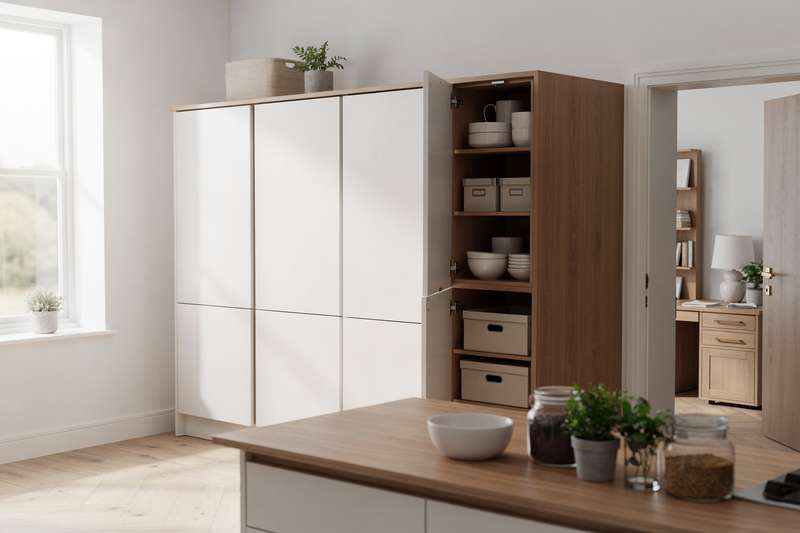
The HOMCOM Kitchen Cupboard Cabinet 2 Adjustable Shelves 160cm White is the pick for anyone who needs a tall, freestanding storage solution in a kitchen, utility room, or narrow hallway. At 160cm in height, it provides meaningful vertical storage without demanding a wide floor footprint — the kind of unit that can change how much usable space a room has, rather than simply shifting clutter from one surface to another.
The two adjustable interior shelves are the feature that matters most here. Fixed-shelf cabinets frustrate quickly: a jar that’s a centimetre too tall for the designated shelf, a stack of plates that doesn’t quite align, or a small appliance that was never going to sit neatly on the lower tier no matter how you rearrange things. The HOMCOM’s adjustable configuration means you can reconfigure the interior to suit whatever you’re actually storing — dry goods, cleaning products, small appliances, or a mix of all three. The white finish gives the unit a clean, minimal appearance that integrates naturally into most kitchen colour schemes, particularly those with white or light grey cabinetry already in place.
With 4.3 out of 5 stars from 94 reviewers, the feedback profile is broadly positive. Assembly is where the most consistent criticism appears: instructions can be unclear at certain stages, and a number of buyers note that holding taller panels in alignment during construction is awkward without a second person present. Budget an hour and a half rather than forty-five minutes, and ask someone to help with the upper sections before you begin rather than wishing you had halfway through. The build itself isn’t complicated, but alignment during the taller stages genuinely benefits from a second pair of hands.
The white finish has a real-world tradeoff: it shows marks. In a kitchen where cooking is an everyday activity, splashes and fingerprints accumulate. A regular wipe-down keeps it presentable, but if your kitchen is high-traffic and hard-use, consider honestly whether white is a finish you’ll maintain or one you’ll grow to resent within a few months. For a pantry cupboard, utility room, or a hallway with low cooking exposure, white is an attractive and practical choice. For an active cooking zone directly adjacent to the hob, adjust expectations accordingly.
Before ordering, check the full assembled dimensions carefully against your space — UK kitchens often have tighter clearances than they appear, particularly between existing units and doorways. The freestanding design means no wall-fixing is required, which adds flexibility, but only if the dimensions work for your layout. As a functional, well-proportioned cabinet for general household storage, this piece delivers exactly what it promises.
Best Lockable Steel Cabinet for Utility Rooms and Workshops
The LAND·VOI Steel Storage Cabinet, 3-Tier Lockable Cabinet with Adjustable Shelves, Double-Door Cupboard Storage is built for buyers whose storage priorities go well beyond aesthetic tidiness. If you’re storing tools, workshop chemicals, medications, valuable equipment, or anything that children or casual visitors shouldn’t access freely, a lockable steel cabinet offers security and structural robustness that wood-composite alternatives can’t match.
Steel construction gives this cabinet a durability advantage in environments where things get knocked, stacked, and leaned against — utility rooms, garages, workshops, or commercial-style storage spaces in a home or small business. The double-door design with an integrated locking mechanism means you control access, and the three adjustable interior shelves let you configure the layout to accommodate items of varying heights. At roughly 40cm wide (noted in the product listing), it has a relatively compact footprint for a cabinet of this type — useful in spaces where a larger unit simply won’t fit.
A note of honesty is needed here: this is a newer product with 13 reviews at 4.4 out of 5 stars. That early rating is encouraging, but with a review count this low there’s less collective real-world experience to draw on than with more established listings. Treat it as a positive early signal rather than a comprehensive verdict. Steel cabinets at this price tier are honest about what they are: the exterior paint coating can chip on edges and corners over time, particularly in a working environment where the cabinet sees regular contact. Minor surface dents are possible if struck. Neither affects structural integrity or locking function — these are cosmetic considerations only.
Where this cabinet shows real value is in practical, workhorse storage situations. A lockable unit in a utility room keeps cleaning products and medications safely away from children. In a home office, it secures contracts, passports, or expensive equipment. In a garage or workshop, it keeps tools organised and protected from opportunistic access. The adjustable shelves address one of the most common frustrations with steel cabinets — fixed shelving that dictates what you can store rather than adapting to what you actually have.
Assembly for a steel cabinet of this type is generally more mechanical than flat-pack wood furniture: expect bolts and panel connections rather than wooden dowels and cam fixings. Lay out all components before starting, read the instructions fully, and confirm all fixings are present before beginning. For secure, hard-wearing storage in a utility or workshop setting, the LAND·VOI covers a need that most wooden cupboards simply cannot address.
Best Sideboard Cabinet for Living Rooms and Dining Spaces
The Vida Designs Arlington Sideboard, Buffet Table, Cupboard Cabinet (White & Oak, 2 Drawer 3 Door) is designed for buyers who want their storage to function as a proper piece of furniture rather than an obvious box in the corner. A sideboard-style cabinet offers something that taller units don’t: a flat surface on top. That surface becomes a shelf for decorative items, a serving area during meals, or a landing zone for everyday essentials — without making the room look like a storage facility.
The White and Oak colour combination suits contemporary UK living rooms and dining spaces well. White-and-oak finishes pair naturally with the Scandi-influenced interiors widespread in modern British homes. The 2 drawers and 3 doors provide a practical split of storage: drawers for smaller items and frequently accessed bits, doors for larger items kept out of sight. The lower, wider profile of a sideboard format means it can sit under windows and alongside dining tables in ways that tall cupboards don’t permit.
Honesty about the rating matters here. At 3.8 out of 5 stars from 591 reviews, this product has a large and revealing dataset — a lower rating with hundreds of reviews is more informative than a high rating with a handful. Buyer feedback points consistently to assembly as the primary friction point. Instructions are described as unclear by a significant number of buyers, and some panels require precise alignment that’s difficult to achieve solo. Reviewers also note that the finish isn’t as robust as the product photography implies: panels can scratch during assembly if dragged against each other, and corners are vulnerable to chipping if care isn’t taken during the build.
Despite that, a substantial proportion of buyers report satisfaction with the finished result. The piece looks good in situ, the storage is practical, and the visual impact relative to cost is favourable. The tradeoff is clear: getting to a good result requires patience during assembly and careful handling of components. If you’re methodical with flat-pack furniture — unhurried, willing to read the instructions properly — the Arlington is a rewarding piece when complete. If flat-pack assembly is genuinely stressful for you, factor in the cost of professional assembly help before purchasing.
Where the Arlington is less suited is under heavy daily use. Hinges and drawer runners are adequate for moderate traffic but not exceptional. In a guest room or dining space that sees light use, this holds up well. In a busy family living room where drawers open and close constantly, durability over two or three years is worth keeping in mind. For the right setting — an aesthetically-conscious space with moderate use — it offers a strong price-to-appearance ratio.
Best Bathroom Mirror Cabinet
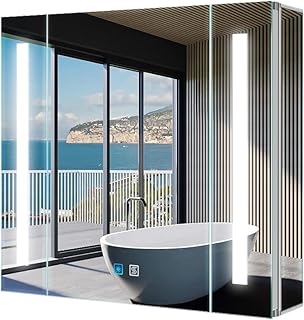
The Tokvon® Alameda LED Bathroom Mirror Cabinet with Lights, USB Ports, Anti-Fog, Shaver Socket, Colour Changing & Touch Sensor, Dimmable LED is the pick for anyone looking to upgrade their bathroom’s functionality without undertaking a full renovation. Rather than replacing just a mirror or just a cabinet, the Alameda consolidates several key bathroom functions — storage, high-quality task lighting, anti-fog technology, and charging access — into a single wall-mounted unit that meaningfully changes how the space works.
At 4.4 out of 5 stars from 268 reviewers, the Alameda has a strong track record for a product at this feature level. The LED lighting is what users most consistently highlight: it provides even, shadowless illumination that addresses the problem of overhead-only bathroom lighting, which creates unflattering shadows when you’re using the mirror. The dimmable, colour-temperature-adjustable function means you can set warm tones for evenings and cooler tones for morning routines — a practical change that makes the bathroom work differently at different times of day.
The anti-fog feature is more practically useful than it might initially appear. A bathroom mirror that clouds up immediately after a shower quickly becomes a daily frustration — you’re waiting for it to clear before you can use it. The heating element behind the glass keeps the mirror surface clear, making it usable straight after a shower. The USB ports are a well-appreciated convenience: charging a toothbrush, electric razor, or phone from within the bathroom cabinet without trailing cables to a distant wall socket. The shaver socket is a standard requirement in many UK bathrooms, and the touch-sensor controls keep the front panel clean and intuitive to use.
The honest tradeoffs relate to installation. This is a wall-mounted unit, meaning secure fixing to your bathroom wall is required. If your walls are tiled, drilling demands care to avoid cracking tiles. The electrical connections for the LED system, shaver socket, and anti-fog element must comply with UK bathroom wiring zone requirements — if you’re not confident working with electrical installations in wet environments, a qualified electrician should handle this, which adds to the overall project cost and is worth factoring in before purchasing.
The internal storage is practical rather than generous: it suits toothpaste, medications, skincare, and small accessories rather than large-volume bathroom storage. If substantial bathroom storage is your primary requirement, pair this with a separate floor-standing unit. As a combination mirror, light, and compact storage solution in a single fitting, the Alameda is one of the more complete wall-mounted options available at this level.
Best Mobile Filing Cabinet for Home Offices
The VASAGLE Filing Cabinet, Mobile File Cabinet with 2 Lockable Drawers, Office Cabinet on Wheels, for A4, Letter-Size Hanging File Folders is the most reviewed product in this guide, with 670 verified ratings — and that volume reflects something concrete: this is a product that does a specific job well and consistently satisfies the buyers who need that job done.
The cabinet moves on wheels, which means it can be tucked under a desk when not in use and pulled out when you need access. In a home office where space is limited — a spare bedroom, a corner of a dining room, a compact dedicated study — this mobility makes a real practical difference. Both drawers lock independently, which matters if you’re storing contracts, financial documents, personal identification, tax records, or paperwork you’d rather not have freely accessible. The interior is designed for A4 hanging file folders — the standard format across the UK — so files slot straight in without modification or cutting.
At 4.3 out of 5 stars from 670 reviews, the feedback is consistently positive. Build quality for the price tier is the most commonly noted strength — reviewers repeatedly observe that the cabinet feels more solid than expected, with the steel-and-engineered-wood construction providing real rigidity. The locking mechanism receives consistent praise for reliability. Recurring criticisms are minor: a number of buyers note that the wheels don’t lock in place, meaning the cabinet can slide on smooth floors if nudged. On carpet, this isn’t an issue; on hard flooring, it’s worth being aware of. Assembly is described as straightforward by most, with a typical build time under an hour.
The most important point of honesty about this cabinet is that it isn’t a general-purpose storage unit. It’s built specifically for document filing in hanging folder format. If you’re hoping to store stationery, equipment, or items that aren’t hanging file folders, the interior won’t serve those needs well. Think of it as a specialist tool: excellent at what it was built for, limited outside of that scope. If what you need is a general-purpose storage cabinet, the HOMCOM or the LAND·VOI will serve you better.
For anyone working from home whose paperwork has been living in a cardboard box, a plastic crate, or spread across drawers that don’t properly fit A4, this cabinet provides exactly the right infrastructure. The combination of mobility, lockable security, and properly proportioned A4 filing capacity makes it the most focused home office storage pick in this selection. It pairs naturally with almost any desk setup: tucked underneath when working, pulled out when filing, locked when done.
What to Look For When Buying a Cupboard or Cabinet
- Height and footprint relative to your space: Measure twice before ordering. UK rooms — particularly kitchens, hallways, and bathrooms — often have tighter clearances than they appear. Check the full assembled dimensions (height, width, depth) against your available wall space, accounting for the fact that doors need room to swing open and that ceiling height affects tall units. A cabinet that fits on paper but blocks a door or can’t be fully opened is an expensive frustration.
- Adjustable versus fixed shelving: Fixed shelves look clean in product photography but become limiting quickly in real use. Items rarely conform precisely to a given shelf height. Adjustable shelves that can be repositioned in small increments let the cabinet adapt as your storage needs change — this matters especially in kitchens and utility rooms where the mix of stored items varies over time.
- Locking mechanisms: Not all cabinets need locks, but for medications, tools, chemicals, sensitive documents, or valuable equipment, a lockable unit is the right specification. Check whether the lock secures doors or drawers fully and whether spare keys can be obtained. Single-cylinder cam locks are standard on budget steel cabinets; more robust locking is found on higher-specification units.
- Build material and finish durability: Solid wood is the most durable and repairable option but the most expensive. MDF and wood composite — standard for most flat-pack cabinets — is adequate for indoor domestic use but vulnerable to sustained moisture exposure. Steel is harder-wearing in utility and workshop contexts. Painted finishes on any material are less durable than non-painted ones and show chips and scratches more visibly — this applies regardless of price tier.
- Weight capacity per shelf: Product listings often omit this specification, but it matters if you’re storing heavy items — tins, tools, books, or equipment. Steel shelving or reinforced board supports considerably more weight than thin MDF or particle board. If the manufacturer doesn’t specify a per-shelf weight rating, err on the side of caution and distribute heavy loads across multiple shelves.
- Assembly complexity and what’s included: Review patterns tell you something real about assembly experience. Products with consistent assembly complaints are worth approaching with realistic time expectations — and check before purchasing whether the listing confirms that all required fixings are included. A flat-pack cabinet that arrives without the right screws or brackets adds unnecessary cost and frustration.
- Room and purpose fit: Before choosing, be specific about the environment and use case — humidity level, security requirement, and aesthetic context all affect which cabinet type is right. A white kitchen cupboard in a utility room works well; the same cupboard in a bathroom will deteriorate quickly. Matching the product to the actual environment, not just the available dimensions, is the most consequential buying decision of all.
Verdict
For the broadest range of UK readers searching for a cupboard or cabinet, the right choice depends entirely on the room and the problem being solved — which is why this guide covers five distinct use cases rather than nominating a single universal winner.
For kitchen and utility room storage, the HOMCOM Kitchen Cupboard Cabinet is the strongest pick: tall, well-proportioned for UK spaces, with adjustable shelving that adapts to real-world storage needs. For secure, hard-wearing storage in a garage, utility room, or workshop, the LAND·VOI steel cabinet addresses a need that wooden alternatives can’t. For living rooms where the cabinet needs to look like furniture, the Vida Designs Arlington Sideboard offers a sideboard format — provided you’re patient with assembly. For a complete bathroom upgrade in a single wall-mounted unit, the Tokvon® Alameda consolidates more functions than any other pick in this selection. And for home office document organisation, the VASAGLE Filing Cabinet is the most purpose-built and well-proven choice available.
If forced to choose just one for the reader who found this article because their home feels disorganised and they’re unsure where to start: the HOMCOM Kitchen Cupboard Cabinet. Kitchen and utility clutter is the most common household storage problem in UK homes, and a well-chosen tall cupboard addresses it more effectively than any other single piece of storage furniture.
We were not paid to feature any specific product in this guide. All opinions are independent and based on publicly available specifications, verified buyer feedback patterns, and category research.
Quick Comparison Table



FAQ
What is the difference between a cupboard and a cabinet?
The terms are often used interchangeably in the UK, but there’s a loose distinction: a cupboard typically refers to any enclosed storage unit with doors, used in kitchens, bedrooms, or hallways. A cabinet tends to imply a more purpose-built or finished piece of furniture — bathroom mirror cabinets, filing cabinets, display cabinets — often designed for a specific use. In practice, both words appear on Amazon and in UK retailers without any consistent distinction between them.
Do I need to fix a freestanding cupboard to the wall?
Most freestanding cupboards don’t require wall-fixing for standard adult use, but for tall units in households with young children, wall-anchoring is strongly recommended as a safety precaution. A tall, top-heavy cupboard that gets climbed on or pulled can tip forward with serious consequences. Most tall freestanding cabinets include an anti-tip bracket or wall strap — use it regardless of whether children regularly access the room.
Can I use a kitchen-style cupboard in a bathroom?
Not unless it’s specifically rated for humid environments. Standard flat-pack kitchen cabinets use MDF or wood composite board, which absorbs moisture over time, causing swelling, warping, and surface delamination. Bathrooms require cabinets made from moisture-resistant materials or specifically listed for bathroom use. Don’t repurpose kitchen or hallway furniture in a wet room environment — the cabinet will not last and the results will be disappointing.
How do I know how much weight a cabinet shelf can support?
The product listing should state a per-shelf weight capacity, but many budget flat-pack cabinets omit this figure. As a practical guide, steel or thick plywood shelves support significantly more weight than thin MDF or particle board. If you’re storing heavy items, look for cabinets that specify shelf weight ratings and distribute loads across multiple shelves rather than concentrating weight on one.
Is a lockable cabinet worth the extra cost for home use?
For general household storage — clothes, kitchen items, books — a lock adds cost without much practical benefit. For specific scenarios, a lock is the right choice: medications that children shouldn’t access, financial or legal documents, workshop tools, or items of meaningful monetary value. Budget steel cabinets with standard cam locks are adequate for most home security requirements without needing anything more sophisticated.
How long does flat-pack cabinet assembly typically take?
Most flat-pack cabinets in this category take between 45 minutes and 2 hours depending on size and component count. The most common mistake is rushing the initial alignment — if panels aren’t square and flush before fixings are tightened, the finished cabinet will rock or the doors won’t hang straight. Read the instructions fully before starting, and don’t tighten anything permanently until the full structure is assembled and checked for alignment.