Picture this: it’s a rainy Saturday afternoon, you’ve laid a sheet of baking parchment across the kitchen table and called the children in. Your seven-year-old settles down eagerly, but within five minutes the tub of modelling dough you ordered online last week has already developed a dry crust at the edges — and their interest is fading fast. Or perhaps you’re the adult in this scenario: you picked up a clay starter kit for a quiet evening of creative work, only to find the clay cracks badly during drying and the tools included snap on first contact with anything thicker than tissue paper. Then there’s the colour problem that catches almost everyone out: twenty-four shades sounds comprehensive until three of them blend into the same murky brown and the set starts feeling designed more for the product listing photograph than for actual use.
Clay and dough products span a wider spectrum than most buyers expect. At one end: soft, reusable modelling doughs that stay pliable as long as you store them correctly, ideal for open-ended play with no fixed outcome. At the other: lightweight air-dry clays that harden at room temperature and produce finished pieces you can paint and keep. In between sits a range of kits with varying tool quality, colour counts, and age suitability. The problem on Amazon UK is not availability — it is distinguishing products that genuinely behave the way they are described from those that look impressive in a product image and disappoint when you open the box. This guide does that filtering for you.
How These Picks Were Chosen
Each product in this guide was evaluated against a consistent set of criteria. Volume and pattern of buyer feedback on Amazon UK carried the most weight — recurring themes across hundreds of real purchases tell you far more about clay softness, colour behaviour, and tool quality than any product description can. For products with a substantial review base, those patterns guided the assessment directly. Where a product has no verified buyer reviews on Amazon UK yet — and this applies to three of the five picks, flagged clearly in each relevant section — the assessment draws instead on stated specifications benchmarked against comparable kits in the category. Additional factors considered: age-appropriate softness, safety markings, included accessories, storage design, and value per quantity of clay included. No picks were ranked by price alone.
Best Overall: AUAUY
The AUAUY modelling clay set is the most buyer-verified choice in this guide: over 540 ratings on Amazon UK at a 4.4-star average is a meaningful evidence base in a category where consistency between product batches genuinely matters. High review volumes, particularly in crafts products, separate reliable everyday choices from items that photograph well and perform unpredictably. That combination of volume and rating tells you buyers are receiving what they expected — and coming back to rate it positively.
The patterns that emerge across buyer feedback are consistent: the clay is soft from the moment you open it, stays workable throughout extended play sessions without surface drying mid-use, and the colour range is broad enough for sustained creative exploration. These three properties — initial softness, working longevity, and colour variety — are the practical benchmarks that actually determine whether a clay set gets used repeatedly or ends up forgotten at the back of the craft cupboard after one session. Clay that resists young hands produces lumpy, half-hearted results and frustrated children; clay that dries too fast curtails the session before anything interesting gets made.
The multi-colour format opens up colour-mixing play that children engage with naturally and often for longer than parents expect. The simple act of discovering that blue and yellow produce green, or that adding white to red gives pink, creates a feedback loop that extends sessions well beyond the initial sculpting impulse. For children aged roughly 4 to 10, this colour experimentation sustains attention more reliably than rolling and pinching alone — and it teaches colour theory without anyone pointing out that is what is happening.
On the practical side, modelling clay in this category is designed for repeated use and reshaping rather than permanent display. If a finished creation matters enough to keep, leave it exposed to air to dry; it will harden, though not to the durability of a dedicated air-dry formula. Between sessions, store unused clay in its original sealed packaging — exposure to air is the primary cause of premature drying, and this applies to any modelling compound regardless of brand. A small number of buyers mention light colour transfer to hands during intensive use, which is normal for soft clay and generally harmless. A table covering or old aprons handle the practicalities.
Whether you are buying for a child’s first clay experience, stocking up for school holiday activities, or looking for a gift that will actually get used, the AUAUY set’s combination of verified buyer confidence, strong rating, and consistent real-world feedback makes it the safest starting point in this round-up. More buyers have tested it and reported back than any other product here — and that evidence base is the closest thing to certainty you will get when buying online.
Best Budget Choice: Ainiv
The Ainiv modelling clay set has accumulated 152 ratings at 4.3 stars — a solid review base for a more accessibly priced option, and enough buyer feedback to give genuine confidence in what you are ordering. For families who want a reliable creative set without stretching to a premium option, this is a pragmatic first choice.
Buyer feedback points consistently to two properties: the clay is soft, and it is non-sticky. These sound like baseline requirements, but they are worth taking seriously. Non-sticky clay keeps sessions cleaner, allows children to switch between colour portions without dragging residue across the set, and significantly reduces frustration — particularly for younger children who are still developing the hand control to separate colours cleanly. Softness matters in parallel: clay that requires adult-level grip strength to knead is a barrier for children under 7 and means the first few minutes of every session are spent waiting for someone to break up the portions.
The lightweight formulation typical of this clay type has a useful implication for finished pieces. Dried shapes made from lighter, less-dense clay compounds are somewhat less brittle than those made from heavier formulas — they are better at surviving the casual handling that children’s finished work inevitably receives. The tradeoff is structural precision: very fine details, thin protrusions, or delicate edges are harder to achieve and maintain in softer formulas. This is a set for bold, satisfying shapes — simple animals, food forms, character faces, abstract sculptures — rather than precision model-making. Know that going in and you will not be disappointed.
If tools are included with your chosen Ainiv configuration, treat them as functional basics rather than precision-grade equipment. This is true at this price tier across the board — plastic sculpting tools get the job done for children’s projects and do not offer the fine control you would expect from dedicated modelling tools. For most of the age range this set serves (broadly 3 to 8 years), hands are the dominant shaping instrument regardless of what accessories come in the box, so this limitation rarely affects the actual creative output.
One storage note applies to Ainiv and any soft clay at this tier: keep colour portions sealed between sessions. Cross-contamination during storage — where softer clays bleed colour into adjacent portions — is a recurring frustration in buyer feedback across the category, and airtight individual storage largely prevents it. The Ainiv’s packaging has been noted as practical for this purpose by buyers. For a functional, well-reviewed set at an accessible price point, Ainiv delivers on what it promises.
Best Feature-Rich Starter Kit: iFergoo
The Air Dry Clay Kit, iFergoo 24 Colors Modeling Clay for Kids brings the most complete package of included accessories to this guide. Before going further: this product has no verified buyer reviews on Amazon UK at the time of writing. What follows draws on stated specifications and category benchmarks rather than buyer-evidenced experience — weight that accordingly when making your final decision.
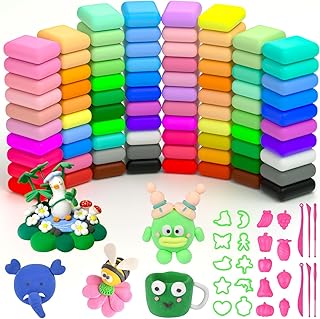
What makes this kit worth considering despite the review gap is the combination of elements that complement each other: 24 colours, included sculpting tools, and illustrated project manuals. Twenty-four colours is a meaningfully generous palette — broad enough to cover the full primary and secondary spectrum with additional tonal variation, so children rarely hit a point where they cannot find what they need. The colour count alone does not separate this from other kits at this level, but the tools and guides alongside it do.
Sculpting tools, even at the basic level typically included in kits like this, raise the quality ceiling of what children can make. A pointed stylus adds eye sockets and surface textures; a flat edge creates clean cuts; a simple roller produces consistent flat sheets for petal or leaf forms. Children quickly discover that tools expand what their hands alone can achieve, which sustains engagement and raises the ambition of finished pieces. Illustrated project guides complement this by providing structured starting points — a step-by-step miniature cake, a simple animal, a flat scene — that anchor sessions and reduce the paralysis that can stall even enthusiastic young crafters faced with a blank creative brief.
As an air-dry clay, the iFergoo kit hardens at room temperature without any oven step — finished pieces can be left to air-dry over several hours to a day depending on piece thickness, and can then be painted and kept. The non-sticky property stated in the product description matters particularly here: working with 24 colours only stays manageable if the clay does not cling to hands and transfer between colour portions. When air-dry clay handles cleanly, the full palette remains usable throughout a session; when it does not, the set muddies quickly and the colour range becomes academic.
The caveat remains firm: without buyer reviews, you are relying on stated specifications rather than verified performance. For a high-stakes occasion — a birthday party activity, a school project with a deadline, a gift with high expectations — pair this with a backup pack of reviewed modelling clay. For everyday home exploring and project-based craft sessions, the stated specifications put this among the more thoughtfully assembled starter kits in the category. If the quality matches its description, it is a strong choice for children aged roughly 5 to 12 who respond well to guided project structures.
Best for Young Children: Ultra Light Air Dry Clay
The Air Dry Clay, 24 Colors Ultra Light Modeling Clay for Kids puts its ultra-light formula at the centre of its offering, and for the right age group that emphasis makes complete practical sense. Disclosure as before: no verified buyer reviews are available for this product on Amazon UK at the time of writing, so what follows benchmarks the stated properties against what this material type typically delivers.
Ultra-light air-dry clay is a genuinely distinct subcategory from standard modelling clay or play dough. The material has a foam-like, almost cotton-soft consistency that requires very little hand pressure to knead, shape, and flatten — far less than either traditional play dough or standard air-dry clay. For children aged 3 to 6 in particular, this is a meaningful practical advantage. Lower resistance means less frustration and less need for adult assistance at the getting-started phase. Children can break off their own portions, begin kneading immediately, and produce a recognisable shape within a few minutes of sitting down. That speed-to-engagement matters when you are trying to maintain focus across a group of pre-schoolers or a sibling pair with mismatched attention spans.
Once dry, ultra-light clay produces pieces that are surprisingly resilient for their weight. The foam-like structure means finished pieces are less likely to shatter on impact than denser clay equivalents — they flex slightly rather than breaking cleanly, which suits the casual handling that children’s work inevitably receives. No oven is required (standard for air-dry clays), which means drying is entirely unsupervised and child-safe. Set the finished piece on a surface overnight, and it will be solid by morning without any adult involvement in the process.
The structural limitation of ultra-light clay is worth stating clearly because it shapes which projects work well with this material. The soft, porous formula does not support fine detail or thin structural elements. Very thin protrusions — the stick-like legs of a clay animal, narrow petal shapes, fine facial features — tend to collapse or break off after drying. The formula performs at its best for rounded, chunky, solid shapes: simple animals with solid bodies, bold flat decorations, fruit and food forms, basic character faces. For children under 6, those are precisely the shapes that match both their motor development and their creative ambitions.
For nursery groups, childminder activity boxes, or home sessions with multiple young children, the ultra-light formula’s accessibility and speed are real advantages. The key variable — once buyer feedback accumulates — will be how consistently this specific product executes on those well-established material properties. Keep the review gap in mind, but do not dismiss the format. For the youngest end of the audience, this material type is the most accessible clay option available.
Best Newcomer to Watch: CiaraQ
CiaraQ carries the joint-highest star rating in this round-up at 4.6 out of 5. The important qualification to state upfront: there are no verified buyer reviews behind that rating on Amazon UK at the time of writing. A high rating with no review count typically indicates a product new to the UK marketplace or one that has had very few initial purchases. Treat the score as a preliminary signal rather than confirmed buyer consensus.
CiaraQ positions itself within the children’s arts and crafts segment, targeting play-focused clay and dough rather than professional sculpting media. The audience is familiar from this guide: families with children looking for creative, tactile play; gift buyers wanting something between basic play dough and serious hobby supplies; group leaders building activity boxes for younger children. If you are in one of those scenarios and the other options in this guide are unavailable or do not quite fit, CiaraQ represents a reasonable alternative to investigate.
Why include a product without a verified review base? The 4.6-star rating, however unconfirmed by volume, is the highest in this guide and warrants an honest mention. Its inclusion is also a practical acknowledgement that some buyers want a broader shortlist rather than a single obvious choice. If you are building a mixed craft supplies collection and want to spread across brands, or if the AUAUY and Ainiv options are temporarily out of stock, CiaraQ is a logical next step to check. The practical caution applies clearly: for high-stakes situations — a party activity, a gift with high expectations, a school session with no backup plan — the AUAUY or Ainiv options carry less risk due to their verified review bases.
One piece of advice that applies across all clay purchases but particularly to products still building their review history: check the Amazon Q&A section and any buyer-submitted images before ordering. Early buyers sometimes provide useful texture and quality details in these channels that have not yet appeared in formal reviews. If you purchase CiaraQ and find the quality matches the early rating, leaving a review is a straightforward way to help future buyers make a better-informed decision.
What to Look For When Buying Clay and Dough
- Clay type and permanence. The single most important distinction before buying is whether you want reusable modelling dough (stays soft, can be reshaped repeatedly, produces no permanent creation) or air-dry clay (hardens on air exposure over hours, produces a piece you can paint and keep). Oven-bake polymer clay — a third category not covered in this guide — offers the most durable finish but requires adult oven supervision throughout. Match the material type to your intended outcome before comparing anything else.
- Age suitability and safety markings. For children under 10, verify that the product carries relevant safety markings. In the UK, look for CE or UKCA marking and stated compliance with EN71 toy safety standards on the packaging. Non-toxic labelling is standard for reputable children’s clay products. Lighter, softer formulas are generally better suited to children under 5; denser compounds better match older children with greater hand strength and fine motor control.
- Colour quality over colour count. More colours are not automatically better. Twenty-four well-saturated, genuinely distinct colours offers more creative range than 48 poorly separated variants. The practical test: when blue and yellow are mixed, do you get a clear green or a muddy grey-brown? Clays that maintain colour integrity when blending are far more satisfying to work with and keep their appeal across repeated sessions.
- Tool quality — function over quantity. A few functional tools add real value; a dozen decorative but flimsy ones add very little. Check whether included tools are sized for children’s hands and whether the materials (plastic, silicone, metal) match the expected level of use. Basic plastic tools are fine for children’s freeform work. Anything requiring precision detail benefits from dedicated sculpting tools bought separately as a deliberate upgrade.
- Storage and packaging design. For modelling doughs intended for repeated use, individually sealed colour portions are far more practical than a single shared container. Airtight individual packaging extends working life and prevents colours from bleeding into each other during storage. For air-dry clay, check how portions are packaged before first use — individually sealed portions prevent premature hardening from the moment the box is opened.
- Clay quantity versus price. Some kits present a large, impressive-looking box where the actual clay content is modest relative to the packaging and accessories. Check whether the listing states clay weight or quantity per colour, then calculate whether the price reflects usable clay or primarily box design. A smaller, well-packed set with more clay per colour will outlast a larger-seeming kit where each colour portion runs out after a single project.
Verdict
For most UK buyers choosing a clay or dough set on Amazon, the AUAUY modelling clay set is the clearest recommendation. More than 540 verified buyers have rated it, and the consistent feedback pattern — soft clay, good workability, satisfying colour range — gives you a level of confidence that no other pick in this guide can currently match. When you are spending money on something children will actually use, buyer-evidenced reliability is worth more than any specification list.
If you are specifically buying for a child aged 3 to 5, the ultra-light formulation of the Air Dry Clay 24 Colors Ultra Light set is worth serious consideration despite its limited review history. The material type is genuinely more accessible for pre-schoolers’ hand strength, and the no-oven requirement makes the drying phase entirely unsupervised and safe. Accept the caveat on reviews and it is a well-suited option for the youngest users in the house.
Budget-conscious buyers should look at Ainiv, where 152 verified ratings give enough buyer evidence to order with reasonable confidence at a lower price point. And for anyone wanting a more structured, tool-and-guide-included experience — particularly for older children who respond well to project-based making — the iFergoo 24-colour kit offers a thoughtfully assembled package, with the zero-review caveat clearly in mind.
When in doubt, start with the AUAUY. The evidence points there.
We were not paid to feature any specific product in this guide. All opinions are independent and based on publicly available specifications, verified buyer feedback patterns, and category research.
Quick Comparison Table




FAQ
What is the difference between air-dry clay and play dough?
Play dough and modelling dough are designed to stay soft and reusable when stored correctly — they suit open-ended play with no permanent outcome. Air-dry clay is formulated to harden when exposed to air over several hours, producing a finished piece that can be kept, painted, and displayed. Choose play dough for repeated tactile play sessions; choose air-dry clay when you want a lasting result from the creative work.
Is modelling clay safe for toddlers and young children?
Most modelling clay and play dough sold for children is non-toxic and designed for use from age 3 upwards. In the UK, look for CE or UKCA safety markings and stated compliance with EN71 toy safety standards on the packaging before buying. Ultra-light clay formulas tend to be softer and gentler on small hands. Always supervise young children during use and ensure clay is not being mouthed.
How do you stop clay from drying out between sessions?
Store unused clay in its original sealed packaging or an airtight container immediately after each session, keeping individual colours separate to prevent cross-contamination. If a surface crust develops, brief kneading before use can restore some softness. Once clay has dried significantly through, it is very difficult to revive — consistent airtight storage from the outset is far simpler than attempting rehydration later.
Can you paint air-dry clay once it has set?
Yes. Once fully dry, air-dry clay accepts acrylic paints well — acrylics adhere without specialist preparation and dry quickly. If the clay’s base colour is dark, a coat of white paint applied first allows lighter colours to show true. Finishing with a clear acrylic sealant or varnish protects the surface and gives the piece a more polished, lasting appearance.
How long does air-dry clay take to fully set?
Drying time varies with piece thickness, clay type, and room conditions. Small, thin pieces can firm up in 4 to 8 hours; thicker, solid pieces may need 24 to 48 hours to cure fully through to the core. A warm, well-ventilated room speeds the process. Avoid placing pieces near radiators or in direct sunlight, as rapid surface drying compared to the interior can cause cracking.
What age is modelling clay suitable for?
Most modelling clay and play dough sets are recommended from age 3, though very soft lightweight formulas can suit younger children with close supervision. Denser sculpting clays are better matched to children from around 6 or 7 who have the hand strength to work the material effectively. Oven-bake polymer clays typically carry an 8-plus recommendation due to the oven supervision required during the baking step — always check the specific manufacturer’s age guidance before buying.