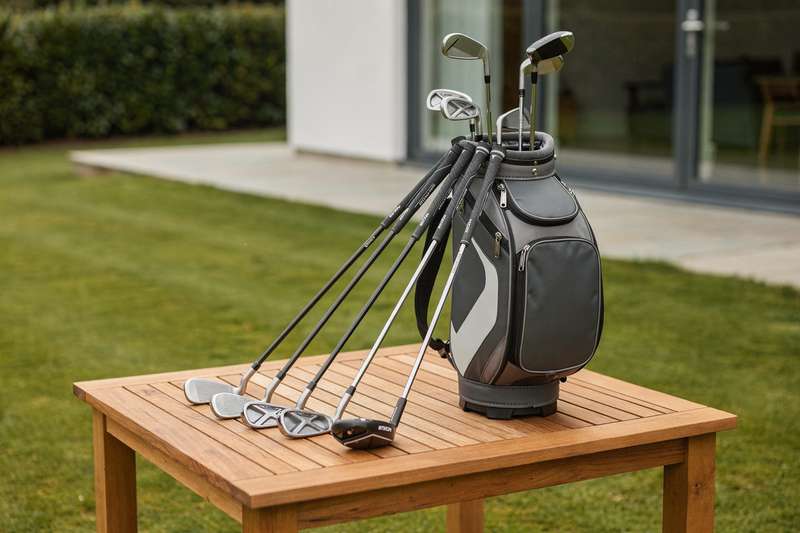
Picture the scenario: you’ve agreed to a round of golf with colleagues or friends, you arrive having borrowed a set of clubs from someone with a completely different physique and swing, and within three holes the equipment is clearly making every bad shot worse. The driver feels unwieldy, the irons are either too stiff or too whippy for your tempo, and the putter seems specifically designed to turn straightforward two-putts into interesting three-putts. Sound familiar? The frustrating truth is that golf is harder when your clubs do not match your swing speed, your build, or your current level of experience.
This is not abstract equipment theory — it has direct, measurable consequences on your score. A shaft that is too stiff for your swing tempo reduces distance and causes pushes right of target; one that is too flexible causes the face to snap closed through impact, producing hooks. Mismatched loft on your driver produces either ballooning shots that sacrifice carry or flat trajectories that rob you of distance. And yet the golf club market is vast and genuinely bewildering: complete sets for absolute beginners, specialist individual clubs for specific gaps in your bag, adjustable travel clubs, casual garden sets, and everything in between. This guide cuts through the noise and gives you five clear, honest picks — each matched to a distinct buyer situation, each backed by verified buyer feedback.
How We Chose These Picks
Every product in this guide went through a consistent evaluation process before making the shortlist. The starting filter was topic fit: only genuine golf clubs and golf club sets qualify — a cleaning accessory, however well rated, is not a golf club and has no place in a buying guide about them. From there, any product without meaningful buyer feedback was set aside when reviewed alternatives were available, because an unreviewed rating tells you very little about real-world performance when better-evidenced options exist.
Beyond those filters, evaluation focused on five criteria: club composition and whether a set is genuinely complete for its stated audience, shaft construction and flex options, verified buyer feedback patterns (not just headline ratings, but what buyers consistently praised and what repeatedly frustrated them), build quality appropriate to the product’s positioning, and practical usability for the stated purpose. The five picks that follow are organised by use case rather than ranked by quality, because the right club for a first-time buyer is a completely different conversation from what a travelling golfer needs.
Best for Beginners
The Wilson Beginner Complete Set is the most comprehensively reviewed golf club set in this guide, with 370 Amazon UK buyers sharing their experience — and the 4.4-star average reflects consistent satisfaction across a wide range of players rather than a cluster of early enthusiasm.
For someone picking up golf for the first time, a matched complete set solves a problem most beginners do not even realise they have: consistency across the bag. When all your clubs come from the same manufacturer as a designed set, the shaft flex, swing weight, and overall feel are calibrated to work together. The moment you start mixing a borrowed driver with a second-hand iron set and a putter salvaged from a car boot sale, you’re fighting inconsistency that has nothing to do with your technique. The Wilson set removes that variable from day one.
The 10-club composition covers everything a beginner needs on a real golf course: a driver to get off the tee, fairway options for longer approach shots, a selection of irons covering the mid-to-short range, and a putter. The stand bag that accompanies the set is a practical addition — it protects your clubs, organises your equipment, and makes walking the course comfortable. Buyers consistently describe the bag as lightweight without feeling flimsy, which is exactly the right balance for someone who will be using it regularly in various conditions.
The “Stretch XL” designation refers to extended-length shafts, which suit taller adult male golfers who find standard-length clubs force them into a cramped address position. If you are above average height, this is a meaningful benefit. If you are of average or shorter stature, the extended length could work against you — club length directly affects your posture and setup, and fighting a club that is even slightly too long adds unnecessary complexity to your swing development. It is worth checking the shaft length against your own measurements before buying.
The irons use steel shafts, which provide clearer feedback on mishits than graphite would. You can feel where impact occurred, which is useful information when you are still learning to control your swing. Some instruction resources recommend graphite for absolute beginners because it is lighter and easier to generate speed with, and that is a fair argument — neither approach is wrong. The Wilson set’s steel option simply asks a touch more physical commitment through the swing in exchange for better learning feedback.
You will likely outgrow this set as your game develops. Once you are consistently breaking 90 and starting to think about shot precision rather than just getting the ball airborne, you will want clubs with more workability and feel nuance. Treat the Wilson set as the foundation it is — designed to take you from your first round to a confident, regular golfer — and you will find it a sound investment at this stage of your development.
Best Step-Up Set for Developing Golfers
The 2024 Callaway Edge Men’s Golf Club Set occupies the next tier: a complete 10-piece package backed by one of the most respected names in golf equipment, aimed at golfers who have moved past the absolute beginner stage and want clubs that reward developing consistency rather than simply compensating for its absence.
Callaway’s position in the golf market carries real weight here. The Edge line is part of a broader portfolio that includes seriously premium equipment, and the brand’s engineering filters down to this level in measurable ways — in club head construction quality, manufacturing tolerances, and the feel through impact on solid strikes. The 18 buyers who have reviewed this set on Amazon UK give it 4.5 stars, which is a positive indicator even if the sample size means you are partly relying on the Callaway name alongside the crowd feedback.
The 10-piece composition in regular flex steel is directed at right-handed male golfers with a moderate swing speed — the kind of player who has been playing for a year or two, taken some lessons, and developed something resembling a repeatable swing. Regular flex steel is a well-established specification for this profile: enough tactile information to reveal what is happening at impact, and a consistent weight profile that suits a swing that is starting to become reliable. Club heads are described by buyers as having a clean, purposeful look at address, without the heavy offset of some entry-level sets that can make the club feel like it is apologising for your technique.
Where the Callaway Edge distinguishes itself from the Wilson beginner set in practical terms is in the quality of the ball-striking experience on solid contact. Once your swing begins to produce repeatable results, clubs that offer some precision alongside forgiveness become more useful than maximum forgiveness alone. The driver and fairway wood feel substantial at address, and the iron construction is the kind that responds positively to an improving swing rather than just catching mishits and sending them somewhere vaguely playable.
The caveats are worth naming. Regular flex covers a fairly standard swing speed range — if your swing speed is particularly fast or slow, a shaft fitting from a PGA professional is worth pursuing before committing to any complete set. The right-handed-only specification means left-handers need to look elsewhere. The bag included is functional rather than impressive, and golfers who walk courses frequently may eventually want a more supportive carry option. But on the clubs themselves, the Callaway Edge reflects the brand’s genuine commitment to quality at every tier of the market.
Best Fairway Hybrid
The Performance Golf 357 Fairway Hybrid addresses a specific and very common problem: the distance gap in many golfers’ bags between their fairway woods and mid-irons, which tends to show up most painfully on long par-3s and demanding approach shots where a long iron is not a reliable option for most club golfers.
With 70 reviews contributing to a 4.0-star rating, this is the second most substantively reviewed product in this guide, and the feedback gives a detailed enough picture to make a fair assessment. The club’s design premise — a 21-degree hybrid that offers the carry distance of a 3-wood with the accessibility of a 7-wood — sounds like bold marketing, but the buyer feedback broadly supports this claim for the right audience. That audience is golfers with moderate swing speeds who struggle to launch traditional long irons consistently.
Long irons are notoriously difficult to hit: a small sweet spot, tight loft, and the requirement for precise ball-first contact mean that a 3 or 4 iron rewards golfers who have already developed a high-quality, repeatable strike. For most recreational club golfers, that level of ball-striking precision is not yet there — and that is not a failing, it is simply where most players sit. A hybrid at 21 degrees addresses this by combining a lower centre of gravity with a wider sole, making clean contact from both tight fairway lies and light rough far more achievable.
Buyers specifically highlight the club’s performance from rough, which is where hybrids justify their practical reputation. Getting a long iron clean from even moderate rough requires very precise, aggressive contact — most recreational golfers will either chunk it or blade it. The wider sole of the hybrid design is far more tolerant, and reviewers describe consistent results from lies that would cost them a recovery shot with a traditional iron.
The caveats are real. Some reviewers note that shaft flex options are limited, and if your swing speed sits well outside the standard range in either direction, the stock shaft may not serve you optimally. The feel through impact is described as competent rather than exceptional — this is not a tour-quality club, and better players accustomed to premium iron feedback may find it a touch muted. Higher-handicap players, though, care far more about reliable launch than nuanced feel, and on that measure the Performance Golf 357 is a credible, well-evidenced choice for filling a gap that costs a lot of recreational golfers shots every round.
Best for Travelling Golfers
The Q Gen 2 Adjustable Golf Club (Steel Shaft) occupies its own distinctive category: a single adjustable club covering the full loft spectrum from putter to lob wedge, designed to break apart for transport without the weight, size, or airline baggage fees associated with a full set of clubs.
The concept is practical for a specific audience. Eight configurable loft settings let you dial in the club for almost any shot type, at least in principle. The two-part steel shaft breaks into a compact form that fits in a suitcase or large holdall, and the design is accessible to both men and women. For golfers who want to play a casual round on holiday without the logistics and cost of travelling with a full bag, the appeal is straightforward.
With 34 reviews and a 3.7-star average, it is worth being direct about what the feedback pattern shows. The lower rating relative to the other picks in this guide reflects divided expectations more than a uniformly poor product. Buyers who purchased the Q Gen 2 as a holiday companion — something for an occasional round abroad or a casual range session — tend to be satisfied. Those who expected it to replicate the feel and precision of a properly matched set tend to come away underwhelmed. Buy it knowing which category you are in and your expectations will align with reality.
The steel shaft provides reasonable feedback, and the loft adjustment mechanism is described by most buyers as straightforward once you have practised with it a couple of times. Changing between settings takes a minute rather than seconds, so this is something you dial in before a particular type of shot rather than a rapid mid-round adjustment system. The two-part shaft join is both the product’s main feature and its main vulnerability: a small but notable proportion of reviewers flag that the connection between shaft sections can loosen over extended use, introducing unreliability you would not accept in a conventional club. Checking the joint before each session is a sensible precaution if you use it regularly.
Beyond holiday golf, the Q Gen 2 also suits anyone who wants to practise swing mechanics in a limited space — a hotel room, a flat with a garden, or a work trip away — without committing space to a full set. For someone who travels for work the majority of the month and only reaches a course occasionally, having a single compact club in a carry-on bag represents a different kind of value that no conventional set can provide. Approach the Q Gen 2 as a creative travel solution rather than a performance upgrade, and it does exactly what it sets out to do within that specific context.
Best for Garden and Casual Play
The KOFULL Bucket Golf Clubs Set with Oversize Head is the most openly niche product in this guide, and it is worth being direct about what it is: this is not a set for course play, and it is not competing with the other four picks in terms of performance or seriousness. What it is, however, is a thoughtfully designed product for its specific context — garden and casual chipping play for adults and families.
The adjustable shaft length, spanning from 21 to 36 inches, makes this a practical multi-user option. Adults and children can use the same set without awkward compromise, removing the need for separate junior equipment in a garden setting. The oversize club heads are calibrated for forgiveness rather than precision, which makes complete sense when the goal is a satisfying garden hit rather than threading approach shots to a tight flag position.
The 4.9-star rating across 8 reviews is striking but statistically thin. Eight reviews is a small enough sample that it plausibly reflects the enthusiasm of early buyers rather than a representative cross-section of long-term users — and this is not a reason to dismiss the product, but it is a reason not to weight the rating as heavily as you would a 370-review dataset. The nature of garden play also means the performance bar is naturally lower, which can inflate satisfaction scores in a category where expectations are modest by definition.
What those 8 reviewers do consistently note is build durability. The heads feel solid rather than toy-like, the adjustable shaft mechanism holds up to repeated extension and retraction, and the overall construction does not feel disposable. For a garden set that will spend much of its life in a shed between uses, that kind of build quality matters more than headline specifications.
For elderly relatives or those with limited mobility who want to engage with golf in a low-pressure, accessible context, the adjustable length and lightweight design of the KOFULL set carry practical advantages worth mentioning. Being able to shorten the club significantly means even very young children or a seated player can get a meaningful swing in. The shorter maximum length also reduces how far a wayward shot travels — a useful consideration when the garden is shared with flower beds, fences, or a neighbour’s greenhouse.
The fundamental limitation is proportional: at a maximum of 36 inches, these clubs are shorter than a standard 9-iron. Swing mechanics developed with this set will not transfer meaningfully to standard course-length clubs. If the goal is genuine golf development, the Wilson or Callaway sets above are the right choice. If the goal is an accessible, low-cost way to introduce a household to ball-striking in the garden — as an introduction to the sport rather than a training method — the KOFULL set is well-suited to exactly that purpose.
What to Look For When Buying Golf Clubs
Whether you are buying a complete set or a single specialist club, several factors should shape your decision. Here are the criteria that matter most:
- Club set composition: A properly complete set includes a driver, at least one fairway wood or hybrid, a range of irons (typically 5 through 9), a pitching wedge, and a putter. Some beginner sets substitute hybrids for hard-to-hit long irons, which is a sensible trade-off. Check exactly what is included before assuming you are fully equipped for a round.
- Shaft flex: This is the most commonly overlooked variable by new buyers. Slower swing speeds benefit from more flexible shafts (Regular or Senior flex) that help generate launch; faster swing speeds need stiffer profiles to maintain directional control. A short fitting session with a PGA professional will give you a clear, specific answer for your swing speed and tempo — and it takes less than 20 minutes.
- Steel vs graphite shafts: Steel shafts are heavier and provide more impact feedback, suiting consistent swingers who want to learn from each strike. Graphite shafts are lighter and help generate more clubhead speed with less physical effort, making them a practical choice for seniors, women, and many beginners. Many complete sets use steel in the irons and graphite in the woods, which is a sensible compromise.
- Forgiveness vs workability: Cavity-back irons with perimeter weighting are far more forgiving on off-centre strikes — the ball still travels somewhere respectable even when you miss the sweet spot. Blade-style irons offer more shot-shaping control but punish mishits severely. If your handicap is above 15, prioritise forgiveness; as it drops below 10, workability becomes increasingly relevant alongside it.
- Grip size: Standard grips suit most adult hands. Grips that are too thick or too thin for your hand size can exaggerate wrist rotation through impact and contribute to directional error. Re-gripping to a more appropriate size is inexpensive and worth doing once you have identified your preferences through experience.
- Left-handed availability: Check this before investing time comparing a set in detail. Many complete sets and specialist clubs are produced in right-handed versions only, with left-handed variants as separate SKUs or absent entirely. Do not assume availability without checking the listing.
- Bag inclusion and quality: For beginners especially, a stand bag is a practical necessity for comfortable course play. If a set includes one, check what buyers say about its durability and comfort — a bag that deteriorates inside a year reduces the overall value of the set substantially, and a poor strap can make a four-hour round feel considerably longer than it should.
Verdict
For the vast majority of UK golfers searching for their first proper set — whether picking up the game for the first time, returning after years away, or buying for a family member who has caught the golf bug — the Wilson Beginner Complete Set is the clearest recommendation in this guide. It has by far the most substantial review base of any product here, with 370 buyers contributing to a 4.4-star average that reflects widespread satisfaction across a diverse range of players. The 10-club composition plus stand bag means you arrive at the course properly equipped rather than piecing things together.
If you already have some regular playing experience and want to invest in a name-brand set that reflects developing skill, the 2024 Callaway Edge Men’s Golf Club Set is the logical step up — quality construction from a brand with genuine pedigree in the sport. For golfers who already own a bag and need to fill a specific distance gap between their fairway woods and mid-irons, the Performance Golf 357 Fairway Hybrid has earned its place as a sensible single addition for the right player type. Travelling golfers and casual players are well served by the Q Gen 2 and KOFULL sets respectively, each addressing a situation that conventional club sets simply cannot.
The common thread across all five picks is this: buy for where your game is now, not where you hope to be in three years. Clubs that match your current swing speed and skill level will improve your enjoyment of the sport far more quickly than aspirational equipment that demands a better swing than you currently have.
We were not paid to feature any specific product in this guide. All opinions are independent and based on publicly available specifications, verified buyer feedback patterns, and category research.
Quick Comparison Table


FAQ
What golf clubs should a beginner buy?
A complete matched set is the best starting point. Look for one that includes a driver, at least one fairway wood or hybrid, a range of irons, a pitching wedge, and a putter — ideally with a stand bag included. Matched sets ensure consistent shaft flex and swing weight across all clubs, which helps you build a repeatable swing far more quickly than mixing individual clubs from different brands and specifications would.
How many clubs can I carry during a round of golf?
The rules of golf permit a maximum of 14 clubs in your bag during a round. Most beginner sets include between 8 and 12 clubs, which is sufficient for the vast majority of recreational players. As your game develops, you can add specialist wedges or replace individual clubs without needing to invest in an entirely new set.
What is the difference between steel and graphite golf shafts?
Steel shafts are heavier, provide clearer feedback through impact, and tend to suit golfers with consistent, moderate-to-higher swing speeds. Graphite shafts are lighter, easier to swing at speed, and are commonly recommended for beginners, seniors, and women. Many complete beginner sets use steel in the irons and graphite in the woods, combining the feedback benefits of steel where it matters most with the speed benefits of graphite in the longer clubs.
What is a hybrid golf club and should I have one in my bag?
A hybrid combines the wider sole and lower centre of gravity of a fairway wood with the shorter, more manageable shaft of a long iron, making it far easier to launch the ball from a variety of lies — including rough and tight fairway lies where a long iron would require very precise contact. If your 3 or 4 iron is difficult to hit consistently, replacing it with a hybrid at a similar loft is one of the most practical improvements most club golfers can make to their bag setup.
Are complete golf sets worth buying compared to building a bag club by club?
For beginners and developing golfers, complete sets almost always offer better value. The clubs are designed to work together in terms of shaft flex and swing weight, and the cost per club in a set is consistently lower than buying equivalent individual clubs separately. Building your bag club by club only becomes worthwhile once you have clear, experience-based preferences and specific identified gaps in your current set-up.
What shaft flex should a beginner use?
Most beginners are best served by a Regular flex shaft. Senior flex is appropriate if your swing speed is particularly low — roughly speaking, if you struggle to carry a driver consistently beyond 150 yards. Stiff flex suits golfers generating faster swing speeds who have progressed beyond the beginner stage. If in doubt, a short fitting session with a PGA professional is the most efficient way to get a clear, specific answer for your individual swing.