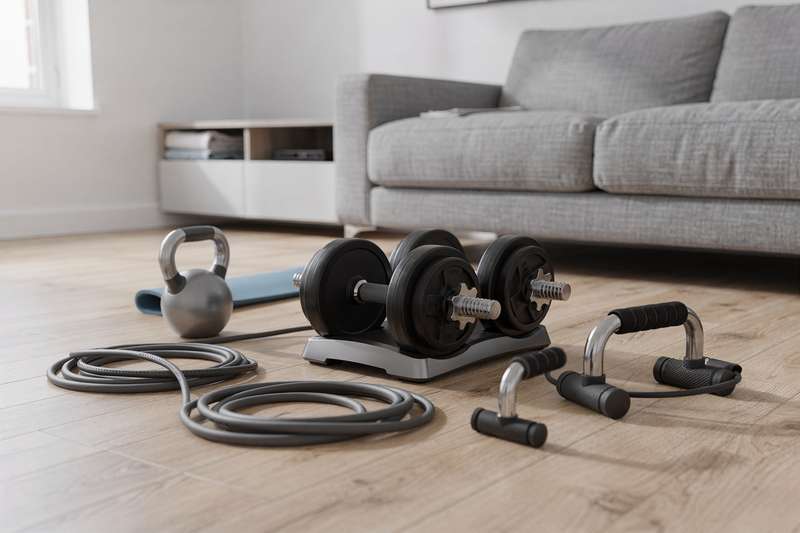
Picture this: you’ve cancelled your gym membership, shifted the coffee table against the wall, and rolled out a mat in your living room. The plan was solid — bodyweight sessions in the morning, maybe some stretching in the evening. Three weeks in, press-ups feel too easy, planks are boring, and you’re not entirely sure your fitness is actually progressing. You need resistance. Something that travels flat in a bag, doesn’t require bolting into the ceiling, and won’t make the neighbours below you question their life choices. You’ve looked at dumbbells — too expensive and heavy for a rental flat — and kettlebells — great, but one slip and there goes the skirting board. What you actually need is a focused set of resistance tools that bridge the gap between pure bodyweight and full barbell training.
That’s exactly the space this guide covers. Whether you’re a complete beginner trying to build your first pull-up, a regular gym-goer who wants something for travel, or someone recovering from an injury and easing back into load-bearing movement, there’s a resistance training option here for you. The products below span loop bands, stackable tube bands with handles, pull-up assist bands, push-up boards, arm exercisers, and grip strengtheners — all available on amazon.co.uk, all assessed against real-world usability.
How We Chose These Picks
Every product featured in this guide was drawn from a live pool of Amazon UK listings filtered by verified buyer rating and review volume. We prioritised items with a rating of 4.4 stars or above, then looked at what the review patterns actually told us: were buyers using these for the same goals you probably have? Did complaints cluster around a single fixable issue (a missing accessory) or a fundamental flaw (bands snapping after two uses)?
Beyond ratings, we assessed six practical criteria: resistance range (does it cover beginner through to intermediate or advanced?), build quality signals (stitching, material, clasp hardware), included accessories (door anchors, handles, straps — things that determine whether you can actually use the product on day one), portability (carry bag, folded footprint), versatility (number of exercise types possible), and value for the tier (budget vs mid-range vs premium). Six products in the final group had meaningful verified review counts; two had zero reviews in the live data at time of assessment — those are flagged clearly in their respective sections so you can weigh that accordingly.
Best All-Round Resistance Band Set: Fokky Resistance Bands
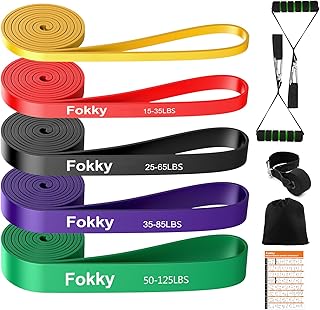
The Fokky Resistance Bands Set is the pick that covers the most ground for the widest range of people, and its 4.6-star rating from 866 verified buyers backs that up with real confidence. This is a five-level set, meaning you get a progression ladder from very light to quite challenging — useful both for beginners who need to start low and for more experienced users who want to layer bands for heavier pulls. The set ships with door anchor, handles, ankle straps, and a carry bag, so you’re not ordering extras before you can actually train.
What makes this stand out from the crowd of similar-looking tube band sets is the consistency of the hardware. Buyers repeatedly note that the metal clips and carabiner-style connectors feel secure rather than plasticky — a detail that matters enormously when you’re under tension in a deadlift pull or a face pull movement. The door anchor is broad enough to seat properly in standard UK door frames without sliding, which is a surprisingly common failure point on cheaper sets.
The training instruction card included is genuinely useful for beginners — it covers the essential compound movements rather than just the obvious bicep curl. If you’re brand new to resistance bands, that visual reference means you’re actually up and running within ten minutes of opening the box, not watching YouTube videos trying to figure out how to rig the anchor.
Where it falls short: the handles are solid but not ergonomically shaped, so if you have larger hands or wrist issues, extended sets can become uncomfortable. The highest-resistance band in the set is appropriate for intermediate users but won’t challenge advanced lifters who are accustomed to heavy barbell work — at that point you’d be stacking multiple bands, which the carabiner system does support, but it becomes fiddlier. For anyone building a first home training kit, though, this is the logical starting point.
Best Budget Pick: Resistance Bands Set for Men & Women — 4-Level Set
If you want a compact, no-frills entry point that still delivers real training value, the Resistance Bands Set for Men & Women — 4 Levels Exercise Band with Door Anchor is the budget pick worth your attention. It carries a 4.6-star rating from 712 verified buyers — a strong signal for a product at this price tier — and it focuses on doing fewer things right rather than overwhelming you with accessories you’ll never use.
The four-level progression is well-spaced for beginners and lighter intermediate users. The included door anchor is straightforward, and the bands themselves are latex-based with a reasonable snap-back response. Buyers using these for pull-up assistance, stretching, and physio-style rehab movements tend to rate them highly; buyers trying to push into heavy compound strength work find the upper resistance limit comes quickly.
This set makes particular sense as a secondary kit — something you keep in a travel bag or at an office for lunchtime sessions — while a heavier set lives at home. It’s light enough to stuff into a backpack without noticing it. The carry bag is basic but functional.
The honest caveat: with four bands rather than five, there’s a slightly larger jump between resistance levels, which can make it harder to progress gradually. If your goal is systematic strength building with a clear incremental ladder, the Fokky five-level set offers a smoother curve. But for stretching, mobility work, lighter pull-up assistance, and general conditioning, this set punches well above its price point and the review volume gives you real buyer confidence to lean on.
Best for Progressive Pull-Up Training: Ayombo Pull Up Assistance Bands
Pull-up training is one of the most common goals in home fitness, and it’s also one of the most commonly abandoned — because the jump from zero pull-ups to your first clean rep feels impossibly steep without the right support. The Ayombo Pull Up Assistance Bands are designed specifically to solve that problem, and they do it well enough to earn a 4.4-star rating from 609 verified buyers.
These are heavy-duty loop bands with a flat, wide profile — the kind built for hanging from a pull-up bar rather than attaching to a door anchor. The wider surface area distributes the assist load across your foot or knee more comfortably than thin tube bands, which can dig in and become the thing you’re thinking about rather than your lat activation. The set ships with four resistance levels, which gives you a sensible deload pathway: start with more assistance, progressively move to lighter bands as your unassisted strength builds.
The practical setup is simple. Loop the band over your pull-up bar, place one or both feet (or a knee) in the bottom loop, and the band takes a portion of your bodyweight on the way up. This is as close to a progressive overload tool as you’ll find for pull-up development without investing in a full assisted pull-up machine. The bands are also versatile enough for banded push-ups, face pulls with a door anchor, and resistance walks for lower-body conditioning.
One honest limitation: these bands require an actual pull-up bar to hang from. If you don’t already have one mounted in a doorframe or as a freestanding rig, this product alone won’t get you training. The material is durable natural rubber, and buyers generally report good longevity, but as with any looped latex band, avoid contact with sharp edges and store away from direct sunlight to extend the lifespan. If progressive pull-up work is your primary goal, this is the most targeted tool in this guide for that specific purpose.
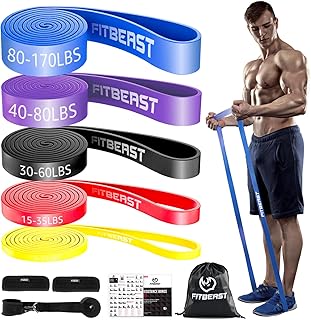
Best Mid-Range Full-Body Set: FitBeast Resistance Bands Set
The FitBeast Resistance Bands Set sits in the mid-range tier and brings a five-level tube band system aimed squarely at people who want to run a structured full-body programme from home. Its 4.4-star rating from 755 verified buyers suggests a product that delivers on its broader promises, even if individual reviewers occasionally flag minor accessory quality quibbles.
The core differentiator for FitBeast relative to the budget options is build consistency. The bands themselves have a reinforced latex core, and the nylon mesh outer sleeve on some levels provides an additional layer of protection against snap-back — useful if you’re doing dynamic movements like banded rows or chest presses where the band is under rapid tension and release cycles. The foam-padded handles are more comfortable for extended sets than the harder handles you get on entry-level kits.
This set is particularly well-suited to people following an existing structured programme — something like a PPL (push/pull/legs) split adapted for resistance bands. The five levels give you enough variety to target different muscle groups with appropriate resistance: lighter bands for isolation work like lateral raises or face pulls, heavier bands for hip hinges and rows. The included workout guide focuses on these multi-movement approaches rather than just the basics.
The ankle straps that come with the set open up lower-body work — clamshells, kick-backs, lateral walks — which is genuinely valuable for anyone adding glute and hip stability work to their routine. This is something the purely upper-body-focused sets in this guide don’t address. If lower-body band work is part of your plan, FitBeast’s full accessory suite makes it the more complete choice at the mid-range tier.
Best for Upper Body Strength & Rehab: Twister Arm Exerciser
The Twister Arm Exerciser, Adjustable 22-440lbs Hydraulic Power Exerciser is a fundamentally different type of product from everything else in this guide — and that difference is exactly why it earns its own category. Rather than bands that attach to anchors or bars, this is a spring-loaded or hydraulic resistance device you grip with both hands and compress or pull apart to work the chest, shoulders, and arms through a short arc of motion.
With a 4.4-star rating from 408 verified buyers, it’s a well-received product for what it does, which is targeted upper body work that’s genuinely hard to replicate with bands alone. The adjustable resistance range is broad — you can dial it down for light rehabilitation work on a shoulder recovering from injury, or crank it up for a serious chest squeeze workout. That adjustability makes it a legitimate rehab tool as well as a conditioning one.
The hydraulic mechanism means the resistance is consistent through the movement arc rather than increasing sharply at the end of range like a spring-based device would. That consistency is important for rehab contexts where you want predictable load — erratic resistance patterns are problematic when you’re working around an irritated joint. It’s also simply more comfortable to use for higher rep sets.
This product works best as a complement to a band set rather than a standalone kit. The movement patterns it trains — chest press, shoulder adduction, arm circles — are different from what resistance bands target efficiently, so pairing the two gives you broader upper body coverage. The main drawback is that it’s a single-use device: unlike bands, you can’t adapt it for lower body work, pulling movements, or anything requiring a door anchor setup. If you travel frequently, bands travel better. But for a home setup where you want something that specifically targets chest and shoulder compression movements without any rigging, this is a smart addition.
Best for Structured Bodyweight Training: Foldable Push Up Board
The Foldable Push Up Board, 24-In-1 Multi-function Home Workout Equipment earns a 4.4-star rating from 612 verified buyers and solves a very specific, very common problem: press-ups on a flat floor are inefficient for muscle targeting and hard on the wrists. This colour-coded push-up board gives you multiple hand position options that shift emphasis between chest, triceps, shoulders, and back — and the handles raise your hands off the floor, improving range of motion and reducing wrist strain.
The colour-coded system is genuinely intuitive rather than gimmicky. Each colour corresponds to a different target muscle group, and the board snaps together (and apart for storage) reliably without the pieces feeling fragile. Folded down, it fits under a bed or in a wardrobe without taking up meaningful space — a real advantage in smaller UK flats.
The 24-in-1 label refers to the combination of handle positions and angles the board enables. In practice, you’ll regularly use five or six configurations, but even that subset represents a meaningful upgrade over floor press-ups alone. The ability to switch between wide-grip chest focus, close-grip tricep focus, and neutral-grip shoulder positions within a single session lets you run a proper push-dominant upper body workout without a single piece of weighted equipment.
Where this board is limited: it’s a push-only tool. It does nothing for pulling movements, lower body, or core — so it needs to sit alongside bands or a pull-up bar in your wider setup, not replace them. It also sits flat on hard floors without any non-slip surface treatment, so on polished wood or tile you’ll want to place it on a mat. For anyone whose goal is building a solid pressing foundation at home — particularly if wrist discomfort has been holding them back — this is the most targeted solution in the guide.
Best Stackable System: COFOF Resistance Bands Set with Handles
The COFOF Resistance Bands Set with Handles takes a different approach to resistance progression: instead of selecting a single band from a set, you stack multiple bands onto the same handle to accumulate resistance up to a claimed maximum of 150lbs. That stackable architecture is the defining feature, and for users who want to keep adding load as they get stronger without buying an entirely new kit, it’s a compelling design.
The set ships with a workout poster, door anchor, and ankle straps, so the full accessory ecosystem is there from the start. The handles are designed to accept multiple band attachments simultaneously — a detail that’s more important than it sounds, because not all handle hardware is built to handle the lateral stress of stacked loads. The COFOF handles appear to address this with a dual-clip connection point.
It’s worth noting that this product had no verified buyer reviews in our live data at the time of assessment. That doesn’t mean it’s a poor product — new listings often take time to accumulate reviews, and the specifications are comparable to well-reviewed competitors — but it does mean you’re working with less buyer-validated evidence than with the Fokky or FitBeast sets. If you value the reassurance of a large review pool, the other tube band options in this guide offer that more clearly. If the stackable-up-to-150lbs system aligns with your specific training goals and you’re comfortable being an early adopter, the COFOF set warrants consideration — just go in with that context in mind.
Best for Grip Strength & Forearm Development: KDG Hand Grip Strengthener 2 Pack
The KDG Hand Grip Strengthener 2 Pack Adjustable Resistance (5-60KG) addresses a training dimension that most band sets simply don’t touch: grip strength. If you’re serious about pulling movements — whether that’s deadlifts, rows, or working towards your first pull-up — grip is a genuine limiting factor that developing forearm and hand strength directly addresses. Training both hands simultaneously with a matched pair also helps identify and correct left-right asymmetries that you might not notice otherwise.
The adjustable resistance range here is broad: spanning from very light to quite demanding, it covers complete beginners working on hand rehabilitation through to athletes specifically targeting crushing grip for sport. The adjustment mechanism is a simple dial on each unit — functional, if not particularly elegant. The ergonomic handle shape accommodates different hand sizes better than a simple oval grip would.
It should be noted clearly: this product had zero verified buyer reviews in our live data at the time of assessment. Unlike the COFOF situation where the product is listed without reviews, this ASIN has been available for longer — which makes the absence of review data more ambiguous. It may reflect review data not captured in our live scrape, or it may indicate a product that hasn’t built meaningful buyer traction. Either way, you should treat it with appropriate caution and check the current Amazon listing for up-to-date buyer feedback before purchasing.
If grip training is genuinely part of your programme — for climbing, martial arts, racket sports, or general strength work — a dedicated gripper adds real value that no band set replicates. The KDG pack is listed here because grip training deserves a place in any serious home workout kit discussion, and this was the only dedicated grip tool in our live product pool. Just do your own review due diligence before committing.
What to Look For When Buying Resistance Training Equipment
- Resistance range and progression architecture: The best sets give you a clear ladder from beginner to intermediate, with enough levels (ideally five) that the jumps between them feel manageable. A set where the lightest band is too hard for a true beginner, or the heaviest too easy for anyone with six months of training, will frustrate you within weeks. Look at the individual band ratings, not just the claimed maximum stacked resistance.
- Accessory completeness: A tube band set without a door anchor is half a kit. Check that the listing includes a door anchor, a pair of handles, and ideally ankle straps before you buy. Sets that bundle all three save you the friction of ordering separately — and the quality of those accessories matters as much as the bands themselves. Cheap metal clips that open under tension are a safety issue, not just an inconvenience.
- Material and construction: Natural latex bands generally offer better snap-back and durability than synthetic alternatives. Flat loop bands (like pull-up assist bands) benefit from being wide and thick rather than narrow and thin — wider bands spread load and last longer. For tube bands, look for a reinforced internal latex core rather than a hollow tube, and check whether the connection points between band and clip are sewn or crimped rather than glued.
- Portability and storage: If you travel or have limited space, the entire kit — bands, handles, anchors, straps — should fit into a carry bag you’d actually bring with you. Most decent sets include one. Check the dimensions of the folded board or stored band coils against your bag or drawer before assuming they’ll fit.
- Exercise versatility: A set that only works for upper body pulling is a half-kit. Look for products where the accessory set (ankle straps, door anchor at multiple heights) enables upper body push, upper body pull, and lower body work. That versatility is what makes resistance bands a genuinely capable training tool rather than a stretching accessory.
- Review volume and rating pattern: A 4.5-star rating from 50 reviews is far less reliable than a 4.4-star rating from 700 reviews. Prioritise products with meaningful review volumes, and read the one- and two-star reviews specifically — they tell you where the actual weak points are in ways that aggregate scores don’t.
- Intended use match: A pull-up assist band won’t help you with forearm training. A grip strengthener won’t help you build your first pull-up. Match the tool to your specific goal rather than buying the highest-rated item in a general category. The best product in this guide for you depends entirely on what you’re actually trying to train.
Verdict
For the modal reader of this guide — someone building or expanding a home training setup, working in a flat or small house, without a huge equipment budget, and wanting genuine progressive resistance work — the Fokky Resistance Bands Set is the pick we’d suggest starting with. Its five-level progression, complete accessory set, solid hardware quality, and 4.6-star rating from 866 buyers give you the highest combination of training versatility and purchase confidence in this group.
If your primary goal is specifically developing pull-ups, pair it with the Ayombo Pull Up Assistance Bands — the two products complement each other without overlapping. If you want a more structured push training tool to sit alongside your band work, the Foldable Push Up Board adds real value at a modest additional outlay. Together, those three items cover pushing, pulling, and full-body resistance work comprehensively — and all fit in a single drawer or sports bag.
We were not paid to feature any specific product in this guide. All opinions are independent and based on publicly available specifications, verified buyer feedback patterns, and category research.
Quick Comparison Table




FAQ
Are resistance bands effective for building muscle, or are they just for stretching?
Resistance bands can absolutely build muscle, provided you’re applying progressive overload — which means gradually increasing resistance over time, just as you would with weights. Studies comparing band and free-weight training for muscle hypertrophy show comparable results when the load is matched. The key is using bands heavy enough to reach muscular fatigue within a reasonable rep range, and progressing to heavier bands or stacked combinations as you adapt.
What’s the difference between loop bands and tube bands with handles?
Loop bands are flat, continuous circles of rubber used mainly for pull-up assistance, lower body work (clamshells, lateral walks), and banded barbell exercises. Tube bands with handles attach to door anchors and mimic cable machine movements like rows, chest presses, and tricep pulldowns. Most serious home setups benefit from having both types, as they target different movement patterns and attach to different anchor points.
Can resistance bands replace dumbbells and barbells for strength training?
For beginners and early intermediates, yes — bands can drive meaningful strength and muscle development without any free weights. For advanced lifters accustomed to moving heavy loads on barbell movements, bands won’t fully replicate the stimulus of a heavy squat or deadlift. Think of them as a highly portable, versatile complement to free weights rather than a permanent replacement for anyone with serious strength goals.
How do I know what resistance level to start with?
A useful rule of thumb: if you can perform more than 20 clean reps of a given exercise without significant effort, the resistance is too light to drive adaptation. Start with the lightest band in your set and assess whether you reach muscular fatigue between 8 and 15 reps. If you can’t feel the muscle working within the first few reps at all, step up a level. Most complete beginners find themselves genuinely challenged by lighter-to-mid bands on compound movements like rows and chest presses.
How long do resistance bands typically last before they need replacing?
With proper care — stored away from direct sunlight and heat, kept away from sharp edges, and not stretched beyond their rated range — quality latex resistance bands commonly last two or more years of regular use. Signs to watch for include surface cracking, a loss of snap-back response, or visible discolouration at stress points near the connectors. Replacing individual bands rather than an entire set is usually possible with tube band systems that use interchangeable connectors.
Do I need a pull-up bar to use pull-up assist bands?
Yes — pull-up assist bands like the Ayombo set require something to hang from: a doorframe pull-up bar, a wall-mounted pull-up station, or a freestanding rig. They won’t function with a door anchor alone, as the load direction is different. If you don’t yet have a pull-up bar, doorframe-mounted options are inexpensive and require no drilling in most cases, making them a practical companion purchase.