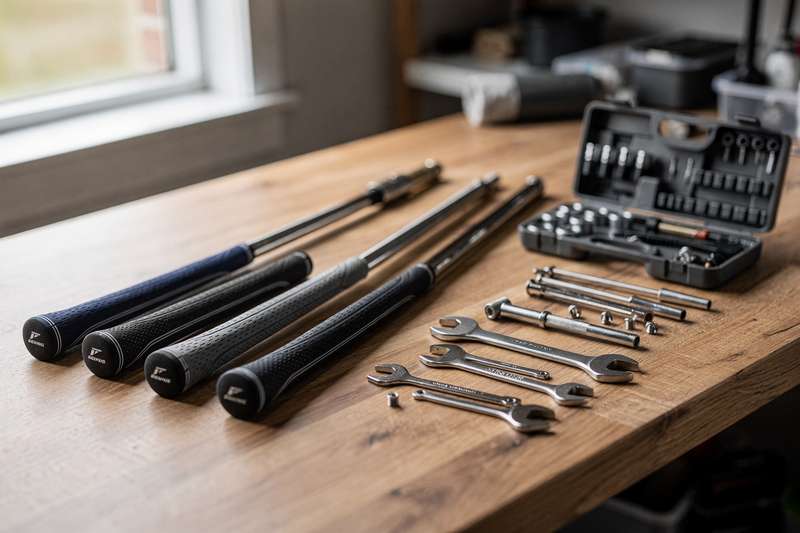
Your irons have gone shiny around the grip — not from overuse exactly, but from accumulated moisture, sunscreen, and a few seasons of play that have stripped whatever tackiness the rubber once had. Your driver’s adjustable hosel hasn’t moved since you bought the club, because you lost the wrench somewhere in a locker-room back in 2023. And one of your long irons sits a half-inch too short for your height, which means you’re compensating at address without even realising it.
The pro shop solution is expensive. A re-grip on a full set, a loft adjustment, and a length tweak can add up to more than you’d want to spend — especially when the parts themselves cost a fraction of what you’re paying for labour. The barrier to doing this at home has dropped considerably. Replacement grips, shaft extensions, adjustment wrenches, and maintenance kits are all available on Amazon UK, and the quality of the budget-tier options has improved enough that a tidy home workshop job is well within reach of any golfer willing to spend a Sunday afternoon on it.
This guide covers the specific parts and tools that come up most often when golfers are sorting out their own equipment — not entire club sets, but the components and accessories that help you keep what you’ve got playing as it should.
How These Picks Were Evaluated
Each product in this guide was drawn from live Amazon UK listings across the main golf club part categories: replacement grips, grip installation kits, shaft extensions, driver adjustment wrenches, putter accessories, and club maintenance tools. Picks were assessed on review volume and consistency — not just star averages, but what buyers actually described praising or criticising in their comments. Compatibility with common UK club brands and setups, kit completeness (whether you need additional supplies to make a product work), and build quality signals from verified buyer accounts all fed into the final selection. Where review counts were low, individual buyer comments were scrutinised more carefully. Products serving essentially the same function — multiple driver wrenches, for example — were compared and the strongest single pick chosen per category rather than padding this guide with near-identical alternatives.
Best Replacement Golf Grips
The Golf Grip Tour Fit Dual Compound Premium Half Cord Golf Grips Standard Midsize Golf Grips with Golf Tape Set is aimed squarely at golfers who want genuine performance grips without paying tour-brand prices, and from 45 UK buyers it holds a 4.6/5 rating — strong for a grip competing with far more established names at this price level.
What separates this grip from a basic rubber replacement is the dual-compound construction. The upper hand section uses a firmer cord-blend material for control and moisture management, while the lower half softens slightly to reduce vibration and hand fatigue on off-centre strikes. That balance — firm where you grip hardest, more compliant where feedback travels through — is exactly what you’d want from a mid-range performance grip. Cord grips were historically the domain of professionals playing in humid conditions; the hybrid approach here means club golfers can benefit from the moisture resistance without the harshness of a full cord grip in cold UK weather.
The listing is available in purchase quantities from a single grip up to a full set of 13, so you can match exactly how many clubs need re-gripping without over-ordering. Grip tape is included, which removes one of the usual friction points in a home re-gripping job. The grips come in both standard and midsize profiles. Standard fits the majority of players; midsize adds roughly 1/16 inch in diameter and can reduce grip pressure for golfers who squeeze too tightly under pressure — a common cause of tension through the forearm during the swing.
The midsize option is worth considering if your current grip leaves red indentations across your fingers after a round. That’s typically a sign the grip diameter is slightly too small for your hand. Conversely, if you play with a lot of wrist hinge and need maximum feel at the point of contact, stay with standard size and keep your grip pressure light throughout the swing.
Where these grips have limits: at 4.6 stars from 45 reviews, they haven’t yet built the track record that Golf Pride or Lamkin carry after decades of production. A handful of buyers noted the cord texture is less aggressive than they expected — if you play year-round in genuinely wet British weather and want maximum bite in all conditions, a full cord grip from an established brand might still be worth the premium. For a golfer re-gripping for the first time or upgrading from worn OEM rubber, this is an excellent starting point and the dual-compound design punches well above its price tier.
Best Golf Grip Re-gripping Kit
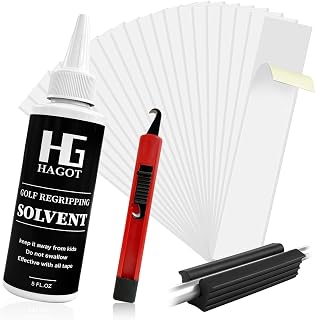
The 4 Pieces Golf Grip Repair Kits, with Golf Grip Tape, Hook Blade, Rubber Vise Clamp & Golf Solvent, Universal Size earns 4.4/5 from 30 reviewers and provides everything a home fitter needs to strip and re-install grips properly — no improvising with WD-40 or kitchen knives required.
The kit bundles four components that work together as a system: double-sided grip tape (the foundation of any grip installation), a hook blade for removing old grips cleanly without gouging the shaft, a rubber vise clamp to hold the shaft securely without leaving surface marks, and grip solvent to activate the tape and allow the new grip to slide on into position before the adhesive sets. This is the same toolkit the pro shop uses, scaled down for home use. The combination matters — many golfers who’ve tried re-gripping with whatever comes to hand end up with a grip that slips under load, or a shaft they can’t redo later without damage.
The hook blade deserves particular attention. Removing an old grip without damaging the shaft underneath is the step most beginners get wrong. A straight-bladed tool risks scoring the shaft wall directly; the hooked profile is designed to slide under the grip and cut from the inside out, keeping the cutting face away from the shaft. For steel shafts this is a minor concern, but if you’re re-gripping graphite irons or a graphite-shafted driver, the right blade genuinely matters — graphite can be compromised by a single deep score mark that wouldn’t visibly affect a steel shaft.
In practice, buyers report the rubber vise clamp holds adequately for a home workbench setup, though it performs best when the shaft rests across a solid surface rather than being gripped freehand. One practical limitation worth knowing: the included tape quantity covers roughly half a full iron set at standard strip lengths. If you’re re-gripping all 13 clubs in one session, pick up an additional roll of double-sided grip tape separately to see the job through. For single clubs, partial sets, or a three-to-five iron refresh, the included tape is sufficient and the kit is self-contained.
Overall, this removes the guesswork from a home re-gripping job at a modest outlay. Pair it with the grips listed above and you have a complete installation setup that most golfers can work through in an afternoon with no prior experience of club-making.
Best Shaft Extension Kit for Irons and Putters
The 2PCS Golf Shaft Extension 0.58in Aluminum Alloy Golf Club Extensions Kit Putter Shafts Length Adjustment Tool for Irons and Woods carries a 4.8/5 rating from eight buyers — a small sample, but the scores are consistent and there are no outlier complaints dragging the average down, which is often telling with low-review products where a single bad experience would be obvious.
Shaft extensions address a specific but common problem: clubs that sit too short for a golfer’s height or swing style. Adding length is far cheaper than buying new clubs or ordering custom-length builds from scratch. These aluminium alloy extensions are sized for a 0.58-inch internal shaft butt diameter, covering the majority of standard steel iron shafts and most putter shafts. The kit includes two extensions, each capable of adding an inch or more of shaft length. Installation involves sliding the extension into the butt end of the shaft, bonding in place with shaft epoxy, and then re-gripping once the adhesive has fully cured — typically 24 hours for slow-cure epoxy at UK room temperatures.
Taller golfers — broadly those at 6’2″ and above — who’ve bought standard off-the-shelf sets often find irons sitting an inch or more too short, which promotes a crouched posture at address and consistent mis-hits towards the lower part of the face. Junior players growing into standard-length clubs are another natural use case: a staged extension can buy another season from a set before replacement is genuinely warranted. Putters are perhaps the most common scenario — many stock putters ship in 34 or 35-inch lengths, and golfers whose natural putting setup requires a longer shaft benefit from an extension rather than purchasing a whole new putter.
Compatibility is the main thing to confirm before ordering. The 0.58-inch tip size fits many standard steel shafts but not all graphite shafts, which vary more widely in their internal butt diameter. Measure your shaft’s opening at the butt end before purchasing. Also worth knowing: extending a shaft raises the effective swing weight of the club, because more length moves the balance point marginally towards the head end. Most golfers adapt within a round or two, but if you’re extending by more than an inch, you may notice a change in timing until you’ve played a few rounds with the new length.
Given the small review count, this product requires a slightly higher degree of trust than the most-reviewed picks in this guide. That said, aluminium alloy shaft extensions as a category are well understood — the function is mechanically simple, and failure modes are generally obvious before you commit. Confirm the diameter matches your shaft, use proper slow-cure shaft epoxy rather than contact adhesive, and this is a cost-effective solution to a length problem that pro shops typically charge a meaningful labour fee to correct.
Best Putter Ball Pick-Up Tool
The LEAGY 2Pack Golf Ball Pick Up Black Rubber Putter Sucker for Putter Grip Golf Parts is the most well-reviewed product in this guide, with 183 buyers giving it 4.0/5 — and that volume represents a realistic picture of what this straightforward putter attachment actually does in the field.
The product is uncomplicated: two rubber suction-cup attachments that press onto the butt end of your putter grip, allowing you to retrieve the ball at the hole by pressing the grip end down onto the ball rather than bending over. For golfers managing back pain, hip stiffness, or reduced mobility — a group that covers a significant proportion of UK golfers over 50 — this is a real quality-of-life improvement that costs very little and takes seconds to fit. The sucker pushes onto the grip end without tools and removes equally easily, so you can take it off before a competition round if your club’s rules or the format require clean equipment.
The 4.0 average from 183 reviews reflects a couple of real limitations worth understanding. First, suction effectiveness depends on ball condition — a wet, muddy ball doesn’t seal as cleanly as a dry one, so on winter courses with soft conditions the pick-up may not work first try every time. Second, fit depends on the putter grip’s butt diameter. Most standard putter grips accept these cups cleanly; fat jumbo or counterbalanced putter grips may not seat properly, and a handful of buyers with oversized grips reported a looser fit that reduced reliability. If your putter already uses a thick grip for counterbalancing, check that detail before ordering.
Two in the pack is a practical choice — one as a backup, or one fitted permanently on your practice putter at home while the other stays on your playing putter. The rubber is flexible enough to accommodate minor diameter variation without losing its seal on standard-size grips. This item won’t affect your ball-striking or improve your short game directly, but if your back complains after 18 holes of bending down at the cup, it removes most of those bends at negligible cost. The review volume here gives reasonable confidence it performs as described for golfers with standard equipment.
Best Driver Adjustment Wrench
The Golf Driver Wrench — Black Golf Tool with Adjustment Handle for Club Driver has 45 reviews at 3.8/5 — the most-reviewed driver wrench in this product set, and a rating that reflects its role as a functional budget substitute rather than a precision instrument.
Most modern drivers and fairway woods use an adjustable hosel system secured by a proprietary torque screw. The wrench that came with your club is easy to misplace, and without it you can’t change loft, lie angle, or face angle — even if your driver’s hosel has full adjustability sitting there unused. Third-party wrenches like this use a star-key tip designed to fit the torque screw interface used by the majority of adjustable hosel systems from mainstream brands. The adjustment handle gives enough leverage to loosen and reseat the screw without applying excessive force, which matters — overtightening can strip the thread in the hosel body, turning a simple adjustment into a workshop repair.
The 3.8/5 rather than a higher score reflects a real limitation that buyers describe fairly consistently: tip fit is not universal. While the star-key profile covers a wide range of brands, some manufacturers use a slightly different torque bit specification and the tip won’t engage cleanly with those. A handful of reviewers with specific driver models noted a loose fit at the tip, which risks rounding the screw head over time. Before applying any force, confirm the tip sits firmly in the screw recess without wobbling — if there’s play in the fit, stop and either source the correct-profile wrench or contact your club manufacturer. Rounding a hosel screw is a costly problem to fix.
For the golfer who has lost their original wrench and owns a driver from a mainstream UK-popular brand, this solves the problem at a fraction of the cost of sourcing a replacement through the manufacturer. Apply reasonable pressure — the standard guidance for most adjustable drivers is to tighten to the click stop or until snug, not as tight as your arm physically allows — and check your driver’s documentation for correct setting positions before adjusting. If you haven’t looked at that page since you bought the club, the PDF is almost certainly available on the manufacturer’s website and worth five minutes of reading before your next tweak.
Best Club Cleaning & Maintenance Kit
The Golf Club Cleaner Brush with Water Spray Bottle, Strong Bristles Non-Leaking Stretchable Golf Brush with Microfiber Golf Towel earns 4.1/5 from 11 buyers — a smaller pool than some picks here, but the feedback is consistent and the bundle addresses the full cleaning setup in a single purchase.
Clean grooves matter more than most recreational golfers give them credit for. Packed grass, mud, and debris in iron and wedge grooves directly reduces the spin the face can generate, which affects how the ball behaves on approach shots, chips around the green, and anything struck from a tight lie. A thorough groove clean before each round — or hole by hole on wedge shots — takes under two minutes with the right kit. This set pairs a firm-bristled brush with an integrated water spray bottle, so you can wet the face, scrub the grooves, and wipe down in one continuous sequence without hunting for a water source mid-round.
The microfibre towel included is worth a specific mention. Standard cotton towels absorb surface water well but can leave fibres in the groove channel; microfibre’s finer structure clears the groove more effectively and doesn’t shed. The brush itself has a retractable design for portability — the bristle head collapses back into the handle so it fits in a bag pocket without the bristles being bent or flattened over time, which is the failure mode that makes cheap fixed brushes deteriorate quickly. Buyers specifically note the spray bottle seals properly when stored upside-down in a side pocket, which is a detail that separates this from cheaper versions that leak quietly across your gear.
Where this kit has limits: the firm bristles are appropriate for irons and wedges but are more aggressive than you’d want for cleaning a driver face or fairway wood face regularly. For metal woods, use the damp microfibre cloth rather than scrubbing with the brush. The bundle also doesn’t include a groove-sharpening tool — if your wedge grooves are genuinely worn flat rather than just clogged with debris, you’ll need a separate groove sharpener to restore spin performance, which is a different product category. As a round-by-round maintenance kit for groove cleaning and club face care across the irons and wedges, this covers the practical basics well for golfers who currently clean clubs with whatever rag happens to be available.
What to Look For in Golf Club Parts
- Grip size and compound: Standard grips suit the majority of golfers, but if your hands measure over 9 inches from wrist crease to the tip of the longest finger, midsize or oversize grips can reduce the tendency to over-rotate the forearms through impact. Rubber is the most versatile base compound; cord embeds a textile fibre for better moisture management; dual-compound designs blend both. Be honest about how much UK winter golf you play — persistent wet conditions push most golfers towards at least a partially corded grip.
- Shaft butt diameter for extensions: The two most common steel shaft internal butt diameters are 0.58 inch and 0.60 inch — extensions specify which they fit, so confirm this matches your shaft before ordering. Graphite shafts vary more widely, so always measure first. Use slow-cure shaft epoxy rather than superglue or contact adhesive for a permanent, stress-tolerant bond that won’t shift under load.
- Driver wrench tip compatibility: The adjustable hosel on a modern driver uses a specific torque screw interface. Most mainstream manufacturers use a similar star-key profile, but there’s no single universal standard. Check your club’s documentation or contact the manufacturer if you’re unsure — confirming before purchase costs nothing, whereas stripping a hosel screw can be expensive to put right.
- Re-gripping kit completeness: A proper grip installation needs double-sided tape, grip solvent, a hook blade, and a way to secure the shaft. Buying these individually from different sellers adds postage and inconvenience. Prioritise bundles that include all four components, and check whether the tape quantity is sufficient for the number of clubs you plan to re-grip in one session.
- Review volume and recency: A product with 200 reviews from four years ago may have changed manufacturer or material since the bulk of those reviews were written. On Amazon, filter by Most Recent specifically — if the last 15 to 20 reviews score noticeably lower than the lifetime average, that pattern is worth taking seriously before you order.
- Club type compatibility: Some parts are essentially universal — grip tape, cleaning brushes — while others are specific to a club type: putter ball pick-ups, driver wrenches, hosel-specific adapters. Confirm the listing explicitly covers your club category. A driver wrench that doesn’t mention irons or putters in its description almost certainly won’t help you with those clubs even if the tip physically resembles what you need.
- Durability of reusable tools: Consumables like solvent and tape are replaced anyway, so longevity is less critical than coverage. But a wrench or a vise clamp should last years of occasional home use. Look specifically for reviews that comment on durability after multiple uses — first-impression reviews immediately after installation don’t always reflect how a tool holds up after the third or fourth re-gripping session.
Verdict
If you’re sorting out one priority in your equipment bag, start with your grips. Worn grips affect every club you own, every swing you take, and every round you play — and re-gripping is the highest-return maintenance task most golfers put off for too long. The Golf Grip Tour Fit Dual Compound Premium Half Cord Golf Grips paired with the 4 Pieces Golf Grip Repair Kits covers a complete home re-grip job for less than you’d pay for two clubs at the pro shop. That combination is the clear starting point for the majority of golfers reading this.
Beyond grips: if your irons sit short and you’ve been bending at address to compensate, the shaft extension kit addresses that cheaply and cleanly. If your driver’s loft adjustment has been frozen in place because the wrench is missing, the driver wrench is a budget fix to a genuinely irritating limitation. And if your wedge grooves are clogged from months of autumn golf, the cleaning kit will restore spin performance you’ve been quietly giving away round after round.
For the modal reader of this guide — a regular golfer, happy to spend an afternoon doing proper maintenance at home, who wants to avoid paying pro shop labour costs for jobs they can handle themselves — fresh dual-compound grips, fitted correctly with the right tools, make more difference to ball control than most equipment upgrades that cost ten times as much.
We were not paid to feature any specific product in this guide. All opinions are independent and based on publicly available specifications, verified buyer feedback patterns, and category research.
Quick Comparison Table




FAQ
How often should you replace golf club grips?
Most fitting professionals recommend replacing grips every 40 to 60 rounds, or at least once per season if you play year-round. The clearest sign it’s time is when the grip surface has gone shiny or smooth in the contact area — at that point, no amount of washing restores the original tackiness, and you’re losing control on every shot without necessarily realising it.
Can I extend my golf clubs at home without specialist equipment?
Yes. Shaft extensions insert into the butt end of the shaft and are bonded in place with shaft epoxy, which you can apply at home without specialist machinery. You’ll need to re-grip after installation. The most important step is confirming the extension’s tip diameter matches your shaft’s internal butt diameter before applying any adhesive — once slow-cure epoxy has fully cured, the extension is permanent and very difficult to remove cleanly.
Are third-party driver wrenches safe to use on adjustable hosels?
Generally yes, as long as the tip seats firmly in the torque screw. The risk with a poorly fitting wrench is rounding the head of the hosel screw, which can make it very difficult to remove without specialist tools. Before applying any turning force, confirm the tip sits with no wobble in the recess — if there’s play in the fit, stop and source the correct wrench profile for your specific driver model.
What is the practical difference between cord and rubber golf grips?
Rubber grips offer a softer, cushioned feel and perform well in dry conditions, making them the default choice for summer golf or golfers who prioritise comfort over grip security. Cord grips embed a textile fibre throughout the rubber for better grip in wet and humid conditions, but feel significantly firmer and transmit more vibration from off-centre strikes. Half-cord or dual-compound grips blend both materials — cord in the upper hand, rubber below — and represent a practical compromise for UK golfers who play through autumn and winter.
Do I need grip solvent for a home re-gripping job?
Yes — grip solvent is essential for a proper installation. It temporarily activates the double-sided grip tape, allowing the new grip to slide along the shaft into the correct position before the adhesive sets. Without solvent, the grip bonds on first contact with the tape and cannot be repositioned. Once the solvent evaporates — typically 20 to 30 minutes in normal conditions, longer in cold UK weather — the tape sets firmly and the grip is secure under normal playing loads.
Will adding a shaft extension change how my clubs feel?
Yes, in two ways. Adding length increases the effective swing weight of the club — the head feels slightly heavier relative to the grip end — and alters the shaft’s flex profile marginally. For extensions of half an inch or less, most golfers adapt within a round or two and the change is minor. If you extend by an inch or more, the swing weight shift is noticeable enough that you may want a club fitter to check the balance, particularly for the clubs you rely on most for consistency.