Picture this: your child has been pestering you for weeks for a proper scooter upgrade. What they have now — a plastic thing from a supermarket clearance shelf — wobbles when they kick off, has a handlebar clamp that slips mid-ride, and makes a grinding noise from the rear wheel that suggests it won’t survive another fortnight. You open Amazon to find something better and instead of clarity you get chaos: three-wheelers for toddlers labelled “all ages,” electric commuter models sitting next to stunt decks for teenagers, hoverboards tucked into the same category, and dozens of listings with near-identical descriptions all promising they’re “professional-grade” and “suitable for beginners” at the same time.
The wrong purchase wastes money and kills enthusiasm fast. A child who’s excited about skate parks doesn’t want a large-wheeled commuter scooter that can’t handle any kind of trick. A toddler handed a stiff two-wheeled stunt deck will fall off in the first minute and lose interest entirely. And the parent who buys a bargain with no recognisable build quality behind it will likely be back on Amazon in three months when the bearings seize and the deck starts to flex under load. This guide cuts through that confusion and delivers five specific, vetted picks — covering every major rider type from first-time toddlers to committed teen trick riders — all available right now on Amazon UK, with honest assessments of where each one succeeds and where it falls short.
How These Picks Were Chosen
Working through the live Amazon UK scooter catalogue against a clear framework, rather than simply ranking by star rating, produced these five recommendations. Frame and deck construction was the first filter: aluminium outperforms steel on weight, corrosion resistance, and stiffness, and the quality of welds under the deck is a leading indicator of long-term durability under trick stress. Wheel diameter and polyurethane compound quality came next — the right wheel size is entirely dependent on the intended riding style, and not all PU is made to the same standard. Brake system reliability, handlebar clamp security (four-bolt versus two-bolt is a meaningful difference on stunt scooters), and age-to-weight ratings were all evaluated against what buyer review patterns actually show months after purchase, not just in the first week. For products with fewer than 50 verified reviews, additional scrutiny was applied to identify any recurring structural issues early in the feedback window. The result is five picks across genuinely distinct use cases: overall stunt, intermediate progression, beginner stunt, young children, and everyday recreational riding.
Best Overall Stunt Scooter
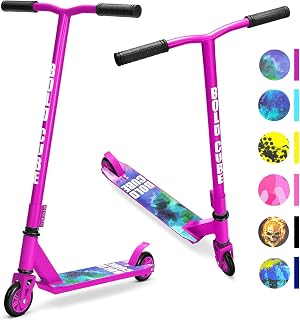
The BOLDCUBE Deluxe Stunt Scooter is the most substantively reviewed scooter in this guide — rated 4.6 stars by 304 verified buyers on Amazon UK — and when a scooter holds that rating across a meaningful number of reviews, the feedback has had long enough to surface any structural problems that initial reviewers tend to miss.
This is the right pick for children aged 8–12 who want to start learning freestyle tricks at a skate park or on a practice surface, but who haven’t yet developed the muscle memory and technique that intermediate riding demands. The “beginner” framing in the name is accurate, but it shouldn’t imply fragility. BOLDCUBE has built the Deluxe around components that are scaled-down versions of what proper stunt scooters use, rather than cheap equivalents that merely look similar in product photos. That distinction matters in practice: after months of bunny hops, kerb drops, and early tailwhip attempts, a properly built beginner stunt scooter holds its geometry and stays tight; a cheaply built one starts to loosen at the headset and creep at the clamp within weeks.
The four-bolt clamp on the handlebar stem is one of the more telling spec details here. Most budget stunt scooters use a two-bolt clamp, which works under moderate use but loosens progressively under the repeated torque that trick riding generates. Four bolts distribute that rotational load across a wider contact area, meaning you set the clamp once to the correct torque and leave it there rather than retightening before every session. Combined with nylon-core PU wheels — lighter than cheap plastic cores and better at absorbing the lateral and vertical forces of landing impact — the BOLDCUBE Deluxe is doing the structural work correctly rather than simply looking the part.
The silent flex brake is a rear foot brake engineered to decelerate smoothly without locking the wheel suddenly under hard pressure. For younger riders, unexpected wheel-lock can send them over the bars, so a progressive, predictable braking feel is genuinely important at this stage. Reviewers consistently describe the braking as confidence-inspiring rather than grabby, which is the right outcome for the 8–12 age group.
The honest tradeoffs: the BOLDCUBE Deluxe uses a fixed-height handlebar, which is standard on all proper stunt scooters because adjustable clamps add weight and introduce flex that compromises trick control. That means sizing matters at point of purchase — the handlebar should sit roughly between the rider’s hip and navel when they stand on the deck, and BOLDCUBE offers different sizes for different rider heights. A rider who progresses quickly through the learning curve will likely want to step up to a more performance-oriented deck within 18 months. That’s the natural trajectory of the sport, and this scooter does exactly what a good beginner stunt model should: it teaches correct form, builds confidence, and gives a solid foundation without holding back a motivated rider during the early phase.
Best for Intermediate Riders and Teens
The FREEDARE Pro Stunt Scooter is aimed at riders who’ve already put time in at the skate park and are progressing beyond the basics — capable of 180s and simple jump tricks, working toward more demanding flatground and ramp moves. Rated 4.3 stars from 150 Amazon UK reviews, it occupies a step up from the standard beginner market in both construction ambition and real-world capability.
The practical difference between this and a beginner model starts with structural tolerance. When a heavier teenager lands hard off a ramp or repeatedly pounds a ledge with grinds, the forces going through the deck, clamp, and forks are significantly greater than what a lighter child generates on a smooth driveway. The FREEDARE Pro’s construction handles that sustained load more comfortably, with the rider weight range extending into the adult bracket — giving heavier teen riders confidence that the scooter won’t start flexing and cracking before they’ve had their money’s worth.
The wheel specification on the FREEDARE Pro reflects intermediate-level priorities. The polyurethane compound and core construction are better matched to the impact work that park riding demands — grinding contact, repeated hard landings, the general mechanical stress that a full park session generates. Cheaper wheels develop flat spots and internal core fractures within months of this kind of use; better-specified wheels hold their shape and performance noticeably longer. For any rider spending meaningful time on concrete park surfaces and working on ledge grinds and transition tricks, wheel durability shifts from a background spec to a deciding factor.
The deck geometry — lower and wider than a pure beginner model — provides a more stable landing platform for riders who are starting to land from height with greater consistency. Reviewers frequently note that the scooter feels composed at speed and forgiving on landings compared to other options at a similar price point, which aligns with the design priorities that separate a genuine intermediate scooter from a beginner model with upgraded aesthetics.
To set expectations clearly: this isn’t a scooter for a child just starting out. The stiffness, fixed geometry, and weight profile tuned for an older rider make it awkward for small hands to manipulate freely. And as with all stunt scooters, the handlebar height is fixed, so verifying fit against your child’s hip-to-navel measurement before ordering is time well spent. A small number of reviewers mentioned minor cosmetic issues with packaging on arrival — this appears to be a shipping variance rather than a manufacturing concern, but worth noting if you’re buying it as a gift where presentation matters.
Best for True Beginners (Ages 6+)
The CORE CB1 Beginner Stunt Scooter brings genuine brand heritage to the entry-level stunt market. CORE is a recognised name in the professional freestyle scooter scene, and the CB1 is their designed-from-the-ground-up entry point for children aged 6 and up taking their first steps into trick riding. It currently holds 4.2 stars from 43 Amazon UK reviewers, with the count still building as a relatively recently listed product.
What makes the CORE name relevant here is that the CB1 benefits from design principles applied across CORE’s wider product range, rather than being an unrelated budget product carrying a known brand as a label. The welds, headset tolerances, and clamp specification are set to a standard that reflects CORE’s understanding of what stunt scooters need to withstand during trick riding — meaningfully different from what an unbranded factory design offers at a similar price. For parents who’ve watched a cheap scooter’s headset loosen within a fortnight, or seen a clamp strip out during the first height adjustment, build consistency from a brand-native design is a genuine differentiator.
The 110mm wheel diameter is the correct specification for beginner stunt riding. Larger wheels suit smooth cruising over longer distances; smaller, harder wheels are lighter, easier for young riders to manipulate during tricks, and better matched to the geometry of a stunt deck. At 110mm, the CB1’s wheels sit at the standard used by stunt scooters across all ability tiers — meaning the riding feel is appropriate for the tricks the rider is learning from the first session, rather than being a design compromise in either direction.
One practical consideration when comparing the CB1 to the BOLDCUBE Deluxe: the BOLDCUBE carries a substantially larger verified review pool (304 versus 43), which provides more confidence in the long-term durability picture. The CB1’s advantage is brand credibility and the design philosophy behind it. If brand pedigree in the scooter community matters to you — or to your child, who may already recognise the CORE name from time spent at the park — the CB1 is the more considered choice. If raw review volume is your primary trust signal, the BOLDCUBE is the safer option on the basis of established feedback.
One expectation worth setting honestly: the CB1 is a first stunt scooter, not a permanent one. A child who takes to the sport seriously will progress past what any beginner model offers within a year or two. CORE’s intention with this model is clear — teach correct technique, build enthusiasm, and make the path to intermediate riding as natural as possible. It follows through on that intention well.
Best for Young Children
The SereneLife 3 Wheel Kids Scooter solves a specific problem that every parent of a young child recognises: the gap between “too young for a regular two-wheel scooter” and “ready to ride independently.” Rated 4.4 stars from 41 Amazon UK reviewers, this three-wheeled model is built for children roughly aged 2–6 who are still developing the balance and coordination that confident two-wheel riding demands.
The three-wheel configuration — two wheels at the front, one at the rear — creates a stable triangular base that removes the balancing challenge entirely. A child on this scooter doesn’t need to worry about toppling sideways; they can focus on steering, kicking, and learning to use the rear foot brake. That lets them build the foundational skills of scooting — weight distribution, directional control, speed management — without the frustration of repeatedly falling over while trying to master balance at the same time. For children who’ve found conventional two-wheelers intimidating or demoralising, the three-wheel setup almost universally produces faster progress and far more willingness to keep practising.
The lean-to-steer mechanic deserves a specific explanation if you haven’t encountered it before. Instead of rotating the handlebars to change direction as on a bicycle, the rider shifts body weight left or right and the front axle articulates to follow. For young children, this turns out to be considerably more intuitive than conventional handlebar steering — it mirrors the natural instinct to lean into a turn. It also teaches the weight-shift awareness that transfers to other board sports later: skateboarding, balance bikes, snowboarding, and eventually two-wheel scooters. The learning curve on lean-to-steer is noticeably faster than on twist-steer alternatives for most children in this age range.
The foldable seat option is the SereneLife’s most practical feature. For the youngest end of the age range — children starting at two or three years old — the option to sit rather than stand means the scooter can also function as a sit-and-push toy for shorter distances, extending its usefulness before the child is physically ready to ride standing. The scooter folds flat for car boot storage or a hallway hook, a daily convenience that parents who handle children’s equipment constantly will appreciate immediately.
Be honest with yourself about what this product is designed for: it’s a developmental scooter for a specific growth window, not a long-term companion. The adjustable handlebar height extends the scooter’s useful life as your child grows through the toddler and early primary years — a detail cheaper three-wheelers often skip. Once your child has the balance and coordination for a two-wheeled scooter, they’ll naturally want to make the switch. Think of the SereneLife as a confidence-building first chapter rather than a permanent fixture.
Best for Everyday Riding (Older Kids and Teens)
The Lightweight Big-Wheel Kick Scooter for Kids 8-12 & Teens 11-15 serves a genuinely different purpose from the stunt models in this guide: fast, smooth, practical riding for children and teenagers who want to cover ground efficiently. Think the school run, a route through the park, or longer recreational rides where you want to arrive comfortably rather than perform along the way. It holds 4.2 stars from 54 Amazon UK reviewers.
The defining specification is the 200mm wheel diameter. For context: most stunt scooters use wheels in the 100–120mm range, and most standard kids’ kick scooters sit between 100mm and 145mm. A 200mm wheel is a substantial step up, and the real-world difference in ride quality on typical UK surfaces — pavements with cracks and joins, rough tarmac, dropped kerbs, gravel paths — is immediately noticeable to any rider who has tried both. Larger wheels carry momentum more efficiently (fewer kicks per unit of distance covered), absorb surface irregularities rather than transmitting them as vibration through the deck, and deliver a more stable, composed ride at moderate speeds. For a child or teenager using a scooter as practical daily transport, this specification directly improves the riding experience in a way that no amount of styling or additional features can replicate.
The handlebar offers three height positions that cover a meaningful range for the 8–15 age bracket. Children grow fast enough that a scooter purchased at age 10 should comfortably still fit a 13-year-old — the three-position adjustment provides that headroom without the weight penalty and added flex risk of a fully stepless adjustable system. The folding mechanism allows the scooter to collapse for transport or storage, relevant for anyone carrying it in and out of a car or school environment on a daily basis.
The lightweight frame construction suits older children and teenagers who have the balance confidence to manage a larger-format scooter without stabilising aids. This is not a stunt scooter by any measure: the geometry and wheel size that make it excellent for distance cruising make it poorly suited to tricks, and attempting park riding on it would accelerate wear on components not built for impact loading. That’s an expectation worth setting clearly before handing it over.
Where it’s a less natural fit: children at the younger end of the bracket (around 8) may find the scooter’s proportions slightly generous until they’ve grown into them. And if your child’s primary goal for getting a new scooter is to develop freestyle skills, one of the stunt-focused picks in this guide will serve them far better. But for the teenager who wants to arrive somewhere with energy left over — rather than perform on the way there — this is the most capable everyday option in the UK Amazon catalogue at this price point.
What to Look For When Buying a Kids’ Scooter
Before settling on any specific model, these buying criteria apply across the whole category and will help you evaluate any listing with confidence.
- Wheel size and compound: Wheel diameter is the most decisive spec, driven entirely by intended use. Small wheels (100–120mm) suit stunt and trick riding — light, easy to spin, designed for smooth surfaces. Large wheels (150–200mm) suit recreational and commuter riding — they absorb rough ground, build momentum faster, and produce a noticeably smoother ride over distance. Whatever the diameter, look for polyurethane (PU) wheels rather than hollow plastic: PU is more durable, grips better in damp conditions, and holds its shape under sustained load.
- Deck material and dimensions: Aluminium decks are the right choice for almost every use case — lighter than steel, corrosion-resistant, and stiffer under repeated impact. Deck width matters more for older or heavier riders who need a stable landing platform; for younger children, a narrower deck is easier to control and manipulate. Deck length affects balance as well, with longer decks better suited to taller riders.
- Brake system quality: Virtually all kids’ scooters use a rear foot brake. The question isn’t whether a brake exists but how it behaves. A well-tuned flex brake decelerates progressively and predictably; a poor one either barely slows the rider or locks the rear wheel suddenly. Look for specific buyer comments about braking feel in reviews — this detail gets mentioned reliably when it’s either notably good or notably problematic.
- Handlebar clamp type: On stunt scooters, a four-bolt clamp is meaningfully better than a two-bolt for riders putting repeated torque through the bars during trick riding. On adjustable recreational scooters, check that the height-lock mechanism holds fixed during riding rather than slowly creeping downward — a common failure point on cheaper adjustable systems.
- Age and weight ratings: Treat the manufacturer’s maximum weight rating as a genuine engineering limit rather than a conservative buffer. A scooter rated to 50kg ridden regularly by a 65kg teenager will wear out its welds, clamp, and bearings faster than intended and may fail suddenly. Match the rating to the rider’s current weight, not a projected future figure.
- Fixed vs. adjustable handlebars: Fixed bars are lighter and stiffer — the correct choice for stunt riding. Adjustable bars grow with the child — the correct choice for recreational and commuter use. This is a design decision driven by purpose, not a quality hierarchy. A fixed-bar scooter bought for a young, growing child will quickly become too small; an adjustable scooter used for serious trick riding introduces structural flex at the worst possible moment.
- Protective equipment: Buy a helmet at the same time as the scooter — not as an afterthought. For children learning tricks or riding at skate parks, knee pads and elbow pads add meaningful protection and are worth including in the initial order. In the UK, children’s helmets should carry a recognised safety certification; check what the relevant standard is at point of purchase and avoid helmets with no standards marking at all.
Verdict
For most UK families browsing Amazon for a kids’ scooter right now, the BOLDCUBE Deluxe Stunt Scooter is the right default. It carries the largest and most consistently positive body of buyer feedback in this guide — 4.6 stars from 304 reviews — and the construction details that actually matter long-term (four-bolt clamp, aluminium deck, nylon-core PU wheels, predictable flex brake) are all executed well. It’s designed for children aged 8 and up who want to develop their riding at a skate park or similar surface, and it handles that remit reliably without falling apart in the first season.
If your child is younger and still developing balance, start with the SereneLife three-wheeler — it teaches the right instincts and transitions naturally to a two-wheeled model when the child is ready. For older kids and teenagers who ride for transport or general recreation rather than tricks, the big-wheel kick scooter covers ground that stunt models cannot match in terms of comfort and rolling efficiency. For riders who are already comfortable with basic tricks and want credible next steps, both the FREEDARE Pro and the CORE CB1 offer well-built options at different points in the skill progression.
The principle is straightforward: match the scooter to where your child is right now, not where you hope they’ll be in six months. A well-matched scooter gets ridden every day; a mismatched one ends up against the garage wall by half-term.
We were not paid to feature any specific product in this guide. All opinions are independent and based on publicly available specifications, verified buyer feedback patterns, and category research.
Quick Comparison Table


FAQ
What age is a stunt scooter suitable for?
Most stunt scooters are designed for children aged 8 and older, though the key factor is physical development rather than age alone. Stunt riding requires confident two-wheel balance, the coordination to jump and land safely, and enough upper-body strength to control a stiff, fixed-height scooter — skills that develop at different rates. For children under 8, a beginner three-wheel scooter or a standard two-wheel kick scooter is a more appropriate and safer starting point.
What is the difference between a stunt scooter and a regular kick scooter?
Stunt scooters have fixed (non-adjustable) handlebars, smaller and harder wheels, a reinforced deck and headset, and a stiffer overall construction designed to withstand the impact forces of jumping and trick riding. Regular kick scooters typically have adjustable handlebars, larger softer wheels, and a more practical build that prioritises comfort and rolling efficiency. Stunt scooters are not suited to long-distance commuting; regular kick scooters are not built for park tricks.
Do I need to buy a helmet separately for a kids’ scooter?
Yes — none of the scooters in this guide include a helmet, and buying one alongside the scooter is far better than adding it as an afterthought. For stunt riders attempting tricks or ramp work, knee pads and elbow pads add meaningful protection and are worth including in the initial order. A correctly fitted helmet is the single most important piece of protective equipment for any scooter rider, regardless of age or experience level.
How do I choose the right handlebar height for my child?
For stunt scooters with fixed handlebars, the bars should sit roughly level with the rider’s hip or belly button when they’re standing on the deck — this creates a natural, controlled riding posture without forcing a hunch or an overextended reach. For adjustable recreational scooters, start at the lowest comfortable setting and raise it as your child grows. Always check the specific height dimensions listed by the manufacturer before ordering a fixed-bar model, because sizing errors cannot be corrected after purchase.
Are adjustable handlebars less durable on stunt scooters?
On stunt scooters specifically, yes — the mechanical joints that allow height adjustment introduce flex and potential failure points under the repeated torque of trick riding. This is why all serious stunt scooters across every ability level use fixed handlebars as standard. On recreational kick scooters, adjustable bars are a sound design choice because the forces involved are much lower, and the practical benefit of growing with the rider outweighs any minor structural difference.
How long should a decent kids’ scooter last with regular use?
A well-built scooter used within its intended weight rating and riding style should last two to three years of regular use. The components that wear first are typically the wheels (particularly on rough surfaces), the wheel bearings, and the rear brake. Both wheels and bearings can usually be replaced inexpensively to extend the scooter’s useful life — which makes a mid-range model with standard, replaceable parts a better long-term investment than a budget model where proprietary or hard-to-source parts force a full replacement.