You have a corner of the desk where no lamp seems to cooperate. The gooseneck version keeps drifting back to its default angle after a week of use. The halogen inherited from a previous office puts out a hot cone of light that covers maybe half of your A3 drawing sheet and leaves the far edge in shadow. The modern touch-base model looks clean in product photographs but wobbles the moment you reach across the desk. You do work that demands precision — architectural drawings, technical sketches, electronics assembly, detailed craft projects — and you need a lamp that holds exactly where you put it, reaches far enough across your workspace without creating shadows, and delivers clean, consistent illumination that lets you work for two or three hours without your eyes complaining about it.
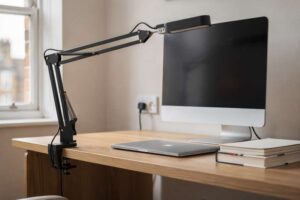
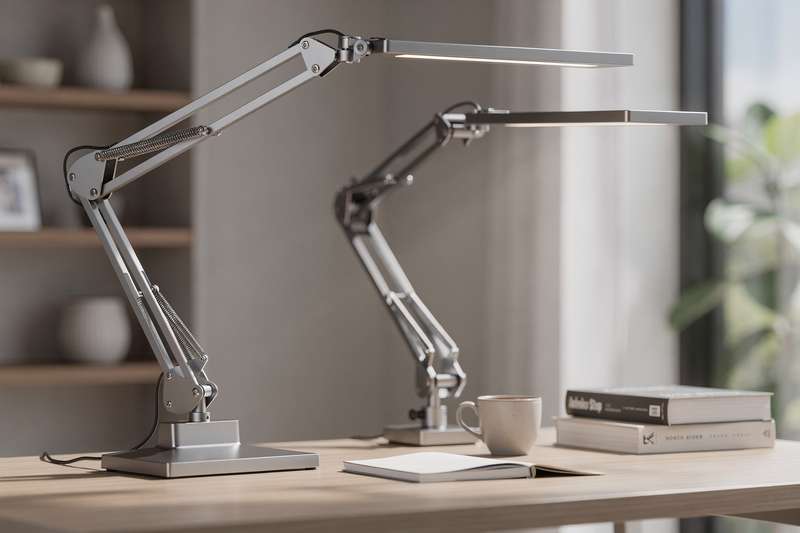
The architect-style swing arm desk lamp, with its multiple jointed arms and lockable hinges, is built precisely for this kind of work. But the category is full of products that look the part in photographs and disappoint the moment you start repositioning them for the third time in a day. A poorly balanced arm drifts downward under its own weight within months. A cheap LED panel produces flat colour rendering where pencil lines disappear into the paper background. A clamp that grips loosely will shift every time you adjust the head. This guide identifies the lamps that actually solve those problems — drawing on verified buyer feedback from UK purchasers who use them in real working conditions.
How These Picks Were Evaluated
This guide focuses specifically on lamps with multiple jointed, adjustable arms — not goosenecks or single-pivot designs — where you can extend the light across a work area, lock it in position, and trust it to stay there. The evaluation drew on verified buyer feedback patterns across hundreds of UK reviews to assess arm reach and joint stability over time, LED quality (brightness output, colour rendering, flicker characteristics, and colour temperature range), mounting options, ease of one-handed repositioning, and build material durability. All five picks are available directly on amazon.co.uk and carry a meaningful verified review base — lamps with zero buyer reviews were not selected given the strength of the reviewed alternatives in this category. The picks span budget, mid-range, and premium tiers so you can match the choice to your actual situation.
Best Overall Task Lamp: Neatfi XL 2200 Lumens 24W LED Desk Lamp
When output, build quality, and real-world buyer confidence all line up in one product, the result is the Neatfi XL 2200 Lumens 24W LED Desk Lamp — the highest-rated product in this selection at 4.7 stars from 613 verified UK buyers. That rating across a substantial review base is a meaningful signal: this lamp has been bought and used by a large number of real purchasers, and the vast majority of them remain satisfied well after the initial purchase rather than updating their reviews downward after a few months of joint sag.
The headline specification is brightness: 2,200 lumens from a 24W LED array is substantially higher than most competitor task lamps in this style, which typically deliver between 600 and 1,100 lumens. In practice, that extra output matters because it allows the arm to extend further back from the work surface while still delivering useful illumination across the full area. A lower-output lamp needs to hover close to the paper to be effective; the Neatfi XL can sit further back and spread its light more evenly, which means fewer shadows at the edges of larger drawings or workbench layouts. For A1-format draughting or a broad electronics bench, that coverage difference is not a minor detail.
Dimmability is smooth and covers a wide range from low ambient output up to the full 2,200-lumen ceiling. For desk work that alternates between paper drawing and screen review, this flexibility is genuinely useful: bright for pencil-on-paper detail, dialled back when you shift to a monitor to prevent light from spilling onto the screen surface. Buyers who use it for crafts and workbench tasks — both explicitly noted in the product description — consistently report that the output removes the need for supplementary lighting, which is a credibility indicator that the brightness specification is honest rather than peak-condition marketing.
Build quality comes through clearly across the reviews. Buyers note that the arm holds position through repeated repositioning without developing sag — the critical failure mode for swing arm lamps in this price bracket. The lamp is available in white and is designed to be a permanent fixture at a dedicated workspace rather than something folded away nightly. For a home studio, a drawing office, or a serious workbench, that permanence is appropriate. If you need a compact lamp you can tuck away at the end of the day, the smaller options below are better suited.
The Neatfi XL is the premium pick in this selection and priced accordingly. But 613 buyers sustaining a 4.7-star average across a range of demanding desk applications is a strong argument for that investment. If quality working light over a meaningful area is the priority and you have a fixed workspace to put it in, this is the lamp to benchmark everything else against.
Best Budget Pick: powerking Swing Arm LED Desk Lamp
The powerking Swing Arm LED Desk Lamp is the most-reviewed product in this entire selection — 904 verified buyers — and it holds a consistent 4.4-star average. Those numbers together tell a straightforward story: a large number of real purchasers have used this lamp and the majority remain satisfied. At a budget price point, that combination of review volume and sustained rating is the most reliable assurance of performance you can find short of testing it yourself.
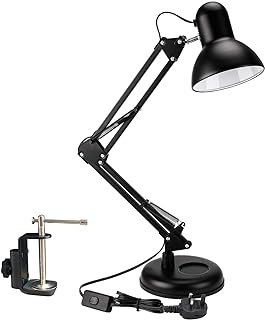
The design follows the classic architect lamp pattern: two jointed arm sections plus an adjustable head, with a desk clamp as the primary mounting method. The clamp attaches to the desk edge and holds the lamp in place without consuming surface area. Arm reach is appropriate for standard desk applications — sketching, reading, draughting on A3 and smaller formats. The LED output handles detailed desk work at home without buyers commonly complaining about insufficient coverage for typical home office tasks.
The most important practical metric for any swing arm lamp is whether the joints hold their set position over months of use. The powerking’s review profile suggests this is not a persistent problem: buyers who have used it for six months or longer report that joints continue to hold rather than progressively sagging. This is precisely where cheaper lamps tend to fail, so the consistency of positive feedback on this specific point is more reassuring than a single impressive brightness specification. The lamp comes in black, a practical finish that suits most desk surfaces without drawing attention.
Where the powerking makes sensible concessions is in light quality nuance. There is no colour temperature switching — you get a single LED colour profile. For sketch work, technical drawing, and general reading where line clarity matters more than colour fidelity, this is perfectly adequate. For colour-critical applications — illustration, fabric matching, or reviewing printed output — the Honeywell HWT-H4 further down this list is the more appropriate choice. The powerking is a tool for getting work done rather than a specialist colour-accuracy instrument.
For anyone equipping a student drawing desk, setting up a secondary work area, or trying the architect lamp format without a significant initial commitment, the powerking is the logical starting point. It will hold its position and light your work properly. With 904 reviews providing the largest confidence base in this guide, it is a budget recommendation with genuine substance behind it.
Best Traditional Architect Style: TEKLED Architect Swing Arm Desk Lamp with Base & C-Clamp
For those who want the look and mechanics of a proper architect’s studio lamp — and the freedom to choose their own light source — the TEKLED Architect Swing Arm Desk Lamp with Base & C-Clamp is the most traditionally styled option in this selection, holding 4.5 stars from 437 verified UK buyers. Its defining feature is an E27 socket rather than an integrated LED module, a design choice that opens up flexibility the other lamps in this guide cannot match.
With an E27 fitting, you supply and choose your own bulb. The available options are broad: standard LED bulbs in warm or daylight tones, high-CRI daylight bulbs for colour-accurate work, smart bulbs with app-controlled colour temperature, or simply whatever screw-cap LED you already buy for the rest of the house. If the bulb fails after a couple of years, replacement takes thirty seconds and costs almost nothing. With integrated LED lamps, a failed LED module can render the entire fixture unusable — particularly with budget-integrated builds where the LED and driver are soldered together with no manufacturer replacement path. The TEKLED sidesteps this concern entirely by using a standard fitting stocked by every hardware retailer and electrical supplier.
The arm assembly offers both a freestanding base and a C-clamp as mounting options. The base suits fixed studio positioning where the lamp will not be moved regularly. The C-clamp frees up desk surface area and suits tighter workspaces where edge-mounting makes more sense. The arm articulation is the classic multi-joint architect style with hinged sections rather than a gooseneck, and the joints hold once positioned. The lamp arrives in black — the standard architect lamp finish — and suits most professional and home studio settings without looking out of place.
The practical consideration to plan for before purchasing is that the lamp arrives without a bulb, as the listing explicitly states. Budget for a quality E27 LED at the same time. For task lighting on drawings and detailed work, a bulb with a CRI of 90 or above and a colour temperature in the 4000–5000K range (neutral to daylight) will serve well. A cheap warm-white bulb at 2700K will give poor results for pencil-line clarity and colour accuracy on paper.
The TEKLED is the right choice if you value the traditional architect lamp aesthetic, prefer to control your light source independently, or want the long-term service advantage of bulb replaceability. The 437-review base and 4.5-star rating provide solid confidence in the arm mechanics and build quality — the elements the manufacturer controls directly. The character of the light output sits in your hands.
Best for Colour Accuracy and Eye Care: Honeywell HWT-H4 LED Desk Lamp
For buyers whose work requires high colour fidelity under artificial light, the Honeywell HWT-H4 LED Desk Lamp is the most technically specified option in this selection, carrying a CRI97 score that positions it well above the standard high-fidelity threshold. To put that in context: natural daylight is CRI100, and the general minimum for high-fidelity task lighting is considered CRI90. At CRI97, colours viewed under this lamp appear very close to how they would look in natural daylight — which for architects reviewing material samples, illustrators mixing colour, or designers checking printed output, is a functional requirement rather than a specification footnote. The lamp holds 4.1 stars from 425 verified buyers.
Three colour temperatures and five brightness levels across each give fifteen output combinations, allowing close matching of the lamp to the task and the ambient light conditions in the room. The auto-sensor feature adjusts brightness based on ambient light levels around the lamp — useful in a studio with windows where natural light shifts significantly through the day. If you prefer to set your brightness and leave it, the auto mode can typically be bypassed in favour of manual control, which is worth confirming in the product details if consistent fixed output is important to your workflow.
The flicker-free specification matters alongside the CRI figure. Flickering LEDs — including those cycling at frequencies above conscious perception — contribute to cumulative eye fatigue during long sessions under artificial light. A flicker-free source removes one contributing factor to that fatigue. It does not eliminate eye strain entirely (posture, screen distance, and regular breaks matter equally), but for someone spending four or more hours daily under task lighting, removing every avoidable source of strain is worth prioritising.
The HWT-H4 is a focused quality-of-light product rather than a large-format task lamp. If your primary requirement is to cover a wide drawing board or a broad workbench with high lumen output, the Neatfi XL’s 2,200 lumens and greater arm reach are better suited to that specific job. The Honeywell serves best at a standard desk, a monitor-adjacent setup, or any situation where you work with colour regularly and need the lamp to render it accurately. At 425 reviews and a 4.1-star average, the feedback base is solid, and the CRI97 specification places it clearly above most lamps in this category on light quality grounds.
For buyers whose work genuinely depends on colour accuracy under artificial light — comparing fabric swatches, reviewing architectural material boards, or checking printed drawings against on-screen references — the mid-range investment in the HWT-H4 is justified by a specification most competitors in this field do not come close to matching.
Best for Wide Desk Coverage: SKYLEO LED Desk Lamp Double Head Desk Light with Remote Control
The SKYLEO LED Desk Lamp Double Head Desk Light with Remote Control is built for buyers who regularly work across a wide desk — a drawing board on the left and reference materials on the right, or a working surface alongside a secondary area — where a single-head lamp forces an awkward choice about which zone gets proper light. It is the only double-head design in this selection, and with 974 reviews at 4.1 stars, it carries the largest verified buyer feedback base of any product in this guide.
The double-head configuration places two independently adjustable LED heads on a shared arm assembly, with a combined output of 2,400 lumens at 24W. That total is comparable to the Neatfi XL, but distributed across two independently directed heads rather than one. You can angle one head onto your working surface and the second onto a reference document, adjacent keyboard, or secondary area — without either zone being left in shadow. Five colour modes are available across the lamp, and the memory function recalls your last settings when the lamp is switched on rather than resetting to full output each time. For a lamp switched on and off daily across different task types, the memory function is a practical convenience rather than a gimmick.
Remote control operation is included — the only lamp in this selection to offer it. If the lamp sits at the far edge of a wide desk, or if you frequently adjust colour mode and brightness through a working session, not having to physically reach the lamp to make those changes is a useful improvement. Whether you will use it every day or configure your preferred settings once and leave them depends entirely on your workflow; the option is there without adding complexity to the package.
The 974-review base deserves emphasis. Nearly a thousand verified buyers is a substantial dataset for a desk lamp, and a maintained 4.1-star average across that group represents genuine, broad satisfaction rather than a score inflated by a thin early review set. Double-head designs introduce more adjustment points than single-arm alternatives, and some reviews note that careful initial assembly and proper joint tightening during setup make a real difference to long-term stability. The feedback suggests most buyers manage this without difficulty — but it is worth spending an extra five minutes on assembly rather than rushing through it.
The double-head format is less well suited to compact or busy desks. Two lamp heads, a longer arm assembly, and the structural footprint needed to support both make this a larger piece of kit than the single-arm options in this guide. For a dedicated, fixed workspace with room to accommodate it — a full-scale drafting setup, a wide electronics workbench, or a studio desk with generous space — that footprint is not a concern. But for a small study desk or a shared surface, the powerking or TEKLED single-arm designs are the more practical solution. If you have tried a single-head lamp on a wide desk and found it consistently insufficient, the SKYLEO double-head directly solves that specific problem.
What to Look For in an Architect-Style LED Desk Lamp
- Number and quality of arm joints: A proper architect lamp needs at least two jointed arm sections plus a separately rotating or tilting head. Joints should lock firmly via tightening knobs, spring tension, or solid friction hinges, and should not drift under the arm’s own weight after months of use. All-metal joint construction outperforms plastic equivalents for both stability and longevity — this is the specification most worth investigating in buyer reviews before committing to a purchase.
- Arm reach: Measure the area you need to cover before buying. A lamp extending 35–45cm from clamp to head suits a compact desk; large drafting tables or workbenches may need 60cm or more of usable reach. Product pages typically quote total extended arm length — compare this figure against your actual workspace dimensions rather than estimating.
- Mounting options — clamp or base: Clamp mounts attach to the desk edge and keep the working surface clear, but require an accessible edge within the clamp’s opening specification. Base mounts are more flexible in placement but occupy desk area. Dual-mount lamps give the most adaptability across different setups. Always verify the clamp opening specification against your desk edge thickness before ordering, particularly with thick hardwood or panel tops.
- LED quality — CRI and colour temperature: For colour-sensitive work, a CRI of 90 or above is the meaningful threshold. Colour temperature control (typically 3000K warm through 5000–6500K daylight) allows matching of the lamp to task and ambient conditions. For pure line draughting where colour accuracy matters less, a single neutral or daylight temperature is adequate. For material selection, illustration, or print review, high CRI is a functional requirement rather than a premium extra.
- Brightness output and dimming range: Higher lumen output allows the head to sit further from the work surface while still illuminating the full area. Smooth, stepless dimming across a wide range is more useful for a multi-task desk than stepping between a handful of fixed presets. If you regularly switch between paper work and screen work, a broad dimming range is worth prioritising.
- Integrated LED versus replaceable E27 bulb: Integrated LEDs tend to be slimmer and often include built-in colour temperature switching. E27 socket lamps give you control over the light source and allow inexpensive bulb replacement if the LED degrades. For a lamp you plan to own for five or more years, replaceability is a practical long-term advantage.
- Flicker-free output: Even flicker rates above conscious perception contribute to eye fatigue during long sessions under artificial light. A lamp with a verified flicker-free specification removes one avoidable source of cumulative strain, which is worth prioritising if you spend four or more hours daily working under the lamp.
The Verdict
For most buyers reading this guide — people doing detailed desk work who need a lamp that holds position reliably, delivers quality light across a meaningful area, and withstands daily repositioning over years of use — the Neatfi XL 2200 Lumens 24W LED Desk Lamp is the strongest overall choice. Its 4.7-star rating from 613 verified buyers is the best confidence signal in this selection, the 2,200-lumen output gives real headroom for larger format work, and the build quality reviews consistently point to an arm that holds up under sustained daily use — which is the single most important practical test in this category.
If the Neatfi XL is more lamp than your setup requires, start with the powerking Swing Arm LED Desk Lamp — 904 reviews and a consistent 4.4-star average make it the most thoroughly proven budget option here. For colour-critical professional work, go directly to the Honeywell HWT-H4 and its CRI97 specification. For a traditional architect lamp with long-term bulb replaceability, the TEKLED with its E27 socket is the natural fit. And if you need to light two simultaneous zones across a wide desk, only the SKYLEO double-head design genuinely addresses that specific setup.
We were not paid to feature any specific product in this guide. All opinions are independent and based on publicly available specifications, verified buyer feedback patterns, and category research.
Quick Comparison Table


FAQ
What makes an architect-style desk lamp different from a standard desk lamp?
Architect lamps have multiple jointed arm sections — typically two or three hinged segments plus a rotating head — which allow you to position the light over a specific point with much greater precision than a fixed-neck or gooseneck lamp. The joints lock in place so the lamp stays where you set it when you step away from the desk. Standard desk lamps usually have a single fixed neck or a flexible gooseneck that drifts back toward a resting position over time and repeated use.
Can architect desk lamps be used for both drawing and computer work?
Yes, with a practical caveat. The adjustable arm lets you direct the lamp head away from your monitor screen to prevent glare and reflections on the display. Models with multiple colour temperature settings allow you to shift to a warmer, lower-intensity output for screen-facing work and a cooler, brighter setting for paper-based tasks. Position the lamp to one side of the monitor rather than directly behind or above it for the most comfortable working result.
What colour temperature is best for architectural drawing?
A neutral daylight tone in the 4000–5000K range is generally the most practical for line drawing and draughting. It renders pencil lines clearly against paper without the orange cast of warm lighting (around 3000K) or the harsh edge of extreme cool-white (6500K). If your work involves colour — material selections, painted illustrations, or printed drawings — prioritise a lamp with a CRI of 90 or above alongside colour temperature control, since CRI determines how accurately you perceive colours under artificial light.
How do I stop a swing arm lamp from drooping over time?
Most adjustable arm lamps use friction-tightening knobs at the joints. If the arm begins to sag with age, check whether the knobs can be tightened further — turning clockwise usually increases resistance at the hinge. Spring-balanced arms that sag may have a fatigued spring; some models allow spring tension adjustment via screws at the joint. Buying a lamp with solid metal joints rather than plastic components reduces the likelihood of sag developing in the first place, which is why build material is worth checking in buyer reviews before purchasing.
Is an integrated LED or a replaceable E27 bulb better for long-term ownership?
Both have real advantages. Integrated LED lamps tend to be slimmer and often include built-in dimming and colour temperature switching in a compact package. E27 socket lamps give full control over the light source — you can specify a high-CRI bulb, a smart bulb with tunable colour temperature, or replace a failed unit in seconds rather than replacing the whole fixture. For a lamp you plan to use for five or more years, the replaceability of the E27 format is a meaningful practical advantage, particularly when replacement bulbs cost very little.
Do clamp mounts work on all desk types?
Most architect lamp clamps accommodate desk edges up to around 50–60mm thick, though this varies by model — always check the product specification and measure your desk edge before ordering. Very thick solid wood tops, desks with rounded or waterfall edges, and glass desks can be difficult to clamp onto securely. If your desk edge is non-standard, prioritise a lamp that also includes a freestanding weighted base, which sidesteps clamp compatibility entirely and allows flexible placement on any flat surface.