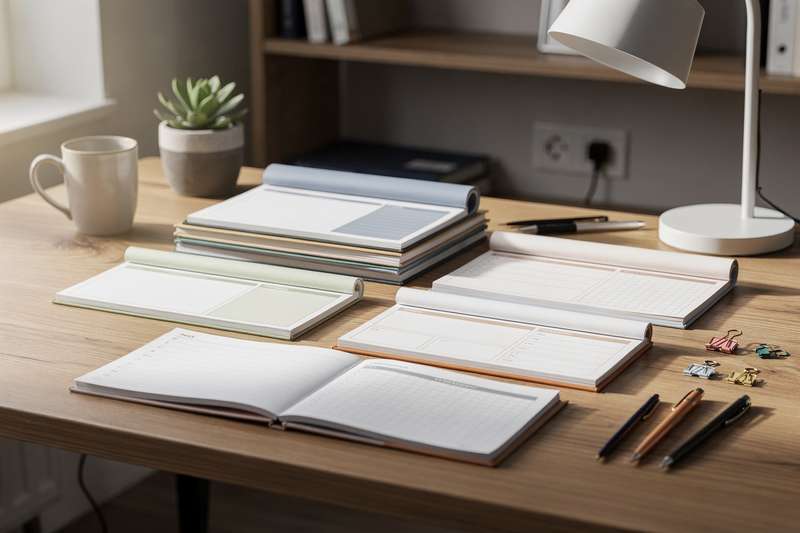
Your desk has sticky notes forming a second border around the monitor, three calendar apps running in browser tabs you never open, and a notepad where last Tuesday’s tasks bleed into this week’s. You tried bullet journaling for about a fortnight before the setup time each morning started to feel like a second job in itself. You downloaded a productivity app, spent an evening configuring it, and now you actively avoid opening it. What you actually want is something physical, structured, and right in front of you — a planning pad that sits on the desk, shows your week at a glance, and doesn’t require a login to be useful.
Planning pads are deceptively simple: structured notepads with pre-printed layouts for tasks, priorities, and scheduling, sized for a desk and designed to tear off cleanly once a week or month. The catch is that Amazon UK stocks dozens of them and quality varies enormously. Paper that bleeds the moment you use a gel pen, perforations that drag the next sheet out of alignment when you remove the current one, layouts that look organised in product photos but can’t fit more than four tasks per day in practice — these are real, recurring problems in this category. This guide identifies the picks worth your time.
How These Picks Were Selected
Eight planning pads currently available on Amazon UK were assessed against four core criteria: paper weight and bleed resistance; layout usefulness relative to real working habits rather than purely visual appeal; the tear-off mechanism (whether perforations are clean and consistent through the full stack); and format value, meaning how the sheet count maps to expected usage frequency. The undated format was treated as a meaningful positive across the board. For products with 50 or more buyer reviews — three in this guide — feedback patterns were used to validate real-world durability and layout experience. Products with smaller review pools were assessed primarily on specifications and available feedback, with that smaller sample size acknowledged plainly in those sections.
Best Overall Weekly Planning Pad
The A4 Weekly Planner Pad sits at the top of this round-up on the strength of its 4.8 out of 5 rating — the highest in this guide — and buyer feedback that the layout works just as well in practice as it does in product photographs.
Being A4 gives you comfortable column widths for each day of the working week. On smaller pads, daily columns compress to the point where you’re writing in abbreviations by Tuesday afternoon; A4 gives each day enough room for a proper task list. The 52 undated tear-off sheets cover a full year of weekly planning without wasted pages — if you take a week off or the pace drops, you simply start the next sheet when you need it rather than losing a page to a date that’s already gone.
Buyers report the tear-off perforations are clean and consistent throughout the pad, which matters more than it sounds. A single ragged tear that pulls the next sheet out of alignment breaks the flat, structured look that makes a planning pad worth using in the first place. That issue doesn’t appear as a recurring theme in the available reviews. The layout follows a standard weekly format — daily columns running across the page with a dedicated section for priorities or notes alongside — and buyers consistently note that the proportions match how they actually work rather than how a designer imagined they would.
The honest tradeoff: 33 reviews, while consistently positive, is a smaller sample than the SUMMIT pad’s 181. The 4.8 rating is the highest in this guide, but statistical confidence grows with sample size. If you want the most widely tested option, the budget pick below is safer. If you want the highest-rated layout currently in this format on UK Amazon, this is it. For solo desk workers who want a clean, uncomplicated weekly view without built-in habit trackers or elaborate section structures, this is the pick that performs most consistently across its available feedback.
Best Budget Pick
The SUMMIT A4 Undated Weekly Desk Planner Pad has the largest buyer base of any weekly pad in this guide — 181 reviews at 4.6 out of 5 — and that depth of verified feedback is one of the strongest reasons to recommend it as the safest starting point for anyone new to planning pads.
181 reviews for a planning pad on UK Amazon is a meaningful number. It means the product has been used in real conditions by a wide range of buyers: home workers, office staff, students, and freelancers with different pen preferences and different working patterns. The 4.6 score is built on that breadth, which makes it statistically more reliable than a higher score from a group of 30. In a product category where paper behaviour and binding quality can vary between batches, a large review sample carries genuine weight.
The SUMMIT’s layout is deliberately unfussy: daily columns for each working day, a notes section, and enough white space to write without feeling cramped. There’s no built-in habit tracker, no time-blocking grid, no illustrated border that reduces the writing area. That restraint is a feature rather than a shortcoming — it means the pad supports your planning rather than prescribing it. If your tasks vary significantly week to week, a rigid layout can feel like working against the pad; the SUMMIT avoids that friction entirely.
Paper quality attracts positive mentions in buyer reviews for standard ballpoint and rollerball pens. If you write with a wet-nib fountain pen or a heavy gel pen, the 120gsm weekly pad reviewed in the next section is the right step up. For everyday writing instruments, the SUMMIT performs reliably. The binding holds through the full 52 sheets according to longer-term reviewers, and the tear-off mechanism consistently leaves a clean stub rather than a torn edge. These basics might sound like a low bar, but a significant proportion of budget planning pads fail at one or both. The SUMMIT doesn’t.
Best for Fountain Pen and Heavy Ink Users
If you write with a fountain pen, a broad-nib gel pen, or a marker — or if you’ve abandoned previous planning pads because your ink turned pages into a bleed-through mess — the Weekly Planner Pad A4 120gsm is the only product in this round-up that addresses bleed-through at the specification level.
The headline differentiator is paper weight. Most budget planning pads use 80gsm paper, which handles ballpoints adequately but shows visible ghosting and bleed-through with anything wetter. At 120gsm, ink from gel pens and moderately wet fountain pen nibs sits on the surface and dries without saturating through to the sheet below. The writing experience is also different in a practical sense: heavier paper provides more resistance to the pen, which many writers find more comfortable and precise, particularly during longer writing sessions when wrist fatigue becomes a factor.
Beyond paper weight, the format is consistent with the other weekly pads in this guide: A4 size, 52 undated tear-off sheets, daily columns, and a notes or priorities section. The layout offers nothing structurally different from the SUMMIT or the A4 Weekly Planner Pad reviewed above. The distinction is entirely about the paper itself. If you’re not particular about paper quality and write with a basic biro, the extra specification here isn’t necessary — the other weekly pads will serve you just as well.
The rating stands at 4.7 from 16 reviews — high marks but a small sample. No consistent negative feedback appears in those 16 reviews, which is encouraging, but you’re working with a limited pool. For most buyers, the 120gsm specification is the deciding factor rather than the review count: either you need bleed-resistant paper for your writing instrument, or you don’t. The pad is modestly priced regardless, so the decision is a straightforward one. For fountain pen users and ink-conscious writers who have found lighter-weight pads unusable, this solves the problem at source.
Best Daily Planning Pad
The Umriox Daily Planner Undated is the only daily planning pad in this guide, and it fills a gap that weekly formats simply cannot: a full, structured page dedicated to a single working day.
Weekly planning pads show you Monday through Friday at once — useful for prioritisation and deadline awareness. But when your day involves back-to-back meetings, a shifting mix of deep-work blocks and administrative tasks, or more items than comfortably fit in an eight-centimetre daily column, you need more space. A daily pad gives you a full A5 page for one day: a priorities section, a task checklist, and a notes area for whatever emerges mid-session. You’re not fitting five days’ worth of planning into one sheet; you’re dedicating a page to each day with room to work properly.
The A5 format is worth highlighting on its own terms because it affects portability in a practical way. A4 desk pads are fine at a fixed desk; they’re inconvenient to carry, prone to bent corners in a bag alongside a laptop, and awkward on a smaller workspace. A5 fits neatly in any bag and sits comfortably on almost any surface. For commuters who split time between an office and home working, or for anyone who moves between environments during the day, this size advantage is real rather than theoretical.
The Umriox rates 4.5 from 69 reviews — the second largest review sample among the individual-use pads in this guide. The feedback pattern supports the basic claims about layout usability and paper quality. The undated format is especially valuable for a daily pad: a dated daily pad wastes every bank holiday, weekend, sick day, and annual leave day automatically. Undated removes that waste entirely, which over the course of a year adds up to a meaningful number of sheets.
The tradeoff of A5 is space per section. If you take detailed meeting notes, draft lengthy task descriptions, or need room for project breakdowns on the same page as your task list, you’ll feel the constraint. A5 rewards focused, concise planning — bullet-point tasks rather than running paragraphs. Treat it as a place to prioritise and capture rather than to document in depth, and it works well for daily use. For people who have found weekly pads too high-level and need more granularity day-to-day, this is the format to try first.
Best for Structured Weekly Planning with a Built-In Daily Schedule
The Weekly Planner Pad A4 with Daily Schedule differentiates itself from the standard weekly column pads by incorporating a structured daily schedule into each day’s section — more scaffolding than a blank column, aimed at planners who benefit from an imposed order rather than blank space to fill as they see fit.
Most weekly planning pads give you a column per day with blank or ruled lines. For self-disciplined planners, that’s sufficient — the structure in their head transfers onto the page reliably. For people who have found that blank columns tend to become unorganised lists with no sequence or priority, a pad with an internal daily order can help considerably. When each day’s column has a built-in flow — priorities at the top, timed tasks in the middle, a notes section at the bottom — the page itself encourages more organised planning without requiring you to build that structure from scratch each Monday morning.
The rating is 4.7 from 19 reviews. That’s a high mark with a modest sample — the usual caution about small data pools applies here. No recurring complaints appear in the available feedback. The tear-off format, A4 size, and 52-sheet undated design are consistent with the other weekly pads in this guide; the comparison point is purely layout preference rather than build quality or paper differences.
The tradeoff worth acknowledging honestly: structured daily sections can feel constraining on weeks where your work pattern doesn’t match the layout. On a week of back-to-back meetings with little independent task work, a fixed daily structure with priority columns and schedule slots may feel like more form than function. The SUMMIT’s blank-column format is more adaptable precisely because it imposes less. If you’ve tried blank-column pads and found yourself not using them consistently, a more structured layout is the right experiment. If you already plan effectively with less structure, the added scaffolding here adds little.
Best Monthly Overview Pad
The Monthly Planner Notepad A4 is the right pick for anyone whose planning horizon regularly extends beyond a single week — project managers tracking multi-week deliverables, freelancers managing several client deadlines simultaneously, and anyone scheduling appointments or commitments weeks in advance.
A monthly planning pad lays an entire calendar month across one sheet: 28 to 31 day cells in a grid, typically alongside sections for monthly goals, a priorities list, and a notes area. The practical benefit is scope. When you’re three weeks out from a deadline, or need to see where your commitments cluster together, a monthly view gives you that context without flipping through weekly pages and reconstructing the timeline in your head. Weekly pads require mental effort to build a multi-week picture; a monthly pad makes it visible at a glance.
This pad rates 4.7 from 25 reviews, with buyers noting the layout works well for both personal scheduling and project tracking. The A4 size gives each day cell enough room for two or three short entries — enough for calendar-style notes without crowding. The 52-sheet count applied at one per month covers more than four years of planning, which means this is a pad you buy once and use for a sustained period rather than restocking annually as a weekly-pad user would.
The undated format deserves emphasis here. Pre-dated monthly planners waste sheets if you start mid-year, use the pad seasonally, or simply skip a slow month. Undated means you fill in the month name yourself and begin each sheet when you actually need it — the extra thirty seconds per month is a worthwhile trade for having no wasted pages at all.
Be clear about the limitation: a monthly grid provides calendar-level overview, not task-management depth. A day cell might hold “client call” and “report due,” but not the ten tasks that make preparing for that client call possible. Most users find a monthly pad works best as a high-level layer alongside a weekly or daily pad rather than in place of one. The monthly view sets the context; the weekly view handles the execution. If you currently rely on one format and want to try monthly planning, understand it as an addition to your system rather than a replacement.
Best for Meal Planning and Household Business Scheduling
The Monthly Planner Pad A4 To Do List occupies a similar format to the monthly overview pad above but is positioned — and, based on its product framing, likely structured — for a combination of domestic and light business scheduling rather than a purely office-centred planning approach.
That positioning matters for a specific type of user. If you run a small business from home, or if your daily life mixes household management with professional commitments, a pad designed around a corporate working model can feel slightly misaligned. A layout that doesn’t look out of place when you write “organise school uniforms” in the same column as “send client proposal” — and that has section types suited to both — is more comfortable to use consistently over time. The monthly format handles both types of commitment at a useful level of detail: not granular enough for task management, but sufficient for capturing when things need to happen.
The rating is 4.4 from 31 reviews — the lowest in this guide. That’s worth acknowledging directly: 4.4 is still a positive rating in absolute terms, but relative to the 4.7 and 4.8 scores elsewhere, it suggests buyers have a slightly more varied experience. No serious or recurring complaints appear in the feedback, which points toward minor layout mismatches for some users rather than a product quality problem. The 52-sheet undated format and A4 size are consistent with the other monthly pad in this guide.
Where to choose this over the B0FB2Z6V3S monthly notepad: if you want one pad to handle both domestic planning and light professional scheduling without forcing one into a template designed for the other. If your planning is primarily project- and deadline-focused in a professional context, the 4.7-rated monthly notepad above has a stronger track record for that specific use case. The difference between the two monthly pads is subtle, but framing shapes layout, and layout shapes whether you actually use the pad every day.
Best for Family and Household Planning
The Smart Panda Magnetic Calendar 2026-2027 is the outlier in this guide — it’s a wall-mounted magnetic family planner rather than a desk-based tear-off pad, and it earns inclusion because it has the most buyer reviews of any product in this round-up at 201 reviews and 4.6 stars, and because many people searching for planning solutions are actually looking for a shared household calendar rather than a personal desk notepad.
The distinction matters practically. Desk planning pads are individual tools, visible only to the person sitting at that desk. A wall planner is a shared artefact — something everyone in the household can see, consult, and update. For families coordinating school schedules, medical appointments, sports fixtures, and work commitments across multiple people, a wall-mounted format solves a coordination problem that a personal desk pad cannot address. This is a different product built for a different problem entirely.
The Smart Panda covers 2026-2027, which makes it a dated planner — unlike the undated pads elsewhere in this guide. That’s appropriate for a family wall planner, where everyone needs to know which actual month a commitment falls in. It attaches magnetically to a fridge, kitchen cabinet, or magnetic noticeboard, keeping it in a high-visibility location where the whole family encounters it in the course of a normal day rather than it sitting unseen on one person’s desk. The pastel colour scheme suits kitchen and hallway environments without being visually intrusive.
With 201 reviews at 4.6, this has the deepest and most diverse feedback pool of anything in this round-up. Buyers consistently highlight the visibility and practical usefulness for household coordination — not as a personal productivity system, but as a shared reference that reduces the friction of everyone having separate, invisible schedules. That volume of positive feedback from a broad UK buyer base gives this product a credibility that a high rating from 20 reviewers cannot match.
The tradeoff is clear and worth stating plainly: this is not a personal productivity tool. It doesn’t give you space for individual task lists, prioritised to-do items, or the daily task management that desk pads provide. It also has a fixed lifespan — when the 2026-2027 date range ends, you’ll need a replacement. But if the planning problem in your household is that no one knows what anyone else has scheduled, and sticky notes on the fridge aren’t sufficient, this is the format with the most tested real-world backing in this entire guide.
What to Look For in a Planning Pad
- Layout type — daily, weekly, or monthly: This is the single most important decision. Daily pads give a full page per working day for granular scheduling. Weekly pads show the whole week at once, which suits task management and deadline awareness for most desk workers. Monthly pads provide the broadest overview for project planning and appointment scheduling. Many productive people use a weekly pad for day-to-day execution alongside a monthly pad for context.
- Paper weight and bleed resistance: 80gsm handles ballpoints and fine-liners adequately. Gel pens and rollerball pens benefit from 100gsm or above to avoid bleed-through. Fountain pen users should look specifically for 120gsm. Paper weight is not always listed prominently in product titles — check the full product description or look for buyer reviews that mention ghosting or bleed-through behaviour.
- Undated versus dated format: Undated pads are almost always the right choice for personal desk use. They waste no pages when you skip weeks or start mid-year. Dated pads make sense only for shared household planners where fixed date references help everyone coordinate around actual calendar dates.
- Tear-off quality: Clean perforations leave a neat stub and allow you to remove a completed sheet without disturbing the rest of the pad. This is one of the most frequent failure points in budget planning pads. Look for buyer reviews that specifically mention the tear-off experience, particularly from users who have worked through a significant portion of the pad.
- Size: A4 (roughly 21×30cm) is the standard UK desk pad size and gives weekly formats comfortable column widths. A5 (half an A4) suits daily pads and anyone who needs portability or works on a smaller desk surface. Letter-size appears on some products and sits close to A4 but is not identical — worth checking if size compatibility matters for your desk setup.
- Sheet count relative to your actual usage: 52 sheets at one per week covers a year. 52 sheets at one per working day covers roughly ten weeks. Be honest about how frequently you’ll use the pad before buying — a daily planning habit depletes a pad several times faster than a weekly one, and restocking mid-year is easy to forget until you’re staring at the last three pages.
- Section structure: Some pads include dedicated priority sections, time-blocking columns, or separate notes areas. More structure helps if blank columns tend to become unorganised lists in your hands. Less structure is more flexible if your work changes significantly week to week. Start simple and add structure only if you find you need it — it’s easier to impose your own structure on a simple layout than to fight a rigid one.
Verdict
For the majority of readers — working at a desk, wanting a weekly view of tasks and priorities, and not yet sure which planning format suits them best — the SUMMIT A4 Undated Weekly Desk Planner Pad is the most trustworthy starting point. Its 181 reviews at 4.6 represents the broadest and most diverse buyer feedback of any weekly pad in this round-up, and that feedback consistently backs the basics: clean tear-off, functional layout, paper that handles common writing instruments reliably, and a format that gets out of your way and lets you plan.
If your pen of choice involves heavier ink, the 120gsm weekly pad is the practical upgrade. If a weekly overview isn’t granular enough for your working style, the Umriox Daily Planner in A5 format is the right format shift. And if the planning problem is a busy household rather than a personal desk, the Smart Panda Magnetic Calendar has the review credentials and shared-visibility format to handle that effectively.
Start with the SUMMIT for one working month. If the weekly format feels too broad after a few weeks, move to a daily pad. If you find yourself wanting to see the whole month at once, add a monthly pad alongside it. Most planning format questions become much clearer once you’ve tried a physical system for a few weeks — and the SUMMIT is the lowest-risk way to find out what actually works for you.
This guide was compiled independently, without payment or inducement from any brand or seller. Product selections are based on publicly available specifications, verified buyer feedback patterns on Amazon UK, and category knowledge. No product was featured as a condition of any commercial arrangement.
Quick Comparison Table


FAQ
What is a planning pad and how does it differ from a regular notepad?
A planning pad is a structured notepad with pre-printed sections designed specifically for scheduling, task management, and prioritisation — typically with daily columns, a priorities area, and a notes section. A regular notepad gives you blank or ruled lines with no built-in structure. The key practical difference is that a planning pad removes the setup work required to start planning each week; the layout is already there, ready to fill in from the moment you open the pad.
Should I choose a daily, weekly, or monthly planning pad?
It depends on how you work. If your day changes frequently and you need granular task scheduling, a daily pad gives you a full page per working day. If you prefer to see the whole week at once while managing individual tasks, a weekly pad is the most popular choice for desk workers. Monthly pads suit project planning and deadline tracking where you need the whole month visible. Many people find that a weekly pad for day-to-day execution, alongside a monthly pad for broader context, works better than either format alone.
Are undated planning pads better than dated ones?
For almost all personal desk pads, yes. Dated pads tie you to a specific year and waste sheets if you skip weeks, take holidays, or start the pad mid-year. Undated pads let you begin when you’re ready and stop without losing pages to dates that have already passed. The exception is shared household wall planners, where fixed dates give everyone in the household the same date reference point and are actively helpful for family coordination.
What paper weight should I look for in a planning pad?
For everyday ballpoint or fine-liner use, 80gsm paper is adequate. Gel pens and rollerball pens benefit from 100gsm or above to avoid bleed-through to the sheet below. Fountain pen users should look specifically for 120gsm paper — anything lighter risks ink soaking through mid-page. Paper weight is not always listed prominently in product titles, so check the full product description or look for buyer reviews that mention bleed-through or ghosting behaviour with their particular pen type.
How many sheets does a planning pad typically contain, and how long will they last?
Most planning pads include 50 to 60 sheets. At a weekly pace of one sheet per week, 52 sheets covers a full year. At a daily pace of one sheet per working day, 52 sheets covers around ten to eleven weeks of five-day working weeks. Check the sheet count against your intended usage frequency before buying — a daily planning habit depletes a pad several times faster than a weekly one, and restocking mid-year is easy to overlook until you’re on the last few pages.
Can a planning pad work alongside a digital calendar?
The combination works well for most people and is arguably more effective than either tool alone. Digital calendars handle timed appointments, meeting invites, and automatic reminders efficiently. Planning pads handle daily task management, priority setting, and the kind of free-form thinking that doesn’t translate naturally into calendar time slots. The physical act of writing tasks by hand can reinforce recall and focus in a way that tapping on a screen rarely does, making the two formats complementary rather than competing.