Your legs feel like concrete the morning after a hard training session. Every staircase becomes an ordeal, and sitting down at your desk involves a half-controlled descent rather than a dignified seat. You’ve already tried the static stretching routine your PT recommended — the 30-second hamstring hold, the hip flexor lunge, the pigeon pose — and while none of it hurts, none of it quite reaches the deep ache settled into your quads and glutes. The foam roller you bought a year ago sits in the corner, because rolling slowly over a rigid EVA cylinder bruises your IT band without providing meaningful relief. Sports massage works well, but booking regular sessions is expensive and difficult to schedule around training, work, and everything else.
A vibrating foam roller changes that equation. By adding oscillation on top of the physical pressure of myofascial release, these tools encourage muscles to relax more quickly, improve local circulation, and can meaningfully shorten your recovery window between sessions. Training twice a week stays twice a week instead of once-plus-two-days-of-hobbling. The category has grown considerably though, and product pages on Amazon all make similar-sounding claims. This guide is built to help you find the right one for UK buyers.
How This Guide Was Put Together
Selecting a vibrating foam roller requires looking past marketing claims, because product pages in this category sound almost identical. For this guide, the key criteria were: vibration speed range and number of distinct settings, since different muscle groups respond better to different frequencies; battery capacity and realistic charge time, which determine whether a roller stays usable across a full training week; surface texture and foam density, which affect how precisely the tool addresses trigger points and broad muscle areas; build quality and portability; and verified buyer feedback patterns on Amazon UK, with close attention to consistency across the review pool. Where a product has a smaller review sample, that limitation is flagged directly in its section. Only genuine vibrating foam rollers available through amazon.co.uk were included — standard non-vibrating rollers and massage tool sets were excluded regardless of their ratings.
Best Overall: Vulken Extra Long 17-inch Vibrating Foam Roller
The Vulken Extra Long 17-inch Vibrating Foam Roller is the standout pick for most people dealing with regular post-leg-day soreness, and with over 700 verified ratings averaging 4.4 out of 5 stars on Amazon UK, it is the most thoroughly tested option in this guide. The 17-inch length is the key differentiator: standard foam rollers typically run 12 to 13 inches, which means constant repositioning to work your full thigh or your entire upper back. At 17 inches, you can roll both sides of a large muscle group simultaneously without shuffling around on the floor mid-session.
The motor reaches up to 3,800RPM across four speed settings, covering the range from a gentle warm-up oscillation to an intense deep-tissue level. At the lowest setting, the vibration is subtle and pleasant — useful for the first few minutes post-workout when your muscles are still hot and reactive. The highest setting produces enough intensity to feel purposeful on quad thickness that a plain roller would never reach. The quick-charge design means you are not left waiting hours between sessions, which matters when you are training four or five times a week.
The Vulken manages its weight-to-length ratio well. At around 2.1 pounds, it is light enough to carry to the gym without adding meaningfully to your bag — a real achievement for a roller of this size. Many longer vibrating rollers need a larger battery to power the extended casing, which pushes total weight up considerably. The Vulken avoids that issue, and the build feels solid rather than hollow throughout.
For post-leg-day recovery specifically, the length advantage is substantial. Hamstrings, quads, and IT bands are long muscles running the full length of your thigh. Rolling them out thoroughly with a shorter roller requires multiple passes and constant repositioning when you are already tired and tempted to cut the cool-down short. One 17-inch pass covers what two or three 12-inch passes would require.
One honest caveat: the surface texture is relatively uniform rather than deeply contoured. If you specifically respond well to ridged or knobbed surfaces that concentrate pressure into precise points, the smoother outer shell might feel too general. But for broad muscle relaxation after a hard session — which is what most people actually need — this roller does exactly what you want. It is the option worth recommending to any friend starting out with vibrating foam rolling, and it holds up as a long-term daily driver for experienced users too.
Best Premium Pick: Therabody Wave Roller
The Therabody Wave Roller comes from the same company behind the Theragun percussion massager line, and that lineage is evident in both build quality and software integration. This is a Bluetooth-enabled vibrating foam roller with five customisable frequencies, controlled via the Therabody app on your phone. For anyone who takes recovery seriously and wants precise, programmatic control over their sessions, it is a meaningfully different experience from pressing a button and cycling through fixed modes.
The wave-textured EVA surface is more thoughtfully designed than a plain smooth outer shell. The raised ridges improve grip on the skin and prevent the roller from sliding on hard floors while you press bodyweight into it. Hypoallergenic EVA foam makes the surface skin-safe and easy to wipe down after a sweaty session. The five-frequency system lets you dial in lower oscillation for sensitive or recently strained areas and higher intensity for dense muscle groups like the glutes or upper calf.
With 59 reviews on Amazon UK averaging 4.3 stars, the Therabody Wave Roller has a smaller review pool than the Vulken but reflects consistent satisfaction rather than a product that divides opinion. Buyers frequently mention the app in positive reviews — the guided warm-up and cool-down routines within the Therabody app provide practical value, particularly for those who are not sure how long to spend on each area or which intensity suits different muscle groups.
The tradeoffs are worth naming directly. The Therabody Wave Roller is considerably heavier than the Vulken — that extra mass is actually useful when rolling your back or glutes, since it keeps the roller stable under pressure, but it is a meaningful addition to a gym bag for daily commuters or frequent travellers. The app dependency is also a consideration: while you can cycle through speeds using the on-device button, unlocking the full five-frequency range requires your phone nearby. For a tech-forward user who already owns Therabody products, this is a natural fit. For someone who wants a simple pick-up-and-roll tool, it is more setup than necessary.
The premium price puts this firmly in the considered-purchase bracket. If you already use the Therabody ecosystem, the Wave Roller integrates cleanly and adds the broad coverage advantage that percussion massagers lack. If you are starting fresh, compare the overall outlay before committing. As a premium foam roller from a brand with real recovery credibility, it justifies its price more consistently than most options in this category.
Best for Serious Training Blocks: Hyperice Vyper 3 Vibrating Foam Roller
The Hyperice Vyper 3 Vibrating Foam Roller sits at the top of the price range in this guide and is aimed at users who push their training hard enough that recovery tooling needs to keep pace. Hyperice is widely used by professional sports teams and international athletes, and the Vyper 3 represents their current foam roller. It is worth being transparent upfront: on Amazon UK, the Vyper 3 currently shows just 6 reviews, with a 5.0-star average. That rating is encouraging but comes from a very small sample — treat it with appropriate caution rather than as a fully validated verdict.
What the Vyper 3 offers beyond typical vibrating rollers is a combination of vibration power and build durability that is harder to find at lower price points. The construction feels unambiguously premium, and the motor is built for high-frequency, consistent use that comes with daily training demands. For athletes in heavy training blocks — multiple sessions per week of squats, deadlifts, sprint work, or competitive sport — the difference in build robustness becomes relevant over months of regular use rather than a first-week impression.
The core appeal is reliability and pedigree. When you are two weeks out from a competition or midway through a demanding training cycle, a roller that becomes inconsistent in charge retention or vibration intensity is a real problem. The Hyperice ecosystem is built for professional-level demands, and the Vyper 3 is compatible with the Hyperice app for structured recovery sessions and guided routines.
Honest limitations: the premium price represents a significant outlay, and for most recreational gym-goers training three to four times per week, the practical difference between the Vyper 3 and the Vulken or Therabody options is unlikely to justify the gap. This is a product for people who train daily, compete regularly, or have specific recovery demands that sit above typical post-leg-day stiffness. The small Amazon UK review pool also means you are relying on Hyperice’s broader industry reputation more than a wide cross-section of verified UK buyer feedback.
If your training sits at that level and the budget fits, the Hyperice Vyper 3 is the most professional-grade tool on this list. For regular gym-goers rather than competitive athletes, the Vulken or Therabody Wave Roller will serve you equally well for considerably less investment.
Best Budget Pick: PURSONIC Vibrating Foam Roller
The PURSONIC Vibrating Foam Roller is the pick for anyone who wants to experience vibrating foam rolling without committing to a premium price point. At 4.2 stars from 27 reviews on Amazon UK, it is a reasonably well-regarded entry-level option that covers the essentials without unnecessary complexity. Five intensity levels provide real flexibility from a gentle warm-up mode to something with more bite, and the USB rechargeable design means you are not hunting for a proprietary charging cable.
The PURSONIC’s most practical feature is its weight — at around 2 pounds, it is among the lightest options in this guide. That matters more than it sounds when you are carrying it in a gym bag already loaded with shoes, a water bottle, and a change of clothes. Lightweight construction at this price tier can sometimes mean a flimsier feel, and it is fair to say the ABS plastic build does not have the solid premium quality of the Therabody or Hyperice options. But for a tool that sits on your bedroom floor and comes out three evenings a week, it performs its role competently.
Five intensity levels provide a useful progression. Lower settings are gentle enough for sensitive areas like the front of the shin or around the knee joint, while higher settings offer enough vibration to feel purposeful on larger muscle groups. The vibration range does not reach the RPM ceiling of more powerful rollers on this list, which means the top setting is better described as firm rather than intense — but that is appropriate for most people’s post-workout use, and overly aggressive vibration on already-fatigued muscles can be counterproductive anyway.
Where the PURSONIC makes most sense is as a starting point or a travel-specific tool. If you have never used a vibrating foam roller before and are not sure whether the vibration element will make a meaningful difference for you, buying into the budget tier first is the rational approach. Use it for four to six weeks, assess the impact on your recovery, and then decide whether to upgrade to something longer or more powerful. It also works well as a travel companion: lightweight, charges from any standard USB adaptor or laptop port, and compact enough for a suitcase without taking up significant space.
The honest tradeoffs: the PURSONIC lacks surface texture variation and the length to cover large muscle groups in a single pass. If you commit to vibrating foam rolling as a regular practice, you will likely notice those limitations within a couple of months. But as a low-risk entry point into the category, it represents fair value and gives your legs what they need on tired evenings.
Best for Targeted 3D Pressure: Vibrating Massage Roller 3D Massage Particles
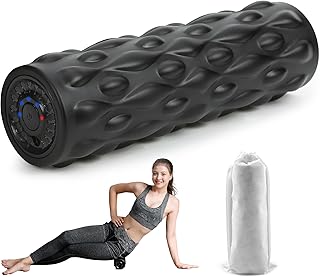
The Vibrating Massage Roller 3D Massage Particles takes a different design approach from the smoother-surface options in this guide. Its patented 3D textured outer shell concentrates pressure into specific contact points rather than distributing it across a broad, even surface — a design aimed at addressing trigger points and stubborn adhesions more directly. With 32 reviews averaging 3.6 out of 5 stars on Amazon UK, it is one of the more polarising options here, and that warrants a candid look at what the mixed feedback reflects.
The 3D particle design is the central idea. Rather than a uniform surface, the textured exterior creates zones of higher localised pressure that engage differently from a standard roller. For users who respond well to intense, pinpointed contact — the type who come away from a deep-tissue massage feeling better rather than bruised — this design has a logical appeal. Five vibration intensity levels add a further dimension of control, and the USB rechargeable system keeps charging practical without proprietary connectors.
The 3.6-star average deserves direct engagement. The feedback patterns split into two recurring concerns: battery consistency being shorter than expected for some buyers, and the 3D surface feeling uncomfortable or too intense for others, particularly on bony or sensitive areas. The battery concern is a genuine quality consideration and the main reason this roller sits lower on the list than its design concept might otherwise merit. The surface intensity issue is partly a use-case fit question — if you are new to foam rolling or have sensitive tissue responses, the 3D texture at medium-to-high vibration is quite demanding. For experienced foam rollers who know they respond to deep, specific pressure and have been frustrated by smooth-surface rollers missing certain spots, that same intensity is the point.
The practical case for this roller over a standard smooth-surface alternative is specific: if you have persistent knots in the calf, mid-glute, or upper back that other rollers consistently miss, the 3D texture offers something meaningfully different. It is not a replacement for the Vulken’s broad coverage or the Therabody’s technology — it is a targeted tool for a particular kind of stubborn soreness.
Approach this one with measured expectations. It will not suit every user or every session type, and the mixed review pool reflects that clearly. But if you have already owned a smooth-surface vibrating roller and still have persistent spots that do not respond, the 3D texture approach is a legitimate avenue worth exploring.
Best for Occasional Home Use: High-Density Vibrating Foam Roller Black
The High-Density Vibrating Foam Roller Black sits in the mid-range price band with four customisable speed settings and a rechargeable battery. It is included here for completeness and as an option for buyers who have exhausted other choices in this tier, but with 20 reviews averaging 3.1 stars on Amazon UK, it is the most mixed-reviewed product in this guide — and that requires a frank assessment before any recommendation.
A 3.1-star average indicates that buyer experience is split rather than consistently positive. Satisfied buyers tend to highlight the straightforward operation and the price-to-size ratio for basic home use. The more critical reviews point to battery longevity falling short of stated specs after a month or two, and inconsistency in vibration intensity over extended use. These are the kinds of issues that do not surface in the first few days but emerge after several weeks, which suggests the lower rating reflects realistic long-term performance rather than first-impression disappointment.
Four speed settings provide a basic progression from gentle to firm, and the high-density foam offers reasonable firmness for general rolling. The rechargeable design is practical and avoids proprietary cables. For someone doing light, occasional rolling once or twice a week primarily at home — as a supplementary tool rather than a cornerstone of their recovery — the basics are present. But the review pool suggests relying on it as a daily driver for regular training recovery is likely to produce inconsistent results.
The honest position: if the budget will not stretch further, this roller covers the fundamentals. But if you can add a small amount to reach the PURSONIC’s price point, the better review record and lighter build are worth the difference. The 3.1 rating reflects a product that works acceptably for some buyers and underdelivers for others, and that inconsistency matters when recovery is something you are counting on being reliable. This is the one pick on this list where the caveat genuinely carries weight.
What to Look For in a Vibrating Foam Roller
- Vibration speed range and settings: Look for at least four distinct speed settings covering a range from around 1,500RPM at the gentle end to 3,500–4,000RPM at the top. A wider range lets you adapt the roller to different muscle groups and recovery states — lower frequencies for sensitive or recently worked areas, higher frequencies for dense muscles like the quads and glutes.
- Roller length: Standard lengths sit around 12–13 inches, which requires more repositioning to cover large muscles. A 17-inch roller covers more surface area in a single pass, particularly useful for back work and full-thigh rolling. If portability and bag space matter more than coverage area, a compact option is easier to carry daily.
- Battery life and charge type: Aim for at least 90 minutes of stated battery life at medium intensity, giving you roughly three to four 20-minute sessions per charge. USB-C is the most practical charging standard; micro-USB or proprietary connectors add inconvenience. Check charge time as well — a five-hour recharge cycle makes keeping a roller in daily rotation difficult.
- Surface texture: Smooth surfaces distribute pressure broadly and suit general post-workout soreness. Ridged, wave, or 3D-textured surfaces concentrate pressure more specifically and suit trigger point work. Neither is universally better — it depends on how your body responds to localised versus distributed pressure.
- Weight and portability: Lighter rollers (under 2.5 pounds) are practical to carry to the gym. Heavier options (above 5 pounds) stay more stable under bodyweight pressure for deep work but are harder to travel with. Weight matters significantly if you plan to carry the roller regularly rather than leaving it at home.
- Foam density: High-density foam does not compress significantly under bodyweight, making it more effective for sustained pressure work. Softer foam may feel more comfortable initially but tends to deliver less useful feedback across large muscle groups over time.
- App connectivity: Bluetooth integration adds precise frequency control, guided routines, and structured recovery programmes. It also adds phone dependency and a slightly longer setup process. Worth it for users who want structure and precision; unnecessary complexity for those who just want to roll out their legs before bed.
Verdict
For the majority of people managing regular post-leg-day soreness — training three to five times per week, dealing with typical DOMS in the quads, hamstrings, and calves — the Vulken Extra Long 17-inch Vibrating Foam Roller is the clearest recommendation in this guide. It has the largest review pool by a significant margin, the most consistent buyer feedback pattern, and the extended length that makes serious leg recovery practical rather than a slow, repetitive process. Four speed settings cover the range most gym-goers actually need, and the weight stays manageable enough to bring to the gym without reconsidering your bag setup.
If you already use Therabody products and want Bluetooth-controlled frequency precision, the Therabody Wave Roller is the logical next step. It is heavier and more expensive, but the app-driven control adds real value for methodical recovery routines and users who want guided sessions. For competitive athletes with daily training demands and a budget to match, the Hyperice Vyper 3 is the most professional-grade option available — though its limited Amazon UK review pool means you are buying largely on brand reputation rather than a wide pool of verified buyer feedback.
If you are just starting out and want to test whether vibrating foam rolling makes a real difference for your recovery before committing to a higher-priced option, the PURSONIC Vibrating Foam Roller is the sensible starting point. It is lightweight, simple to use, and well-reviewed enough to give you a fair trial of what the category can offer.
This guide was not commissioned by any brand, and no product featured here was paid for placement. All assessments are independent and based on publicly available specifications, verified buyer feedback patterns on Amazon UK, and category research.
Quick Comparison Table


![Vibrating Massage Roller 3D Massage Particles [Design Patent Obtained] Electric Foam Roller USB Rechargeable with 5 Vibration Intensities, High Durability ABS Foam Suitable for Gym/Home/Office/T](https://m.media-amazon.com/images/I/51hBr1bbGtL._AC_UL320_.jpg)


FAQ
Do vibrating foam rollers actually work for muscle recovery?
Yes — combining vibration with myofascial release pressure produces meaningfully better results than static rolling alone. Vibration appears to reduce perceived muscle soreness and improve range of motion post-exercise, and most people notice a difference within a few weeks of consistent use. Results vary between individuals, particularly in how much vibration intensity feels beneficial versus uncomfortable.
How long should I use a vibrating foam roller after leg day?
Most guidelines suggest 30 to 90 seconds per muscle group, working through your quads, hamstrings, IT bands, glutes, and calves. A thorough post-leg-day session typically takes 10 to 15 minutes. Move the roller slowly to locate adhesions rather than holding statically in a single painful spot — slow, purposeful movement tends to produce better results than pressing and holding.
Is it safe to use a vibrating foam roller every day?
For most people, daily use is safe and beneficial, especially if you train frequently. Listen to your body — if a particular area is acutely inflamed or you are managing an injury, rolling directly over it may aggravate rather than help. Use lower vibration settings on sensitive days and save the higher intensity for sessions when your muscles are well-recovered and receptive.
What is the difference between a vibrating foam roller and a percussion massager?
A vibrating foam roller applies oscillation across a broad surface while you use bodyweight as the pressure mechanism, making it efficient for covering large muscle groups quickly. A percussion massager uses a reciprocating head that drives into specific muscle points, making it more precise for isolated trigger points. Many regular trainers find the two tools complement each other rather than replacing one another.
Can I use a vibrating foam roller before training as well as after?
Yes, and it is worth doing. Lower vibration settings before exercise help increase blood flow, improve range of motion, and prepare the muscles you are about to work. Keep pre-training sessions shorter — around five minutes — and less intense than your post-training recovery sessions, so you are priming rather than fatiguing the muscles before you need them.
How much battery life do I actually need in a vibrating foam roller?
More than many buyers expect. Rolling for 15 to 20 minutes per session four or five times a week means you need at least 90 minutes of battery life per charge to avoid mid-week top-ups. Also check the charge time — a roller that takes four to five hours to recharge is harder to keep in daily rotation than one that quick-charges in 60 to 90 minutes.