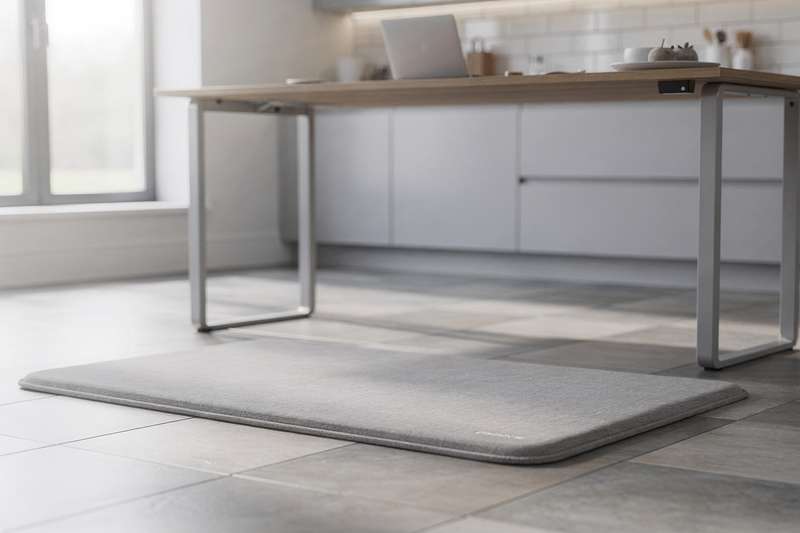
Standing on kitchen tiles for any length of time is a particular kind of punishment. Whether you have pushed a sit-stand desk into the kitchen to make the most of limited space, you are working at a kitchen island for long stretches, or you simply spend longer on your feet meal-prepping and dealing with emails in the same part of the day — the floor beneath you matters enormously. Glazed ceramic and porcelain tiles combine three separate problems: they are unyielding, they transmit cold directly into your feet, and their smooth surface sends poorly designed mats sliding the moment you shift your weight sideways.
You have probably tried a few workarounds already. The folded bath towel lasted until the first time you shuffled backwards and nearly went over on it. The cheap foam rectangle from the hardware shop compressed flat within a month. The decorative kitchen runner looks pleasant but delivers about as much cushioning as a sheet of card. The problem is that kitchen tiles require a mat that simultaneously insulates from cold, cushions without collapsing under daily use, and stays put on a slick glazed surface. That is a more specific brief than most general anti-fatigue guides acknowledge — this one is written precisely for it.
How These Picks Were Selected
Each mat was assessed against five criteria specific to kitchen tile use: foam density and long-term resilience under daily standing; thermal insulation from cold subfloor surfaces, which is particularly relevant for ground-floor kitchens in older UK properties; non-slip backing performance on smooth glazed tile; size suitability for typical UK kitchen layouts; and ease of cleaning given the inevitable cooking spillages. Where verified buyer review data was available, it directly shaped the assessment — two of the five products here have meaningful buyer review counts (805 and 36 respectively). The remaining three have limited or no buyer review data on the UK Amazon listing; for those picks, the assessment draws on manufacturer specifications, foam material properties, and general anti-fatigue mat category knowledge. Those sections are flagged clearly so you can weight the evidence accordingly.
Best for Kitchen Tiles Overall: Carvapet Non Slip Kitchen Mat Anti Fatigue Standing Mats
If you want a starting point backed by genuine buyer experience, the Carvapet Non Slip Kitchen Mat Anti Fatigue Standing Mats Cushioned Comfort Kitchen Floor Mats is the most extensively reviewed option in this shortlist, with 805 owners rating it an average of 4.2 out of 5 stars. That is the only product here with enough real-world feedback to draw patterns from, and for a guide focused on a specific use case — standing on cold kitchen tiles — that volume of experience is meaningful.
What makes the Carvapet particularly well-suited to kitchen tiles is its construction. Rather than a pure PU or EVA foam core, it uses a PVC-based waterproof construction with a cushioned inner layer. This combination does two things that matter in a kitchen environment: it resists spillages without soaking through or staining — cooking happens nearby, pans tip, liquids spill — and its non-slip backing is formulated for smooth hard floors rather than the carpet-gripping profiles that perform poorly on glazed tile. On polished porcelain in particular, one of the most challenging surfaces for mat adhesion, PVC backing maintains contact better than many fabric-bottomed alternatives.
The runner format is another kitchen-specific advantage. Where a square foam pad suits a fixed desk position, a runner can extend across the prep zone from hob to sink, approximating how you actually move in a kitchen rather than how you stand at a fixed desk. If you are working at a worktop rather than a stationary desk, covering more linear distance means fewer moments where you step off the mat and feel the contrast of cold hard tile. The Carvapet’s elongated proportions match this movement pattern well, and the product is available in multiple size variants — pay close attention to which size you are selecting at checkout, as the dimensions vary significantly between options.
The honest tradeoff: a PVC cushioned mat, while noticeably better than bare tile, does not match the anti-fatigue performance of the thicker pure-foam options elsewhere in this guide. If you are planning to stand for two or more hours continuously at a height-adjustable kitchen desk, the 20–25mm foam mats provide more meaningful fatigue reduction than PVC cushioning alone. The Carvapet sits more precisely as a high-quality kitchen comfort mat — excellent for moderate standing sessions, kitchen-appropriate in every practical sense, and straightforward to maintain — rather than a dedicated ergonomic tool for extended desk use.
Cleaning is one of the Carvapet’s clearest advantages: the waterproof surface wipes clean with a damp cloth, and it does not absorb cooking odours or retain grease the way fabric-backed mats do. Any mat living on a kitchen floor needs to be properly cleanable between uses, and the Carvapet handles this without effort. When you lift it to sweep or mop underneath, it is light enough to pick up easily and lays flat again without the curling edges that some foam mats develop after repeated displacement.
Best Dedicated Foam Anti-Fatigue Mat: Anti Fatigue Mat WODSTA 20mm Thick Anti Fatigue Standing Mat No-Slip
The Anti Fatigue Mat WODSTA 20mm Thick Anti Fatigue Standing Mat No-Slip is the highest-rated product in this shortlist with genuine buyer reviews behind it: 4.6 out of 5 stars from 36 verified purchasers. Thirty-six reviews is a modest dataset — treat the rating as a strong early signal rather than an established consensus — but consistent early ratings often reflect real quality, and the WODSTA’s specifications support the positive reception.
The mat measures 440mm by 720mm at 20mm thick. In practical terms, that is roughly 44cm wide by 72cm long — enough surface area to accommodate both feet with room to shift your weight, but compact enough not to extend into the walking path behind you in a narrow kitchen. UK galley kitchens can be as little as 80cm wide between counter and opposing wall, and a mat that reaches beyond its intended position becomes a trip hazard for anyone passing through. The WODSTA’s footprint appears sized with this constraint in mind.
The 20mm foam thickness is central to what this mat does on cold tiles. Thicker foam creates a thermal break between the cold subfloor and your feet — one of the less-discussed benefits of a proper anti-fatigue mat in a kitchen context. When you are on bare tile in winter, cold conducts directly through thin material. At 20mm, the WODSTA puts enough foam between you and the floor to make a noticeable difference in cold-weather standing, particularly in older UK properties with ground-floor kitchens and no underfloor heating. You will not feel warm in just socks, but the persistent cold-seeping-up sensation that makes bare tile unbearable in January is substantially reduced.
The no-slip base is described as designed for hard floors, which is the right specification for glazed kitchen tiles. Smooth, impervious tile is challenging for mat backing — many materials that grip carpet fibres slide freely on hard surfaces. The limited buyer feedback available does not flag sliding as an issue, which is a useful baseline indicator even from a small review sample. It is worth noting that 36 reviews is too small a pool to confirm durability over months of daily use, so the long-term compression behaviour of the foam remains an open question until more buyers report back.
Where the WODSTA has limits: the 20mm thickness, while cushioning well, sits below the 25mm option described later in this guide. For occasional standing of up to an hour, this difference is unlikely to be perceptible. For readers planning extended daily standing of two or more hours, that additional 5mm in the thicker option may translate into reduced leg fatigue over longer sessions. Additionally, the 440mm by 720mm footprint — while kitchen-appropriate — offers less lateral movement range than wider formats if you prefer to shift sideways or pace slightly as you think.
Best for Standing Desk Use Specifically: FLEXISPOT Standing Desk Anti-Fatigue Mat
The FLEXISPOT Standing Desk Anti-Fatigue Mat Comfort Kitchen Floor Mat Flat Kitchen mats Black comes from a brand with a specific standing desk heritage — and that distinction matters more than it might initially appear. FLEXISPOT manufactures height-adjustable desk frames, monitor arms, and ergonomic workstation accessories as their core business, which means this mat is engineered around the mechanics of prolonged standing desk use rather than being a kitchen floor product with standing desk compatibility added as an afterthought.
That background informs the design philosophy. A brand invested in the standing desk market understands the core problem: not just cushioning underfoot, but reducing the cumulative fatigue that builds during sustained standing in a relatively fixed position. Brands that primarily make decorative floor coverings approach mat design from an aesthetic and durability standpoint; brands whose primary products are ergonomic tools are more likely to treat comfort performance as the lead specification. For readers who genuinely intend to use the mat for extended work sessions at a kitchen-based height-adjustable desk — rather than primarily for cooking — that starting point makes a practical difference to the engineering priorities.
The flat design is appropriate for kitchen environments. Contoured terrain-style mats with raised islands and slopes are excellent at encouraging micro-movements during fixed desk use in a home office, but in an active kitchen where you are moving between worktop, hob, and sink, a raised terrain surface underfoot becomes a hazard rather than a benefit. The FLEXISPOT’s flat construction works equally well whether you are in a static desk position or moving around the kitchen during cooking.
The significant limitation to flag directly: this product currently carries no verified buyer reviews on the UK Amazon listing. The assessment here is based on the manufacturer’s specifications and the brand’s track record in the standing desk market, not buyer feedback. If you are cautious about purchasing without review validation — entirely reasonable — the Carvapet and the WODSTA are the more evidenced choices. The FLEXISPOT earns its place in this shortlist on brand credibility in the standing desk niche; check the current listing for any updated buyer feedback before committing. The black finish is a practical kitchen choice, less likely to show the scuffs and cooking splatters that kitchen floors accumulate than lighter colourways.
Specific dimensions and foam thickness were not fully detailed in the UK listing description at the time of assessment. Verify these at checkout against your standing position requirements — the flat foam anti-fatigue construction is appropriate for tile use, but confirming the size before purchasing is sensible given that information gap.
Best for Long Worktop Stretches: 25mm Extra Thick Anti Fatigue Floor Mat 100L x 50W cm
The 25mm Extra Thick Anti Fatigue Floor Mat 100L x 50W cm, Kitchen Mat, Standing Desk Mat, 140D Advanced PU Foam has the strongest specification on paper of any mat in this guide, and the two numbers that matter most are right there in the title: 25mm thick and 100cm long.
Twenty-five millimetres of foam is a substantial thickness for an anti-fatigue mat. Most mainstream options in the UK market sit at 18–20mm; the step up to 25mm delivers a meaningful increase in both cushioning underfoot and — critically for kitchen tile use — thermal insulation from cold subfloor surfaces. The physics are straightforward: thicker foam traps more air within its structure, creating a better thermal barrier between the cold tile and your feet. If you are on a ground-floor kitchen in winter, particularly in an older property without underfloor heating, this thickness advantage is not trivial. It is the difference between a mat that reduces tile cold and one that effectively removes it from your awareness during a standing session.
The 100cm by 50cm footprint — a full metre of length — is the other key differentiator. Standard mats typically measure 60–75cm long, which suits a fixed desk position but limits movement range if you like to step in place or shift your stance frequently. A full metre of standing length gives you substantially more room to distribute weight across different positions without stepping onto bare tile. For readers working at a kitchen island spanning two or more metres of counter space, positioning this mat at the most-used section creates a comfortable ergonomic zone without covering the entire floor area.
The 140D Advanced PU Foam designation points to a specific quality of foam construction. In anti-fatigue mats, foam density is the key variable for long-term performance — higher-density foam resists permanent compression better than lower-density alternatives, maintaining its cushioning properties over months of daily use rather than flattening within weeks. Cheap foam mats feel adequate on day one but fail quickly under regular standing load; a mat specifying a denser foam formulation is more likely to remain effective as a long-term standing desk companion.
The limitation to flag directly: this product currently carries no verified buyer reviews on Amazon UK. Without real buyer feedback, it is impossible to confirm whether the non-slip base grips glazed tile as described in practice, how the foam holds up under heavier users over time, or how pronounced the off-gassing smell is in a kitchen environment. The specifications are credible and the foam type is appropriate for the use case; this mat is included on the strength of its spec sheet rather than crowd-sourced experience. If certainty from other buyers matters to you, the Carvapet is the safer choice. Other size variants in the same product line are available if the full 100cm length is more than your kitchen layout can accommodate.
Best Budget Compact Option: Art3d Anti Fatigue Mat – 1/2 Inch Cushioned Kitchen Mat
The Art3d Anti Fatigue Mat – 1/2 Inch Cushioned Kitchen Mat – Non Slip Foam Comfort Cushion for Standing Desk, Office or Garage Floor is the most accessible entry point in this shortlist — and at its price point, it covers the anti-fatigue basics without the premium foam thickness of the more expensive options.
The dimensions — 17.3 inches by 28 inches, which translates to roughly 44cm by 71cm — make it a compact standing mat suited to smaller kitchen positions. If your kitchen has limited floor space around the worktop and you cannot fit a larger mat without creating a trip hazard in the traffic lane behind you, the Art3d’s footprint is practically useful. Narrow UK galley kitchens and compact open-plan flats often have tight floor constraints, and a mat that fits the space without dominating it addresses a real problem. The same product is available in alternative colourways under a separate listing if the particular variant shown is out of stock.
The 1/2-inch (approximately 12.7mm) foam thickness is where the main tradeoff appears — particularly for the cold tile scenario this guide addresses. Twelve-point-seven millimetres is noticeably thinner than the 20mm WODSTA or the 25mm Extra Thick option, and this difference matters in two ways. First, cushioning: at half an inch, you will notice a clear improvement over standing on bare tile, but fatigue reduction during extended standing sessions is more modest than with thicker alternatives. For standing of 30 to 45 minutes at a stretch, this is workable. For readers planning to stand at a kitchen desk for two or more hours per session, the thinner foam will reach its limits earlier than the thicker options. Second, thermal insulation: a thinner foam layer means a thinner thermal barrier from the cold subfloor. On cold tiles in a poorly heated kitchen, 12.7mm is better than nothing — noticeably so — but it will not fully eliminate the cold sensation the way 25mm will.
That said, the Art3d makes sense for readers with specific constraints. Budget is the obvious one: getting meaningful, if modest, anti-fatigue improvement on a cold tile floor for less outlay is a reasonable position, particularly if you are new to standing desk use and uncertain how much time you will actually spend on your feet. Art3d produces various flooring and decor products; their foam mat construction includes a non-slip backing described as suited to hard floors, which is the right profile for kitchen tile use.
The limitation to flag directly: like several other picks in this shortlist, the Art3d currently has no verified buyer reviews on the UK Amazon listing. The assessment is based on manufacturer specifications and category knowledge rather than confirmed buyer outcomes. At the budget price tier, the financial risk is lower, but factor in the limited evidence base when deciding. For the most buyer-validated choice at an accessible price, the Carvapet remains the better-evidenced recommendation; the Art3d appeals specifically when the compact dimensions and lower price point are the deciding factors.
What to Look For When Buying a Standing Mat for Kitchen Tiles
- Foam thickness and thermal insulation: For cold kitchen tiles specifically, aim for at least 20mm of foam. The additional material creates a thermal barrier that meaningfully reduces the cold coming up from the subfloor. Mats under 15mm improve comfort over bare tile but will not fully address cold transfer on unheated ground-floor kitchens. Twenty-five millimetres is noticeably more effective in very cold conditions.
- Non-slip backing for hard floors: Not all non-slip backings perform equally on glazed tile. Look for backings described specifically for hard floors or tile — rubberised PVC backings and suction-pattern bases tend to grip smooth tile better than fabric-texture backings designed for carpet use. Checking this specification before purchasing avoids the frustration of a mat that slides the moment you shift your weight.
- Foam density and long-term resilience: Cheap foam flattens quickly under daily use. Higher-density foam retains its shape and cushioning over months and years. Manufacturers sometimes list a density rating; if no density specification is given at all, that is a gap worth noting. A mat that degrades within three months offers poor value regardless of the initial price.
- Waterproof or wipeable surface: Kitchen mats live in a spill zone — oil splatters, water from the sink, food prep liquids. A surface that wipes clean with a damp cloth without absorbing liquids, grease, or food residue is non-negotiable. Avoid fabric-topped mats in kitchen environments unless they are machine-washable, and even then factor in the inconvenience of frequent washing cycles in a busy household.
- Bevelled edges: Squared edges that stand proud of the floor are a trip hazard in a kitchen where you are moving quickly between worktop, hob, and sink. Properly bevelled (tapered) edges lie flush against the floor surface and are significantly safer. If an edge starts to curl upward after a few weeks, that indicates a quality issue — and a specific hazard in an active kitchen environment.
- Size relative to your standing position: The mat should be wide enough to accommodate both feet with room to shift laterally. As a practical minimum, 40cm by 60cm works for a fixed position; 50cm by 80cm or larger is more comfortable for extended sessions where you move your feet frequently. For worktop use rather than a fixed desk, a runner format covering 80–100cm of linear length better reflects how you actually stand and move along a kitchen counter.
- Off-gassing in food environments: New foam mats typically emit a chemical smell that is particularly noticeable in a kitchen where you are also cooking and tasting food. Allow a new mat to air in a well-ventilated space for several days before bringing it into full kitchen use — this is a practical consideration in a food preparation area, not just an aesthetic one.
Verdict
For most readers landing on this guide — standing on cold glazed ceramic or porcelain tiles at a kitchen worktop or height-adjustable desk — the Carvapet Non Slip Kitchen Mat Anti Fatigue Standing Mats Cushioned Comfort Kitchen Floor Mats is the most defensible choice. It is the only product here with a substantial buyer feedback pool, its waterproof PVC construction handles kitchen spills without degrading, and its non-slip backing is formulated for the smooth tile surfaces that defeat less specialised mats. With 805 reviews at 4.2 out of 5 stars, you have real-world evidence that it performs in the environment this guide is written for.
If your priority is maximum cushioning and thermal insulation — if your kitchen is genuinely cold and you plan to stand for extended daily sessions — the 25mm Extra Thick Anti Fatigue Floor Mat 100L x 50W cm makes a compelling case on specification alone. The 25mm foam thickness and full-metre footprint directly address the cold tile problem at scale. The risk is the complete absence of buyer reviews; the reward is a specification purpose-built for the issue.
For the middle ground — a dedicated foam mat with encouraging early buyer signals — the WODSTA at 4.6 stars from 36 reviewers is worth considering, particularly if you want pure foam cushioning rather than a PVC-construction kitchen mat. Any of these five options will bring a meaningful improvement over standing on bare tile; the question is which tradeoffs between verified evidence, thickness, and format best suit your specific kitchen layout and standing habits.
We were not paid to feature any specific product in this guide. All opinions are independent and based on publicly available specifications, verified buyer feedback patterns, and category research.
Quick Comparison Table


FAQ
How thick should a standing mat be for cold kitchen tiles?
For cold kitchen tiles, 20mm is a practical minimum — at that thickness, the foam creates a genuine thermal break between the cold subfloor and your feet. If your kitchen is particularly cold (ground floor, older property, no underfloor heating), 25mm is noticeably more effective. Mats under 15mm provide cushioning but will not fully address the cold-transfer problem on unheated tile floors, even if they improve comfort compared to standing on bare tile.
Will an anti-fatigue mat stay in place on smooth glazed tiles?
Whether a mat stays put depends primarily on the backing material. Rubberised PVC backings and suction-pattern bases designed specifically for hard floors grip glazed tile far better than fabric-texture backings made for carpet use. Always check the product description for hard floor or tile compatibility. New mats also tend to grip better once they have had a day or two to relax completely flat after unrolling — the natural curl from packaging reduces the effective contact area of the backing against the tile.
How long do anti-fatigue foam mats last before losing their cushioning?
Quality PU foam at adequate density typically retains most of its cushioning for one to three years of daily use under a typical adult. Low-density foam can flatten visibly within weeks of regular standing. The practical test: step off the mat and watch whether it springs back immediately. If it stays compressed for more than a second or two, or shows a visible permanent indentation, the foam density was insufficient for the load and frequency of use.
Can I use a standing desk mat in a kitchen with underfloor heating?
Most foam anti-fatigue mats are compatible with underfloor heating systems, but thick foam does partially insulate the heat, reducing system efficiency slightly — you may find the heating needs to work a little harder to reach the set temperature. Always check the manufacturer’s guidance for maximum recommended floor temperatures before placing a thick foam mat over an underfloor heating circuit. PVC-construction mats are generally more tolerant of gentle floor heat than dense foam alternatives.
What is the difference between a kitchen runner and an anti-fatigue mat?
A kitchen runner is primarily a decorative floor covering — typically woven or printed fabric designed to protect the floor surface and look presentable. An anti-fatigue mat is an ergonomic product engineered to reduce fatigue during prolonged standing, using foam or structured PVC cushioning with comfort performance as the primary design aim. Some products bridge both categories by combining a runner format with real cushioning. For extended standing desk use, a dedicated foam anti-fatigue mat will outperform a purely decorative runner by a significant margin.
Should I choose a foam mat or a PVC kitchen mat for standing on cold tiles?
Foam mats — PU or EVA foam — typically provide better cushioning and better thermal insulation from cold subfloors, making them the stronger choice if reducing fatigue during longer standing sessions is the main concern. PVC-construction mats are more waterproof, easier to clean, and more practical against kitchen-specific hazards like spillages and grease. If you are standing for shorter sessions but need a mat that survives kitchen life without constant maintenance, a PVC-cushioned mat handles the environment well. For long daily standing sessions on a very cold floor, thicker foam addresses both the ergonomic and thermal problems more directly.