When One Size Never Fits All
You open the fridge on a Tuesday evening to find last night’s pasta sitting in a bowl covered with a dinner plate balanced at an angle, doing almost nothing to keep it fresh. On the shelf below, half a tin of chopped tomatoes has been wrapped in a scrap of cling film that’s already peeling off at one side. Somewhere in a drawer is a set of those rigid plastic lids that came with a long-lost food storage set — two of them fit nothing you actually own, and the third has a crack running through the rim.
This is the everyday reality of trying to keep food fresh without a unified system. Your kitchen contains bowls in four different sizes, mugs, glass jars, half-cut vegetables that don’t fit anything, and the occasional saucepan you want to pop in the fridge. What you need is a set of lids that stretches — literally — to cover all of them.
Reusable silicone stretch lids are the straightforward answer. They grip around the rim of almost any container, create a seal without suction cups or clips, and go straight into the dishwasher afterwards. But not every set is equally good. Some are too thin and split after a few months, some don’t include large enough sizes for mixing bowls, and some have a critical weakness that most marketing copy never mentions: they don’t seal reliably on a wet rim. Understanding which set handles your specific mix of containers — from a small espresso cup to a wide salad bowl — is what this guide is about.
How These Picks Were Evaluated
The criteria used to assess each pick below were drawn from verified buyer feedback patterns across hundreds of reviews, published product specifications, food-safety certification requirements, and the practical reality of everyday kitchen use in the UK.
Key factors considered: the range of sizes included in each set and whether they genuinely span small, medium, and large containers without awkward gaps; the thickness and durability of the silicone (thinner lids tear sooner and lose their grip faster); whether the set carries credible food-safety certifications such as BPA-free and food-grade compliance; ease of stretching and removing, particularly for older users or anyone with limited hand strength; dishwasher, microwave, and freezer compatibility; and honest tradeoffs identified by real buyers over extended use. Price-per-lid ratio was also factored in, since a cheap set that lasts six months is worse value than a more expensive one lasting three years.
Best Overall: The 6-Size Versatility Set
If you have a typical UK kitchen with a random assortment of bowls, mugs, plates, and glass jars, a set covering six distinct sizes is almost always the right starting point. The best examples of this format include two small lids (roughly 6–8 cm diameter) for cups, cans, and small ramekins; two medium lids (around 10–13 cm) for cereal bowls, soup mugs, and standard tins; and two large lids (14–18 cm) for mixing bowls, pasta bowls, and wide pots. That spread means you’re unlikely to reach for the drawer and find nothing that fits.
What makes a good versatility set is the consistency of the silicone across all sizes. The stretch-to-seal mechanism only works when the material has uniform elasticity — if the large lids feel floppy while the small ones feel stiff, you’ve got a quality-control problem that will show up as failed seals and early splitting. Look for sets where all lids feel similarly pliable and return to their original shape quickly after stretching. Pull tabs are a small but genuinely useful detail: they make removal far easier, especially when lids have been in the freezer and the silicone has stiffened slightly.
The main honest tradeoff with any round versatility set: they work best on round and oval containers. Square or rectangular containers get covered, but the corners don’t seal tightly and the lid tends to dimple at the edges. If more than half your containers are square, this type of set will frustrate you — see the rectangular-specific pick further down instead.
One caveat worth repeating across the whole category (not just this pick): silicone stretch lids rely on dry contact to grip. A wet rim — from washing, condensation, or wet food — dramatically reduces the seal. This applies to all silicone stretch lids regardless of brand or price. Always dry the rim before fitting any lid. It sounds like a small thing, but it’s the single most common complaint in negative reviews across every set in this category.
Best Budget Pick (Under £7): The Pull-Tab Multi-Pack
A no-frills set priced under £7 is worth considering if you’re testing the format for the first time, if you want a spare set for the office kitchen, or if you simply want the lowest possible cost-per-lid. Sets in this price band typically offer five or six lids in assorted sizes — usually a roughly equivalent spread to the versatility set above, but made with slightly thinner silicone and with fewer quality-control checks.
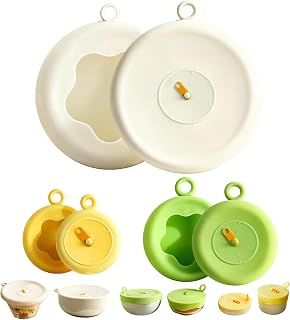
At this price, you should expect the silicone to be thinner — typically around 2 mm compared to 3–4 mm on premium sets. Thinner silicone stretches more easily, which some users prefer, but it’s also more prone to tearing if overstretched, less resistant to sharp edges around a can rim, and tends to lose its elasticity faster under repeated dishwasher cycles. Budget sets also more commonly use plastic reinforcement rings at the rim edge rather than pure silicone construction, which can affect the seal on uneven container edges.
That said, many budget sets genuinely last a year or more with careful use. The key is not to overstretch them — if a lid is straining to cover a container, go up a size rather than forcing it. With reasonable treatment, these represent solid value. The pull tabs on better budget options are robust enough not to tear away from the body, which is the failure point to watch for on cheaper versions — check that the tab is integral to the lid rather than a separate piece bonded on.
Budget sets are less suitable for regular microwave use. While most are technically microwave-safe, thinner silicone can warp slightly under prolonged microwave heat cycles, affecting the seal over time. For occasional reheating they’re fine; if you microwave daily, invest in the higher-rated sets below.
Best for Small Containers: The Small-Focused 12-Pack
This pick solves a specific problem: you have a lot of small containers. Espresso cups, baby food jars, standard baked-bean tins (roughly 7 cm across the opening), soda cans, half-used tins of coconut milk, small ramekins, shot glasses — none of these are well-served by a standard mixed set, which usually includes only one or two small lids and four to six medium and large ones.
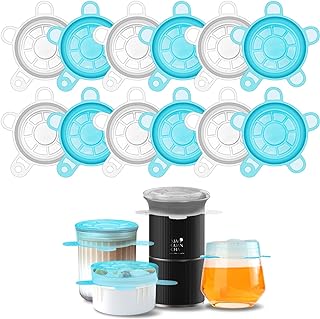
A 12-pack focused on the 6–10 cm diameter range gives you plenty of lids for this size category, in multiple colours (which makes it easy to tell at a glance which size you’re grabbing). Look for sets in this category that are independently lab-tested for food safety — the best ones carry explicit BPA-free, lead-free, and phthalate-free certification rather than just a generic “food-grade silicone” claim. That distinction matters if you’re covering baby food or drinks.
The honest limitation of small-focused sets is that they work best when the container rim matches the lid size closely. With larger round sets, you can stretch a medium lid over a slightly larger bowl and still get a seal. Small lids don’t have much stretch headroom — if you try to force a 6 cm lid over a 9 cm opening, the tension is too high and it will either pop off or not seal properly. These are precision fits, not universal stretchy covers. So use them for what they’re designed for: small, consistently-sized containers.
Critically — and this applies with extra force to small lids — dry the container rim before fitting. Small lids have less surface contact area than large ones, so any reduction in grip from moisture has a proportionally bigger effect on the seal. This isn’t a flaw unique to any one product; it’s a physical reality of how silicone grip works. Dry the rim, press the lid on firmly, and you’ll get a reliable seal. Skip the drying step and you’ll get leaks.
Best for Microwave and Oven Use: The High-Temperature Set
Standard silicone stretch lids are usually safe for microwave use up to around 120 °C — fine for reheating but not for prolonged oven cooking. If you want lids you can leave on while something heats in the oven, you need a set specifically rated to higher temperatures, typically around 220–230 °C. Note that the Comparison Table reflects the published specs for each set: standard sets cap at roughly 120 °C for microwave use, while high-temperature sets are rated to around 220–230 °C for oven use. These are meaningfully different products for meaningfully different purposes.
Sets in this category are typically made with thicker, denser silicone that retains its shape under sustained heat. They also tend to include both round and square/rectangular shapes, which makes them more versatile for oven dishes. Sizes usually run from around 6 cm to 20 cm, covering everything from small ramekins to standard 20 cm square baking dishes.
There are two genuine tradeoffs at this end of the market. First, the thicker silicone is stiffer to stretch, which makes fitting and removing lids slightly more physical work — not a problem for most people, but worth noting if you have arthritis or reduced hand strength. Second, the higher price point (typically £12–£18 for a good set) means you’re spending more for a capability you may rarely use if you mainly want fridge storage rather than oven use. Be honest about your actual use case before paying the premium.
One thing to look for with microwave-safe lids specifically: vented designs are available at this price point and are worth seeking out. A small steam vent prevents pressure buildup under the lid during microwave use, which means less splatter, safer removal, and no risk of the lid being forcefully displaced. Unvented lids work fine for short microwave bursts but can lift or distort under longer heating cycles.
Best for Leakproof Sealing: The Small Tight-Grip Set
For situations where you’re actually carrying food — packed lunches, transporting a bowl to a colleague’s kitchen, taking food on a short car journey — a standard silicone stretch lid isn’t always enough. The grip has to be tighter, the silicone thicker at the rim edge, and the seal more consistently reliable across different surface textures (glass, ceramic, stainless steel).
Leakproof-rated sets in this category tend to be smaller (covering the 6–9 cm range) and are engineered around maximum grip rather than maximum stretch range. They’re not designed to cover wide mixing bowls — they’re designed to keep a cup of soup sealed when it’s in a bag. Reviews for the best options in this category consistently confirm that the liquid stays in even when the container is turned upside down. That’s the standard to look for in buyer feedback: “turned it upside down” or “carried in a bag without spilling.”
The tradeoff is selectivity: these lids work best within a narrow size range. If you stretch them too far, the seal becomes less reliable because the silicone thins out at the edges. And — consistent with the rest of this category — they only leakproof on a dry rim. On a wet or damp rim, even the best leakproof lids will allow seepage. That’s worth flagging clearly because people buying specifically for transport are most likely to discover this limitation at the worst possible moment.
For transport use, also look for whether the set comes with a storage pouch or case. It’s a small detail, but lids loose at the bottom of a bag attract grime quickly, and a pouch keeps them clean between uses.
Best for Rectangular Containers: The Purpose-Shaped Rectangular Set
If your food storage is dominated by rectangular containers — meal prep boxes, loaf tins, square baking dishes, rectangular fridge-drawer trays — round silicone stretch lids are the wrong tool. You can pull a round lid over a rectangular container, but you’ll get poor sealing at the corners, wasted material bunching at two sides, and a lid that pops off under the slightest pressure. A purpose-shaped rectangular lid set solves this properly.
Rectangular silicone stretch lids are cut to match standard rectangular aspect ratios — typically around 1:1.5 and 1:2 ratios — and stretch uniformly across all four edges rather than four separate points. The seal is genuinely better on a rectangular container than any round lid forced to the same job. They usually come in small, medium, and large variants covering roughly 10 × 7 cm up to 25 × 18 cm.
The honest limitation: rectangular lids don’t work well on round containers. If your kitchen is a mix of round and rectangular, you’ll need both types. A combined purchase — one round versatility set plus one rectangular set — covers essentially every container shape you’re likely to own. The total spend is still less than replacing rigid-lid plastic containers, and the lids last years with decent care.
Check thickness on rectangular sets carefully. Because the corners have to stretch diagonally — a more demanding movement than uniform radial stretch — thinner silicone tends to split at the corner bend points first. Look for sets that explicitly mention corner reinforcement or use silicone of at least 3 mm thickness throughout.
Best for Long-Term Durability: The Thick-Silicone Premium Set
If you’ve been through two sets of budget lids in eighteen months and you’re done replacing them, a premium thick-silicone set is worth the higher upfront cost. Sets in this category use silicone that’s noticeably denser and heavier than standard options — you can feel the quality difference immediately when you handle one. They don’t stretch quite as effortlessly as thinner lids, but they resist tearing, maintain their elasticity after hundreds of dishwasher cycles, and hold their shape without warping over time.
Durability-focused sets typically come in packs of six to eight, covering the full size range, and are priced at £10–£15. The cost-per-lid is higher, but the lifespan is proportionally longer — buyers who’ve used these sets consistently report two to three years of daily use without significant degradation. That compares favourably to budget sets that often show wear within six to twelve months.
What to look for when evaluating durability claims: silicone thickness (thicker is better; 3–4 mm is a reasonable benchmark), whether the pull tab is integrated into the lid body or bonded on (integrated is more durable), and whether the ribbed grip pattern on the underside is deep and consistent. The ribs are what create the seal — shallow or uneven ribs mean a less reliable grip, especially on smooth ceramic or glass rims.
The tradeoff: heavier, thicker silicone requires more hand strength to fit and remove, which matters if you have limited dexterity. And at this end of the market, you’re paying for longevity and consistency rather than a fundamentally different user experience — the lids do the same job as cheaper versions, just more reliably and for longer.
What to Look for When Buying Silicone Stretch Lids
- Size range and coverage: Count your actual containers before buying. Most sets cover five to six sizes, but the specific diameter range varies. A set spanning 6 cm to 25 cm covers far more ground than one spanning 8 cm to 18 cm. Measure your largest bowl and smallest jar before committing to a set.
- Silicone thickness and quality: Thicker silicone (3–4 mm) lasts longer and seals more consistently. Thinner silicone (under 2.5 mm) is easier to stretch but tears sooner and loses elasticity after repeated dishwasher cycles. If a set feels flimsy on first handling, it probably is.
- Food-safety certification: Look for BPA-free, food-grade silicone with explicit testing documentation rather than vague claims. The best sets are independently lab-tested and list certifications (FDA, LFGB, or EU food-contact standards). This matters especially if you’re covering children’s food or drinks.
- Temperature ratings and actual use case: Standard lids are microwave-safe to around 120 °C — adequate for reheating. Oven-safe sets are rated to 220–230 °C. If you plan to use lids during oven cooking, confirm the temperature rating before buying; a lid rated for microwave use only will degrade or warp under sustained oven heat.
- Rim contact requirement (dry surfaces): This is the most underappreciated buying criterion in the whole category. Silicone stretch lids seal by gripping a dry surface. On a wet or damp rim — from washing, from condensation, or from a food surface — the grip fails and the seal leaks. This is not a defect of any particular product; it’s how the material works. Build drying the rim into your routine, and factor this in if you’re planning to use the lids on containers that come straight from the dishwasher or fridge.
- Container shape compatibility: Round lids work on round and oval containers. They cover rectangular containers partially but don’t seal the corners well. If you have a significant proportion of rectangular or square containers, buy purpose-shaped rectangular lids rather than stretching round ones over the corners.
- Pull tabs and ease of removal: A well-designed pull tab makes removing lids from cold or frozen containers much easier. Check that tabs are integral to the lid body (not bonded on) and positioned at the edge rather than the centre, which makes leverage easier.
Verdict
For most UK households with a typical mix of bowls, mugs, plates, and glass jars, the 6-size versatility set is the right starting point. It covers the widest range of container sizes without requiring you to think too hard about which lid to grab, it’s priced accessibly enough to be low-risk, and when you look after the silicone it’ll outlast several rounds of cling film and roll of foil.
If you have a lot of small containers (tins, cups, baby food jars), add a small-focused 12-pack to your order — the two sets together cover essentially every container size in a standard kitchen for under £20 total, which is hard to argue with on value grounds.
One reminder worth making one final time: whichever set you choose, dry the rim before fitting the lid. Every silicone stretch lid in this category depends on dry surface contact to create a seal. Get into that habit from day one and you’ll avoid the most common complaint across every product in this category — lids that “don’t seal properly” almost always turn out to be lids fitted onto damp rims.
If you microwave daily or cook with the lids on in the oven, the high-temperature set is worth the extra spend. For everyone else, the versatility set hits the practical sweet spot.
We were not paid to feature any specific product in this guide. All opinions are independent and based on publicly available specifications, verified buyer feedback patterns, and category research. Prices shown were accurate at time of writing and may change.
Quick Comparison Table




FAQ
Do silicone stretch lids work on all container shapes?
Round silicone lids work well on round and oval containers. They can be stretched over rectangular or square containers but won’t seal properly at the corners, so liquid and odours can escape. If most of your containers are rectangular, look for purpose-shaped rectangular silicone lids rather than relying on round ones stretched to fit.
Why does my silicone lid keep popping off or leaking?
The most common cause is a damp or wet container rim. Silicone stretch lids create their seal by gripping a dry surface — any moisture on the rim significantly reduces that grip. Always dry the rim thoroughly before fitting the lid. If the rim is dry and the lid still pops off, the lid is probably too small for the container; go up a size.
Are silicone stretch lids safe to use in the microwave?
Most food-grade silicone stretch lids are safe in the microwave for standard reheating temperatures (up to around 120 °C). For longer or hotter microwave cycles, or for oven use up to 220–230 °C, look specifically for sets rated to higher temperatures — not all silicone lids are equal in this regard. Always check the manufacturer’s stated temperature range, and prefer vented lids for microwave use to allow steam to escape.
How do I clean silicone stretch lids?
The vast majority of silicone stretch lids are dishwasher-safe and can go on the top rack alongside other kitchenware. They can also be hand-washed with warm soapy water. Avoid abrasive scrubbers, which can scratch the surface and degrade the grip over time. Allow them to dry completely before storing — silicone takes slightly longer to dry than plastic, so laying them flat rather than stacking them helps.
How long do reusable silicone stretch lids last?
With normal use and regular dishwasher cleaning, a decent-quality set should last two to three years. Thinner budget lids may show wear (loss of elasticity, small tears near the rim) within six to twelve months, especially if regularly overstretched or used in the microwave daily. Thicker, premium silicone lids last longer but cost more upfront — the cost-per-use over two to three years typically makes them the better value choice.
Can I use silicone stretch lids on cans and tins?
Yes — covering opened tins (baked beans, tomatoes, coconut milk) is one of the most practical uses for small silicone stretch lids. A lid sized to fit a standard tin (around 7–8 cm diameter) creates a much better seal than cling film and is far easier to remove and refit. As with all silicone lids, dry the top rim of the tin before fitting the lid, especially if there’s condensation from the contents.