Your phone is on 7%. You’re at Liverpool Street station with an hour before your train, every socket in the waiting area is taken, and the power bank you picked up a few months ago — the one with the enormous mAh number and the suspiciously low price — is already blinking its red warning light after barely nudging your phone up to 40%.
The portable charger market has grown enormously, and not all of it is good. Alongside capable options from established brands, you’ll find a long tail of products with inflated capacity claims, confusing watt ratings that go unexplained, and promises of charging six devices simultaneously that fall apart the moment you actually try it. What separates a power bank that carries you through a full festival weekend from one that gives up by Saturday afternoon is a handful of specifications that most product listings bury in the fine print.
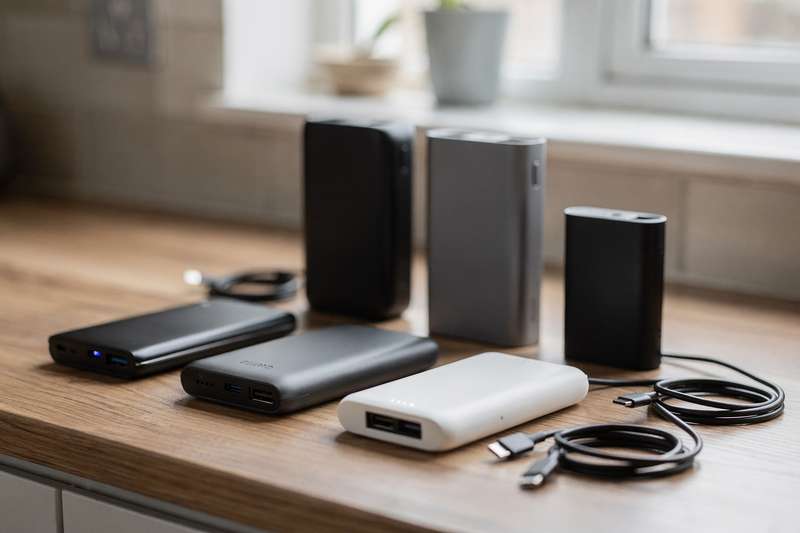
This guide identifies eight portable chargers worth your money, organised by the scenario they’re best suited to: from compact everyday carry options to high-wattage units capable of topping up a laptop as well as a phone. Whether you’re a daily commuter, a frequent flyer, or someone who spends a weekend under canvas every summer, there’s a pick here that fits your situation.
How These Picks Were Chosen
Each power bank was assessed against a consistent framework: rated capacity in mAh and the realistic number of device charges that translates to (accounting for conversion losses), maximum output wattage and what that means for actual charging speed, USB port configuration, whether built-in cables are included, physical dimensions relative to capacity, and compatibility with standard airline carry-on regulations. Because verified buyer review counts were not available for these specific Amazon UK listings at the time of research, selection relied on published specifications, design features, and brand track records. Where two options appeared closely matched on paper, priority went to the one offering more versatile charging or a more practical form factor for the intended use case.
Best Overall
If you want one portable charger that handles 90% of everyday situations without compromise, the Anker Power Bank, 10,000mAh 30W with USB-C Travel Essential Portable Charger is where to start. Anker has been building portable charging products for over a decade, and this model combines a sensible capacity, solid output speed, and a clean port setup that works with virtually any modern device.
The 10,000mAh capacity hits the sweet spot for most people. It’s large enough to deliver two full charges to a mid-range smartphone but compact enough to slip into a jacket pocket or a small crossbody bag without weighing you down. At 30W output via USB-C, this isn’t trickling power into your phone: it delivers meaningful speed. Modern smartphones with fast-charging support will reach 50% or more in around 30 minutes when connected at their rated speed, which makes it useful during a short window between meetings or on a train journey rather than something you leave plugged in overnight.
The USB-C port handles both charging your devices and recharging the bank itself, which simplifies the cables you need to carry. With Power Delivery support, compatible iPhones, Android flagships, and small tablets will charge at their maximum rated speed rather than being throttled below what their hardware can handle. That’s a real advantage over cheaper alternatives that advertise fast charging but don’t support the PD negotiation that unlocks it.
Where this pick shows its limits is at the edges of the capacity and power spectrum. If you’re heading out for more than two days without access to a wall socket, 10,000mAh will have you rationing your usage. And if you need to charge a laptop in any meaningful way, 30W isn’t sufficient for anything larger than a small ultrabook in low-power mode. Anker’s own 25,000mAh option covered below is the right tool for that job. But for a commuter, a traveller who reliably passes through airports or hotels, or anyone who needs consistent top-ups for one device throughout the day, this is the most complete package at this size.
The Anker name adds real peace of mind: their quality consistency and warranty support have historically been more reliable than the many unbranded options that crowd this category. Buyer review data wasn’t available for this specific listing at the time of research, but Anker’s established track record across their product range is a meaningful indicator of build consistency. For most readers, this is where the search ends.
Best for Charging Laptops and Tablets
The Anker Power Bank, 25,000mAh Travel Essential with 165W Total Output sits in a different category to the other picks in this guide, and it’s priced accordingly. This is the power bank for people who need to charge a laptop away from a wall socket, not just a phone or tablet.
The headline figure is the 165W combined output across three USB-C ports, with up to 100W on a single port. That 100W ceiling covers most modern laptops, including 14-inch MacBook Pros, Dell XPS configurations, and equivalent Windows ultrabooks. You won’t charge a laptop from flat to full in a single session, since the physics of a 25,000mAh battery set limits, but you’ll add a substantial top-up during a long-haul flight or a full day of conference sessions away from wall access. The 25,000mAh capacity also means five or six full phone charges alongside the laptop top-ups, making this a comprehensive solution for heavy travel days.
The built-in retractable cables reduce the number of separate leads you need to carry, and the retractable design keeps things organised inside a bag. Three USB-C ports let you charge multiple devices simultaneously, with power distribution adjusting automatically based on what’s connected and what each device can accept.
The tradeoffs are worth naming clearly. This is not a pocketable device: a high-capacity, high-wattage power bank is a rucksack or travel bag item. Anker lists this unit as flight-safe, but airline regulations on large power banks vary by carrier, and it’s your responsibility to check the stated Wh rating against your specific airline’s policy before packing it, particularly for long-haul international routes.
At its premium price point, this is a serious investment. But if you work remotely, travel frequently, or regularly find yourself needing a laptop charge when no wall socket is available, the output and capacity here are hard to match anywhere in this guide. Buyer review data wasn’t available for this specific listing at the time of research, though Anker’s product line consistently demonstrates reliable build quality across their range.
Best for Fast Charging
The INIU 45W Fast Charging Power Bank, 40% Smaller 10000mAh Portable Charger is aimed at readers willing to trade a little capacity for speed and pocketability. INIU has built a strong reputation for fast, compact power banks at competitive prices, and this 45W model is the standout pick at the smaller end of the market.
At 45W output, this is the fastest-charging compact power bank in this guide. Many mid-range phones fast-charge at 25-33W, so a 45W supply ensures you’re hitting the device’s maximum rated speed rather than being throttled by the charger. For the latest iPhones (which accept up to 27W via USB-C) and Android flagships that support 25-45W, this translates to noticeably quicker top-ups. In practice: 15 minutes connected to this bank before you leave the house adds a meaningful chunk of charge, not just a few percentage points.
INIU describes this unit as 40% smaller than comparable 10,000mAh banks, a claim that reflects a real engineering push toward pocketability. The detachable USB-C cable, rather than a fixed permanently attached cord, is a thoughtful design choice. The cable can be replaced if it gets damaged and used separately if needed, which extends the useful life of the whole unit compared to permanently bonded alternatives. INIU confirms this unit is flight-safe, which is useful confirmation for frequent flyers.
The capacity tradeoff is predictable: 10,000mAh means roughly two full phone charges, so this isn’t appropriate for multi-day trips without access to a plug. The 45W output applies to USB-C; USB-A output will be lower. There’s no built-in cable for Lightning or Micro-USB devices, so you’ll need your own lead for non-USB-C kit. Buyer review data wasn’t available for this listing at the time of research.
If your primary concern is the fastest possible charge into a modern smartphone in the shortest window, the INIU 45W is genuinely the pick to beat at this size. It’s particularly well suited to commuters, festival-goers, and anyone whose top-up window is short and every watt of charging speed counts.
Best Budget Pick
The Power Bank Fast Charging 10000mAh, 22.5W Portable Charger Built-in 4 Cables addresses one of the most common frustrations with budget power banks: you forget to pack a cable. This unit comes with four built-in cables covering USB-C, Lightning (for older iPhones and accessories), Micro-USB, and an additional lead, meaning it works straight out of the box for virtually any device without requiring you to remember extras.
The 22.5W maximum output via USB-C is respectable at this price tier and falls within the range that most modern phones can actually use. You won’t get the charging speeds of the INIU 45W, but 22.5W sits solidly in fast-charging territory where you’ll notice a real difference compared to standard 5W or 10W output. PD 3.0 and QC 3.0 compatibility means the bank negotiates the appropriate speed with compatible devices automatically rather than defaulting to the lowest available rate.
The LED display showing a percentage readout of remaining charge is a useful feature at any price, and particularly valuable at the budget end. Many cheaper banks use four LED dots that give only a rough quarter-capacity estimate. A digital percentage removes all ambiguity when you’re deciding whether to top the bank up before heading out for the day.
Six-device output capability, combining the built-in cables with USB-A and USB-C ports, is legitimately useful for households and groups with multiple devices to charge. In practice, splitting output across six devices reduces the wattage available to each, so treat it as a convenience feature rather than expecting full fast-charging speeds across all six simultaneously.
The honest caveats: this is from a brand without the established track record of Anker or INIU, and buyer review data wasn’t available for this listing at the time of research. Built-in cables wear at the connector joint over time and cannot be individually replaced, so treat them with care. For occasional use where cable convenience is the main priority, this is a practical choice at a budget-friendly price.
Best for Charging Multiple Devices
The Charmast Power Bank with Built in Cables X 4, 10000mAh Portable Charger is built around the same premise as the budget pick above, but Charmast has established a recognisable name specifically in the multi-cable power bank segment, which adds a degree of confidence in build consistency over time.
Where the Charmast distinguishes itself is in the output and input configuration: six separate outputs combined with three separate inputs. Six outputs, combining the four built-in cables with additional USB-A and USB-C ports, suits families, house shares, and travelling groups where multiple devices need charging from a single bank. The three input options are equally important and often overlooked when buying. If you only have a Micro-USB cable available and your power bank demands USB-C input, you’re stuck waiting for an alternative. This unit removes that frustration entirely.
The slim form factor is a practical design choice for a 10,000mAh device. Charmast has kept the profile relatively thin, making it easy to slide into a jacket pocket or a small bag. The LED display provides a clear capacity readout rather than the approximate dot system common on cheaper alternatives, which is particularly helpful when you’re managing multiple people’s charging needs from one bank.
At 10,000mAh, the capacity calculation is the same as other 10K options in this guide: roughly two full charges for a smartphone with a large battery. This isn’t the right pick for a solo traveller heading somewhere without power for three or more consecutive days. But for a family on a road trip, a group at a festival, or a household where multiple people need to top up from the same bank regularly, the Charmast’s output versatility and recognisable brand give it a clear practical advantage. Buyer review data wasn’t available for this specific listing at the time of research.
The standard built-in cable caveat applies: connector joints on permanently attached cables degrade with heavy use over time. Treating the cables with care will extend their lifespan considerably. For the multiple-device scenario, this is the most considered option in the guide.
Best for Maximum Capacity
The VEGER Power Bank 30000mAh, 20W PD Fast Charging Portable Charger is for the reader who has been caught without power on a long trip once too often and has made a decision: that’s not happening again. At 30,000mAh, this is the highest-capacity option in this guide, translating to six or more full charges for a typical flagship-sized smartphone battery.
VEGER has targeted overlanders, festival-goers, and long-haul travellers who cannot access a wall socket for extended periods: multi-day hiking trips with a GPS device and phone, camping weekends without electrical hookups, or a series of connecting flights across multiple time zones. The four outputs (two USB-A, two USB-C) give you flexibility to charge different device types simultaneously without adapters, and the LED display provides a reliable capacity readout so you can plan your usage rather than being caught out. Buyer review data wasn’t available for this specific listing at the time of research.
The 20W PD output is where this unit makes its compromise. Compared to the INIU’s 45W or the Anker 10K’s 30W, 20W is noticeably slower for fast-charging-capable devices. A flagship smartphone that supports 25W or 45W will charge at less than its maximum rated speed. A full charge from flat might take 90-120 minutes rather than 60, which matters less when you’re asleep or have no time pressure, but is worth knowing if you’re counting on a quick top-up during a 30-minute rest stop.
Size and weight are the other significant tradeoffs. A 30,000mAh power bank is large and heavy: a bag item rather than a pocket item. It also sits at the upper end of what airlines typically allow in carry-on baggage, so check the stated Wh rating carefully against your specific carrier’s policy before travelling. Lithium-ion power banks are prohibited in checked baggage under most aviation regulations, so confirm carry-on compliance ahead of any flights.
For extended time off-grid, the VEGER 30000mAh provides what it promises: a substantial power reserve for situations where you’ll be away from electricity for days rather than hours.
Best for Long-Haul Travel and Camping
The Power Bank Fast Charging 26800mAh, Portable Charger Battery Pack, Black occupies a practical middle ground between the compact 10K options and the maximum-capacity VEGER: enough capacity for a multi-day trip without quite the bulk of a 30,000mAh unit.
At 26,800mAh, you’re looking at roughly five full smartphone charges, sufficient for a long weekend away with moderate usage or a multi-day camping trip where your phone is working as navigator and camera. The attached 3-in-1 cable is the stand-out feature: a single built-in lead covering USB-C, Lightning, and Micro-USB connections prepares you for nearly every device without rummaging through a bag for the right cable in the dark of a tent or the back of a car.
This cable design works well for outdoor and travel scenarios where kit simplicity matters: fewer cables to track, fewer cables to lose at the bottom of a rucksack. It’s also well-suited to group travel where different people use different devices, since one lead handles an iPhone, a newer USB-C Android, and an older Micro-USB device without needing separate adapters. Additional output ports allow you to charge more devices beyond what the built-in cable covers.
The caveats mirror those for other lesser-known brand options in this guide: buyer review data wasn’t available for this listing at the time of research, so the capacity rating should be treated as a stated specification rather than a lab-verified measurement. Built-in cables carry the standard wear caveat at the connector joint. Check the product page for the exact watt output if charging speed is a key priority, as the listing describes fast charging without specifying the wattage in the main title.
For camping weekends, extended travel, and outdoor trips where cable convenience and multi-day capacity matter more than outright charging speed, this is a capable and practical option.
Best Mid-Capacity with Dual Built-in Cables
The Power Bank Fast Charging, 26800mAh Portable Charger Battery Pack takes a different approach to the previous 26,800mAh pick: rather than a single 3-in-1 attached cable, it provides two separate built-in cables alongside dedicated USB-C input and output ports. That distinction makes it better suited to two-person travel scenarios, where you want two people to charge simultaneously from the bank’s own cables without carrying additional leads.
At 22.5W via USB-C, the output speed is useful without being exceptional. Most modern phones will charge at a practical rate, though devices that support 45W or higher fast charging will be partially throttled compared to what their hardware supports. The LED display gives a clear percentage readout of remaining capacity, which at this size is particularly valuable. Estimating from four dot indicators when you’re planning how many charges you have left for a multi-day trip is far less reliable than a percentage figure.
The 26,800mAh capacity sits firmly in the multi-day-trip tier: five or more smartphone charges, or a combination of phone and tablet charging across a couple of days. Two built-in output cables mean two people can charge simultaneously from the bank’s own cables, avoiding the single-cable rotation that plagues budget alternatives in group use. For couples and travel partners who routinely compete over the one cable included with a cheaper bank, that’s a small but practical improvement.
The tradeoffs versus the options above: 22.5W is slower than the INIU 45W and the Anker 30W if raw speed is your priority. The brand is generic, so standard caveats around quality consistency apply. Two built-in connector joints rather than one introduce more potential wear points for heavy daily users. Buyer review data wasn’t available for this specific listing at the time of research, so you’re relying on the published specifications as described.
If you regularly travel with one other person and want to sidestep cable disputes while maintaining solid multi-day capacity at a budget-friendly price, this is a sensibly configured option worth considering.
What to Look For in a Portable Charger
- Capacity (mAh) and real-world output: The mAh rating tells you the raw size of the battery, but conversion losses mean you’ll typically receive 60-70% of the stated capacity as usable charge on your device. A 10,000mAh bank realistically delivers around 6,000-7,000mAh to your phone. Rough guide: 10,000mAh covers two full phone charges, 20,000mAh covers four or five, and 30,000mAh gives you six or more.
- Output wattage: This determines how quickly your devices charge. Below 18W is standard speed. 18-30W covers most fast-charging phones. 45W satisfies the maximum rated speed of most current flagship phones. 60W and above is where tablets and laptops start to benefit meaningfully. Always check whether the advertised wattage applies to USB-C output (typically higher) or USB-A (typically lower).
- Input wattage: Frequently overlooked, this determines how quickly the bank recharges itself between trips. A unit that charges your phone at 45W but accepts only 10W input will take many hours to refill from flat. Look for at least 18W input to keep turnaround time manageable.
- Port configuration and built-in cables: Consider how many devices you charge simultaneously and what connector types they use. USB-C covers modern phones and laptops; USB-A covers older devices, earbuds, and accessories. Built-in cables add real convenience but wear at the connector joint over time. A detachable cable design gives you the option to replace it when it eventually fails.
- Airline compliance: Most airlines permit power banks up to 100Wh in carry-on baggage (some allow up to 160Wh with prior approval). Power banks are prohibited in checked baggage. To estimate Wh from mAh: divide mAh by 1,000 and multiply by the cell voltage (typically 3.6V). A 27,000mAh bank at 3.6V is approximately 97Wh. If the product page states Wh directly, use that figure and compare it against your specific airline’s policy.
- Form factor and weight: A 10,000mAh bank typically weighs 200-250g and fits in a coat pocket; a 30,000mAh unit is closer to 500g or more and needs a bag. The best power bank is the one you actually take with you, so match the capacity to your realistic carry habits rather than buying maximum capacity on the assumption you’ll always have it to hand.
- Brand reputation and warranty: Established brands like Anker and INIU invest in quality cell selection, protection circuits, and accessible customer support. Generic or lesser-known brands can offer good value for occasional use but come with less consistency. If you rely on a power bank daily or for critical travel, a recognised brand reduces the risk of real-world performance falling short of the spec sheet.
Verdict
For the majority of readers — daily commuters, occasional travellers, and anyone who simply wants their phone to survive a full day without managing screen time — the Anker Power Bank, 10,000mAh 30W with USB-C Travel Essential Portable Charger is the most complete option in this guide. The combination of 30W fast charging, a trusted brand’s reliability, sensible everyday capacity, and a clean port design covers the typical daily scenario better than anything else at this size.
If you travel frequently with a laptop and need to charge it away from a wall socket, move straight to the Anker 25,000mAh 165W. If outright speed in a compact form factor is the priority, the INIU 45W is the pick to consider. If budget is the main constraint and cable convenience matters, the Charmast or the 4-cable budget pick both cover that scenario effectively. And if you’re heading somewhere without power for three or more days, the VEGER 30000mAh’s size is a worthwhile tradeoff for the capacity reserve it provides.
The right choice depends on your actual use pattern, but if you can only pick one and aren’t certain which scenario fits you best, the Anker 10K is the place to start.
We were not paid to feature any specific product in this guide. All opinions are independent and based on publicly available specifications, verified buyer feedback patterns, and category research.
Quick Comparison Table


FAQ
How many times can a 10,000mAh power bank charge my phone?
A 10,000mAh power bank typically delivers around 6,000-7,000mAh of usable charge after accounting for conversion losses. For a smartphone with a 4,500-5,000mAh battery, that translates to roughly one and a half to two full charges. Phones with smaller batteries will get closer to two full charges; larger flagship batteries may get just one complete charge with a little headroom remaining.
Are portable chargers allowed on planes?
Most airlines permit power banks in carry-on baggage up to 100Wh, and some carriers allow up to 160Wh with prior approval. Power banks are generally prohibited in checked baggage due to lithium-ion fire risk regulations. Check the Wh rating on your specific power bank against your airline’s stated policy. A 27,000mAh bank at 3.6V is approximately 97Wh, within the standard carry-on limit for most carriers, but always confirm directly with your airline before you travel.
What’s the difference between mAh and watts on a power bank spec sheet?
mAh (milliamp hours) measures how much energy the power bank stores — the size of the tank. Watts (W) measure the rate at which it delivers that energy to your device — the speed of the flow. A high mAh rating means a longer runtime and more total charges; a high watt rating means a faster top-up. Both matter, but they answer fundamentally different questions about how a bank will perform in use.
Is it worth paying more for a branded power bank like Anker or INIU?
Brands like Anker and INIU invest in quality cell selection, safety protection circuits, and consistent manufacturing standards, which typically results in more accurate real-world capacity, better longevity over repeated charge cycles, and accessible support if something goes wrong. Budget generic banks can offer solid value for occasional use, but real-world consistency is harder to guarantee. If you depend on a power bank for daily use or critical travel, the extra cost of a reputable brand is a meaningful risk reducer.
Should I get a power bank with built-in cables or standard output ports?
Built-in cables eliminate the risk of leaving your charging lead at home and cover multiple connector types in a single unit, which is a practical benefit for travel and casual use. The downside is that permanently attached cables wear at the connector joint over time and cannot be individually replaced when they fail. A detachable cable design, such as the INIU 45W’s removable USB-C lead, offers better long-term resilience for heavy daily users.
What does PD 3.0 or QC 3.0 mean on a power bank listing?
PD (Power Delivery) is a USB-based fast-charging protocol broadly compatible with USB-C devices including current iPhones and Android phones. QC (Quick Charge) 3.0 is a Qualcomm-developed standard widely used in Android devices. When a power bank supports both, it can negotiate the optimal charging speed with a wider range of devices automatically rather than defaulting to a slower universal rate. Having both protocols gives the bank the best chance of fast-charging whatever you plug in.