Picture the scenario: it’s a damp Saturday afternoon, third game of the season, and your club kicker lines up a conversion that would pull your side ahead by four points. He places the ball on the tee — one of those anonymous rubber nubs that’s been rattling around the kit bag since 2019 — and it tilts left on the soft turf. He resets it. It tilts again. He kicks anyway, and the ball drifts wide right. Two minutes later, the final whistle goes and those two points were the difference. The kicking tee never gets blamed. But it should.
Poor tees introduce variables that even polished technique can’t reliably cancel out: inconsistent ball angle from one kick to the next, a base that skids on wet grass, a cradle too shallow to hold a match ball firmly through your approach. You’ve probably tried the flat rubber nubs in the club’s training bag, or borrowed a teammate’s cracked plastic tee held together more by habit than integrity. The result is always the same — you can’t tell whether a missed kick was the kicker’s fault or the equipment’s.
This guide removes that uncertainty. All seven picks are available on Amazon UK, designed specifically for rugby union and league, and selected on the basis of genuine buyer feedback and meaningful design differences. Whether you’re a club player, a school team coach, or a specialist kicker looking to control every variable, there’s a tee here that fits your setup.
How We Chose These Tees
We assessed eight kicking tees available on Amazon UK, removing one pair of colour variants — two ASINs sharing an identical design and product name — to arrive at seven distinct products. The evaluation drew on aggregate buyer review patterns across each listing, with particular attention to durability reports after prolonged outdoor use in British conditions, stability comments on soft or uneven ground, and whether buyers found the ball reliably returning to the intended angle after repeated kicks. We also weighed the practical trade-offs between fixed-height designs (simpler, nothing to lose or break) and adjustable models (more versatile, more complexity). One product in the guide has a relatively small review sample, and that limitation is flagged clearly in its section. All seven tees are designed for rugby rather than American football, and suitability across both union and league was noted where relevant.
Best Overall Pick: Carta Sports Prince Kicking Supertee
The Carta Sports Prince Kicking Supertee tops this list for straightforward reasons: 4.7 stars from over 615 reviewers is the kind of consistency that’s hard to argue with, and the feedback patterns tell a coherent story about a tee that performs reliably across different conditions and player levels.
The Prince Supertee uses a soft rubber construction throughout, which gives it a gentle but firm grip on the ball rather than the rigid cradle you get with harder plastic tees. In practice, that matters because a rigid cradle can cause the ball to bounce slightly off-centre if your approach nudges it — soft rubber absorbs that contact. The base is wide enough to provide solid contact with the turf, and the overall weight of the tee prevents it from skittering across the surface on a windy day.
The reason this tee scores so well across a large sample comes down to consistency. Club-level reviewers frequently report that the ball angle stays true from one kick to the next without constant readjustment — which is exactly what you want when building muscle memory through repetition. Whether you’re working on conversions from the touchline or practising kickoffs from the halfway line, the Prince Supertee gives you a platform that removes one variable from the equation.
The trade-off is that this is a fixed-height tee. If you’re the type of kicker who experiments with different launch angles — lower for windy conditions, higher for distance work — you’ll find it limiting. There’s no adjustment mechanism, so what you get is what you get. For most club players and school kickers who simply want something that works every time, that’s not a problem. But if you’re a specialist kicker who actively fine-tunes ball position, consider supplementing this with an adjustable option for technical sessions.
On durability, the rubber construction resists cracking in cold conditions better than harder plastics, and reviewers who’ve had theirs for multiple seasons report no signs of splitting at the base. That longevity makes this excellent value. If you’re buying for a school team or a club and need something that will survive a full season of regular use in British weather, this is the tee to start with.
Best for Rugby Union and League: DAN CARTER Supertee King Rugby League Union Kicking Tee
The DAN CARTER Supertee King Rugby League Union Kicking Tee carries the name of arguably the finest fly-half of his generation, and while player endorsements can sometimes be pure marketing noise, the 4.7-star rating from over 524 reviewers suggests this one reflects genuine product quality rather than just a famous name on the packaging.
What makes the Supertee King practically useful is that it’s explicitly designed for both rugby union and rugby league. The two codes use the same ball shape, but place kicking styles and preferences can differ — particularly around tee height and ball angle for place kicks. The King’s design accommodates both, with a cradle geometry that works comfortably for the slightly different techniques favoured in each game. If you play both codes or coach at a club that runs union and league teams, this removes the need for separate tees.
The construction is firm rubber, sitting between the ultra-soft feel of some training tees and the rigidity of pure plastic. You get enough give to prevent the ball pinging off on contact, but enough resistance to hold position confidently once the ball is seated. Reviewers note that it performs well on hard, baked summer ground as well as soft, waterlogged winter pitches — a useful range for UK conditions where you might face both extremes in the same season.
The main consideration is that the Supertee King sits in the mid-range of this category’s pricing, and unlike the Optimum adjustable tee later in this guide, it doesn’t offer height adjustment. What you’re paying for is build quality and a design refined through multiple iterations — not additional features. For a club first XV kicker or a school first team player, that’s a reasonable trade-off. If you want adjustability, look at the Optimum Professional or Rhino Pro picks below.
One small practical point: the tee’s distinctive design makes it easy to spot on a pitch after a kickoff — useful when you’re coaching junior teams and need to retrieve scattered equipment quickly. Overall, the Supertee King is a confident choice for any serious club kicker who values cross-code reliability over the ability to adjust height on the fly.
Best for Club Teams: Rhino Club Kicking
The Rhino Club Kicking tee holds the highest review count in this roundup — 872 ratings at 4.5 stars — and that volume of feedback tells you something meaningful: this is the tee many clubs buy in bulk, and the one individual players come back to after trying other options.
Rhino is a well-established name in UK rugby equipment, and their Club tee sits at the practical, accessible end of their range. It’s a single-piece rubber design built to be robust rather than technically sophisticated. The base is wide and flat, giving it strong contact with the ground and preventing the rocking motion that affects narrower-based tees on soft pitches. The ball cradle is sized for a standard size 5 rugby ball, and reviewers consistently report that the ball sits at a reliable angle without needing attention between kicks.
Where this tee works particularly well is in a team setting where multiple people are using the same kit. Because it’s a one-piece design with no adjustable parts, there’s nothing to lose, break, or tamper with. Junior players and beginners especially benefit from this simplicity — the tee does its job without introducing any complexity around setup. Coaches buying for an age-group squad will find it ideal: accessible enough to buy several, durable enough to last a season without issues.
Durability feedback across the 872 reviews is strong. Multiple buyers report using the Rhino Club tee through a full season of weekly training and competitive match use without any cracking or splitting. The rubber compound holds up in cold British winter conditions, which is exactly where cheaper tees tend to fail first.
The limitation is, again, fixed height. The Rhino Club tee offers one ball position, and while it’s a well-judged height for most conversions and penalties, kickers who want to vary their setup for kickoffs or experiment with launch angle during training will need a second adjustable option. As a reliable, everyday tee for club use, it fully justifies its position as the most widely purchased option in this category.
Best Budget Pick: Lusum Rugby Kicking Tee
The Lusum Rugby Kicking Tee is the most accessible entry in this guide in terms of pricing tier, and with 4.3 stars from 235 reviewers, it offers solid performance rather than simply the lowest cost.
Lusum is a UK-based rugby equipment brand with a broad catalogue covering balls, training aids, and protective gear. Their kicking tee is a clean, no-frills rubber design that does the fundamentals well: a stable base, a ball cradle that holds a size 5 ball at a consistent angle, and rubber construction that resists cracking in cold or wet conditions. It’s not competing with premium tees on adjustability or design complexity — it focuses on doing the basics correctly and reliably.
Where the Lusum tee delivers particular value is for youth teams and junior coaching setups. If you’re running a mini or junior section and need to equip multiple groups for kicking drills without heavy expenditure, buying several Lusum tees gives you coverage across parallel training activities without stretching the budget. The straightforward design also means young players can pick up and use the tee immediately without any instruction around setup.
The trade-offs are honest and predictable. At this price tier, the rubber compound is softer and slightly less resilient than the material you get in Rhino or Carta products. Some reviewers note that after heavy use over a full season, the cradle shows minor compression — the ball seat becomes fractionally shallower over time. This doesn’t affect performance in the short to medium term, but if you’re expecting a single tee to last two or three seasons under high-frequency use, you may need to replace it sooner than with a pricier option.
For individual players doing regular skills work or a school PE department teaching basic kicking, this is excellent value. The 235 reviews at 4.3 stars confirm that the product works as described — this isn’t a blind gamble on an unknown brand, it’s a sensible, well-supported choice at the budget end of the market.
Best Adjustable Tee: Optimum Professional Rugby Kicking Tee with Lift-to-Adjust & Rotatable Base
The Optimum Professional Rugby Kicking Tee with Lift-to-Adjust & Rotatable Base is the pick for kickers who want to control their ball angle rather than accept whatever a fixed tee provides. At 4.3 stars from 734 reviewers, it has a large enough sample to be confident that the design performs as advertised across a wide range of users and conditions.
The headline feature is the lift-to-adjust mechanism. Rather than a twist or push-button system, you lift the ball platform to cycle through height settings — intuitive to operate one-handed even mid-session, with no small components to lose in wet grass. The rotatable base adds a second axis of adjustment: you can angle the tee left or right to fine-tune the lean angle of the ball, which experienced kickers use to influence the ball’s rotation and flight path during place kicks.
This combination of vertical height adjustment and angular rotation is what sets the Optimum Professional apart from simpler fixed-height tees. A kicker dealing with a strong crosswind can lower the ball and adjust the lean to compensate. Someone working on distance kicks will set a higher position to increase launch angle. These are subtle adjustments, but for a player who has already sorted their core technique and wants to make deliberate changes to ball placement, this flexibility is useful rather than just a marketing point.
Durability feedback is nuanced. The adjustment mechanism adds complexity, and some longer-term users report that the lift function becomes slightly looser with very heavy use — not broken, but less positive in feel. The base and cradle themselves are solid, and the rubber construction absorbs impact well. For match kicks and regular training use, longevity isn’t a concern. If you’re completing hundreds of repetitions weekly as a specialist, the mechanism is worth keeping an eye on over time.
This tee is available in more than one colour variant — the two product listings for this design share an identical mechanism under different ASINs, so choose whichever colour suits you visually. For most club players looking to step up from a basic fixed tee and start making deliberate technical adjustments, the Optimum Professional is the natural progression.
Best for Dedicated Kickers: Rhino Pro Adjustable Kicking Tee
The Rhino Pro Adjustable Kicking Tee sits above the Rhino Club tee in the brand’s lineup, and the differences matter for players who invest significant time in kicking practice. At 4.4 stars from 136 reviewers, it’s a smaller sample than some picks here, but the feedback is consistently detailed and positive — the kind of reviews left by people who know what they’re evaluating.
The key upgrade from the Club model is adjustability. The Rhino Pro offers multiple height positions, allowing you to alter how high off the ground the ball sits. For conversion and penalty kicks, many kickers prefer a higher placement that gives clean access to the ball’s sweet spot. For kickoffs, a lower position helps control trajectory and distance. Being able to switch between these during a single training session — rather than needing separate tees for different drills — is a practical advantage when practice time is limited.
Rhino’s build quality carries through from the Club range: robust rubber throughout, a stable base, and construction that holds up in cold British weather. The adjustment mechanism on the Pro is solid enough that it doesn’t loosen over the course of a session — a genuine issue with cheaper adjustable tees, where the height setting gradually drops under repeated impact. As with any tee that has moving parts, it’s worth a periodic check if it’s being shared among multiple players who might not always handle it carefully.
Reviewers who explicitly compare the Rhino Pro against budget adjustable alternatives consistently highlight the build quality difference. The base doesn’t flex under impact, and the ball cradle maintains its shape after a full season of regular use. For a fly-half doing additional skills sessions several times a week, or a full back working on her long-range game, this is the kind of tee that keeps up with the training load without becoming a source of frustration.
One honest note: the Rhino Pro sits at the higher end of the price range in this category. If you’re just beginning to take kicking seriously and aren’t sure how much you’ll use it, the Rhino Club tee or the Lusum budget pick is a smarter starting point. But if you’re committed to deliberate, high-volume kicking practice and want equipment that doesn’t impose its own limitations, the Pro is the better long-term investment within the Rhino range.
Best High-Visibility Adjustable Option: Rhino Adjustable Kicking Tee
The Rhino Adjustable Kicking Tee is a newer addition to Rhino’s lineup, and with 34 reviews averaging 4.5 stars, it has the smallest buyer sample of any pick in this guide. We’ll be upfront: 34 reviews is a thin basis for definitive claims about long-term durability. That said, the consistent positive feedback, combined with Rhino’s established reputation in UK rugby, makes it worth including with that caveat clearly stated.
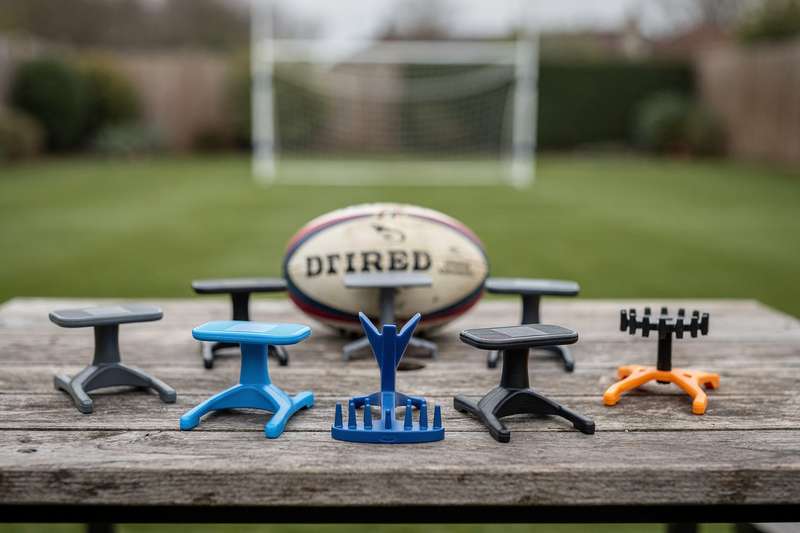
The most immediately practical feature is the multi-coloured design, which makes this tee easy to locate on a training pitch. During kickoff drills, tees get left at various points across the field, and a brightly coloured tee is faster to retrieve than a plain black or white one. If you’re running a session with multiple groups kicking simultaneously, being able to glance across the pitch and immediately spot each tee saves time — a small point that anyone who’s ended a session hunting for kit in long grass will appreciate.
Like the Rhino Pro, this tee is adjustable, offering multiple height positions for different kicking styles and scenarios. Based on available feedback, the adjustment mechanism appears comparable to the Pro model in terms of stability and ease of use. Buyers report it works well for both place kicks and kickoffs, and the base provides solid stability on soft grass. The one-size designation means it accommodates standard size 5 rugby balls without any additional fitting.
The honest limitation here is review volume. There’s no pattern of negative feedback about durability or mechanism problems — which is encouraging — but the feedback is still accumulating, and 34 buyers can’t provide the long-term scrutiny that the Rhino Club or Optimum Professional tees have received. If certainty backed by review volume matters to you, the Rhino Pro is the safer choice in Rhino’s adjustable range. If you’re a coach looking for something distinctively coloured and adjustable for group training sessions, and you’re comfortable with a newer product that Rhino’s broader track record gives reasonable cause to trust, this is a fair pick.
What to Look For in a Rugby Kicking Tee
- Fixed vs adjustable height: Fixed-height tees are simpler, lighter, and have nothing to break — they’re the better choice for match use and general club training. Adjustable tees let you change the ball’s height off the ground for different kick types (higher for conversions, lower for kickoffs), which benefits players doing deliberate technical work. The trade-off is additional complexity and moving parts that can wear with sustained heavy use.
- Base stability: A wide, flat base with some weight to it is essential on soft or wet ground. Narrow-based tees tip more easily, especially if a player nudges the tee during their approach. Look for products where reviewers specifically mention stability in wet conditions — British pitches demand it through much of the season.
- Rubber vs hard plastic construction: Rubber gives slightly more grip on the ball and absorbs impact better, which reduces the chance of the ball being knocked off its intended angle during the kicking approach. Hard plastic is more rigid but tends to crack more readily in cold conditions. Most of the better-reviewed tees in this guide use rubber or rubber-dominant construction, and the review patterns reflect why.
- Rotatable base: Some adjustable tees allow you to rotate the base to angle the tee left or right, giving you control over the ball’s lean angle independently of its height. This lets experienced kickers compensate for wind or fine-tune ball spin. It’s not essential for beginners, but it’s a meaningful feature for specialist or advanced players.
- Competition compliance: Most standard kicking tees are permitted in both rugby union and rugby league at amateur and club level, but check the specific rules of your competition before using an adjustable tee in a match. Tee height restrictions can vary across different leagues and governing bodies, so a quick conversation with your club’s league administrator avoids any issues.
- One-piece vs multi-part design: For club and school use, a one-piece tee is preferable to multi-part designs — there’s nothing to leave on the pitch or lose in the kit bag. If you do choose an adjustable model, check whether the adjustment mechanism could result in parts separating during use or transport.
- Review volume and pattern: Pay particular attention to reviews that mention durability after a full season of use. Any tee can feel solid when new; what matters is whether it holds up after hundreds of kicks on various surfaces through a British winter. Reviews mentioning cold-weather performance are especially informative.
Verdict
For the majority of readers — a club rugby player, a coach equipping a squad, or a parent buying for a school-age kicker — the Carta Sports Prince Kicking Supertee is the pick to reach for first. Its combination of a 4.7-star average across 615 reviews, soft rubber construction, and consistent ball-angle performance makes it the most reliable all-round option in this category. It’s a fixed-height tee, which is actually an advantage for most users — nothing to adjust, nothing to break, and a ball that sits in the same position every single time.
If you’re a more technical or specialist kicker who actively uses different ball heights for different scenarios, the Optimum Professional Rugby Kicking Tee with Lift-to-Adjust & Rotatable Base is the natural step up. Its lift-and-rotate mechanism gives you real control over ball placement, and the 734-review sample means the design has been thoroughly tested by real players across a range of conditions.
If you’re equipping a youth squad or buying in quantity on a tight budget, the Rhino Club Kicking tee — with 872 reviews behind it — is the safe, proven bulk buy. All three will serve you well; the choice depends on whether you need adjustability and how many tees you’re purchasing at once.
This guide was produced independently. We were not paid to feature any specific product. All opinions are based on publicly available specifications, verified buyer feedback patterns, and category research.
Quick Comparison Table


FAQ
What height kicking tee should I use for rugby?
Most club and amateur players use a standard-height fixed tee, which positions the ball at a consistent height off the ground — sufficient for clean contact on place kicks. If you prefer to vary your setup depending on the kick type (lower for kickoffs, higher for long-range conversions), an adjustable tee gives you that flexibility. Most beginners are better served by a reliable fixed-height tee until their technique is consistent enough that ball height becomes a variable worth experimenting with.
Are kicking tees allowed in rugby union matches?
Yes — kicking tees are permitted in rugby union for all place kicks at goal, covering conversions and penalties. World Rugby’s Laws of the Game explicitly allow their use. Tee specifications and any restrictions can vary at competition level, however, so it’s worth confirming with your league or competition authority if you’re in any doubt, particularly for cup or representative fixtures.
What’s the difference between a fixed-height tee and an adjustable tee?
A fixed-height tee holds the ball at one set position — it’s simpler, lighter, and has no moving parts to wear out or go missing. An adjustable tee lets you change the ball’s height off the ground and, in some designs, its lean angle too. Adjustable tees benefit experienced kickers who fine-tune their setup for different conditions or kick types; for most club and youth players, a fixed-height tee is the more practical everyday choice.
Can I use the same kicking tee for training and matches?
Yes — and it’s better to do so. Using the same tee in training as in matches means your foot learns to work with that specific height and cradle shape. Swapping between a training tee and a different match tee introduces small but unnecessary variables into your kicking mechanics at precisely the moment when consistency matters most.
How do I stop my kicking tee from tipping over on soft ground?
A wider, heavier base makes a significant difference on soft or wet pitches. Look for tees with a flat, broad base rather than a narrow-stem contact point. Some players lightly press the base into the turf before placing the ball, which creates a small amount of purchase in softer ground. If your current tee tips consistently, it’s a sign the base design isn’t suited to your pitch conditions — tees with wider bases, such as the Rhino Club Kicking or the Carta Sports Prince Supertee, are worth considering.
Is there a meaningful difference between a rugby union and a rugby league kicking tee?
In practice, no — most general rugby kicking tees work equally well in both codes. The ball shape is the same across union and league, so compatibility is rarely a concern. Some tees are explicitly marketed for both codes as a reassurance rather than a technical necessity. The more relevant differences are individual height preference and kicking style, both of which an adjustable tee can accommodate regardless of the code you play.