You planned the room layout for weeks, finally unrolled your new area rug, stepped back to admire it — and within 48 hours one corner has peeled up into a trip hazard and the whole thing has shuffled sideways. Sound familiar? Or maybe it’s the bathroom mat that slid out from under a wet foot last week, or the hallway runner that buckles and bunches every time someone walks through quickly. These are not niche complaints — slipping rugs are one of the most common domestic hazards in UK homes, and curling corners are the kind of low-level frustration that grinds you down precisely because the fix should be straightforward.
The root cause is rarely the rug itself. It’s what’s missing underneath it. Rug pads, non-slip gripper sets, and anti-curl tape all solve different versions of the same problem — but choose the wrong solution for your floor type and you risk sticky residue on oak boards, a pad that bunches under furniture, or grippers that lose adhesion within a fortnight. This guide covers the most relevant products currently available on Amazon UK, matched to the specific scenario each one handles best, so you can solve the problem properly rather than cycling through options that don’t quite work.
How These Picks Were Selected
Products were assessed across four functional sub-categories: full-surface rug pads, individual gripper pad sets, corner anti-curl tabs, and area rugs for buyers who want a complete room solution. Evaluation criteria included floor-type compatibility across hard surfaces (hardwood, laminate, tile, vinyl) and carpet-on-carpet layering contexts, ease of removal without residue or floor damage, washability in standard domestic conditions, and long-term durability based on material type.
For products carrying verified buyer reviews, patterns in both positive and critical feedback were analysed — the lower-rated responses in particular expose performance gaps that product descriptions rarely acknowledge. Several picks in this guide do not yet carry a substantial UK review base; in those cases, published specifications were assessed alongside knowledge of how comparable materials perform in this category, and this is flagged clearly within each relevant section. Variant products (the same product in different sizes or colours) are grouped under a single section rather than given separate picks.
Best Large-Format Rug Pad for Hardwood Floors
The Waterproof Felt Rug Pad, 150×200cm Non-Slip Rubber Backing is the product to consider when you have a substantial area rug on a hard floor surface and want grip, cushioning, and floor protection working together across the rug’s full footprint — not just at the corners. It holds 4.2 out of 5 stars from 62 verified UK buyers, a modest but meaningful review base for a product at this size and specification.
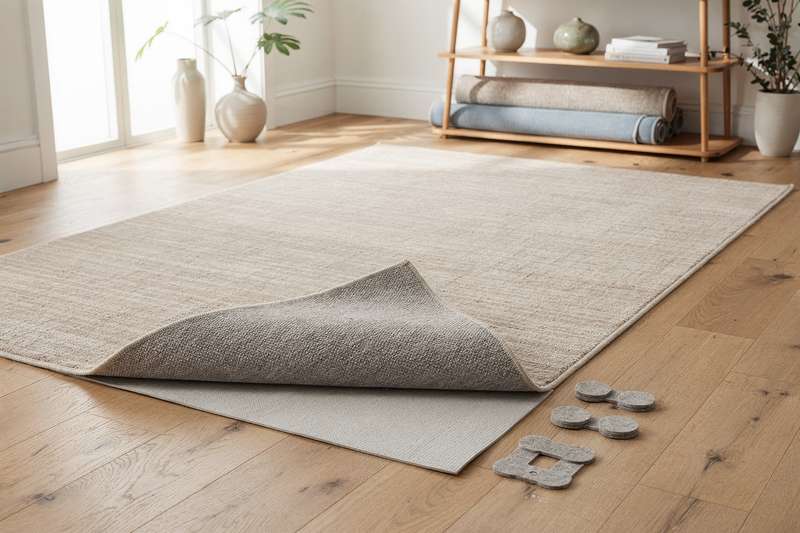
This sits firmly in the felt-and-rubber category of rug pads, which is the most versatile and floor-friendly construction type available. The rubber underside grips your floor, preventing lateral movement. The felt upper surface cushions the rug’s backing from friction and abrasion — something that matters more than most people realise, since a rug laid directly on a hard floor in a busy area can wear through its backing faster than the face pile shows any sign of wear. The combination also adds underfoot comfort, which makes a tangible difference in any room where people sit or stand on the floor for extended periods.
The 150×200cm size covers the most common UK living room and dining room rug footprint — large enough to sit under a coffee table with seating positioned partially on the rug, without overwhelming a modestly sized room. If your rug runs slightly smaller, the same product is also listed in a 120×190cm size with identical construction and a matching review profile. Both sizes can be trimmed with standard household scissors if the rug’s dimensions don’t align perfectly with either standard size, which is a practical advantage when fitting around furniture arrangements.
The waterproof designation matters most in dining rooms and kitchen-diners. Standard felt-rubber pads are water-resistant rather than truly waterproof at depth, but this construction helps prevent moisture wicking through to sit against your floor — reducing the risk of warping or surface damage on wood and engineered board floors. For the rubber underside to perform safely long-term, it should be a patterned or waffle-grid design rather than solid rubber, since solid rubber can trap moisture and create conditions for floor discolouration. The pad’s construction is consistent with that better design approach.
One firm limitation to state clearly: rubber-backed pads are designed exclusively for hard floors. Placing one on wall-to-wall carpet causes the rubber to grab carpet fibres and can damage both surfaces. If you’re layering a smaller decorative rug on top of existing carpet, you need a carpet-on-carpet underlay with a textured mesh or open-weave construction — a completely different product type. For hardwood, laminate, tile, and vinyl, though, this full-surface pad is the most complete single solution in this guide.
Best Budget Non-Slip Underlay Set
The Pack of 8 Non-Slip Mats for Carpet, Reusable and Washable takes a fundamentally different approach to rug grip: instead of a continuous pad covering the full rug underside, you position eight individual non-slip pieces at strategic points — corners and midpoints of longer sides — and let friction do the work where it matters most. With 482 verified buyer reviews and a 3.9/5 star rating, this is the most extensively reviewed product in this guide by a considerable margin.
The 3.9 rating deserves context rather than just a number to glance past. It reflects solid average performance rather than exceptional results, and the lower-rated reviews cluster mainly around two scenarios: very smooth, high-gloss tiles (where silicone and rubber pad surfaces generate less friction) and lightweight rugs with smooth, flat backings such as woven cotton or thin jute. On the far more common UK domestic surfaces — satin-finish laminate, standard vinyl, and mid-gloss ceramic tile — buyers consistently report reliable grip with minimal ongoing maintenance required.
The washability is a real advantage over cheaper peel-and-stick products. One of the standard failure modes for adhesive-type grippers is dust accumulating on the adhesive surface, which progressively kills grip until the pad becomes essentially decorative. These reusable mats can be rinsed under a tap, laid flat to air dry, and reapplied — buyers confirm this cycle works across multiple repetitions without meaningful loss of performance. That longevity makes the modest cost feel even lower across a full year of use.
Eight pieces is enough to cover all four corners and the midpoints of both longer sides of a standard-sized rug — the configuration that delivers the most stable result. The pads are small enough to sit completely hidden under most rug edges without creating any visible bump or raised step, and light enough to move between rooms when needed, which is not practical with a full-surface pad.
The honest limitation: individual pads do not prevent the centre of a large rug from wrinkling or bunching under heavy foot traffic. For rugs above roughly 140cm in any dimension where traffic consistently crosses the centre, a full-surface pad will outperform this approach over time. For smaller rugs — bedroom, bathroom, hallway runner, or a reading nook — the pack of 8 is a cost-effective, flexible, and well-evidenced choice that most buyers find adequate.
Best Washable Rug Gripper Pack
The Rug Gripper 10 Pcs – Washable & Reusable Rug Grippers follows the same individual-pad logic as the budget pick above but provides 10 pieces rather than 8, and specifically flags compatibility with laminate, hardwood, marble, and wooden floors in the listing. One important caveat before going further: this product currently carries no verified buyer reviews on the UK Amazon listing. The assessment here is based on specification review and knowledge of how this construction type typically performs — not buyer feedback — and that distinction matters when making your purchase decision.
The washable-and-reusable claim is the right priority to examine in this sub-category, and the mechanism behind it matters considerably. Better gripper pads in this format use a silicone or microfibre contact surface that adheres through pressure rather than adhesive. This allows you to rinse the pad under cold water, allow it to dry flat, and restore most of its original grip — a cycle that products of this type typically sustain for several months before needing replacement. Products using traditional adhesive instead of a contact-grip surface lose effectiveness as dust accumulates, and washing does not restore adhesive the way it can a silicone surface.
Ten pieces covers all four corners plus the midpoints of a larger rug, or splits cleanly across two smaller rugs without needing a second pack. The individual gripper pieces at this price point typically measure around 10×10cm — small enough to stay completely hidden under most rug edges without any visible bump or raised step that could catch underfoot.
One caution worth stating: some silicone gripper pads can leave faint marks on certain polished stone or marble surfaces if left fixed in place for an extended period, particularly in warm rooms. If you have marble, polished granite, or high-gloss stone floors, lift the grippers periodically — every two to three months — to check underneath, rather than leaving them in place indefinitely and assuming all is well.
Without UK buyer reviews to anchor performance expectations, treat this as a secondary purchase rather than a lead solution. If the Pack of 8 budget mats work well on your specific floor type but you simply need more pieces, this 10-pack is a sensible next step. It is not the product to stake a high-traffic hallway rug on without some prior evidence that this grip mechanism suits your particular floor surface and rug backing combination.
Best Anti-Curl Carpet Grip Tape
The X-Protector 12 Pcs Anti-Curling Carpet Grips addresses one of the most specific — and persistently irritating — rug problems in UK homes: the corner that refuses to stay flat no matter what you try. While the previous picks address whole-rug sliding, anti-curl grips are the targeted solution for situations where the rug’s general position is fine but edges and corners keep lifting to create both a trip hazard and an untidy appearance. This listing currently carries no verified UK buyer reviews; the X-Protector brand has a track record in the anti-curl niche in other markets, and this pick is included because it addresses a specific need that none of the other products in this guide covers. Treat it as a speculative purchase until UK-specific buyer evidence builds up.
The description of “renewable gripper tape” points to a repositionable rather than single-use adhesive mechanism — which is exactly the right design choice for corner grips. Repositionability matters because corner grips are frequently the product people buy first, find inadequate on a specific floor type, peel off, and replace with something else. No-residue, no-damage removal is a higher priority here than it would be for a full-surface rug pad installed once and left in place for years.
Twelve pieces is a generous allocation — more than enough for one large rug with all four corners addressed and spare pieces to hand, or enough to deploy across three or four smaller rugs in different rooms. Anti-curl grips work by pressing the corner flat and holding it down under the rug’s own weight at the edge. The heavier the rug backing, the more effectively this works — the rug’s weight assists the grip rather than fighting it.
One honest reality check: no anti-curl product reliably flattens a corner that has been tightly rolled or folded for a long time, particularly on rugs with memory foam or thick rubber backing. The curl in those cases is embedded in the backing material rather than being a grip failure at the surface. Before applying any corner grips, lay the rug face-down with heavy books or furniture legs on the affected corners for 24 to 48 hours. After that treatment, the backing will be substantially more compliant and any corner grip product will have a far better chance of keeping it flat for the long term.
Anti-curl grip tape works best on thin-backed rugs — flatweave cotton, jute, low-pile woven styles — where corners lift from foot traffic or poor initial unrolling rather than a structural issue in the backing. For those scenarios, 12 targeted pieces is a low-cost, low-effort answer to a daily domestic irritation.
Best Decorative Area Rug for Living Rooms
Not every reader coming to this guide is purely solving a grip problem — some are choosing a rug as well and want a solid decorative option in the mix. For that purpose, the THE RUGS Modern Luxury Shaggy Rug, 140×200cm (Duck Egg) is the most style-complete pick available in this product selection. If you are here purely for pads and grippers, the sections above are more directly relevant — but for buyers who want to choose a rug and understand how to protect it in the same guide, read on.
The review situation needs stating plainly before anything else: this listing carries no verified buyer reviews on Amazon UK at the time of writing. The rating visible on the listing appears to have been drawn from other marketplace regions rather than UK buyers. This is a specification-based recommendation rather than a crowd-sourced one, and you should factor that in when deciding whether to buy. THE RUGS produces across a wide range of styles; this specific UK listing has not yet built up a UK feedback base.
The 140×200cm format is one of the most practical rug sizes for UK living rooms. It sits comfortably under a coffee table with seating partially on the rug, without crowding a medium-sized room or requiring a large open-plan space. The Duck Egg colourway — a soft, muted blue-green — is a versatile choice for UK interiors: it pairs with warm wood furniture, grey or white walls, and both warm and cool lighting without competing for attention or becoming a short-lived trend commitment.
Shaggy rugs with a longer pile need more maintenance than flatweave alternatives. Plan to vacuum weekly in the direction of the pile to prevent matting, and avoid a motorised rotating brush bar, which can pull longer pile fibres over time. In south-facing rooms with significant sunlight, rotating the rug every few months prevents uneven fading across the pile. These are standard requirements for this rug construction rather than product-specific concerns.
On a hard floor, pair this rug with a full-surface rug pad from the outset. Long-pile shaggy rugs tend to walk across hard floors more than low-pile alternatives because the dense pile creates uneven friction underfoot — the rug gets pushed incrementally forward with each foot placement. The large-format felt-rubber pad covered earlier in this guide is the natural complement. Two other variants in the THE RUGS shaggy range are worth noting for sizing flexibility: the THE RUGS Modern Luxury Shaggy Rug 120cm Square for a smaller room or bedside placement, and the THE RUGS Modern Luxury Shaggy Rug 160×230cm Pink for a larger open-plan living space — though both carry the same absent UK review caveat at present.
What to Look For When Buying Rug Pads & Protectors
These are the factors that genuinely separate effective products from those that underperform in real domestic use:
- Floor type compatibility — This is the single most important variable. Rubber-backed pads grip well on hardwood, laminate, tile, and vinyl but can trap moisture against delicate floor finishes and cause discolouration over time. For layering a rug on existing carpet, you need a carpet-on-carpet mesh underlay rather than a rubber-backed pad — the two are different product types and should not be substituted. Never assume a pad marketed for “all floors” has been tested on your specific surface and finish level.
- Full-surface coverage vs spot solutions — A full-surface pad prevents both lateral sliding and central wrinkling. Individual gripper pads or corner tabs install faster and cost less, but they cannot stop a large rug from scrunching at the centre under sustained foot traffic. For any rug above 140cm in any dimension, full-surface coverage is usually worth the additional spend.
- Pad thickness — A pad in the 5–8mm range adds useful underfoot cushioning and can muffle some impact noise between floors, which matters in flats and first-floor rooms. Very thick pads can cause problems at door thresholds and around furniture legs. Very thin pads (under 3mm) offer minimal cushioning but are less likely to create transition issues.
- Adhesive vs contact-grip mechanisms — Adhesive pads give strong immediate grip but often leave residue on removal and lose effectiveness as dust accumulates on the surface. Contact-grip pads (silicone or microfibre) can be washed and reused with no residue left behind — a better option for rented properties or rooms that get rearranged regularly.
- Washability and longevity — Any pad placed in a bathroom or kitchen will need periodic cleaning. Check whether it can go through a washing machine or requires hand-rinsing. Pads that cannot be washed and are placed in damp environments can harbour mildew and degrade considerably faster than the product description suggests.
- Trimmability — Many rug pads can be cut to size with household scissors. This is particularly useful for runners, alcoves, or any space where standard pad dimensions don’t match your rug’s footprint precisely. Always confirm trimmability before buying a fixed-size pad for a non-standard space.
- Long-term floor safety — Every pad claims to be safe for hard floors, but real-world performance over months and years varies. Check buyer reviews for comments about residue or discolouration after extended use, and lift any rubber-backed pad periodically to inspect the floor underneath — particularly on unsealed, freshly oiled, or waxed wood surfaces where the risk of marking is highest.
Verdict
For the majority of readers coming to this guide — a living room or dining room rug on hardwood or laminate that slides, bunches, or has corners that won’t stay flat — the Waterproof Felt Rug Pad, 150×200cm is the strongest choice on current evidence. It addresses grip, cushioning, and floor protection in a single no-adhesive solution, can be trimmed to fit with scissors, and is backed by a consistent review base pointing to reliable performance on standard UK hard floors.
If your rugs are smaller, if you need to cover multiple rooms without significant spend, or if you want a washable, repositionable solution you can shift between rugs as needed, the Pack of 8 Non-Slip Mats is the smarter pick. It’s the best-evidenced product in this guide with nearly 500 buyer reviews — honest rather than exceptional performance, but reliable for smaller rugs on standard domestic floor surfaces at a very low cost per room.
The X-Protector anti-curl grips are a sensible addition if curling corners are your specific problem on top of an otherwise satisfactory rug arrangement. The washable gripper pack and the shaggy area rug are both speculative choices at the current stage of their UK listings — worth considering if the specifications match your situation, but not the first place to spend money on specification alone.
We were not paid to feature any specific product in this guide. All opinions are independent and based on publicly available specifications, verified buyer feedback patterns, and category research.
Quick Comparison Table


FAQ
Do rug pads damage hardwood floors?
Good-quality rug pads should not damage hardwood floors when used correctly. The main risks are rubber pads leaving discolouration on unsealed or waxed wood, and moisture being trapped under solid rubber backings over time. Choose pads with a waffle or grid-patterned underside to allow air to circulate, and lift the pad every six to twelve months to check the floor underneath — regardless of what the product claims about floor safety.
Can I use a rug pad on top of carpet?
Standard rubber-backed rug pads are designed for hard floors — placing them on carpet can snag carpet fibres and damage both surfaces over time. For laying a smaller rug on top of existing carpet, you need a carpet-on-carpet underlay with a textured mesh or open-weave felt construction that grips without pulling at the pile below. These are two distinct product types and should not be substituted for each other.
How do I stop rug corners from curling?
Curling corners usually have two causes: a backing with shape memory from being stored rolled, and insufficient edge grip. Lay the rug face-down with heavy books on the affected corners for 24 to 48 hours before applying any corner grip product — this relaxes the backing considerably. Once flat, apply dedicated anti-curl grips and ensure any rug pad you use extends fully to the rug’s edges rather than stopping several centimetres short.
Are rug grippers the same as rug pads?
No — they serve related but distinct purposes. A rug pad is a continuous underlay covering the full rug-floor contact area, providing uniform grip, cushioning, and floor protection. Rug grippers are smaller, discrete pieces placed at corners and edges to prevent sliding. Grippers are cheaper and quicker to install but do not add cushioning or prevent the centre of a large rug from wrinkling under foot traffic — for that, a full-surface pad is more effective.
What size rug pad do I need?
Your rug pad should be roughly 2 to 4cm smaller than your rug on every side. This keeps the pad hidden under the rug and prevents its edges from catching underfoot around the perimeter. A pad that extends to or beyond the rug’s edge creates its own trip risk and looks untidy. Most rug pads can be cut to size with household scissors, making a slight size mismatch straightforward to resolve without needing a custom order.
How often should a rug pad be replaced?
Quality felt-rubber pads typically last three to five years in normal residential use before the rubber loses elasticity or the felt compresses to the point of no longer providing meaningful cushioning or grip. Adhesive-style corner grippers may need replacing every six to twelve months depending on foot traffic and cleaning frequency. Washable silicone gripper pads can be extended through regular rinsing, but check periodically that the grip surface is still performing effectively rather than assuming it is.