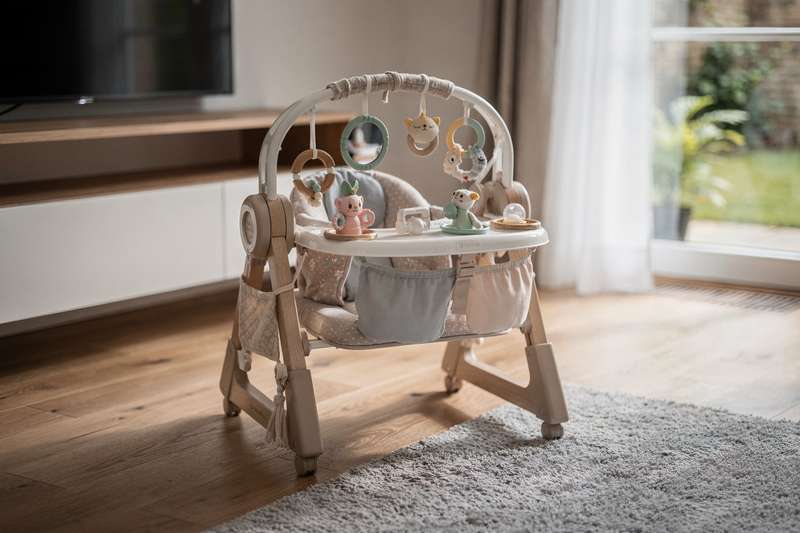
Picture this: your seven-month-old has discovered that screaming is an effective way to demand your undivided attention, and your living room floor is a graveyard of rattles that lost their novelty within forty-eight hours. You’ve tried a simple playmat, a basic bouncer, and that overpriced set of stacking cups that now lives under the sofa. Nothing keeps them engaged long enough for you to drink a hot cup of tea. What you actually need is something that grows with your baby, stimulates them across multiple senses, and holds their attention for longer than a soap bubble. An activity centre — whether that’s a freestanding jumper, a musical activity table, or a wooden multi-activity cube — is designed to solve exactly that problem. But the market is flooded with options ranging from budget tabletop toys to full-sized bouncing stations with lights, sounds, and spinning toys in every direction. This guide cuts through the noise and tells you exactly which ones are worth your money and floor space, based on honest assessment of what real parents actually experience.
How These Picks Were Evaluated
Every product in this guide was assessed against a consistent set of criteria: developmental appropriateness (does it actually suit the stated age range?), build quality and safety (sturdiness, non-toxic materials, stability), sensory engagement (lights, sounds, textures, colours), ease of assembly and storage, and — critically — honest buyer feedback patterns where available. Products with verified review counts received extra weight, since aggregate real-world feedback tells you things that spec sheets never will. For products with limited review data at the time of writing, evaluation leaned heavily on brand reputation, category benchmarks, and the quality of stated specifications. Price tiers were factored in to ensure there’s a genuine option across budget, mid-range, and premium categories. The goal throughout was to match each pick to a specific type of parent and baby, rather than simply listing what looks good on paper.
Best Budget Activity Table: Baby Activity Table by Generic
If you’re after a compact, no-nonsense musical activity table that won’t take up half your living room, the Baby Activity Table (30×30×30cm) is the standout budget pick in this guide — and with over 440 verified reviews and a 4.2/5 rating, it’s the most road-tested option available here. At a cube-style footprint of 30×30×30cm, it’s genuinely compact enough to sit on a coffee table or be picked up and moved between rooms without fuss.
This table is aimed at babies from around six months up to toddlers of two or three years, and it earns that wide range by offering a mix of activities on each face. You’ll typically find piano-style keys, shape sorters, spinning gears, and light-up buttons — the kind of cause-and-effect features that are developmentally valuable at this stage. The musical elements respond to touch, which gives babies immediate feedback and helps build the understanding that their actions produce results. That sounds simple, but it’s genuinely one of the most important cognitive building blocks in the first year.
Where it struggles is in build robustness. Buyers consistently note that the plastic feels lightweight, and a few report that battery compartments can be tricky to open for adults but occasionally too easy for curious toddlers. The volume on the music is fixed on some versions, which can become tiresome in a small flat. That said, for a budget-tier product, the activity variety is impressive and the durability is adequate for normal use — it’s not being thrown out of a moving vehicle, after all.
This is the pick for parents who want to test whether their child will actually engage with an activity table before committing to a higher-end version. It’s also a solid choice for grandparents’ houses, nurseries, or any setting where you need a practical toy without spending heavily. The square footprint means it doubles as a sitting-height play surface once your baby can pull themselves up to standing — which extends its useful life considerably.
One thing to check when ordering: confirm the battery type required and whether batteries are included. Several buyer reviews mention that the product arrives without batteries, which is an easy fix but worth knowing in advance. Overall, for parents working with a tighter budget, this table delivers solid developmental value and has enough verified buyer backing to feel like a safe choice.
Best Compact Activity Table with Modern Design
The Baby Activity Table, Baby Musical Toys 6-12 Months, Activity Center for 1 2 3 Years Old (30×30×30cm) shares its dimensions with the budget pick above, but sits at a higher rating of 4.7/5 across 34 reviews — a smaller sample but a notably positive one. If you’re torn between the two similarly sized tables in this category, the difference comes down to finish quality and consistency of positive feedback.
This version appeals to parents who want something that looks a little more considered on the playroom floor. The activity range covers the expected bases for this age bracket: interactive buttons, musical responses, and tactile elements that encourage fine motor development. The 6-12 month starting age is appropriate — you’ll want your baby to have enough neck and trunk stability to sit either independently or with light support before introducing a table-height toy like this.
The slightly higher rating compared to the budget version suggests fewer quality-control complaints in the buyer pool, though the smaller review count means you should weight that modestly. What’s encouraging is that the positive reviews focus specifically on engagement — parents noting that their babies returned to the toy repeatedly over weeks rather than abandoning it after a couple of sessions. That repeat engagement is what makes an activity table genuinely useful rather than just a novelty.
One honest caveat: at this size and price tier, you’re not getting something that will last until age four or five. This is a toy optimised for roughly the six-month to two-and-a-half-year window, and its build reflects that. The plastic construction is appropriate but not heirloom-grade. If you’re buying for a second child or want something that will survive years of enthusiastic toddler use, you might look at the wooden option later in this guide.
For a parent who wants a compact table with good developmental coverage and a slightly more consistent quality track record than the entry-level option, this is the pick. It’s also worth noting that at these dimensions, it works well in smaller flats or as a secondary toy for visits to relatives — it’s genuinely portable in a way that jumper-style activity centres simply aren’t.
Best Interactive Learning Activity Table: VTech Baby Busy Bee
The VTech Baby Busy Bee Activity Table steps up the developmental ambition considerably, and with 56 reviews at a 4.5/5 rating it has enough real-world feedback to back up its claims. VTech is one of the most established names in electronic educational toys in the UK, and this table reflects the brand’s characteristic strengths: structured learning content, good audio quality, and thoughtful age-appropriate design.
Where this table differs from the generic options is in its educational framework. VTech products typically build in songs, melodies, and voice prompts that introduce concepts like colours, numbers, and simple vocabulary — not in a dry, rote-learning way, but woven into the play experience. The Busy Bee Activity Table specifically targets motor skill development and cause-and-effect understanding, with features designed around sensory development. If you’re a parent who wants a toy that does more than just beep in response to random button-pressing, this is a meaningful step up.
Build quality is a VTech hallmark. The plastic is thicker and more robust than budget-tier alternatives, the buttons have satisfying tactile feedback, and the audio is clear rather than tinny. Parents in the review pool consistently mention that their children engaged with the toy over extended periods — a sign that the content has enough variety to hold attention as babies develop.
The honest tradeoff is that VTech toys can lean heavily on electronic stimulation, which not every parent wants. If you prefer more open-ended, less prescriptive play, or if you’re trying to limit screen-adjacent electronic noise in your home, you might find this table a bit busy. The volume also, as with most toys in this category, can feel intrusive in a quiet flat — though many VTech products do include a volume control or mute function, which is worth confirming before purchase.
This is the pick for parents who want structured developmental content delivered through play, backed by a brand with a strong UK support and warranty track record. It’s particularly well-suited to babies in the six-to-eighteen-month window who are becoming more deliberate in how they interact with objects around them.
Best All-Round Activity Centre for Younger Babies: VTech Baby Discovery Play Centre
The VTech Baby Discovery Play Centre is the highest-rated product in this guide with meaningful review volume — 62 reviews at 4.6/5 — and it earns that position by genuinely covering the earliest months of a baby’s developmental journey. Suitable from three months plus (with six- and nine-month milestones built in), this is designed for babies who aren’t yet sitting independently, which immediately sets it apart from the table-format options above.
The three play modes mean the toy adapts as your baby does. In the earliest months, the focus is on visual stimulation — colours, lights, and gentle sounds that a baby lying on their back or tummy can interact with. As motor control develops and your baby starts reaching, batting, and grasping, the interactive elements become more accessible. By six to nine months, when sitting with support is possible, the centre can be used in a more table-adjacent configuration. That adaptability is what justifies the investment: you’re not buying a toy for a three-month window, you’re buying one that spans the better part of the first year.
The educational content follows VTech’s established approach — songs, melodies, and voice prompts that introduce early concepts without overwhelming. The build quality is consistent with VTech’s reputation: solid, with no sharp edges, and materials that meet UK toy safety standards. The 62-review pool is large enough to detect any consistent quality issues, and the feedback pattern is reassuringly positive, with parents frequently noting that the toy held attention across multiple developmental stages.
Where it falls short is in physical footprint — it’s larger than a tabletop toy and requires floor space. In a small flat or a household where floor space is already at a premium, this could be a consideration. It’s also primarily suited to the pre-walking phase; once your toddler is up and moving, they’ll quickly outgrow it. Think of it as the ideal first activity centre rather than a long-term investment.
If you have a newborn or young baby and want one product that will see them through the first year without needing replacement every few months, this is the most compelling choice in the guide. The combination of early-months accessibility, developmental progression, and verified positive feedback makes it the pick for parents of very young babies.
Best Wooden Activity Centre: TOWO Activity Centre Triangle Toys
For parents who want to step away from plastic and electronic noise entirely, the TOWO Activity Centre Triangle Toys — Wooden Alphabet Blocks Abacus Clock, 5-in-1 Wooden Activity Cube for Toddlers offers a genuinely different approach to early childhood development. This is a wooden multi-activity cube with five distinct activity panels — typically including an abacus, an alphabet section, a clock face, shape-sorting elements, and a bead maze — packed into a single freestanding cube designed for children from around one year old.
The appeal of wooden toys in this category is well-founded. They’re durable in a way that plastic simply isn’t — a well-made wooden activity cube can survive two or three children and still look presentable. There’s no battery dependency, no volume complaints, and no electronic elements to malfunction. The play experience is quieter, more tactile, and more open-ended. Children can spin beads, slot shapes, move abacus counters, and manipulate the clock hands in whatever order and combination they choose, which encourages more creative and self-directed play than an electronic toy that rewards specific button presses.
TOWO as a brand has a positive reputation in the wooden toy space, and the activity cube format is a proven design that’s been used in children’s waiting rooms and nurseries for decades — because it works. The five-in-one format means children can move between activities as their interest shifts, and because none of the activities are electronic, there’s no novelty-wearing-off dynamic in the same way. A bead maze remains interesting for different reasons at twelve months, eighteen months, and two-and-a-half years.
The honest limitation here is that this product has no verified reviews in the current data, which means you’re relying more on brand reputation and category knowledge than on aggregate buyer feedback. That’s a genuine caveat, and if verified feedback is important to your decision, the VTech or table options above provide more of it. That said, TOWO’s position in the wooden toy market and the inherent durability of the product type make this a lower-risk choice than an unknown brand in the same format.
This is the pick for parents who actively want to reduce electronic toy exposure, who value durability and longevity over novelty, and whose child is around twelve months or older. It also makes an excellent gift — it presents well and avoids the battery-required awkwardness of electronic alternatives.
Best Jumper-Style Activity Centre: Baby Einstein Neptune’s Ocean Discovery
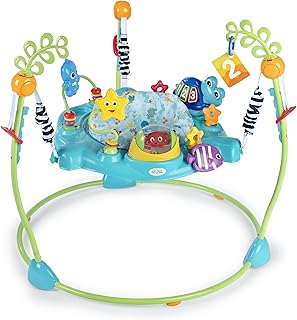
The Baby Einstein Neptune’s Ocean Discovery Activity Jumper & Bouncer represents a fundamentally different category of activity centre — the full-size jumper — and it’s important to understand what that means before buying. A jumper suspends your baby in a fabric seat at the centre of a ring of toys, allowing them to bounce, spin, and interact with surrounding activities. This is genuinely engaging for babies in the six-to-twelve-month range who have head and neck control but aren’t yet walking, and the physical bouncing element adds a vestibular stimulation component that tabletop toys simply can’t provide.
Baby Einstein is a well-regarded brand in early childhood development, and Neptune’s Ocean Discovery reflects the brand’s characteristic approach: an ocean theme with educational elements introducing numbers and colours, removable toys that can be used independently, and language exposure through audio prompts. The adjustable height is a practical feature that extends the usable age range — as your baby grows, the seat height can be raised to keep the bouncing action appropriate.
The honest reality of jumper-style activity centres is that they take up a significant amount of floor space. This is not a toy you slot into a corner — it requires a dedicated area, and in a smaller home that’s a genuine consideration. Assembly is typically more involved than a tabletop toy, and storage between uses is similarly cumbersome. Many parents find that a jumper becomes a permanent fixture in one room for the duration of its usefulness, which is fine if you have space but restrictive if you don’t.
This particular listing has no verified reviews in the current data, so the recommendation rests on Baby Einstein’s established brand reputation and the general quality of the jumper format rather than specific buyer feedback for this model. If reviews are available by the time you read this, check them for reports on the bounce resistance and ease of height adjustment, as these are the two most variable factors in jumper quality.
For parents with adequate floor space whose baby is in that energetic six-to-twelve-month window and craving physical stimulation alongside cognitive play, a jumper like this offers something genuinely different. It’s the pick for active, bouncy babies who find purely tabletop engagement insufficient.
Best Premium Jumper with Character Theme: Bright Starts Disney Baby Finding Nemo
The Bright Starts Disney Baby Finding Nemo Sea of Activities Jumper is the premium end of the jumper category, and it justifies that position through sheer activity density — thirteen distinct activities surrounding the central seat, plus lights, music, and ocean sounds tied to the beloved Finding Nemo character universe. If you have a baby who is already showing strong character recognition or if you’re a Nemo-enthusiast household, the theming is genuinely engaging rather than superficial.
Thirteen activities is a substantial number for a product in this format. You’re looking at a combination of spinning elements, light-up panels, buttons with sound responses, and texturally varied toys arranged around the bouncing ring. That variety means a baby can work through different activities in a single session without repeating themselves, which is part of what sustains engagement over weeks and months rather than just days. The addition of lights and ocean-themed sounds creates an immersive environment that tabletop toys can’t replicate.
Bright Starts has a strong reputation for build quality in this product category, and jumper-style activity centres from established brands tend to be significantly more robust than budget alternatives — the frame needs to safely support a bouncing baby, which concentrates engineering attention in a way that a tabletop toy doesn’t require. The adjustable height settings are a practical necessity and are typically well-implemented on Bright Starts products.
As with the Baby Einstein jumper above, the main limitations are size and storage. This is a large piece of equipment that requires dedicated floor space, and the character theming — while appealing to many — does mean the aesthetic is very specific. In a minimalist home, a Nemo-themed jumper can feel visually dominant. The premium price point is also a consideration: you’re paying for the Disney licence, the activity count, and the brand reputation, which makes it the highest-investment pick in this guide.
There are no verified reviews for this specific listing in the current data, so as with the Neptune’s Ocean jumper, the recommendation draws on brand and format knowledge rather than specific buyer feedback. This is the pick for parents who want the most complete jumper experience, who have the floor space to accommodate it, and whose budget stretches to the premium tier.
What to Look For When Buying an Activity Centre
- Age appropriateness: Activity centres span a wide developmental range, from three-month-old babies who need visual and auditory stimulation at floor level, to two-year-old toddlers who need shape-sorting and fine motor challenges. Check the stated minimum age carefully — using a jumper before a baby has adequate head and neck control carries real safety risks. Conversely, buying a table toy for a baby who can’t yet sit independently means it will gather dust for months.
- Floor space and storage: Jumper-style activity centres are genuinely large. Measure your available floor area before purchasing one, and consider how you’ll store it between phases of use. Tabletop toys and wooden cubes are far more space-efficient. If you live in a flat or have limited floor space, a compact activity table will serve you better than a full-size jumper.
- Electronic vs non-electronic: Both have genuine merit. Electronic activity centres (with lights, music, and voice prompts) offer high engagement and educational content, but they require batteries, can be noisy, and have finite novelty. Wooden and mechanical activity toys are quieter, more durable, battery-free, and support more open-ended play — but they don’t deliver the same immediate audio-visual stimulation. Choose based on your household preferences and your child’s temperament.
- Build quality and safety: For any product a baby will chew, grip, and pull, material quality matters. Look for BPA-free and non-toxic plastics, and for wooden toys, check that finishes are child-safe and that there are no splinters or sharp edges. For jumper-style centres, stability of the frame and the quality of the bounce mechanism are critical safety considerations.
- Volume control: If you live in a flat, share walls with neighbours, or simply value a quieter home, check whether a toy has a volume control or mute setting before purchasing. Many electronic activity toys lack this feature, which can make them a source of significant irritation over extended daily use.
- Developmental progression: The best activity centres offer multiple modes, adjustable configurations, or diverse enough activities that a baby can engage with them differently at different developmental stages. A toy that works only at one specific milestone becomes redundant quickly — look for options that genuinely stretch across several months of your child’s development.
- Assembly and maintenance: Consider how much assembly the product requires and whether cleaning is practical. Jumpers in particular can be difficult to clean if the fabric seat isn’t removable and machine-washable. For tabletop toys, check whether the battery compartment requires a screwdriver (a sensible child safety measure) and how easy it is to access.
Verdict
For most parents reading this guide — particularly those with a baby in the three-to-nine-month range — the VTech Baby Discovery Play Centre is the pick we’d choose. Its three play modes mean genuine developmental progression across the first year, the verified review count gives you confidence in its real-world performance, and VTech’s build quality and UK brand support are reliable. It’s not the cheapest option, but it’s the most versatile for the earliest and most intensive period of developmental need.
If your baby is already around twelve months and you’re looking for something durable that sidesteps electronic noise entirely, the TOWO wooden activity cube is a compelling alternative that will outlast several years of use. For parents with space for a jumper and an active baby who craves physical stimulation, either of the Baby Einstein or Bright Starts jumper options will provide something qualitatively different from any tabletop toy. And if budget is the primary constraint, the most-reviewed activity table in this guide delivers genuine value without overextending your spend.
Quick Comparison Table



Editorial Note
We were not paid to feature any specific product in this guide. All opinions are independent and based on publicly available specifications, verified buyer feedback patterns, and category research.
FAQ
At what age should I introduce an activity centre?
It depends on the type. Floor-based activity centres designed for tummy time or lying-down play can be introduced from around three months, when babies begin tracking objects and responding to sounds. Jumper-style activity centres should wait until your baby has strong head and neck control and can bear some weight through their legs — typically around six months, though always follow the manufacturer’s stated minimum age. Tabletop activity tables are generally suitable from around six months (with support) and become more appropriate once your baby can sit independently.
Are jumper-style activity centres safe?
Yes, when used correctly and within the manufacturer’s recommended age and weight range. The key safety rules are: don’t introduce a jumper before your baby has adequate head and neck control, always follow the height adjustment guidance so your baby’s feet are flat or slightly tiptoeing on the floor, and never leave a baby unsupervised in a jumper. Most paediatric guidance also recommends limiting jumper use to short sessions rather than extended periods, as babies benefit from varied positions throughout the day.
How long will an activity centre remain useful?
It varies by type. A three-mode floor activity centre designed for three months plus may only be actively used until around twelve to fifteen months before a baby outgrows it. Jumper-style centres are typically useful in the six-to-twelve-month window. Tabletop activity tables often have a longer useful life — from around six months up to two or three years depending on the activity variety. Wooden activity cubes tend to have the longest usable life, often remaining engaging through the toddler years.
What’s the difference between a jumper and an exersaucer?
A jumper uses a suspended seat that allows babies to bounce by pushing off the floor, while an exersaucer (or stationary activity centre) has a fixed seat that rotates and swivels but doesn’t bounce. Jumpers provide vestibular stimulation through the bouncing motion, which many babies find particularly enjoyable. Exersaucers are generally considered by paediatric physios to be slightly less demanding on hip development, though both are widely used and considered safe in moderation.
Should I choose a wooden or electronic activity centre?
Both serve valid developmental purposes. Electronic activity centres offer structured learning content, audio-visual stimulation, and high engagement — particularly for babies under twelve months who respond strongly to lights and sounds. Wooden activity centres support open-ended, self-directed play, are battery-free and quieter, and tend to be more durable over time. If your household has preferences around screen-adjacent electronic noise or sustainability, a wooden option is worth prioritising. If your baby is in the early months and you want maximum sensory engagement, an electronic option will typically hold attention more readily.
Can I use an activity centre as my baby’s main play area?
An activity centre works best as one component of a varied play environment rather than the sole play space. Babies benefit from a range of positions and experiences — floor time for gross motor development, free play with simple objects for exploration, social interaction, and time outdoors. Using an activity centre for focused sessions while you cook or respond to messages is entirely practical, but paediatric guidance consistently recommends varying your baby’s play environment throughout the day rather than relying on any single toy as the primary source of stimulation.