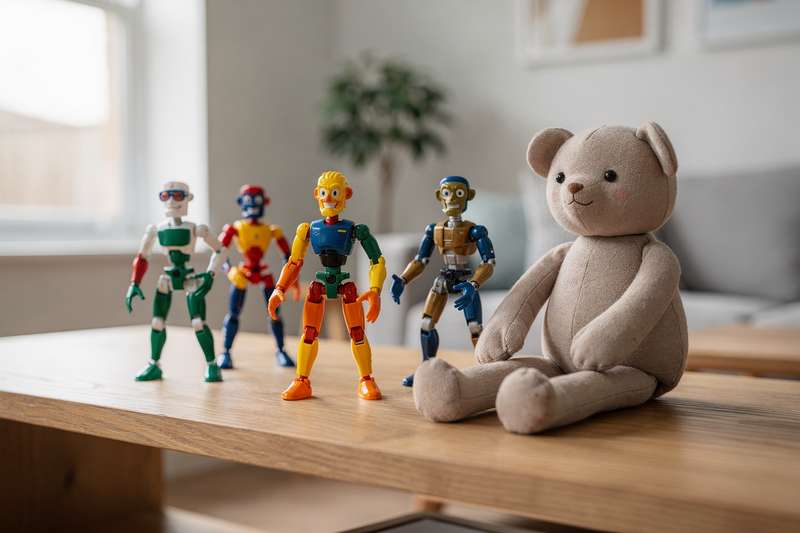
Picture yourself filling a bag of party favours and genuinely wondering whether the bendable rubber figures you have picked will survive the car ride home, let alone a week of enthusiastic six-year-old handling. Or imagine hunting for a tactile desk companion — something you can fold into a small seated pose and leave beside your monitor as a quiet personal joke — only to find that the options either look embarrassingly cheap, take three weeks to arrive from abroad, or snap at the first firm bend. Then there is the personalised angle: a poseable miniature of someone built around a photo, the kind of gift that gets placed on a mantelpiece and pointed out to every visitor for the next three years. Whether you are shopping for party bags, sensory support, or a memorable personalised present, the frustration is the same: the gap between what a bendable figure promises in the listing photo and what actually turns up at your door.
The UK market for bendable toys and figures is notably thinner than many shoppers expect, especially if you have browsed the US equivalents. What is available on UK Amazon tends to cluster at opposite ends of the quality spectrum — cheap party-bag fodder and premium personalised options — with a notable gap in the character-based poseable figures that are so common in the US catalogue. This guide works honestly with what is actually stocked and is upfront where the field runs dry.
How These Picks Were Evaluated
The criteria weighted most heavily across these picks were internal wire frame integrity, outer casing material quality, safety profile for the intended age group, and whether a finished figure holds a set position or slumps back to neutral. For bendable figures, frame integrity is the single biggest quality predictor — a thin or brittle armature produces a toy that fails fast, sometimes leaving an exposed wire end that is actively unsafe. For sensory tools in stick form, the relevant criteria shift toward material consistency, texture quality, and whether buyers in verified feedback report the product holding up over time.
For personalised plush options, the additional criteria are photo-transfer accuracy, the seller’s transparency around production stages, and what happens if the result does not meet expectations. Buyer reviews are the most reliable signal in this category, and the first honest admission is that they are sparse for UK-listed bendable products. One pick in this guide has a meaningful review count with a solid rating; the other two are made-to-order personalised items with no public reviews at the time of writing. Those picks are included with explicit caveats and specific guidance on what to verify before ordering, rather than a false confidence the record does not support.
Best for Sensory & Fidget Play
The ddLUCK Fidget Toys for Kids Adults 6 Pack Sensory Sticks takes a purposeful angle on the bendable category: these are flexible, textured sensory tools rather than poseable character figures, designed to be continuously twisted, looped, and reshaped in the hand as an outlet for physical restlessness or anxious energy. They will not hold a pose the way a wire-frame rubber figure does, and that distinction matters — but for the specific use case they address, they are the only pick in this guide backed by significant verified buyer feedback.
With a 4.2-star rating from 389 verified buyers, these are by some margin the most reviewed option currently available in the UK flexible toy space on Amazon. That review count represents real-world use across a range of settings — classrooms, waiting rooms, therapy sessions, home offices — where users have had enough time with the product to form informed opinions. A sub-4.0 rating would be a warning sign in this category; 4.2 from nearly four hundred buyers indicates consistent quality rather than a lucky batch or a skewed sample of early reviewers.
The six-pack format suits a range of practical contexts. For a classroom sensory resource box, six pieces means multiple children can use them simultaneously without a sharing dispute. For a parent buying for a child with ADHD or sensory processing differences, having several rather than one means a misplaced stick is not a crisis, and the variety of textures across the set gives the child something different to engage with rather than the identical experience every time. For adults who fidget at a desk, the multicolour design is unobtrusive enough for a professional setting and the per-item value is reasonable.
The crucial tradeoff is clear: these are sensory sticks, not poseable characters. They are designed to spring back toward form when released rather than staying in a fixed position, which is exactly the right behaviour for a fidget tool but completely wrong for someone who wants to arrange a figure on a shelf. They have no recognisable face or narrative — a strength for focused sensory use and a real limitation for character-based imaginative play. A child who wants a bendable zoo animal or a poseable robot will find these less engaging than the listing implies. A child or adult who needs a quiet, tactile fidget outlet will find them useful in a way that cheap unverified alternatives rarely match.
The quiet operation is worth flagging specifically. Many fidget tools — spinners, clickers, poppers — produce noise that quickly disrupts shared environments. These sensory sticks are described by buyers as quiet, which makes them appropriate for open-plan offices, classrooms, and public transport where noise would be an issue. That is a real differentiator in the fidget-toy space and one that does not appear prominently enough in most category listings.
What to avoid: do not assume any unreviewed flexible sensory stick will match this quality simply because it costs less or comes in a larger pack. The review count here is the trust signal. Products with no reviews and suspiciously low prices in this category often use flimsier materials that off-gas a noticeable chemical smell — a complaint that recurs across bargain-tier flexible toy reviews. Paying for verified quality over volume is the pragmatic call when you are literally putting the product in someone’s hands.
Best Personalised Novelty Bendable Gift
The Personalised Doll with Face Custom Bendable Plush Doll with Your Photo belongs to a specific and appealing gift category: personalised novelty items built on a poseable wire frame. The listing describes a plush doll constructed around a photo you supply, with a flexible internal armature so the finished object can be shaped and posed rather than lying flat like a cushion or a printed card. The description also references a “personalised ugly pillow” format, which signals that the aesthetic leans into deliberate exaggeration rather than photographic accuracy.
Understanding that framing before you order is important. This is not a product promising a lifelike miniature portrait. The “ugly” in the description is part of the concept — the humour of a cartoonishly exaggerated face on a poseable plush object is the point, not an apology for limited production quality. For a birthday present, a leaving-do gift, a Secret Santa item for someone who can laugh at themselves, or a novelty desk companion, that framing works well. If you want a realistic, high-fidelity figure, a specialist custom figure service with higher production standards will suit you better than this format.
There are no buyer reviews on this listing at the time of writing. That is an important gap to acknowledge plainly. Made-to-order personalised products accumulate reviews slowly because each item is unique and many buyers do not return to leave public feedback after receiving a custom order. The absence of reviews is not evidence of poor quality, but it does mean your purchase decision is based on the listing photos, the Q&A section, and any seller communication — not a pattern of verified buyer outcomes. Approach it accordingly.
Before placing an order, contact the seller via Amazon’s messaging system and confirm three specific things: whether a digital mockup or preview is produced before manufacturing begins; what the procedure is if the finished product differs significantly from what was agreed; and what the realistic production and delivery timeline is. Made-to-order items commonly take two to four weeks from photo submission to delivery, sometimes longer if revisions are needed. If you are buying for a specific date, build in adequate margin and get those answers in writing — it protects you and gives you a basis for resolution if something goes wrong.
The wire frame and poseable format is what separates this from a flat novelty item. If the construction is solid — and without reviews that is an assumption based on the listing description rather than verified experience — you can pose the figure seated, arms raised, or leaning in whatever position suits the joke or sentiment. When a personalised bendable gift lands well, it earns a semi-permanent spot on a desk rather than a drawer after three weeks. The concept is sound; the execution requires verification through seller communication before you commit to production.
Best Poseable Personalised Photo Figure
The Personalised Photo Doll Custom Human or Pet Poseable Plush Wire Frame Figure with Bendable Arms and Legs represents the most explicitly poseable personalised option in the current UK catalogue. The listing centres on a wire-frame figure — covering both human subjects and pets — with arms and legs you can independently position and reposition. For a gift designed to be handled, adjusted, and displayed in an evolving series of poses rather than sitting statically on a shelf, that specific capability matters more than any surface-level novelty.
Like the previous pick, this listing has no buyer reviews at the time of writing, and the same due-diligence steps apply: contact the seller before ordering, ask about the proof or preview stage, confirm the revision policy, and establish a realistic delivery timeline. What distinguishes this listing is the language used to describe the construction. Terms like “bendable arms and legs” and “poseable plush” appear prominently and with specificity — the seller is describing the wire-frame mechanism explicitly rather than vaguely gesturing at flexibility. That level of description suggests a product designed intentionally around the poseable-figure format rather than a standard stuffed item with a wire loosely inserted.
The human or pet scope is particularly worth noting. Custom poseable pet figures occupy a niche that is underserved on the UK high street. A bendable plush of someone’s cat or dog, posed in a sitting or stretching position, is a different and more interactive gift than a flat-printed pet cushion — it has the engaging quality of a toy and the personalisation of a keepsake. For pet owners who are the kind of people who put their pet’s face on everything (a very specific demographic, but a loyal one), a poseable plush version represents a natural escalation. As a pet memorial gift, the poseability adds an emotional dimension that a flat image does not.
For human subjects, the natural occasions are the same as for any personalised figure: milestone birthdays, leaving-do gifts, long-running in-jokes made physical, retirement presents that will live on someone’s new desk. The poseable element adds to the longevity of the gift — something you can adjust and repose occasionally has more presence than something that just sits there. Done well, a poseable personalised figure occupies a permanent spot rather than ending up in a bottom drawer after a fortnight.
The photo you supply will significantly shape the finished result. High-resolution images with even lighting and a clear, unobstructed view of the face produce noticeably better outcomes than dark, blurry, or low-resolution snapshots. Most sellers in this category apply a photo-transfer or print process to the plush fabric, and the quality of the source image is a ceiling the seller cannot work above. Before ordering, select the best available photo of your subject: face clearly visible, well lit, ideally in natural light near a window or outdoors. The effort is modest and pays direct dividends in quality.
Allow more lead time than feels necessary. Requesting a revision — which is sometimes needed if the first proof is not quite right — adds further time to an already extended production window. For a specific occasion, four to six weeks of lead time is not excessive. For a spontaneous last-minute gift, this category in general and this product type specifically is not the right choice.
What to Look For When Buying Bendable Figures
The bendable figure and flexible toy category spans cheap party-bag fillers, sensory tools, and handcrafted personalised keepsakes. Before you buy, these are the factors that most reliably determine whether the product meets expectations:
- Internal wire frame quality and gauge: The armature is the functional core of any traditional bendable figure. Thin or brittle wire fatigues quickly, especially when the same flex point is bent repeatedly. Listings that describe the frame specifically — “heavy-gauge armature,” “reinforced internal wire” — signal more rigorous construction than those that only vaguely mention flexibility. In buyer reviews, the phrases “wire snapped” or “wire poked through the coating” are direct warning signs; search for them explicitly before purchasing.
- Outer casing material: Rubber and vinyl coatings on wire frames crack and split at repeated flex points, particularly in cold conditions or after prolonged handling. Plush fabric is softer and less prone to sharp-edge failure, but it is not washable in most cases and degrades in damp environments. For children under five, assess whether wire-exposure failure is a realistic scenario given the casing thickness described in the listing.
- Shape retention versus springback: There is a fundamental difference between figures that hold a set pose and tools designed to return to neutral when released. Poseable wire-frame figures should stay in position once bent; sensory sticks and flexible tubes are designed for continuous manipulation, not fixed display. Know which behaviour you actually need before you purchase — this distinction is what separates a fidget tool from a poseable toy.
- Age appropriateness and safety: Classic rubber bendable figures typically carry a minimum age of three or older due to small-parts risks. For children under three, choose products specifically designed for that age group — larger, chunkier, with no detachable components and a plush rather than rubber casing. Check the listing’s stated age recommendation and do not rely on general assumptions about toy safety standards in this category.
- Personalisation quality and photo transfer: For custom plush dolls, the photo-transfer process varies enormously between sellers. Look for listings that show real finished products rather than digital renderings, confirm whether a proof stage is offered before production begins, and ask about resolution requirements for the source image. The quality of the photo you supply functions as a hard ceiling on the quality of the output.
- Pack size and intended use: A single premium figure makes sense for a keepsake, collectible, or personalised gift. Multi-packs of six or more suit party favours, classroom resources, and sensory toolkits. The per-item quality at budget bulk prices rarely matches what a single premium option delivers, and buying twelve premium custom dolls for party bags is simply impractical. Match pack size to purpose.
- Seller communication and after-sale policy: In a category where quality variance is real and personalised items cannot be returned in the conventional sense, the seller’s responsiveness and policy clarity matter more than in most toy categories. Always message before ordering a personalised item to confirm the process, establish a timeline, and get the revision or returns policy stated clearly. A seller who responds promptly and specifically is a better indicator than review-free star ratings alone.
Verdict
The UK catalogue for bendable figures is limited right now, and this guide reflects that honestly rather than inflating the field with irrelevant products. Three distinct use cases are covered: sensory and fidget play, personalised novelty gifting, and poseable personalised figures. The right pick depends entirely on which of those scenarios you are actually shopping for.
For most readers, the ddLUCK Fidget Toys 6 Pack Sensory Sticks is the safest and most straightforwardly satisfying purchase. Close to four hundred buyers have validated the product, the rating holds above four stars, and the multi-pack format gives practical flexibility in how you deploy them. These are not poseable character figures — that has to be said plainly — but as a verified, quality-consistent flexible toy with real sensory-tool credentials, they have the strongest evidence base of anything in this guide. For parents, teachers, and anyone looking for a tactile fidget outlet that actually works in shared or professional settings, the choice is clear.
For the personalised poseable figure — the kind of gift that sticks in memory — either of the photo-doll picks has the format right on paper. The honest caveat is that both lack buyer reviews, which introduces real uncertainty about production quality. If you are going that route, do the due diligence: contact the seller before ordering, get answers on proof stages and revision policies, allow ample lead time, and supply the best possible source photo. When a personalised poseable figure lands well, it is a gift that earns a permanent place in someone’s space. When it does not, the combination of custom production and absent reviews means your options for resolution are limited.
Start with the sensory sticks if you want a proven, low-risk purchase. Move to the personalised options if you are buying a specific gift and are willing to invest the planning time they require.
We were not paid to feature any specific product in this guide. All opinions are independent and based on publicly available specifications, verified buyer feedback patterns, and category research.
Quick Comparison Table


FAQ
What are bendable figures exactly?
Bendable figures are toys or novelty objects built around a flexible internal wire armature, covered in rubber, vinyl, foam, or plush fabric. You can pose them into different positions — seated, crouched, arms raised — and well-constructed versions hold that position once set rather than drooping back to a neutral stance. They range from mass-produced party-bag characters to premium personalised plush dolls made around a specific photo of a person or pet.
Are wire-frame bendable toys safe for young children?
Most rubber or vinyl bendable figures carry a minimum recommended age of three or older, primarily because of small-parts risks. There is also a wire-exposure concern: if the outer coating cracks or splits through repeated use, the wire end can become a sharp edge. For children under five, look for versions with a thick plush or foam casing rather than thin rubber, and check the age recommendation stated in the listing before purchasing.
How do I stop a bendable figure’s wire frame from breaking?
The most common cause of wire fatigue is bending the same point repeatedly. Vary the flex points when posing the figure rather than always folding at the same joint, avoid extreme angles that put concentrated stress on a single bend, and store the figure in a relaxed position rather than tightly coiled. A heavier-gauge wire frame always outlasts a thin one, which means construction quality at the point of purchase determines lifespan more than any individual handling habit.
Can I get a custom personalised bendable figure in the UK?
Yes — there are sellers on UK Amazon offering made-to-order personalised plush figures with wire frames and bendable limbs, covering both human subjects and pets. Before ordering, look for listings that include real finished-product photos rather than renderings, ask whether a digital proof is provided before production begins, and confirm the revision and returns policy. Allow more lead time than you think you need, especially if buying for a specific date. Four to six weeks.
What is the difference between a bendable figure and a standard action figure?
A standard action figure uses rigid plastic with click-point articulated joints at preset locations — elbows, knees, hips, shoulders. A bendable figure uses a continuous wire armature running through the body, so you can pose any part of the figure, not just at defined joints. Bendables achieve more fluid, organic positions; action figures offer more mechanical precision and tend to be more durable at their joints but cannot replicate the same natural in-between poses.
Do flexible sensory sticks actually count as bendable toys?
Flexible sensory sticks are bendable in that they flex in the hand and can be continuously reshaped, but they differ from wire-frame poseable figures in one key respect: they are designed to return toward a neutral form rather than hold a fixed position once set. For fidget and sensory use, that springback behaviour is exactly what you want. For display or imaginative play where you want a figure to stay in a specific pose, a wire-frame character figure is the right tool rather than a sensory stick.